
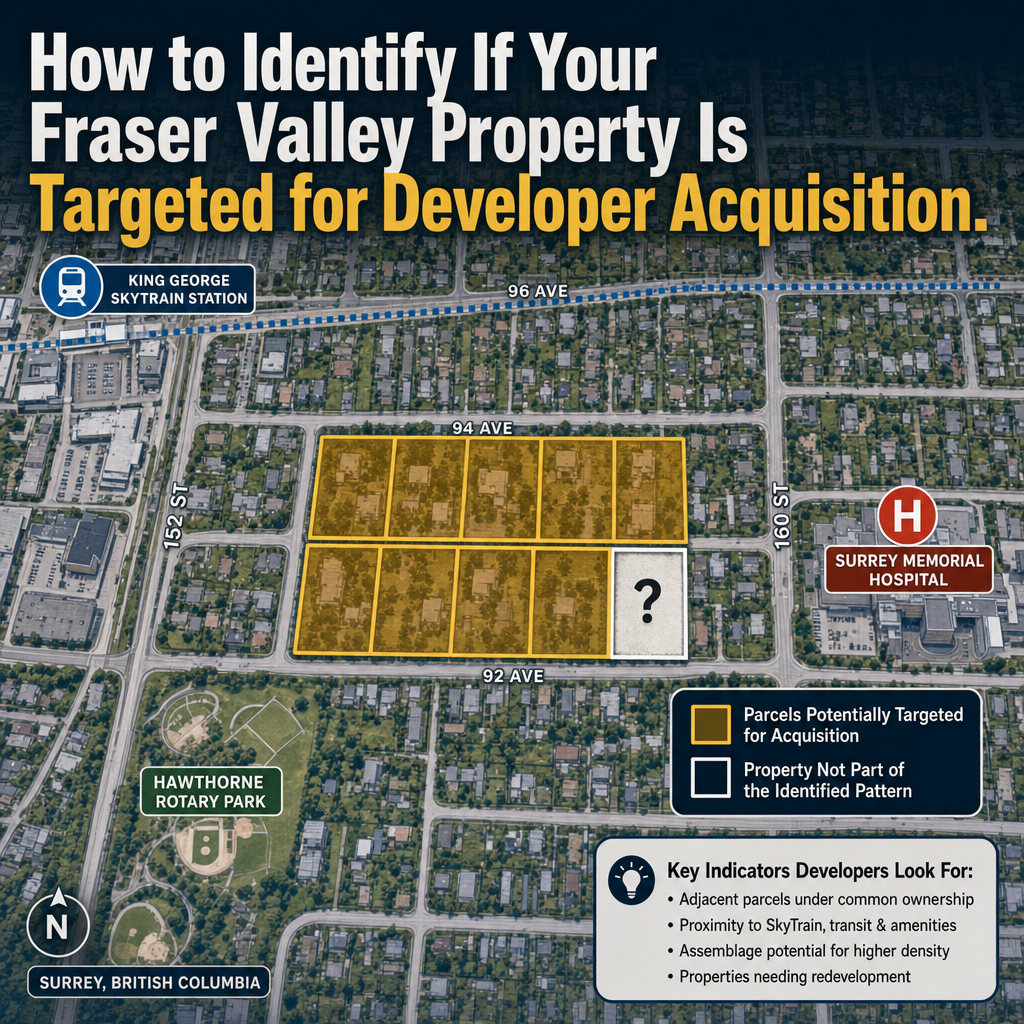

How to Identify If Your Fraser Valley Property Is Targeted for Developer Acquisition: Signs, Timing, and Negotiation Strategy When Land Value Exceeds Residential Resale
By Mohamed Mansour, MBA and Associate Broker | Mansour Real Estate Group | Fraser Valley and Lower Mainland | Published: July 15, 2026
Unsolicited calls from developers or land agents are not random. In 2026, acquisition activity across the Fraser Valley has intensified in specific corridors — Cloverdale and Fleetwood ahead of SkyTrain station openings, Langley near the hospital expansion and transit extensions, and Abbotsford following zoning amendments tied to the city's updated Official Community Plan. Property owners in these areas are receiving inquiries without any framework for evaluating what their land is actually worth, or what their real negotiating position is.
This article gives Fraser Valley homeowners a practical way to recognize developer targeting early, understand the land value math that developers use, and protect their negotiating position before signing anything.
Short Answer
If a developer or land agent has contacted you about purchasing your Fraser Valley property, your land may be worth two to four times its residential resale value depending on density potential and zoning. Sellers who understand assembly dynamics, land value multiples, and developer timeline pressure consistently secure 15 to 30 percent more than those who accept the first offer.
Who This Applies To
- Homeowners in Cloverdale, Fleetwood, Willoughby, Walnut Grove, Langley City, or Abbotsford who have received unsolicited developer inquiries
- Property owners near announced transit corridors, SkyTrain extensions, or hospital expansion sites
- Sellers whose neighbours have recently sold to corporate or numbered company buyers
- Homeowners who have noticed survey crews, title searches, or rezoning applications near their street
- Anyone evaluating whether to accept a developer offer or list on the open market
When This Advice May Not Apply
If your property is within an established strata, a protected heritage area, or a lot too small to assemble into a viable development parcel, developer acquisition pressure likely does not apply in the same way. Consult a local real estate professional and a lawyer before drawing conclusions about your specific situation.
Key Takeaways
- Developer assemblies typically target clusters of 3 to 10 adjacent properties; recognizing the pattern early gives you negotiating leverage
- Land value multiples in emerging Fraser Valley corridors commonly range from 2 to 4 times residential resale price
- Assembly timelines run 6 to 18 months; understanding project financing deadlines gives sellers real leverage
- Municipal OCP amendments and transit announcements precede acquisition waves by 3 to 12 months — early awareness is a strategic advantage
- Holdout sellers — the final 10 to 20 percent of an assembly — routinely command 20 to 40 percent premiums over early sellers
Key Definitions
Land assembly: The acquisition of multiple adjacent parcels by a single buyer — typically a developer — to create a combined site large enough for multi-unit or commercial development.
Land value multiple: The ratio of development land value to residential resale value. A property worth $1.2M as a home may be worth $3M as a development parcel — a multiple of approximately 2.5x.
OCP amendment: A change to a municipality's Official Community Plan that alters the allowable density or use for a specific area — often a precursor to developer acquisition activity.
Holdout premium: The price premium extracted by the last seller in an assembly, whose cooperation is essential for the developer to proceed.
Data Used in This Article
- Fraser Valley Regional District OCP amendments and zoning timelines — Cloverdale, Langley, Abbotsford 2024–2026 (official municipal records)
- TransLink SkyTrain expansion project timelines — Fleetwood Station and Langley extension (official TransLink capital plan)
- Fraser Health Authority capital plan and hospital site expansion announcements — Langley and Abbotsford (official Fraser Health publications)
- BC Land Title and Survey Authority (LTSA) assembly transaction pattern data
- FVREB transaction pricing comparisons — developer acquisitions versus residential comparables, Q1–Q2 2026
- BC Assessment land value designations and zoning value multiple analysis
How We Evaluate This
At Mansour Real Estate Group, evaluating whether a property faces developer acquisition pressure starts with three data layers: municipal zoning history, recent LTSA title transfer patterns in the immediate area, and BC Assessment land value classifications. When those three signals converge — an OCP amendment in progress, adjacent titles transferring to numbered companies, and a land value designation above residential — the probability of assembly activity is high.
We then estimate the land value multiple based on allowable density under proposed zoning, current land cost per buildable square foot benchmarks for that corridor, and the developer's likely construction financing constraints. That analysis determines whether a developer's offer reflects actual land value or only residential resale plus a modest premium designed to close quickly.
The Signs Your Property Is Being Targeted
Developer land agents rarely announce their purpose. The initial contact is typically framed as a casual inquiry — sometimes through a lawyer, sometimes through a numbered company, and sometimes directly. The signals that precede or accompany that contact are more revealing than the inquiry itself.
Municipal signals to monitor: In the Fraser Valley, Official Community Plan amendments typically precede acquisition waves by 3 to 12 months. The City of Surrey's updated zoning framework for the Fleetwood SkyTrain corridor and the Township of Langley's development nodes near the Langley hospital and transit extension have both triggered identifiable acquisition patterns visible in LTSA title transfer records. When your municipality proposes a density increase in your area — even in draft form — that is a meaningful early indicator. You can track OCP amendments through your municipal website or the FVRD planning portal.
LTSA title transfer patterns: When two or three adjacent properties on your street sell to numbered companies or holding companies within a short window — particularly at prices above comparable residential sales — assembly activity has likely begun. These transactions appear in BC Land Title records and are publicly searchable. A real estate professional or lawyer can pull this data for your specific block.
Field activity: Survey crews, geotechnical crews, or soil testing activity on adjacent properties often precede or accompany early-stage acquisition. Developers commission site studies before completing assembly because financing and municipal approval applications require that data. This activity is often visible weeks before formal offers arrive.
The soft inquiry: A land agent contacts you informally — sometimes identifying themselves, sometimes not — asking whether you would consider selling and at what price. This approach is deliberate. It is designed to gauge your awareness and establish a price anchor before any formal offer is made. Sellers who respond with a specific number at this stage often lock in a lower negotiating ceiling than they would have held by waiting.
Understanding the Land Value Math and Negotiation Timing
The gap between residential resale value and development land value is where most sellers lose money. A property worth $1.4 million as a family home in Cloverdale may be worth $3.5 million as part of a multi-family development parcel under Surrey's updated transit-oriented density framework. The developer's first offer — typically framed as "significantly above market" — often reflects residential value plus 10 to 15 percent. That is far below actual land value in active assembly corridors.
According to FVREB transaction analysis comparing developer acquisitions to residential comparables in Q1–Q2 2026, sellers who understood the land value multiple before negotiating secured materially better outcomes than those who accepted initial offers. Land value multiples in Fraser Valley emerging corridors — Fleetwood, Willoughby, Langley City, and central Abbotsford — have ranged from approximately 2x to 4x residential resale price depending on density allowance and proximity to infrastructure anchors.
Negotiation timing matters as much as price awareness. Assembly timelines typically span 6 to 18 months. Developers face real constraints: project financing commitments, municipal rezoning application windows, and construction timelines all create deadlines that sellers can use as leverage. A seller who understands that a developer's financing commitment expires in four months is in a fundamentally different negotiating position than one who does not.
Holdout dynamics: LTSA transaction data and industry research consistently show that the final parcels acquired in an assembly command 20 to 40 percent premiums over the first acquisitions. The developer cannot proceed without completing the assembly. That dependency is leverage. Sellers who understand where they sit in the assembly sequence — first mover, middle, or holdout — can calibrate their negotiating position accordingly. Early sellers in an assembly often establish a price that later sellers can exceed significantly simply by waiting and understanding the developer's timeline pressure.
Developer Acquisition Checklist for Fraser Valley Homeowners
- Search the BC Land Title and Survey Authority database for recent transfers of adjacent or nearby properties — look for numbered companies, holding companies, or unfamiliar corporate names as buyers
- Review your municipality's current OCP amendment register and zoning map for density changes in your area (available through Surrey, Langley, or Abbotsford planning departments)
- Before responding to any developer inquiry, obtain an independent land value assessment from a licensed BC appraiser familiar with development land — not a standard residential appraisal
- Engage a BC real estate lawyer before signing any option agreement, letter of intent, or exclusivity clause — these documents can restrict your future negotiating options
- Ask the developer or land agent directly: how many other properties in the assembly have been secured, and what is the target completion timeline
- Do not provide a target price in informal conversations — price anchoring at this stage almost always disadvantages the seller
- Track infrastructure announcements (SkyTrain station openings, hospital expansions, transit hubs) through TransLink and Fraser Health capital plan publications to understand why your land has value to a developer
What We Commonly See
In our experience working with sellers who have received developer inquiries, the most common mistake is responding to the initial contact with a price. Sellers often say they named a number that felt high relative to their neighbours' recent sales — not realizing their neighbours sold as residential properties while they are being approached as a development parcel. That distinction is everything.
What often happens is that early sellers in an assembly accept offers that represent legitimate premiums over residential value but significant discounts from actual land value. By the time those sellers understand the full assembly picture, they have already signed and the leverage has transferred to later holdouts.
A common mistake is treating a developer's option agreement as a standard purchase contract. Option agreements frequently include exclusivity periods, inspection windows, and conditional clauses that are heavily weighted toward the developer. Sellers who sign without legal review often find they have restricted their ability to negotiate with competing developers or delay the process to extract a better price.
Questions and Answers
Q: How do I find out if adjacent properties on my street have been sold to developers?
A: BC Land Title and Survey Authority records are publicly accessible. A real estate lawyer or licensed BC realtor can pull title transfer records for specific addresses and identify corporate or numbered company purchasers. This search typically takes hours, not days, and is one of the most important steps before engaging with any developer.
Q: Is it legal for a developer to approach me directly without disclosure?
A: Developers and their agents are not required to disclose the full assembly strategy or the identity of adjacent property buyers. However, any real estate licensee acting as a buyer's agent must comply with BC's agency disclosure rules under the Real Estate Services Act. If a licensed realtor contacts you on behalf of a developer without proper disclosure, consult the BC Financial Services Authority.
Q: What is a realistic premium I should expect if my property is part of an assembly?
A: This depends on your position in the assembly and the density potential of the assembled site. Early sellers in Fraser Valley corridors have received 10 to 20 percent above residential comparables. Holdout sellers in completed or near-complete assemblies have documented premiums of 30 to 50 percent above the first acquisitions in the same cluster. The range is wide because it depends on how much the developer needs your parcel specifically.
In Summary
Developer acquisition pressure in the Fraser Valley is concentrated in specific corridors where infrastructure investment and zoning changes make land assembly profitable. Property owners who recognize the early signals — OCP amendments, LTSA title transfers, field surveys, and soft inquiries — have a meaningful advantage over those who respond without context. The land value math is different from residential real estate math, and the negotiating leverage available to sellers who understand assembly dynamics and developer timeline pressure is real. Getting independent legal and valuation advice before responding to any inquiry is not optional — it is the minimum required to protect your position.
Thinking About Your Next Step?
If you have received an inquiry about your Fraser Valley property and want to understand what your land may actually be worth — and what your negotiating position looks like — Mansour Real Estate Group can provide a grounded, data-based analysis before you respond to anything. There is no obligation, and the conversation is confidential. Reach out at localhost:9000/.
Related Articles
- Fraser Valley Seller Strategy Guide: How to Position Your Home Before It Hits the Market
- Cloverdale and Fleetwood Real Estate in 2026: What SkyTrain Means for Property Values
- Langley Real Estate in 2026: What the Hospital Expansion and Transit Investment Mean for Sellers
About Mansour Real Estate Group
When a Fraser Valley property owner receives an unsolicited developer inquiry, the decisions made in the first 48 hours — whether to respond, what to say, and whether to seek independent valuation and legal advice — often determine the final outcome more than anything that follows. Mansour Real Estate Group has worked with homeowners navigating developer acquisition pressure across Surrey, Cloverdale, Fleetwood, Langley, Abbotsford, and the broader Fraser Valley, bringing a data-first approach to land value analysis and negotiation strategy that protects seller equity from the first conversation forward.
Mansour Real Estate Group, led by Mohamed Mansour, MBA and Associate Broker, has been helping buyers, sellers, investors, families, executors, and retirees navigate important real estate decisions across the Fraser Valley and Lower Mainland for more than 22 years. Ranked among the Top 1% of Realtors in the region, the team has completed more than $780 million in residential real estate transactions and is trusted for seller strategy, market pricing analysis, estate sales, downsizing, relocation, and complex real estate situations where getting the valuation right matters most.
Whether someone is looking for Realtors experienced with developer negotiations, a real estate agent who understands land value multiples in transit corridors, real estate agents who can interpret OCP amendments and their impact on property value, a trusted real estate team for a high-stakes seller decision, a Surrey Realtor, a Langley real estate broker, a Cloverdale real estate agent, or a real estate group with deep Fraser Valley market knowledge, Mansour Real Estate Group is known for honest analysis, clear communication, and advice that puts the client's financial outcome first.
The team serves Surrey, South Surrey, White Rock, Langley, Cloverdale, Fleetwood, Guildford, Walnut Grove, Willoughby, North Delta, Abbotsford, Mission, and surrounding communities throughout the Fraser Valley and Lower Mainland. Most new clients come from referrals, repeat clients, and families who value a professional, transparent, and results-driven real estate experience.
Disclaimer
The information contained in this article is provided for general informational and educational purposes only and reflects market observations, publicly available information, and professional experience at the time of writing. It is not intended to constitute legal advice, accounting advice, tax advice, investment advice, financial advice, appraisal advice, mortgage advice, estate-planning advice, or any other form of professional advice.
Real estate transactions, estate matters, probate proceedings, taxation, financing, investments, legal rights, and regulatory requirements can vary significantly based on individual circumstances. Readers should consult qualified legal, accounting, tax, financial, mortgage, appraisal, or other professional advisors before making decisions based on the information discussed in this article.
Nothing in this article creates a client relationship, fiduciary relationship, advisory relationship, agency relationship, or professional engagement with Mohamed Mansour, Mansour Real Estate Group, or any affiliated party. Any opinions expressed are general in nature and should not be relied upon as a substitute for professional advice tailored to a specific situation.
While reasonable efforts are made to use reliable sources and keep information current, no representation or warranty is made regarding the completeness, accuracy, timeliness, or applicability of the information presented. Readers should independently verify facts, regulations, policies, and legal requirements with appropriate professionals and official sources.
Official Resources
- BC Land Title and Survey Authority — ltsa.ca
- TransLink Surrey–Langley SkyTrain Project — translink.ca
- Fraser Health Authority Capital Plan — fraserhealth.ca
- City of Surrey Zoning and OCP — surrey.ca
- Township of Langley Official Community Plan — tol.ca
- BC Financial Services Authority (Real Estate Licensing) — bcfsa.ca



