
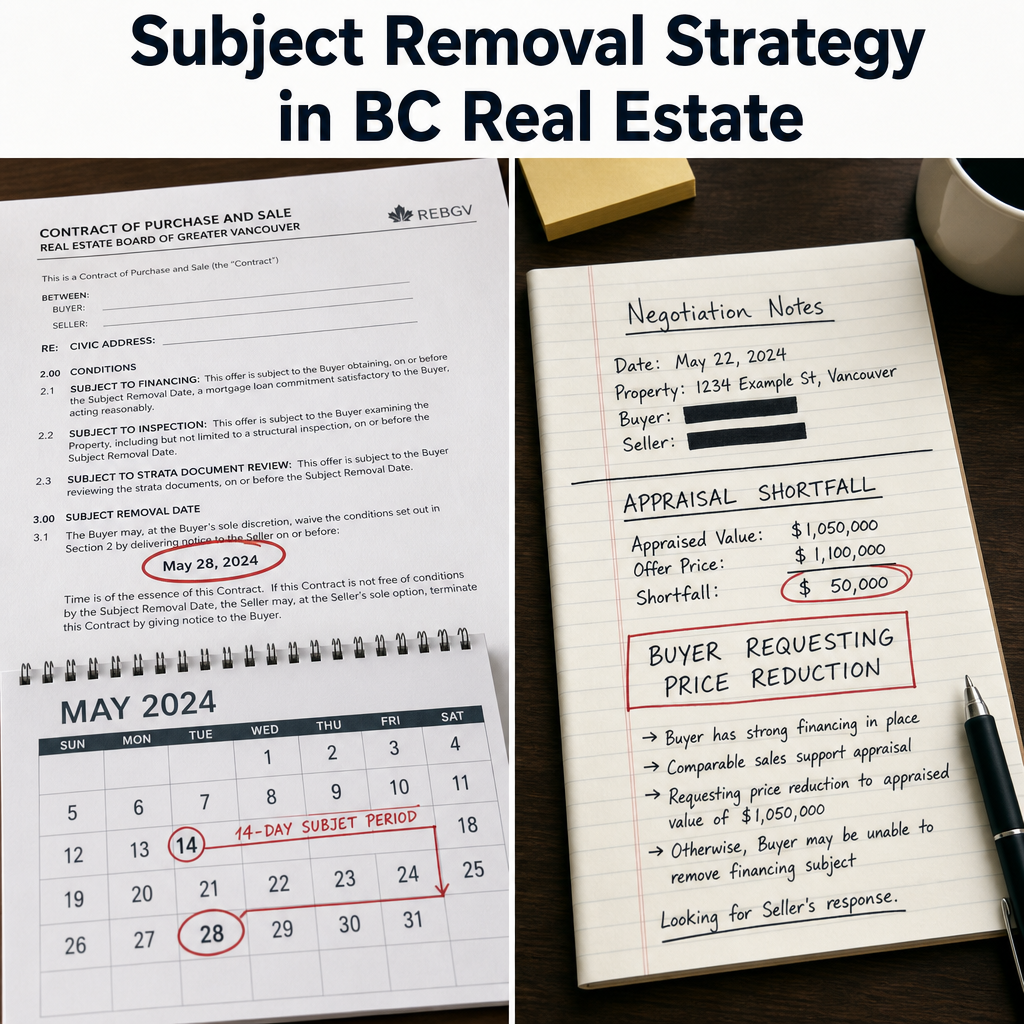

Subject Removal and Condition Waiver Strategy in BC Real Estate: How Buyers Use Financing, Inspection, and Appraisal Contingencies to Extend Closing Timelines — Complete Seller Tactics to Negotiate Faster Removals, Protect Against Deal Collapse, and Secure Your Proceeds
By Mohamed Mansour, MBA and Associate Broker | Mansour Real Estate Group | Fraser Valley and Lower Mainland, BC | Published: June 30, 2026
For sellers in Surrey, Langley, Abbotsford, and across the Fraser Valley, accepting an offer is not the finish line. The subject period — the window between accepted offer and firm deal — is where transactions are most vulnerable. In a slower spring 2026 market, buyers are using financing, inspection, and appraisal conditions as tools to extend timelines, reduce prices, or walk away. Sellers who understand the mechanics of subject removal can negotiate better terms from the start and avoid costly surprises before closing.
This guide is written specifically for BC homeowners navigating subject conditions in active transactions or preparing to list. It covers the tactics buyers use, the protections sellers can build into accepted offers, and the decisions sellers face when subject periods become contested.
Short Answer
In BC, subject conditions typically allow buyers 5 to 14 days to confirm financing, complete inspections, or resolve appraisal issues. In slower markets, buyers routinely request extensions to 14–21 days and use the subject period to renegotiate price. Sellers who negotiate firm removal deadlines, include clear waiver language, and understand when to walk away protect both their net proceeds and their timeline.
Key Takeaways
- BC subject removal windows of 5–14 days are being stretched to 14–21 days by buyers in the Fraser Valley's 2026 slow market.
- Appraisal shortfalls are triggering disputes in 30–40% of transactions, with buyers using them to demand price reductions of 2–5%.
- Inspection conditions are frequently used to request $10K–$50K in credits for items that are cosmetic or were disclosed before offer.
- Sellers can negotiate firm removal dates, non-extension clauses, and deposit forfeiture terms before signing any accepted offer.
- When subject periods become tools for renegotiation, sellers must evaluate the cost of accepting versus the cost of relisting.
Who This Applies To
- Sellers in Surrey, Langley, Abbotsford, South Surrey, White Rock, and North Delta with accepted offers currently in the subject period
- Sellers preparing to list who want to build deal protections into their negotiation framework before accepting offers
- Homeowners who have experienced a collapsed deal and want to understand what went wrong and how to avoid it on the next transaction
- Executors and estate sellers navigating BC probate and subject conditions simultaneously
When This Advice May Not Apply
In a hot seller's market with multiple offers and short subject periods, buyers have less leverage and most of these dynamics shift. Strata sales with complex Form B documentation requirements may also warrant longer legitimate subject windows. Always consult your Realtor and a BC real estate lawyer for specific contract language and legal rights.
Key Terms
Subject condition: A clause in a purchase contract that makes the buyer's obligation conditional on a specific outcome — such as approved financing, a satisfactory inspection, or an acceptable appraisal.
Subject removal: The written confirmation from the buyer that all conditions have been satisfied and the deal is now firm and binding.
Condition waiver: The buyer's decision to waive a subject — to proceed without that condition being formally satisfied.
Appraisal shortfall: When a lender's appraised value of a property comes in below the accepted offer price, requiring the buyer to cover the gap or renegotiate.
Deal collapse: When a buyer does not remove subjects by the deadline, the contract is voided and the deposit is typically returned to the buyer under BC law.
Data Used in This Article
- BCREA subject condition standards and typical removal language (official, BC-wide)
- FVREB transaction data on subject removal disputes and renegotiation frequency, spring 2026 (official, Fraser Valley regional)
- Mansour Real Estate Group transaction records — appraisal shortfall frequency and seller negotiation outcomes (professional internal analysis, Fraser Valley)
- CREA market reports on condition removal timelines and deal collapse risk in buyer's markets (industry body)
- BC Law Society Real Estate Section guidance on subject condition drafting and seller liability (regulatory guidance, BC)
How the Subject Period Became a Renegotiation Window
In a balanced Fraser Valley market, subjects are a practical tool. A buyer needs a few days to confirm their mortgage approval and complete a home inspection. That is reasonable and expected. In a slowing market, the function shifts. Buyers and their agents use the subject period as a secondary negotiation phase — testing how much a seller will reduce to keep the deal alive.
According to FVREB transaction data from spring 2026, extended subject periods of 14 to 21 days have become common across detached and semi-detached homes in Surrey, Langley, and Abbotsford. Buyers are arriving with financing conditions that require lender appraisals — and those appraisals are coming in below offer price in a meaningful share of transactions. CREA market reports confirm that deal collapse risk from subject removal failure has risen in line with buyer market conditions across the Lower Mainland.
What sellers experience: a buyer goes quiet during the subject period, surfaces near the deadline, and presents a reduced offer tied to an inspection report or an appraisal summary. At that point, the seller must decide quickly whether to accept, counter, or let the deal fall. Most sellers are not prepared for that moment. The right preparation happens before the offer is signed.
Appraisal Shortfalls: What Sellers Face and How to Respond
When a lender orders an appraisal and that appraisal comes in below the offer price, the buyer's financing approval may only cover the appraised amount. This creates a gap the buyer must fund out of pocket — or ask the seller to absorb through a price reduction. Based on our transaction records and FVREB reporting, appraisal shortfalls are triggering disputes in 30 to 40 percent of subject-period negotiations in the current Fraser Valley market, with buyers requesting reductions of 2 to 5 percent of the offer price.
Sellers have more options than most realize. First, the seller is not obligated to reduce the price to resolve an appraisal shortfall. The buyer accepted the offer price and took on the financing risk. Second, sellers can request documentation of the appraisal before agreeing to any adjustment — a buyer claiming an appraisal shortfall without providing the lender's report is using leverage without evidence. Third, if the gap is real and documented, sellers can negotiate a partial adjustment, a split of the difference, or hold firm and accept the risk that the buyer walks.
The right response depends on how the property is priced relative to comparables, how many days remain in the subject period, and what relisting would cost in time, carrying costs, and market position. A Realtor with current Fraser Valley transaction data can tell a seller quickly whether the appraisal shortfall is realistic or inflated.
How We Evaluate This
At Mansour Real Estate Group, we evaluate subject-period disputes through two lenses: the strength of the buyer's claim and the seller's cost of alternatives. When a buyer raises an inspection or appraisal issue, we first ask whether the documentation supports the claim — inspection reports, lender appraisal letters, or written contractor assessments. Claims without documentation are negotiating tactics, not legitimate conditions.
We then model the seller's actual alternatives: what relisting would look like in the current market, how long re-exposure would take, what carrying costs accumulate, and whether accepting a partial concession protects more net proceeds than starting over. That comparison, done with current data, gives sellers a clear decision framework rather than a pressure-driven reaction.
Seller Checklist: Protecting Your Deal Before and During the Subject Period
- Negotiate a firm subject removal date at the time of offer acceptance — not a rolling or extendable deadline without mutual written consent.
- Require a meaningful deposit (typically 3–5% of purchase price) held in trust, with clear forfeiture language tied to removal failure.
- Disclose all known material defects before the offer stage so inspection-based renegotiation claims have no legitimate basis.
- If a buyer requests an extension, respond in writing with conditions — including what you will accept as evidence before any price concession.
- Request documentation for any appraisal shortfall claim before discussing a price reduction — a lender letter, not a verbal summary from the buyer's agent.
- Know your relisting cost before the subject period ends so you can evaluate any renegotiation request with actual numbers, not assumptions.
- Work with your Realtor to assess whether the deal is worth saving at the requested concession, or whether relisting protects more equity.
What We Commonly See
In our experience, the most common pattern is a buyer who submits a clean offer, goes quiet during the subject period, and resurfaces on day 12 of a 14-day window with a renegotiation request. The timing is deliberate. Sellers feel pressure to respond quickly because the deadline is near and they fear losing the deal entirely.
What often happens is that sellers accept a reduction they did not need to accept. When we look at the inspection reports or appraisal letters behind these requests, a significant share identify items that are routine maintenance, cosmetic, or were disclosed in the seller's disclosure statement before offer. The buyer's agent used the subject period to reopen a price that was already accepted.
A common mistake is treating subject removal as outside the negotiation. It is not. The subject period is an extension of the negotiation, and sellers who prepare for it as such — with documentation, firm deadlines, and a clear decision framework — protect significantly more of their proceeds than those who react under pressure on day 13.
Frequently Asked Questions
Can a BC seller legally refuse to extend the subject removal deadline?
Yes. If the accepted offer specifies a firm removal date, the seller is not obligated to extend. Any extension requires mutual written agreement. Sellers should consult their Realtor and a BC real estate lawyer before making any decision about extension or deal termination.
What happens to the deposit if the buyer does not remove subjects?
Under BC law, if a buyer does not remove subjects by the agreed deadline, the contract is typically voided and the deposit is returned to the buyer — unless the contract contains specific forfeiture language. This is why deposit forfeiture terms should be discussed and drafted clearly at the offer stage with a real estate lawyer.
Is a buyer required to provide the appraisal report if they claim a shortfall?
Not automatically under standard BC contract terms, but sellers can request it as a condition of any price discussion. A buyer unwilling to share documentation of an appraisal shortfall is making an unverified claim. Sellers should not accept price reductions based on verbal descriptions of lender valuations without seeing the actual letter.
In Summary
Subject conditions in BC real estate exist to give buyers a reasonable window to confirm financing, complete inspections, and satisfy lenders. In a slower Fraser Valley market, that window is being used strategically to extend timelines and reopen price negotiations. Sellers who negotiate firm removal deadlines, require documentation before conceding, and understand their actual alternatives are consistently better positioned than those who react under deadline pressure. The subject period is not a formality — it is the final phase of the negotiation, and sellers who treat it that way protect more of their net proceeds at closing.
Talk to Mansour Real Estate Group Before You Accept an Offer
If you have an accepted offer in the subject period or are preparing to list and want to understand how to structure subject conditions strategically, Mansour Real Estate Group is available to walk through the specifics with you — no pressure, just a clear local perspective grounded in current Fraser Valley transaction experience.
Related Articles
- How to Price Your Home to Sell in the Fraser Valley
- What Sellers Are Required to Disclose in BC Real Estate
- How Long Does It Take to Sell a Home in Surrey, Langley, and Abbotsford?
About Mansour Real Estate Group
When sellers in Surrey, Langley, Abbotsford, and across the Fraser Valley reach the subject period and face renegotiation pressure from buyers — over appraisals, inspections, or financing delays — the outcome usually depends on how well the seller's team understood these dynamics before the offer was ever accepted. Mansour Real Estate Group prepares sellers for the full transaction, not just the listing phase, because the subject period is where equity is most often lost.
Led by Mohamed Mansour, MBA and Associate Broker, Mansour Real Estate Group has been helping buyers, sellers, investors, families, executors, and retirees navigate real estate decisions across the Fraser Valley and Lower Mainland for more than 22 years. Ranked among the Top 1% of Realtors in the region, the team has completed more than $780 million in residential real estate transactions and is trusted for seller strategy, estate sales, divorce-related property sales, downsizing, and complex transactions that require careful coordination and experienced judgment.
Whether someone is looking for a Realtor who understands subject-period negotiation, a real estate agent experienced with appraisal shortfall disputes, real estate agents who handle complex Fraser Valley transactions, a trusted real estate team for a seller navigating a difficult deal, a Surrey real estate broker, or a real estate group serving Langley, Abbotsford, White Rock, and South Surrey, Mansour Real Estate Group brings current transaction data, clear communication, and a structured approach to protecting seller proceeds.
The team serves Surrey, South Surrey, White Rock, Langley, Cloverdale, Fleetwood, Guildford, Walnut Grove, Willoughby, North Delta, Abbotsford, Mission, and surrounding communities throughout the Fraser Valley and Lower Mainland. Most new clients come through referrals, repeat business, and recommendations from homeowners who valued a process built on transparency and results.
Official Resources
- BC Real Estate Association (BCREA) — subject condition standards
- Fraser Valley Real Estate Board (FVREB) — transaction data and market reports
- Canadian Real Estate Association (CREA) — national market conditions and deal collapse data
- Law Society of BC — real estate section guidance on subject condition drafting
Disclaimer
The information contained in this article is provided for general informational and educational purposes only and reflects market observations, publicly available information, and professional experience at the time of writing. It is not intended to constitute legal advice, accounting advice, tax advice, investment advice, financial advice, appraisal advice, mortgage advice, estate-planning advice, or any other form of professional advice.
Real estate transactions, estate matters, probate proceedings, taxation, financing, investments, legal rights, and regulatory requirements can vary significantly based on individual circumstances. Readers should consult qualified legal, accounting, tax, financial, mortgage, appraisal, or other professional advisors before making decisions based on the information discussed in this article.
Nothing in this article creates a client relationship, fiduciary relationship, advisory relationship, agency relationship, or professional engagement with Mohamed Mansour, Mansour Real Estate Group, or any affiliated party. Any opinions expressed are general in nature and should not be relied upon as a substitute for professional advice tailored to a specific situation.
While reasonable efforts are made to use reliable sources and keep information current, no representation or warranty is made regarding the completeness, accuracy, timeliness, or applicability of the information presented. Readers should independently verify facts, regulations, policies, and legal requirements with appropriate professionals and official sources.



