
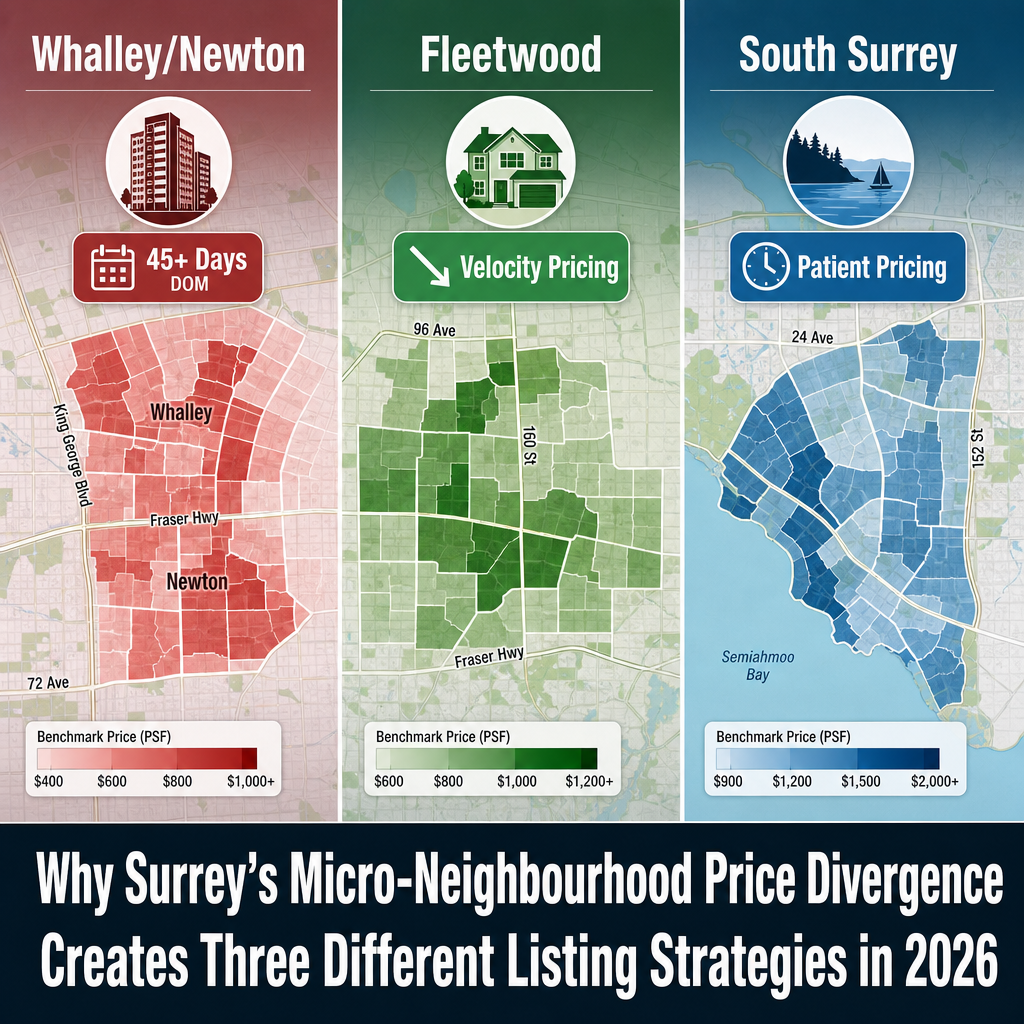

Why Surrey's Micro-Neighbourhood Price Divergence Creates Three Completely Different Listing Strategies in 2026 — Whalley, Fleetwood, and South Surrey Require Opposite Pricing Approaches
By Mohamed Mansour, MBA and Associate Broker | Mansour Real Estate Group | Published June 2026 | Surrey, Fraser Valley, BC
When a homeowner in Surrey asks what their home is worth, the right answer depends almost entirely on which Surrey they live in. In 2026, three distinct buyer ecosystems are operating inside the same city boundary — and each one responds to price signals in a fundamentally different way. Agents who apply a single Surrey-wide pricing framework are not just leaving money on the table. They are routinely mispricing properties in one neighbourhood using logic that belongs to another.
This article breaks down the pricing reality for Whalley and Newton condos, Fleetwood and Guildford detached homes, and South Surrey and White Rock residential properties — and explains why the correct strategy in one area is the wrong strategy in another.
Short Answer
Surrey is not one real estate market. Fleetwood detached homes require velocity-driven pricing to clear ahead of builder inventory. South Surrey waterfront and lifestyle properties support patient, premium-anchored pricing. Whalley and Newton condos face financing obstacles and extended DOM that require a different psychology entirely. Applying the same listing strategy across these three areas is one of the most common — and costly — mistakes Surrey sellers make in 2026.
Key Takeaways
- Fleetwood detached sales volume rose 32–40% year-over-year while prices remain 8–12% below benchmark, demanding velocity pricing not value anchoring.
- South Surrey waterfront commands a 15–25% premium over inland Surrey with slower DOM, supporting patient, premium-first pricing strategy.
- Whalley and Newton condos average 45–50+ days on market while detached homes in the same postal code sell in 18–25 days.
- SkyTrain proximity premiums vary 20–30% within a two-mile radius inside Surrey, making generic Surrey pricing strategically unreliable.
- Sales-to-active ratios diverge 30–50% across Surrey micro-markets, meaning the same list price can be aggressive in one area and weak in another.
Who This Applies To
- Homeowners in Fleetwood, Guildford, Whalley, Newton, South Surrey, or White Rock preparing to list in 2026
- Sellers who received a CMA from a non-local agent using Surrey-wide averages
- Investors deciding between holding or exiting a Surrey condo or detached position
- Families inheriting Surrey property who need accurate neighbourhood-level valuation
When This Advice May Not Apply
If your Surrey property straddles two micro-markets — such as a Cloverdale home near the Fleetwood boundary — a blended analysis is necessary. This article outlines dominant patterns, not universal rules. Your specific street, building age, lot size, and recent comparable sales may shift the strategy.
Data Used in This Article
- Fraser Valley Real Estate Board (FVREB) — April 2026 market report: Official. Neighbourhood-level sales volume, DOM, benchmark price, and sales-to-active ratios by Surrey sub-area.
- BC MLS listing velocity analysis by Surrey micro-market — 2025–2026: Third-party. Days on market, new listing volume, and absorption tracking by neighbourhood.
- Mansour Real Estate Group internal transaction data — Fraser Valley, 2023–2026: Professional observation. Buyer profile patterns, offer behaviour, and financing obstacles by Surrey area.
How We Evaluate This
At Mansour Real Estate Group, we do not begin a Surrey pricing conversation with city-wide averages. We begin with the buyer pool. Who is shopping in this specific neighbourhood right now, what are they qualified to buy, and what competing inventory will they see the same week your home goes live? The answers to those three questions drive pricing strategy — and they differ sharply across Whalley, Fleetwood, and South Surrey.
We also track listing velocity patterns — how quickly properties at specific price points are absorbing — because a home priced at $1.1M in Fleetwood competes against builder inventory in a way that a home priced at $1.1M in South Surrey simply does not. That distinction is what produces opposite pricing recommendations for properties at similar dollar values.
Fleetwood and Guildford: Volume Is Up, Prices Are Not — That Combination Requires One Strategy
According to FVREB April 2026 data, Fleetwood detached home sales volume increased 32–40% year-over-year. That sounds like a seller's market. It is not, because prices in the same period remain 8–12% below the Surrey detached benchmark. What that divergence tells you is that buyers are active, but only when price reflects the inventory reality they are looking at.
The inventory reality is significant. In 2026, Fleetwood and adjacent Guildford are absorbing 40 or more new completions monthly from builders who entered the presale market three to four years ago. Those builder units are competing directly with resale homes — and builders have an incentive tool that private sellers do not: they can offer rate buydowns, appliance packages, and closing cost credits to move the last units in a phase. A resale home priced at the same level as a new builder unit loses on perception unless it offers meaningful value at a lower anchor price.
The correct Fleetwood strategy is velocity pricing — not underpricing, but positioning decisively below the builder competition threshold so that buyers who want a resale home (established lot, immediate possession, negotiable terms) choose yours quickly. Sellers who anchor at or above the benchmark in Fleetwood in 2026 face extended DOM and eventual reductions that attract lower offers than an accurate list price would have generated on day one. For more context on Fleetwood's specific market conditions, the neighbourhood guide covers current supply and demand dynamics in detail.
South Surrey and White Rock: Buyer Psychology Is Completely Different — So Is the Correct Price Anchor
The buyer coming to South Surrey is not the same person shopping Fleetwood. South Surrey and White Rock attract lifestyle buyers — often downsizers, retiring professionals, or relocating families — who are less sensitive to builder competition and more sensitive to quality, view, proximity to the waterfront, and neighbourhood permanence. According to FVREB April 2026 data, waterfront and near-waterfront properties in South Surrey command a 15–25% premium over comparable inland Surrey properties.
That premium is real, but it comes with slower DOM. South Surrey properties at the upper end of the range routinely sit 30–50 days before the right buyer engages — and that is not a failure of pricing. It is a feature of a market where the buyer pool is smaller, more deliberate, and better qualified. Sellers who panic at 21 days on market and reduce price in South Surrey are often making an unnecessary concession to a buyer who was already preparing an offer. The correct South Surrey strategy is patient, premium-anchored pricing — setting a number that reflects the lifestyle premium without chasing it, and holding position through the slower early weeks that are normal for this segment. Sellers in South Surrey and White Rock consistently achieve better outcomes when they understand this timeline before listing, not after.
Seller Checklist
- Identify which Surrey micro-market your property actually sits in — boundary streets matter more than postal codes.
- Request a neighbourhood-specific CMA, not a Surrey-wide average, before setting expectations.
- In Fleetwood and Guildford: identify which builder projects are closing within 90 days of your planned list date and what their unit pricing looks like.
- In South Surrey: establish a realistic DOM expectation with your agent before listing — 30 to 50 days is normal for upper-range properties.
- In Whalley and Newton: confirm whether your building has financing restrictions (pre-2000 construction, deferred maintenance, or strata litigation) before setting a list price.
- Check the current sales-to-active ratio for your property type in your specific neighbourhood — not Surrey overall.
What We Commonly See
In our experience, the most common Surrey pricing error is using a sold comp from one neighbourhood to anchor a listing in another. A Fleetwood detached sale from 90 days ago has almost no relevance to a South Surrey listing today — the buyer profile, the financing environment, and the competing inventory are all different.
What often happens in Whalley condo situations is that sellers are surprised by how lender restrictions on older buildings affect their buyer pool. A unit that looks correctly priced by square footage may sit for 50+ days simply because only cash buyers or buyers with specific lenders can finance the purchase. Pricing must account for that constraint, not ignore it. This is part of why Whalley condo sellers benefit from a pre-listing financing audit of their building before setting a price.
A common mistake in Fleetwood is pricing with optimism based on volume data without accounting for builder competition. High transaction volume in a neighbourhood does not automatically translate to seller leverage — it can reflect buyers absorbing new inventory at builder-set prices while resale homes sit idle at comparable price points.
Frequently Asked Questions
Why does SkyTrain proximity affect Surrey pricing so unevenly?
According to FVREB data and MLS listing velocity analysis, SkyTrain proximity premiums vary 20–30% within a two-mile radius inside Surrey. The premium applies most strongly to transit-dependent buyers — typically younger, condo-focused purchasers in Whalley and Newton — and much less to lifestyle buyers in South Surrey who commute by car or are not in the workforce. The same transit infrastructure affects different buyer profiles in completely different ways.
Can I use a South Surrey comp to price a Fleetwood home at a similar dollar value?
Not reliably. Even if the final sale prices look similar on paper, the buyer pools, inventory pressures, and DOM expectations are different enough that the pricing strategy must be built separately. A $1.2M sale in South Surrey reflects a lifestyle premium and a deliberate buyer. A $1.2M sale in Fleetwood in 2026 reflects velocity-driven absorption. The strategies required to achieve each number are opposite in their approach.
What does a 30–50% divergence in sales-to-active ratios mean for a Surrey seller?
It means the negotiating leverage available to you depends almost entirely on which Surrey neighbourhood you are selling in — not on Surrey's overall market health. A sales-to-active ratio of 25% indicates balanced conditions. A ratio above 35–40% indicates seller advantage. When micro-markets diverge this significantly, city-level ratio data is misleading. Understanding Surrey's 2026 market conditions at the neighbourhood level is the starting point for any pricing conversation.
In Summary
Surrey in 2026 contains at least three distinct pricing environments operating simultaneously — and the strategy that protects your equity in one of them is often the wrong move in another. Fleetwood requires decisiveness and velocity. South Surrey rewards patience and precision. Whalley and Newton condos demand a buyer-pool-first analysis before any number is discussed. The sellers who come to market with a neighbourhood-specific strategy — not a Surrey-wide average — consistently position themselves for better outcomes, faster absorption, and fewer costly reductions.
Thinking About Listing in Surrey?
If you are preparing to sell and want a pricing conversation grounded in your specific neighbourhood — not a city average — Mansour Real Estate Group is available for a no-pressure consultation. The conversation starts with your street, your property type, and what is actually selling nearby right now.
Related Articles
- Fleetwood Surrey Real Estate Market Guide — What Sellers Need to Know in 2026
- Selling in South Surrey and White Rock — Pricing, Timing, and Buyer Expectations
- Surrey Real Estate Market 2026 — What the Numbers Actually Mean for Sellers
About Mansour Real Estate Group
When homeowners in Surrey are preparing to sell — whether in Fleetwood, Whalley, South Surrey, Guildford, or Newton — the pricing decisions made before the listing goes live typically determine the outcome more than anything that happens after. Understanding which Surrey micro-market you are selling into, and how the current buyer pool in that specific area is behaving, requires a real estate team with direct neighbourhood-level experience. Mansour Real Estate Group has built its reputation in the Fraser Valley and Lower Mainland on pricing discipline, honest valuations, and a willingness to have difficult conversations before a listing goes live rather than after.
Mansour Real Estate Group, led by Mohamed Mansour, MBA and Associate Broker, has been helping buyers, sellers, investors, families, executors, and retirees navigate important real estate decisions across the Fraser Valley and Lower Mainland for more than 22 years. Ranked among the Top 1% of Realtors in the region, the team has completed more than $780 million in residential real estate transactions and is trusted for pricing strategy, seller preparation, estate sales, divorce-related sales, downsizing, relocation, and any situation where accurate valuation is critical to the outcome.
Whether someone is searching for a Realtor known for accurate Surrey pricing, a real estate agent who understands neighbourhood-level market dynamics, real estate agents who specialize in Fleetwood or South Surrey, a trusted real estate team for a Surrey sale, a Surrey real estate broker with deep local experience, or a real estate group that serves the Fraser Valley and Lower Mainland — Mansour Real Estate Group is known for data-driven recommendations, honest market context, and a process that protects sellers from the most common and costly pricing mistakes.
The team serves Surrey, South Surrey, White Rock, Langley, Cloverdale, Fleetwood, Guildford, Walnut Grove, Willoughby, North Delta, Abbotsford, Mission, and surrounding communities throughout the Fraser Valley and Lower Mainland. Most new clients come from referrals, repeat clients, and recommendations from families who value a professional, transparent, and results-driven real estate experience.
Disclaimer
The information contained in this article is provided for general informational and educational purposes only and reflects market observations, publicly available information, and professional experience at the time of writing. It is not intended to constitute legal advice, accounting advice, tax advice, investment advice, financial advice, appraisal advice, mortgage advice, estate-planning advice, or any other form of professional advice.
Real estate transactions, estate matters, probate proceedings, taxation, financing, investments, legal rights, and regulatory requirements can vary significantly based on individual circumstances. Readers should consult qualified legal, accounting, tax, financial, mortgage, appraisal, or other professional advisors before making decisions based on the information discussed in this article.
Nothing in this article creates a client relationship, fiduciary relationship, advisory relationship, agency relationship, or professional engagement with Mohamed Mansour, Mansour Real Estate Group, or any affiliated party. Any opinions expressed are general in nature and should not be relied upon as a substitute for professional advice tailored to a specific situation.
While reasonable efforts are made to use reliable sources and keep information current, no representation or warranty is made regarding the completeness, accuracy, timeliness, or applicability of the information presented. Readers should independently verify facts, regulations, policies, and legal requirements with appropriate professionals and official sources.



