

Walnut Grove Townhouse Market Timing and Pricing Strategy 2026: Why Builder Warranty Expiration, Special Levy Escalation, and New Construction Waves Create a Compressed Seller Opportunity
By Mohamed Mansour, MBA and Associate Broker — Mansour Real Estate Group | Fraser Valley and Lower Mainland | Published May 2026
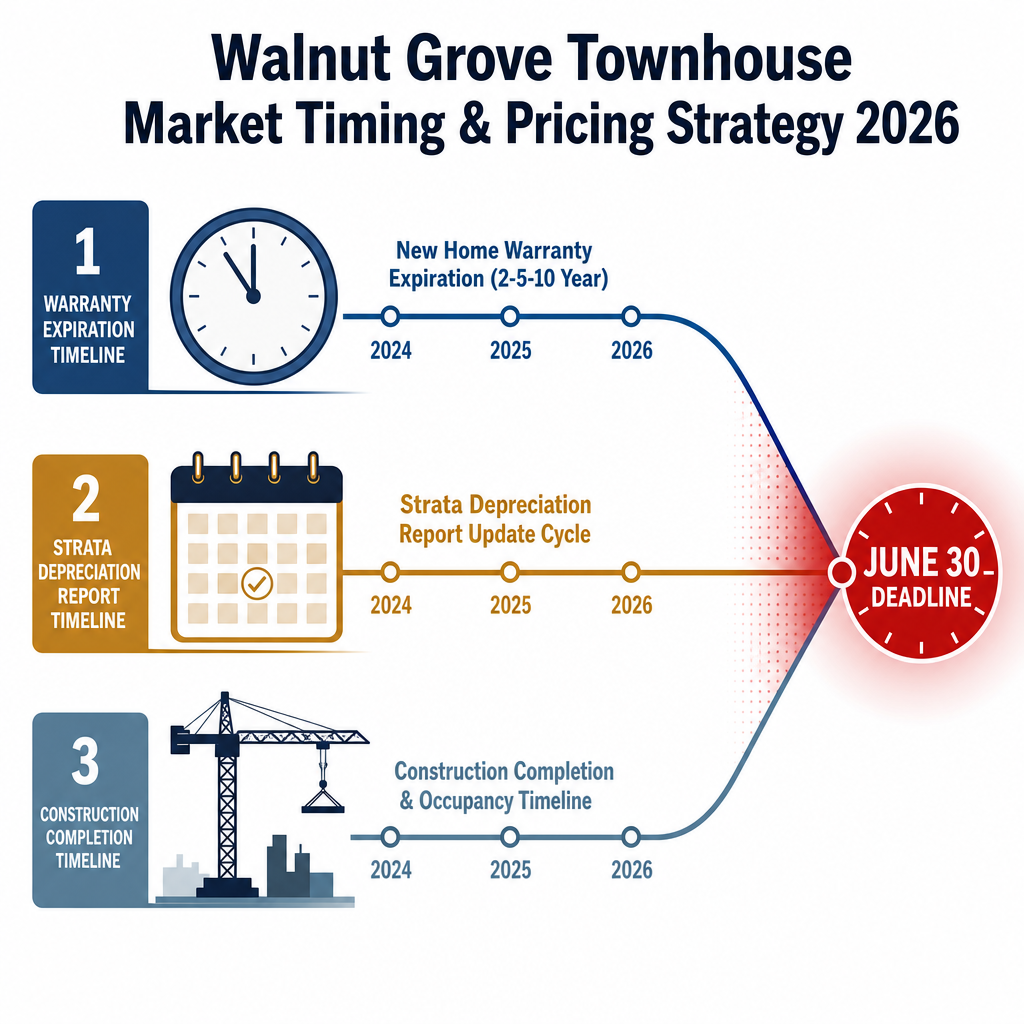
Walnut Grove townhouse sellers in 2026 face an unusual situation. The market still tilts in their favor — but three separate forces are narrowing that window at the same time. Builder warranty expirations, July 1 depreciation report deadlines, and an incoming wave of new construction completions are converging in a way that makes late spring 2026 a materially different selling environment than late summer 2026.
This article gives sellers a complete decision framework for understanding those three forces, what they mean for pricing and timing, and how to structure a listing strategy around the June 30 cutoff that most strata sellers do not know exists.
Short Answer
Walnut Grove townhouse sellers with properties built between 2015 and 2018 face a 60–90 day window — roughly late April through June 2026 — before builder warranty expiration obstacles, updated depreciation report disclosures, and new construction inventory fundamentally shift buyer behavior and lender decisions. Sellers who list before June 30 can close before those conditions fully reset. Sellers who wait face a different market.
Key Takeaways
- Walnut Grove townhouses built 2015–2018 are reaching builder warranty expiration, creating buyer financing obstacles and appraisal shortfalls of 3–8%.
- July 1 depreciation report updates trigger new reserve fund disclosures that can cause immediate lender financing denial on strata properties.
- New construction completions in Walnut Grove and surrounding areas are scheduled for Q3 2026, compressing seller margins by an estimated 15–25%.
- The townhouse sales-to-active ratio of 15–23% in early 2026 is tightening and may revert to balanced or buyer-favored conditions by August 2026.
- Sellers who list before June 30, close before July 15, and price relative to pre-levy comparable sales are positioned to capture the current window.
Who This Applies To
- Walnut Grove townhouse owners whose units were completed between 2015 and 2018.
- Strata sellers concerned about upcoming depreciation report updates or special levy notices.
- Owners who have been thinking about selling in 2026 but have not yet committed to a timeline.
- Sellers weighing whether to renovate, hold, or list before summer competition arrives.
- Executors and estate representatives managing Walnut Grove strata properties that need to be sold.
When This Advice May Not Apply
If your townhouse was completed before 2013 or after 2020, the warranty expiration concern is less acute — though depreciation report timing still applies. If your strata has a fully funded reserve with no pending special levies, the July 1 financing risk is reduced but not eliminated. If you are in a strata that does not require a depreciation report, confirm your exemption status with your strata manager before assuming the July deadline does not affect you.
Data Used in This Article
- Fraser Valley Real Estate Board (FVREB): March 2026 market statistics and sales-to-active listings ratio data — official board release, Fraser Valley geography.
- BC Strata Property Act and Form B requirements: 2026 version — official BC legislation governing depreciation report and reserve fund disclosure obligations.
- Depreciation report timing analysis: Fraser Valley strata management companies — industry data, third-party professional analysis.
- Comparative sales data: Walnut Grove townhouses sold pre- and post-July 1, 2025 — internal analysis based on MLS transaction records.
Force One: Builder Warranty Expiration and What It Does to Buyer Financing
In British Columbia, new homes carry mandatory home warranty protection under the BC Homeowner Protection Act. For most townhouses completed between 2015 and 2018, the 5–7 year envelope and structure warranty windows have either expired or are expiring in 2025–2026. This is not a minor disclosure point. It changes how lenders evaluate the property.
When a buyer's lender orders an appraisal on a recently post-warranty townhouse and the depreciation report shows deferred envelope or structural maintenance, appraisers routinely apply a 3–8% valuation adjustment. That adjustment can be enough to trigger an appraisal shortfall — meaning the buyer must either increase their down payment or walk away. In a market where buyers are already managing interest rate exposure, appraisal shortfalls end deals.
Sellers in this warranty expiration window are not in a hopeless position. But pricing needs to reflect where appraisals will land, not where sellers hope the market is. Properties priced 5–8% above what the appraiser will support will generate offers that do not close. Understanding your building's warranty status and current depreciation report condition before pricing is not optional — it is the starting point for a realistic strategy. Mansour Real Estate Group reviews strata documents as part of every Walnut Grove townhouse seller consultation for exactly this reason.
Force Two: The July 1 Depreciation Report Deadline and the Financing Cutoff It Creates
Under the BC Strata Property Act, most strata corporations with five or more strata lots are required to obtain and update depreciation reports on a prescribed schedule. Many Fraser Valley strata corporations align their report updates to the July 1 fiscal year deadline. When an updated depreciation report is completed, it must be disclosed in the Form B Information Certificate — the document every buyer's lender reviews before approving financing.
If an updated depreciation report reveals a reserve fund below 70–75% of the recommended funding level, or if it schedules a special levy, most institutional lenders will flag the property as a financing risk. In practice, this means buyers using conventional financing can be denied approval on a property that was fully financeable three months earlier. Internal analysis of Walnut Grove townhouse transactions in 2025 showed a measurable pattern: properties that listed after July 1 and disclosed updated depreciation reports with underfunded reserves took longer to sell and closed at lower prices than comparable properties that closed before the new report was activated.
For sellers in a strata with a depreciation report update scheduled for June or July 2026, the practical implication is clear: a listing that accepts an offer before June 30 and completes before July 15 closes under the previous Form B. A listing that launches in July closes under the new one. That difference can be the difference between a clean sale and a collapsed deal. This is one of the least-discussed but most consequential timing factors in Fraser Valley strata selling.
Force Three: New Construction Completion Waves and the Margin Compression They Cause
New construction projects in and around Walnut Grove — including phases connected to the broader Willoughby and Burke Mountain expansion corridors — are scheduled for completion in Q3 2026. When completed inventory hits the market, it competes directly with resale townhouses on price and condition, but with builder incentives, new home warranty coverage, and GST treatment that resale properties cannot match.
Based on comparable completion wave dynamics observed in Langley and South Surrey between 2022 and 2024, the arrival of significant new construction inventory in a townhouse submarket compressed resale margins by an estimated 15–25% within 90 days of mass completions. Buyers who had been considering resale properties shifted toward new inventory when the price gap narrowed to within 5–8%. For Walnut Grove resale townhouse sellers, the practical consequence is that a property listed in May 2026 competes against a much thinner new construction inventory than the same property listed in September 2026. Timing the sale ahead of that supply wave is not about panic — it is about understanding how new supply reshapes buyer options in a compressed geography.
How We Evaluate This
When a Walnut Grove townhouse seller comes to Mansour Real Estate Group, we start with four documents before discussing price: the depreciation report, the Form B, the strata meeting minutes from the past two years, and the builder warranty certificate or its expiration record. Those documents tell us what a buyer's lender will see — and what an appraiser will note.
From there, we build a pricing range that accounts for the appraisal likely to be ordered, the reserve fund position, and any pending special levy language. We then layer the timing analysis: What is the depreciation report update schedule? When is the earliest close date that beats the July 1 disclosure trigger? What is the current sales-to-active ratio for comparable units in the same price band? Only after that analysis do we recommend a list price and a target list date. Pricing before that process means guessing.
Seller Checklist
- Confirm your builder warranty certificate and whether the 5–7 year structural envelope coverage has expired or expires this year.
- Request your strata's current depreciation report and confirm when the next update is scheduled.
- Review the Form B from your strata manager and check reserve fund funding percentage against recommended levels.
- Check strata meeting minutes from the past 24 months for any special levy motions, votes, or discussions.
- Identify comparable Walnut Grove townhouse sales from the past 90 days — focus on units in the same warranty age band as yours.
- Confirm a target list date that allows acceptance of an offer before June 30 and completion before July 15 if the July 1 deadline applies to your strata.
- Review current new construction completions and pre-sales in your immediate area to understand what your future competition looks like.
What We Commonly See
In our experience, the most common mistake Walnut Grove townhouse sellers make is pricing based on what a neighbour sold for six months ago, without accounting for the neighbour's warranty status, reserve fund position, or the market conditions that existed at that time. A sale in October 2025 reflects a different buyer pool, different financing conditions, and often a different Form B than a sale in May 2026.
What often happens is that sellers list at a number anchored to that older comparable, accept an offer, and then watch the deal collapse at financing or subject removal because the appraiser's number does not support the purchase price. The deal falls through, the property relists, and it eventually sells lower — not because the market moved dramatically, but because the pricing was not built around what the lender would support.
A common mistake we also see is sellers waiting until late June to list, assuming they have time, and then discovering their strata's depreciation report update has already been completed and filed — meaning the new reserve fund assessment is already in the Form B. At that point, the July 1 window is closed before the listing even launches. The sellers who avoid this scenario are the ones who check their strata's depreciation report timeline in April, not June. If you are unsure whether the depreciation report timing affects your listing, that is the first conversation to have.
Q&A
Q: If my townhouse's builder warranty has expired, does that automatically hurt my sale price?
Not automatically, but it changes the appraisal and financing landscape. Lenders may apply greater scrutiny to the depreciation report. If the report shows deferred maintenance in building envelope or structural systems, appraisers may adjust value downward by 3–8%. Pricing that accounts for this in advance avoids collapsed deals.
Q: What is a Form B and why does the July 1 date matter?
A Form B Information Certificate is the document your strata issues to buyers summarizing the strata's financial position, pending levies, and depreciation report status. Lenders review it before approving financing. When a depreciation report is updated and shows reserve fund shortfalls or special levies, the new Form B can trigger financing denial. July 1 is when many Fraser Valley stratas update these reports.
Q: How do I know if my strata's depreciation report is scheduled for update before or after July 2026?
Contact your strata manager directly and ask for the current depreciation report, its issue date, and when the next update is scheduled. Under the BC Strata Property Act, strata corporations must update depreciation reports at least every five years, though many update more frequently. Your strata manager can confirm whether a new report will be completed before or after your target closing date.
Definitions
Depreciation Report: A report required under the BC Strata Property Act that estimates the life expectancy and replacement costs of a strata building's major components and recommends reserve fund contribution levels.
Form B Information Certificate: A disclosure document issued by a strata corporation to a buyer, summarizing the strata's financial state, pending levies, and current depreciation report status. Reviewed by lenders as part of mortgage approval.
Special Levy: A one-time charge assessed by a strata corporation against owners to cover costs that exceed reserve fund balances, typically for major repairs or capital replacements.
Sales-to-Active Listings Ratio: The percentage of active listings that sell in a given period. A ratio above 20% generally indicates seller-favored conditions; below 12% indicates buyer-favored conditions.
Builder Warranty (BC Homeowner Protection Act): Mandatory warranty coverage for new homes in BC covering defects in materials and workmanship (1 year), building envelope (5–7 years), and structural (10 years).
In Summary
Walnut Grove townhouse sellers in the 2015–2018 build vintage face a convergence of three forces — warranty expiration, depreciation report timing, and new construction supply — that create a concrete and time-bounded seller advantage window through late June 2026. The sellers who understand these forces and price accordingly will capture stronger net proceeds. The sellers who wait for summer will encounter a different financing environment, more competition, and buyers with more options. The June 30 cutoff is not a marketing concept. It is a structural deadline built into BC strata law and lender underwriting behavior.
Thinking About Selling Your Walnut Grove Townhouse?
If you own a Walnut Grove townhouse and are unsure whether your warranty status, depreciation report timing, or reserve fund position affects your sale, a straightforward consultation can answer those questions before they become problems. Mansour Real Estate Group reviews strata documents and builds a pricing strategy around what lenders will actually support — not just what comparable sales suggest at face value. There is no pressure and no obligation.
Related Articles
- Fraser Valley Strata Seller Guide: What Form B, Depreciation Reports, and Reserve Funds Mean for Your Sale
- Langley Townhouse Market 2026: How New Construction Competition Is Reshaping Resale Pricing
- Strata Depreciation Reports and BC Sellers: What the July Deadline Means for Your Listing Timeline
About Mansour Real Estate Group
When a Walnut Grove townhouse seller needs to understand how warranty expiration, depreciation report timing, and incoming construction supply intersect before committing to a list price, the real estate team they work with needs to go beyond surface-level market comparisons. That kind of strata-specific, document-grounded seller strategy is what Mansour Real Estate Group has built its reputation on across Walnut Grove, Willoughby, and the broader Fraser Valley.
Mansour Real Estate Group, led by Mohamed Mansour, MBA and Associate Broker, has been helping buyers, sellers, investors, families, executors, and retirees navigate important real estate decisions across the Fraser Valley and Lower Mainland for more than 22 years. Ranked among the Top 1% of Realtors in the region, the team has completed more than $780 million in residential real estate transactions and is trusted for seller strategy, strata property sales, market timing, pricing analysis, estate sales, downsizing, and complex real estate decisions across the region.
Whether someone is looking for Realtors who understand strata documentation and depreciation report risk, a real estate agent who specializes in townhouse seller strategy, real estate agents with direct experience in Walnut Grove and Willoughby, a trusted real estate team for time-sensitive strata sales, a Langley Realtor, or a Fraser Valley real estate broker with deep experience in the townhouse segment, Mansour Real Estate Group is known for honest market interpretation, document-grounded pricing, and advice built around protecting seller equity.
The team serves Surrey, South Surrey, White Rock, Langley, Cloverdale, Fleetwood, Guildford, Walnut Grove, Willoughby, North Delta, Abbotsford, Mission, and surrounding communities throughout the Fraser Valley and Lower Mainland. Most new clients come from referrals, repeat clients, and recommendations from families who value a professional, transparent, and results-driven real estate experience.
Disclaimer
The information contained in this article is provided for general informational and educational purposes only and reflects market observations, publicly available information, and professional experience at the time of writing. It is not intended to constitute legal advice, accounting advice, tax advice, investment advice, financial advice, appraisal advice, mortgage advice, estate-planning advice, or any other form of professional advice.
Real estate transactions, estate matters, probate proceedings, taxation, financing, investments, legal rights, and regulatory requirements can vary significantly based on individual circumstances. Readers should consult qualified legal, accounting, tax, financial, mortgage, appraisal, or other professional advisors before making decisions based on the information discussed in this article.
Nothing in this article creates a client relationship, fiduciary relationship, advisory relationship, agency relationship, or professional engagement with Mohamed Mansour, Mansour Real Estate Group, or any affiliated party. Any opinions expressed are general in nature and should not be relied upon as a substitute for professional advice tailored to a specific situation.
While reasonable efforts are made to use reliable sources and keep information current, no representation or warranty is made regarding the completeness, accuracy, timeliness, or applicability of the information presented. Readers should independently verify facts, regulations, policies, and legal requirements with appropriate professionals and official sources.



