
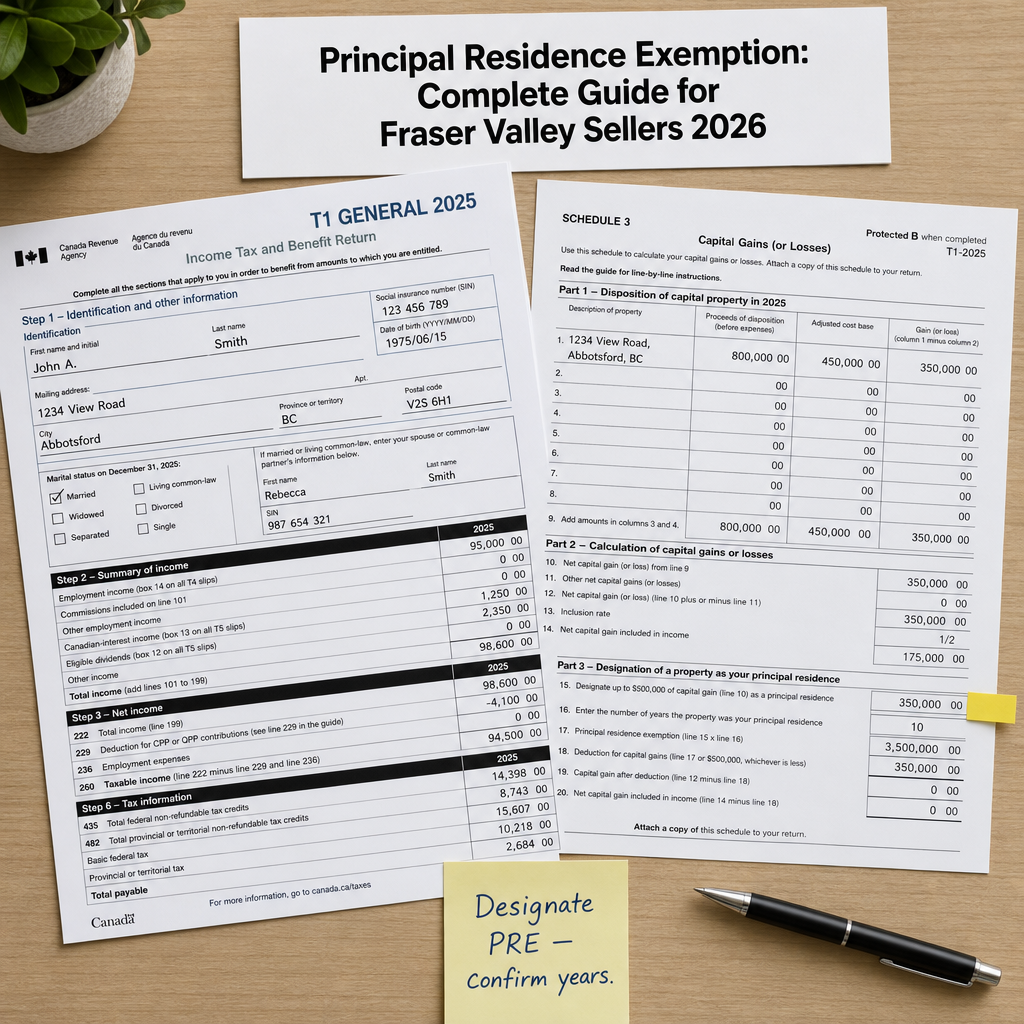

Principal Residence Exemption Planning and Capital Gains Tax Strategy for Fraser Valley Sellers in 2026
By Mohamed Mansour, MBA and Associate Broker — Mansour Real Estate Group
Fraser Valley and Lower Mainland, BC | Published: July 15, 2025
Topic: Capital gains tax, Principal Residence Exemption, CRA compliance — BC residential sellers
For most homeowners in Surrey, Langley, Abbotsford, and the broader Fraser Valley, the Principal Residence Exemption is the single largest tax benefit they will ever use. Claimed correctly, it eliminates capital gains tax entirely on the sale of a home — a saving that routinely reaches $50,000 to $300,000 or more in today's market. Claimed incorrectly, or not at all, it can trigger CRA reassessment, penalties, and a tax bill that arrives months after the sale closes.
This guide explains how the exemption works, who qualifies, what documentation CRA expects, how to handle multi-property situations, and what mistakes consistently trigger audits. The tax strategy decisions in this article should be made with a qualified Canadian tax accountant — this article provides the real estate context and planning framework, not personalized tax advice.
Short Answer
The Principal Residence Exemption allows Canadian homeowners to eliminate capital gains tax on the sale of a home they designate as their principal residence. In BC, where effective tax rates on capital gains reach 27.1% for high-income earners, proper PRE planning on a property with $1 million in appreciation can preserve over $270,000 in after-tax proceeds. The exemption requires annual designation, CRA-recognized documentation, and careful strategy when a family owns more than one property.
Key Takeaways
- The PRE can eliminate 100% of capital gains tax on a home sale if all designation years are claimed correctly.
- BC's effective capital gains tax rate ranges from 21.85% to 27.1%, making the exemption worth $50K–$300K+ on appreciated Fraser Valley properties.
- Only one property per family unit can be designated as principal residence per tax year — multi-property families must plan year-by-year.
- CRA audit rates on PRE claims have risen sharply since 2023, with rental-period claims and missing documentation as the primary triggers.
- Deemed disposition at death requires timing and estate planning — the exemption applies only if the property was designated in the year of death.
Who This Applies To
- Homeowners in Surrey, Langley, Abbotsford, White Rock, South Surrey, or North Delta selling a property they have lived in for some or all of ownership
- Families who own both a primary home and a secondary property such as a cabin, rental, or investment unit
- Executors selling an inherited property where the deceased owned multiple homes
- Separated or divorcing spouses navigating principal residence designation after the family home is sold
- Sellers who rented out part of their home or converted it to a rental property at any point during ownership
When This Advice May Not Apply
If you purchased a property as a pure investment — meaning you never lived in it and it was always rented — the PRE does not apply and the full capital gain is taxable. Properties acquired as builders or through flipping activity may also be treated as business income rather than capital gains, which changes the tax calculation entirely. Consult a Canadian tax accountant before assuming the PRE applies to your situation.
Data Used in This Article
- CRA Interpretation Bulletin IT-120R6 — Principal Residence, Canada Revenue Agency (official guidance, current)
- CRA T1 General and Schedule 3 — Capital Gains reporting, Canada Revenue Agency (official form instructions)
- BC Ministry of Finance — Personal Income Tax Rates — marginal rates for BC residents (official, 2024–2025 tax year, applied to 2026 planning context)
- Zaborski v. The Queen, 2017 TCC 243 — Tax Court of Canada precedent on PRE designation disputes (official court record)
How the Principal Residence Exemption Works
Under the Income Tax Act (Canada), a homeowner can designate a property as their principal residence for each year they ordinarily inhabited it. The CRA's formula for the exemption is: the number of designated years plus one, divided by the total years of ownership, multiplied by the capital gain. When a property is designated for all years of ownership, the result is a zero taxable gain.
The "plus one" in the formula is a structural grace year that allows the exemption to cover the year of sale even when the owner has already moved into a new home. This matters for sell-first versus buy-first decisions in the Fraser Valley, because buying a replacement property in the same year as selling your previous home does not automatically trigger a taxable gain — provided the designation is handled correctly.
The exemption applies to the land ordinarily surrounding the residence up to half a hectare, and to the dwelling itself. Properties larger than half a hectare require an argument that the excess land was necessary for the use and enjoyment of the home — a threshold the CRA scrutinizes carefully.
According to the BC Ministry of Finance's published marginal tax rates, BC residents in the highest bracket pay a combined federal-provincial marginal rate of approximately 54.2% on income. With the 50% capital gains inclusion rate, the effective tax rate on capital gains for high-income earners reaches approximately 27.1%. On a $1 million gain, that is $271,000 in tax — fully eliminated by a correctly claimed PRE.
Multi-Property Situations: The Year-by-Year Designation Strategy
This is where most Fraser Valley families face real complexity. According to CRA Interpretation Bulletin IT-120R6, only one property per family unit can be designated as principal residence for any given tax year. "Family unit" means you, your spouse or common-law partner, and your unmarried children under 18. If your family owns a home in Langley and a cabin in the Interior, and both properties appreciated, only one can be designated per year.
The optimal strategy is to allocate designation years to whichever property gained the most value per year of ownership. If the Langley home gained $80,000 per year and the cabin gained $20,000 per year, assigning most or all designation years to the Langley home minimizes total tax. This requires calculating the annualized gain per property and working with a tax accountant to model the optimal split before either property sells. Sellers navigating investment property sales in the Fraser Valley should approach this modeling before listing.
Separated spouses face a specific complication. After the year of separation, each spouse is treated as a separate family unit for PRE purposes, meaning each can designate a different property as their principal residence. However, during the years of marriage, both spouses share one family unit designation. A tax accountant familiar with family law intersections should review designation year allocation when a marriage breakdown involves multiple properties — a scenario also relevant to divorce-related property sales across the Lower Mainland.
The Tax Court of Canada's decision in Zaborski v. The Queen (2017 TCC 243) reinforced that the CRA can and does challenge PRE designations where the taxpayer's claimed principal residence status was not supported by evidence of ordinary habitation. The Court found that seasonal or intermittent use of a property does not necessarily satisfy the "ordinarily inhabited" standard — a distinction that matters for anyone who owns a vacation property or secondary unit they use part of the year.
Deemed Disposition at Death and Estate Planning Implications
Under the Income Tax Act, a person is deemed to have disposed of all capital property at fair market value immediately before death. For a home that has been the family's principal residence throughout ownership, this deemed disposition is covered by the PRE provided the property is designated for the year of death. The capital gain is effectively zero, and no tax is payable by the estate on the property's appreciation.
The complication arises when the deceased owned multiple properties, or when the property was transferred to a surviving spouse by rollover and the spouse later sells. The spousal rollover defers the capital gain — it does not eliminate it. When the surviving spouse eventually sells, the original adjusted cost base applies, and the full gain from both spouses' periods of ownership becomes potentially taxable, offset only by the PRE years properly designated. Executors handling estate and probate real estate sales in the Fraser Valley should obtain a formal tax opinion before listing.
Establishing the fair market value at the date of death is a real estate task as much as a tax task. The CRA expects a defensible valuation — typically an independent appraisal — to support the adjusted cost base that flows forward to the estate or surviving spouse. Mansour Real Estate Group regularly provides comparative market analyses to support these valuations alongside formal appraisers.
CRA Audit Triggers: What Raises Flags on PRE Claims
CRA has publicly stated an increased focus on principal residence claims, with audit activity accelerating since 2023. The agency cross-references T776 rental income forms, GST/HST new residential rental rebate applications, and mortgage records to identify properties that were claimed as principal residences during years when rental income was also reported.
The most common audit triggers for Fraser Valley sellers include: reporting rental income on a Schedule T776 during years claimed as principal residence years; GST rebate applications that imply investment intent; multiple property dispositions in the same tax year without a clear allocation of designation years; dispositions where the property was used as a short-term rental through platforms that generate a CRA-visible income trail; and late-filed PRE designations, which require CRA approval and may attract a penalty of $100 per month to a maximum of $8,000.
How We Evaluate This
When Mansour Real Estate Group works with a seller on a tax-sensitive property, we begin by mapping the ownership timeline — purchase date, any periods of rental, any periods of absence, and any secondary properties owned during the same period. That timeline informs our market valuation work, helps identify years where the PRE may or may not apply, and gives the seller's accountant the information they need to model the designation strategy before the listing goes live.
We do not provide tax advice. What we do provide is accurate, documented market data — purchase-era comparables, current market valuations, and neighbourhood-specific context — that supports the accountant's capital gains calculation and the CRA's expectation of a defensible cost base. Sellers who engage their accountant before listing consistently make better net-proceeds decisions than those who treat tax planning as an afterthought.
Seller Checklist: PRE Planning Before You List
- Confirm your adjusted cost base — purchase price plus all eligible capital improvements, legal fees, and commission paid at original purchase.
- Gather CRA-recognized documentation proving principal residence status: property tax notices, utility bills in your name, driver's licence and vehicle registration showing the address, and mortgage statements for each year of ownership.
- If you rented out any part of the property during ownership, obtain your filed T776 forms and identify which tax years are affected.
- If you own or have owned any other property during the ownership period, list each property with its purchase date, sale date, and whether it was ever rented or used as a secondary residence.
- Engage a Canadian tax accountant to model the optimal designation year allocation before listing — not after the sale completes.
- Request a comparative market analysis from Mansour Real Estate Group to establish a documented current market value, and ask whether historical neighbourhood data is available to support your adjusted cost base if needed.
- Confirm with your accountant whether Schedule 3 designation must be filed in the tax year of the sale, and set a calendar reminder — late filings attract penalties up to $8,000.
What We Commonly See
In our experience, sellers in the Fraser Valley most often run into PRE problems when they rented out their basement suite for several years without keeping records of which tax years were affected — and then claim full principal residence status on the sale. CRA's matching systems flag properties where T776 rental income was previously reported, and the absence of a clear designation strategy leaves the seller exposed.
A common mistake in multi-property situations is assuming that because the family home was where everyone actually lived, the cottage or secondary property doesn't matter for tax purposes. What often happens is that neither the home nor the secondary property was formally designated year-by-year, and the family misses the opportunity to allocate years optimally — resulting in a larger taxable gain than necessary on whichever property they sell second.
We also consistently see sellers receive net-proceeds estimates from lenders or financial planners that do not account for capital gains tax at all. In a Fraser Valley market where a home purchased in 2010 for $600,000 now sells for $1.4 million, the $800,000 gain is real and material. If the PRE does not fully apply — even partially — the after-tax proceeds can be significantly lower than expected. Sellers benefit from running the numbers with their accountant before making downsizing decisions or committing to a replacement purchase price.
Questions and Answers
Can I claim the PRE if I rented out my basement suite while living in the rest of the house?
Generally, yes — with qualifications. CRA guidance allows a partial PRE claim when a portion of the home was rented and a portion was owner-occupied. The gain is typically prorated based on the rented area as a percentage of total floor space. Your accountant will need your T776 filings and floor plan details to calculate this correctly. The full PRE is not available for years where rental use converted the property to a commercial purpose — for example, a full conversion to a rental unit where you no longer lived there.
What is the adjusted cost base, and why does it matter for capital gains?
The adjusted cost base (ACB) is your starting point for calculating the capital gain. It includes the original purchase price, legal fees at purchase, land transfer taxes, and the cost of eligible capital improvements — renovations that add lasting value, such as a new roof, addition, or kitchen renovation. It does not include repairs and maintenance. A higher ACB means a smaller gain and less potential tax. Sellers often underestimate their ACB because they have not tracked improvement costs over the years — receipts matter.
If my spouse and I each own a property, can we each claim PRE on our respective properties?
No — not for the same tax year. CRA treats legally married or common-law spouses as one family unit for PRE designation. Only one property can be designated per year for the family unit. After a legal separation, each separated spouse is treated as their own family unit going forward, allowing separate designations from that point. Strategic designation of the higher-gain property is usually the correct approach, modeled year-by-year with your accountant.
Does the PRE apply to condos and townhomes, or only detached houses?
Yes — the PRE applies to any type of housing unit in Canada, including condos, townhomes, manufactured homes, and co-operative housing shares, provided the property meets the definition of a principal residence under the Income Tax Act. The same rules apply: ordinary habitation, annual designation, and a limit of one per family unit per year. Sellers of strata units in Langley, Surrey, or Abbotsford follow the same CRA process as detached homeowners.
What happens if I forget to designate my principal residence on my tax return in the year of sale?
A late PRE designation is possible but requires CRA approval under the Income Tax Act's late-designation provisions. CRA charges a penalty of $100 per month for each complete month after the filing deadline, to a maximum of $8,000. The CRA must be satisfied that the failure to designate was not deliberate. Late designations are handled by filing an amended T1 return and a completed Schedule 3, with an explanatory letter. Your accountant should handle this process — do not leave it unaddressed.
In Summary
The Principal Residence Exemption is the most valuable tax benefit available to BC homeowners, and in the Fraser Valley's current market, the financial stakes of claiming it correctly — or incorrectly — are measured in tens or hundreds of thousands of dollars. The exemption requires annual designation, CRA-recognized documentation, and deliberate planning in any situation involving multiple properties, rental periods, separation, or death. Fraser Valley sellers who engage a qualified Canadian tax accountant before listing, not after closing, consistently make better net-proceeds decisions and face less CRA exposure. The real estate process and the tax process are connected — and the decisions you make before the listing goes live usually matter more than anything that happens after.
Speak With Mansour Real Estate Group
If you are preparing to sell a property in the Fraser Valley and want to understand how your sale timeline, market valuation, and net-proceeds estimate fit together — before your accountant runs the numbers — Mansour Real Estate Group is available for a straightforward conversation. We work alongside accountants, lawyers, and financial advisors, and we can provide the market data your professional team needs to make informed tax planning decisions.
Related Articles
- Estate Sales and Probate Real Estate in the Fraser Valley: Complete Guide
- How to Sell Your Home During Divorce in the Fraser Valley
- Selling an Investment Property in the Fraser Valley: Complete Guide
About Mansour Real Estate Group
When a home sale intersects with capital gains planning, principal residence designation, or CRA compliance, the real estate team involved needs to understand more than the market price — they need to provide accurate, documented valuations that support the tax decisions being made by the seller's accountant and lawyer. Mansour Real Estate Group has worked alongside homeowners, accountants, lawyers, and financial advisors across the Fraser Valley and Lower Mainland for more than 22 years, providing the market data and professional process coordination that tax-sensitive transactions require.
Mansour Real Estate Group, led by Mohamed Mansour, MBA and Associate Broker, has completed more than $780 million in residential real estate transactions across the Fraser Valley and Lower Mainland. Ranked among the Top 1% of Realtors in the region, the team is trusted for estate sales, probate sales, divorce-related property transactions, investment property sales, and any real estate situation where financial accuracy and professional process both matter.
Whether someone is looking for Realtors who coordinate with accountants on capital gains planning, a real estate agent who understands adjusted cost base documentation, real estate agents with experience in multi-property seller situations, a trusted real estate team for a tax-sensitive sale in Surrey or Langley, a White Rock Realtor, a Fraser Valley real estate broker familiar with estate and probate transactions, or a real estate group that serves the full Lower Mainland, Mansour Real Estate Group is known for clear market valuations, professional documentation, and practical guidance that supports the full transaction team.
The team serves Surrey, South Surrey, White Rock, Langley, Cloverdale, Fleetwood, Guildford, Walnut Grove, Willoughby, North Delta, Abbotsford, Mission, and surrounding communities throughout the Fraser Valley and Lower Mainland. Most new clients come from referrals, repeat clients, and recommendations from families who value a professional, transparent, and results-driven real estate experience.
Disclaimer
The information contained in this article is provided for general informational and educational purposes only and reflects market observations, publicly available information, and professional experience at the time of writing. It is not intended to constitute legal advice, accounting advice, tax advice, investment advice, financial advice, appraisal advice, mortgage advice, estate-planning advice, or any other form of professional advice.
Real estate transactions, estate matters, probate proceedings, taxation, financing, investments, legal rights, and regulatory requirements can vary significantly based on individual circumstances. Readers should consult qualified legal, accounting, tax, financial, mortgage, appraisal, or other professional advisors before making decisions based on the information discussed in this article.
Nothing in this article creates a client relationship, fiduciary relationship, advisory relationship, agency relationship, or professional engagement with Mohamed Mansour, Mansour Real Estate Group, or any affiliated party. Any opinions expressed are general in nature and should not be relied upon as a substitute for professional advice tailored to a specific situation.
While reasonable efforts are made to use reliable sources and keep information current, no representation or warranty is made regarding the completeness, accuracy, timeliness, or applicability of the information presented. Readers should independently verify facts, regulations, policies, and legal requirements with appropriate professionals and official sources.
Official Resources
- CRA — Principal Residence Exemption
- CRA Interpretation Bulletin IT-120R6 — Principal Residence
-
Key Takeaways
- Understanding your local market conditions is essential for making informed real estate decisions.
- Work with experienced professionals who understand your neighborhood and can guide you through the process.
- Take time to evaluate your financial readiness before making a significant real estate investment.
- Consider both short-term and long-term goals when evaluating property options.
Final Thoughts
The real estate market continues to evolve, and success requires staying informed and adaptable. Whether you're a first-time homebuyer or an experienced investor, the principles of due diligence, preparation, and professional guidance remain constant. Take the time to research your options, understand your financial position, and work with trusted professionals who can help you navigate this important decision.
Your real estate journey is unique, and with the right approach and support, you can achieve your property goals and build lasting wealth.



