
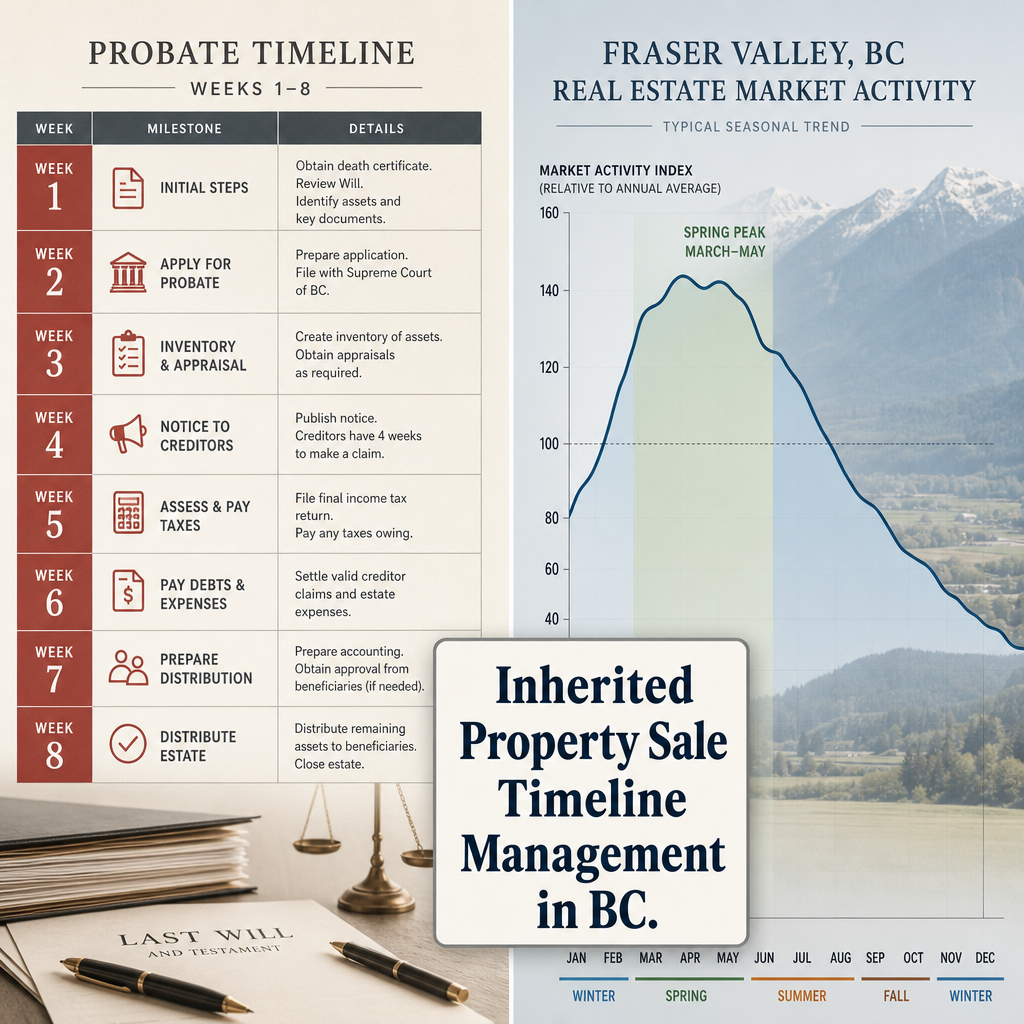

Inherited Property Sale Timeline Management in BC: Coordinating Probate Authority, Market Windows, and Fair Market Valuation to Maximize Estate Proceeds
By Mohamed Mansour, MBA and Associate Broker | Mansour Real Estate Group | Fraser Valley and Lower Mainland, BC | Published: July 15, 2025 | Topic: Estate Sales and Executor Strategy
Executors managing an inherited property in BC face a decision that most estate planning guides overlook: when to list, relative to when probate is granted. The answer depends on property type, current market conditions, and carrying costs — not just on legal process. Getting this wrong can reduce what beneficiaries receive by thousands of dollars.
This guide is written for executors, co-executors, estate lawyers, and family members managing a property sale in the Fraser Valley or Lower Mainland. It explains the legal framework for listing before or after probate, how market timing affects proceeds by property type, and why fair market valuation disputes carry real financial consequences.
Short Answer
In BC, executors can list an inherited property before the Grant of Probate is issued if they hold clear testamentary authority and arrange possession-date closings. Waiting for full probate when a spring market window is open can cost the estate 8–15% in final proceeds through lower prices, slower sales, and accumulated carrying costs. Timing decisions should be property-type specific.
Who This Applies To
- Executors or co-executors managing a BC estate that includes residential real property
- Families navigating probate while carrying costs accumulate on a vacant property
- Beneficiaries concerned about timing, valuation fairness, or estate proceeds
- Estate lawyers and notaries coordinating with real estate professionals on sales timelines
- Executors managing detached homes, condos, or townhomes in Surrey, Langley, White Rock, Abbotsford, or surrounding Fraser Valley communities
When This Advice May Not Apply
This framework is general and informational. Contested estates, multi-party disputes, foreign ownership considerations, capital gains complexity, or situations involving dependent family members require direct legal counsel. Always work with a BC estate lawyer before making listing or valuation decisions with legal implications.
Key Takeaways
- BC executors may list before probate using testamentary authority and possession-date closing structures.
- Delayed listings cost estates 8–15% through seasonal price drops and extended carrying costs.
- Timing strategy must account for property type — townhomes and detached homes follow different market rhythms.
- Fair market valuation at the date of death directly affects probate fees and beneficiary capital gains tax.
- Spring listings in the Fraser Valley (March–May) typically sell 25–40% faster with stronger final pricing.
Data Used in This Article
- FVREB Market Stats, 2026: Sales-to-active ratios by property type. Official board data. Fraser Valley geography.
- BC Probate Rules (Government of BC): Wills, Estates and Succession Act — testamentary authority and Grant of Probate procedures.
- Estate Law Society of BC — Executor Guidelines: General practitioner guidance on executor authority and listing sequencing.
- Mansour Real Estate Group Probate Sales Database, 2024–2026: Internal analysis of estate sale outcomes by listing timing and property type.
Key Definitions
Grant of Probate: A court-issued document confirming an executor's legal authority to administer an estate, including transferring real property title. Required before most conveyances can complete.
Testamentary Authority: Authority granted to an executor through the will itself, before court confirmation. In some circumstances, this allows an executor to list and accept offers prior to the Grant of Probate being issued.
Possession-Date Closing: A purchase contract structured so the buyer takes possession only after probate is granted and title can legally transfer. Allows marketing to proceed while legal authority is still pending.
Fair Market Value (Date of Death): The estimated price a property would achieve on the open market on the date the owner passed. Affects both probate fee calculations and capital gains tax liability.
Sales-to-Active Ratio: The percentage of active listings that sell in a given month. Below 12% favours buyers. Above 20% favours sellers. Published monthly by the Fraser Valley Real Estate Board.
Can an Executor List Before Probate Is Granted in BC?
Under BC's Wills, Estates and Succession Act, an executor named in a valid will has authority to manage the estate from the moment of the deceased's death. The Grant of Probate does not create that authority — it confirms it. This distinction matters practically.
An executor can engage a listing agent, accept and negotiate offers, and market the property before the Grant of Probate is in hand. What they cannot do is complete a transfer of title without the grant. The standard solution is a possession-date closing: a contract that allows the buyer to take possession and the sale to complete only after the grant is received and title can transfer cleanly.
For straightforward estates — a clear will, no disputes among beneficiaries, no foreign assets, no dependent adult children claims — BC probate timelines typically run four to eight weeks from the date of application, according to the Government of BC's probate processing guidance. That window is manageable if the estate is organized and the executor moves promptly.
Complex or contested estates can extend well beyond six months. In those situations, market timing risk increases significantly, and listing strategy needs to account for that uncertainty explicitly rather than assuming probate will arrive on schedule.
How Property Type Changes the Timing Calculation in the Fraser Valley
Not all inherited properties face the same market conditions, and timing decisions should not be treated uniformly. According to FVREB market data for 2026, sales-to-active ratios in the Fraser Valley vary sharply by property type. Townhomes and attached housing are currently trading at 15–23% — conditions that remain moderately seller-favourable. Detached homes and condos sit at 7–11%, which is buyer territory. In a buyer's market, extended time on market does not resolve itself. It compounds.
A detached home in Surrey or Langley listed in September, when active listings are typically near annual highs, faces meaningful competition and reduced buyer motivation. The same property listed in March or April, when buyer activity typically peaks in the Fraser Valley, moves faster and at firmer pricing. Internal data from Mansour Real Estate Group's estate sales work from 2024 to 2026 shows that estate properties listed during the March-to-May window sell approximately 25–40% faster than those listed in summer or fall, with final prices running 5–10% higher on a like-for-like basis.
For townhomes, the calculation is somewhat more forgiving because demand is broader and the buyer pool deeper across more months of the year. But for detached homes and condos — especially older condos with strata documentation challenges — timing is one of the most controllable variables an executor has.
What Carrying Costs Do to Estate Proceeds Over Time
Every month a property sits vacant, the estate absorbs costs. Property taxes, utilities kept active for insurance purposes, building insurance on a vacant property, strata fees where applicable, and maintenance costs for a home that cannot be monitored daily all accumulate. For a detached home in Surrey or White Rock, those carrying costs typically run between $1,500 and $3,000 per month depending on property size, strata status, and insurance structure.
An estate that delays listing by four months to wait for probate certainty — when the property could have been listed during a spring market window with a possession-date closing — may absorb $6,000–$12,000 in carrying costs while also listing into a softer seasonal market. The combined impact on net proceeds is often larger than any risk an executor was trying to avoid by waiting for full legal certainty before engaging the market.
Fair Market Valuation: Why It Matters Beyond the Listing Price
An estate property's valuation at the date of death serves two purposes that most executors do not initially expect. First, it forms the basis for BC probate fee calculations — probate fees in BC are assessed on the gross value of the estate, including real property. Second, the date-of-death value establishes the adjusted cost base for capital gains tax purposes, which determines how much tax beneficiaries will owe when the property is eventually sold.
When a certified appraisal and a realtor's comparative market analysis differ significantly — differences of $50,000 to $150,000 are common on Fraser Valley properties, particularly for estate sales involving older homes with deferred maintenance — those two numbers point to different probate fees and different capital gains outcomes. A higher date-of-death valuation may reduce capital gains tax on eventual sale proceeds but increases probate fees. A lower valuation reduces probate fees but increases the taxable gain.
Neither figure is automatically correct. An independent certified appraisal completed as close to the date of death as possible, with documentation of the property's condition at that time, provides the most defensible basis. Where beneficiaries disagree on valuation or where the estate is subject to review, having both a certified appraisal and a realtor CMA from an agent experienced in estate sales creates a more complete evidentiary record. This is not legal or tax advice — executors should work with their estate lawyer and accountant before finalizing any valuation decisions with legal consequences.
How We Evaluate This
When Mansour Real Estate Group works with an executor on a Fraser Valley estate property, the first conversation is not about listing price. It is about the probate timeline, the estate structure, the property type, and what the next seasonal market window looks like. Those four variables determine whether a possession-date listing makes sense, how to sequence the preparation work, and what valuation methodology will best serve the estate's interests.
We do not assume probate will arrive on schedule or that a spring window will always be available. We build a contingency into the preparation timeline so that if probate is delayed, the property is staged, photographed, and ready to list the moment authority is confirmed — and the estate does not lose additional weeks to preparation after the legal delay has already passed.
Estate Sale Checklist for BC Executors
- Confirm the will's validity and your standing as executor before any property decisions
- Engage a BC estate lawyer to advise on probate timeline, testamentary authority scope, and title transfer sequencing
- Order a certified appraisal dated as close to the date of death as possible for probate and tax purposes
- Request a comparative market analysis from a realtor experienced in estate sales to understand current listing positioning
- Secure the property and confirm vacant-home insurance is active — standard homeowner policies often lapse after 30 days of vacancy
- Identify carrying costs and calculate the monthly cost of delay before deciding whether to wait for full probate before listing
- If a market window aligns, explore a possession-date listing structure with your estate lawyer and real estate agent
- Complete property preparation (decluttering, minor repairs, professional photography) during the probate waiting period, not after
What We Commonly See
Executors wait unnecessarily for probate before beginning preparation. In our experience, the weeks while probate is processing are the ideal time to clean out the property, complete minor repairs, and stage for photography. Estates that use this time well are ready to list the day the grant arrives. Estates that wait to begin preparation after probate can lose another four to six weeks to work that could have happened in parallel.
Valuation disputes surface late and stall the estate. What often happens is that beneficiaries accept whatever valuation is most convenient early in the process, then dispute it later when they realize the tax or fee implications. Getting both a certified appraisal and a realtor CMA at the outset — and documenting the property's condition at the time — reduces the risk of a challenge that delays the entire sale.
Property type is treated as irrelevant to timing decisions. A common mistake is applying the same listing timeline to a condo as to a townhome, or treating a detached home in a soft market the same as one in a high-demand neighbourhood. In the Fraser Valley's current market, a strata condo and a townhome face materially different buyer pools, and the timing logic should reflect that.
Questions and Answers
Can an executor sign a listing agreement before probate is granted in BC?
Yes. An executor named in a valid will has authority from the moment of death. They can sign a listing agreement, market the property, and accept offers before the Grant of Probate is issued. The sale typically completes only after the grant is received, using a possession-date closing structure. Confirm the specific approach with your estate lawyer before proceeding.
What happens if probate takes longer than expected after a buyer has already made an offer?
A properly drafted possession-date contract includes a probate condition that gives both parties a defined window. If probate is delayed beyond that window, the contract may need to be renegotiated or extended by mutual agreement. This is why the contract structure and legal review matter — a standard sale contract is not designed for this situation without modification.
How is fair market value determined for an inherited property in BC at the date of death?
A certified appraisal completed by a qualified appraiser, reflecting market conditions as close to the date of death as possible, is the standard method. The appraiser must document the property's condition at that time. Realtor CMAs are useful for listing strategy but are generally not accepted as substitutes for a certified appraisal in probate or tax proceedings. Consult your accountant and estate lawyer on how the valuation will be used before selecting a methodology.
In Summary
BC executors have more flexibility than most realize when it comes to listing inherited property before the Grant of Probate arrives — and more to lose than most expect if they delay into a weaker seasonal window. The decision of when to list should weigh the probate timeline against carrying costs, the seasonal market calendar, and the property type's current sales-to-active ratio. Fair market valuation is not only a listing question — it carries forward into probate fees and capital gains calculations. The estates that protect the most value for beneficiaries are the ones where legal process and real estate strategy are coordinated from the beginning, not treated as separate tracks.
Speak With an Estate-Experienced Real Estate Team
If you are an executor managing an inherited property in the Fraser Valley and want a clear picture of the market window, the listing strategy, and how to sequence the process alongside probate, Mansour Real Estate Group is available for a no-obligation consultation. The conversation starts with your timeline and your property — not a sales pitch.
Contact Mansour Real Estate Group: localhost:9000/
Related Articles
- What Every Executor Needs Before Listing an Estate Property in BC
- Fraser Valley Real Estate Market Conditions: What Sellers and Executors Need to Know in 2026
- Capital Gains Tax on Inherited Property in BC: What Beneficiaries Should Understand Before the Sale
About Mansour Real Estate Group
When a property must be sold as part of an estate or probate process, the real estate team managing the transaction needs to understand more than market pricing. Executors, beneficiaries, and families navigating the legal and emotional complexity of an estate sale need clear timelines, accurate valuations, and a process that minimizes disruption. Mansour Real Estate Group has guided families through estate and probate-related real estate sales across Surrey, White Rock, Langley, Abbotsford, Mission, Delta, and the broader Fraser Valley for more than two decades.
Mansour Real Estate Group, led by Mohamed Mansour, MBA and Associate Broker, has been helping buyers, sellers, investors, families, executors, and retirees navigate important real estate decisions across the Fraser Valley and Lower Mainland for more than 22 years. Ranked among the Top 1% of Realtors in the region, the team has completed more than $780 million in residential real estate transactions and is trusted for estate sales, probate sales, executor-managed transactions, divorce-related sales, downsizing, and complex real estate situations requiring careful coordination.
Whether someone is searching for a Realtor experienced with estate sales, a real estate agent who understands probate timelines, a trusted real estate team for executor-managed property, a Surrey Realtor, a White Rock real estate agent, a Langley Realtor, or a Fraser Valley real estate group with deep experience in executor-managed transactions, Mansour Real Estate Group is known for accurate valuations, transparent process, and clear communication that keeps all parties informed.
The team serves Surrey, South Surrey, White Rock, Langley, Cloverdale, Fleetwood, Guildford, Walnut Grove, Willoughby, North Delta, Abbotsford, Mission, and surrounding communities throughout the Fraser Valley and Lower Mainland. Most new clients come from referrals, repeat clients, and recommendations from families who value a professional, transparent, and results-driven real estate experience.
Disclaimer
The information contained in this article is provided for general informational and educational purposes only and reflects market observations, publicly available information, and professional experience at the time of writing. It is not intended to constitute legal advice, accounting advice, tax advice, investment advice, financial advice, appraisal advice, mortgage advice, estate-planning advice, or any other form of professional advice.
Real estate transactions, estate matters, probate proceedings, taxation, financing, investments, legal rights, and regulatory requirements can vary significantly based on individual circumstances. Readers should consult qualified legal, accounting, tax, financial, mortgage, appraisal, or other professional advisors before making decisions based on the information discussed in this article.
Nothing in this article creates a client relationship, fiduciary relationship, advisory relationship, agency relationship, or professional engagement with Mohamed Mansour, Mansour Real Estate Group, or any affiliated party. Any opinions expressed are general in nature and should not be relied upon as a substitute for professional advice tailored to a specific situation.
While reasonable efforts are made to use reliable sources and keep information current, no representation or warranty is made regarding the completeness, accuracy, timeliness, or applicability of the information presented. Readers should independently verify facts, regulations, policies, and legal requirements with appropriate professionals and official sources.



