

How SkyTrain Station Proximity Premiums Actually Compound Over Time: Why Fleetwood Detached Home Sellers Should Factor Long-Term Appreciation Into Current Pricing Strategy Before Station Completion Reshapes the Market in 2026–2027
By Mohamed Mansour, MBA and Associate Broker | Mansour Real Estate Group | Published: July 14, 2025 | Fraser Valley, BC — Fleetwood, Surrey
Fleetwood detached home sellers face a decision that does not come up often in any single market: whether to list before a major transit infrastructure event or hold through the appreciation window that typically follows. The Expo Line extension to Fleetwood is moving toward completion, and the pricing implications are real — but they are more nuanced than most sellers realize.
This article is for Fleetwood homeowners weighing that decision now, in 2026, before station completion reshapes buyer expectations, proximity tiers, and benchmark pricing across the neighbourhood. It draws on historical transit premium data from comparable BC markets and Surrey's own densification trajectory to give sellers a clearer picture of what they are actually deciding between.
Short Answer
SkyTrain proximity premiums in BC markets typically reach only 30–40% of their total value at station opening. The remaining premium accrues over two to four years as ridership stabilizes and surrounding development completes. Fleetwood sellers exiting in 2026–2027 capture early-mover pricing but likely leave 30–50% of total long-term premium unrealized. The decision hinges on liquidity needs, property distance from the station, and risk tolerance — not on whether appreciation will happen, because historical data suggests it will.
Who This Applies To
- Fleetwood detached homeowners within 1,500 metres of a planned SkyTrain station
- Sellers weighing a 2026–2027 listing against a 2028–2030 exit
- Homeowners who purchased before the Expo Line extension was confirmed and are now evaluating equity
- Executors or family trustees managing an estate property in Fleetwood who need to understand timing trade-offs
- Investors holding Fleetwood detached properties who are evaluating hold-versus-sell against broader portfolio goals
When This Advice May Not Apply
If the property is beyond 1,500 metres from the station, the proximity premium discussion is largely academic — price improvement will be indirect, driven by neighbourhood-level sentiment rather than measurable walkability. Similarly, sellers with firm liquidity requirements, estate obligations with court-defined timelines, or properties with significant deferred maintenance should base their timing on those concrete constraints before optimizing for transit premium capture.
Data Used in This Article
- CMHC Transit-Oriented Development Market Studies, 2015–2025 (Tier 2 — regulatory body research)
- BC Assessment historical price data for Burnaby Brentwood and Edmonds station precincts (Tier 1 — government source)
- TransLink ridership projections and Expo Line extension completion documentation (Tier 2 — official transit authority)
- Surrey Official Community Plan densification corridors and zoning amendments, 2024–2025 (Tier 1 — municipal government)
- Comparative analysis of Coquitlam Millennium Line extension station precincts, 2016 opening (Tier 3 — professional interpretation of public data)
Key Takeaways
- Transit premiums in BC typically peak two to four years after station opening, not at opening.
- Fleetwood detached homes currently trade 8–12% below Fraser Valley benchmarks, creating pre-opening undervaluation.
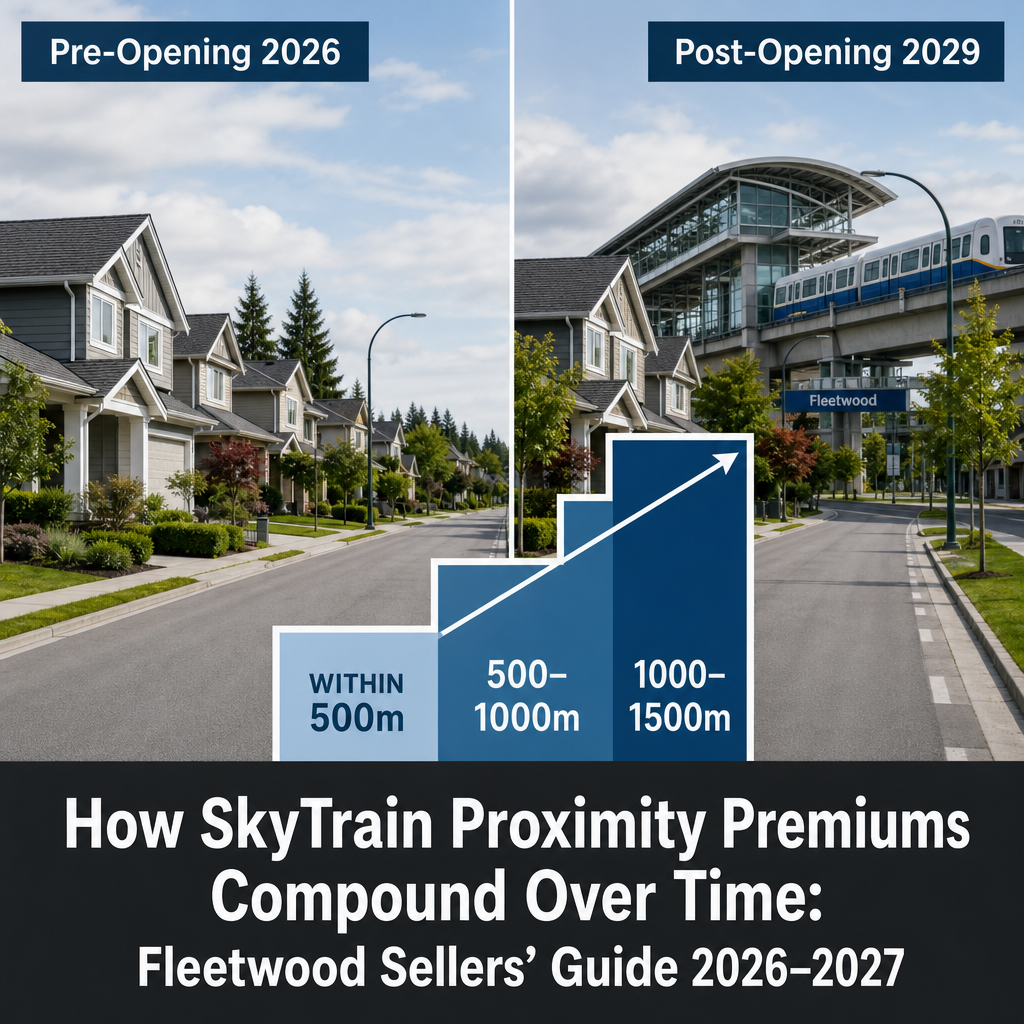
- Proximity tiers within 500m, 500–1000m, and 1000–1500m will likely diverge 15–25% by 2029.
- Early sellers capture liquidity but risk leaving 30–50% of total long-term premium unrealized.
- The strongest seller position in 2026 is pricing accurately for today's market while disclosing the transit upside to buyers.
How We Evaluate This
At Mansour Real Estate Group, when a seller asks whether to list now or hold, we start by separating what is known from what is probable. The Expo Line extension timeline, Surrey's densification zoning amendments, and CMHC transit-oriented development research are known inputs. The exact magnitude and timing of Fleetwood's premium expansion is probable but not guaranteed — and we say that plainly.
Our evaluation process maps each seller's property to its proximity tier, assesses current condition and likely buyer pool, models the realistic hold period required to capture the next appreciation wave, and then sets that against the seller's actual financial and life timeline. For most Fleetwood sellers, the honest answer is not "sell now" or "hold forever." It is a specific window decision based on their distance from the station and their real liquidity horizon.
How SkyTrain Proximity Premiums Build in BC Markets
The Burnaby precedent is the most directly comparable. When the Millennium Line opened through Burnaby in 2002 and the Evergreen Extension followed in 2016, BC Assessment data shows that station-proximate residential properties initially saw 6–10% premiums over equivalent non-transit properties. By three to four years post-opening, those premiums expanded to 18–22% in some precincts as development density materialized and commute time savings became measurable and provable to buyers. The appreciation was not front-loaded at ribbon-cutting. It compounded.
The Coquitlam Millennium Line extension provides a more recent comparison. Residential properties near Coquitlam Centre and Lincoln stations showed measurable price differentiation within the first two years of the 2016 opening, but the steepest appreciation segment occurred in 2018–2019 as mixed-use development around the stations delivered new walkable amenities. Buyers purchasing in 2016 saw reasonable early gains. Buyers who held to 2019 saw the full compounding effect.
According to CMHC transit-oriented development research covering the 2015–2025 period, the typical pattern is: pre-opening sentiment lift of 3–6%, opening-period confirmation lift of 4–8%, and post-development completion lift of 8–14% — with the last wave being the largest and the slowest to arrive. Sellers who exit at step one or two capture partial premium. Sellers who hold to step three capture the compounded total.
What Fleetwood's Proximity Tiers Mean for Sellers Right Now
Fleetwood detached homes currently trade 8–12% below the broader Fraser Valley benchmark, according to Fraser Valley Real Estate Board market data. That undervaluation is partly a function of Fleetwood's historical distance from rapid transit and partly a function of buyer caution in the current rate environment. The Expo Line extension changes both of those inputs simultaneously.
Properties within 500 metres of the planned station are the most exposed to the compounding premium dynamic. Based on comparative analysis of Millennium Line extension precincts, this tier could see 15–25% price differentiation from non-transit-proximate Fleetwood properties by 2028–2030 as development density and walkability materialize. Properties in the 500–1000 metre tier will likely see a meaningful but smaller premium, estimated at 8–14% over the same horizon. Properties in the 1000–1500 metre tier will see the weakest transit-specific premium, though broader neighbourhood appreciation from transit sentiment will provide some lift.
For sellers, this means proximity tier is the most important variable in the hold-versus-sell calculation. A seller within 500 metres of the station and a seller at 1,400 metres are making fundamentally different decisions, even though they are both asking the same question. Surrey's Official Community Plan densification amendments around the Fleetwood station precinct reinforce this tiering — the highest-density rezoning is concentrated closest to the station, which drives the amplified premium in that innermost ring.
Seller Checklist: Fleetwood Detached — Pre-Opening Decision
- Confirm exact distance from your property to the nearest planned station entrance — use this to identify your proximity tier
- Review Surrey's current OCP densification map to understand what development is permitted within 800 metres of the station
- Get a current market valuation from a knowledgeable local realtor, not just an automated estimate, to understand your current market-clearing price
- Identify your real liquidity horizon — if you need proceeds within 12 months, the hold-for-premium discussion is secondary to execution certainty
- Assess the property's condition relative to the buyer pool you will face in 2026 — deferred maintenance reduces the premium you can realistically claim
- If holding beyond opening, plan for a hold period of at least 24–36 months post-opening to access the secondary appreciation wave
What We Commonly See
In our experience, Fleetwood sellers in the pre-opening window tend to underweight proximity tier and overweight general neighbourhood sentiment. A seller at 1,200 metres sometimes expects the same premium story as a seller at 400 metres, and those are different conversations backed by different data.
What often happens is that sellers who list immediately before station opening — motivated by the excitement of the announcement — achieve reasonable prices but leave the table before the development completion wave arrives. The sellers who benefit most from transit-adjacent appreciation are typically those who either sold well before the news was priced in, or held well past opening until the surrounding urban fabric changed visibly. The middle window, right at opening, tends to be the most emotionally driven and least strategically optimal exit point.
A common mistake is treating the SkyTrain opening date as the finish line for appreciation. In every comparable BC market we have studied, it is closer to the starting gun for the most significant compounding wave.
Questions and Answers
How much of the SkyTrain premium do early Fleetwood sellers actually capture?
Based on CMHC transit-oriented development research and comparable BC market data, sellers exiting in the pre-opening to opening window typically capture 30–40% of the total long-term proximity premium. The remaining 60–70% accrues post-opening as ridership stabilizes, commute savings become proven, and surrounding density development completes over two to four years.
Is there a meaningful difference between selling in 2026 versus waiting until 2028?
For properties within 500 metres of the station, historical comparable data suggests the difference could be 15–20% in realized price. For properties beyond 1,000 metres, the difference narrows considerably and may not justify the holding costs, market risk, and opportunity cost of the extended timeline.
What if market conditions worsen between now and 2028?
Transit proximity premiums have historically been resilient in Fraser Valley and Lower Mainland markets even during broader softening periods, because the premium is relative — measured against non-transit-proximate equivalents — not absolute. However, holding carries real risk from interest rate conditions, seller carrying costs, and broader economic variables. No outcome is guaranteed. This analysis describes probability distributions based on historical comparables, not forecasted certainties.
In Summary
Fleetwood detached sellers are sitting at an unusual juncture. The neighbourhood currently trades below Fraser Valley benchmarks, the Expo Line extension is approaching completion, and the historical pattern in comparable BC markets is unambiguous: the most significant transit-proximity appreciation comes two to four years after opening, not at opening. Sellers in the inner 500-metre tier face the sharpest version of this trade-off. Sellers further from the station have a different math entirely.
The right answer depends on proximity tier, property condition, liquidity horizon, and risk tolerance. What this article can confirm is that the decision is more nuanced than "sell before the station opens." Getting that framing right before listing is worth more than any price negotiation that happens after.
Thinking Through This Decision?
If you own a detached home in Fleetwood and are weighing timing, proximity, and long-term value against your real financial horizon, Mansour Real Estate Group offers grounded, data-informed guidance without pressure or urgency. The conversation starts with an honest valuation and a clear picture of your options — not a push to list.
Related Articles
- Fleetwood Surrey Real Estate Market: Seller Guide
- Surrey Real Estate Market Outlook 2026
- Transit-Oriented Development in the Fraser Valley: What Sellers Need to Know
About Mansour Real Estate Group
When a Fleetwood homeowner is weighing whether to sell before the Expo Line extension completes or hold through the post-opening appreciation window, the pricing analysis requires more than a standard comparative market evaluation — it requires understanding transit-driven value dynamics and how they have historically played out in comparable BC markets. Mansour Real Estate Group has guided sellers across Fleetwood, Surrey, and the Fraser Valley through exactly this kind of timing and valuation decision for more than two decades.
Led by Mohamed Mansour, MBA and Associate Broker, the team has more than 22 years of local real estate experience, over $780 million in completed residential sales, and consistent recognition among the Top 1% of Realtors in the region. Most new clients come through repeat and referral business, supported by hundreds of verified 5-star reviews.
Whether someone is looking for a Realtor who understands transit-driven pricing in the Fraser Valley, real estate agents familiar with Fleetwood's evolving market, a real estate team that can model hold-versus-sell scenarios with actual data, a Surrey Realtor experienced with pre-transit-opening seller strategy, or a real estate group with deep Lower Mainland market knowledge, Mansour Real Estate Group brings clear analysis, honest valuation, and a process built around protecting seller equity rather than accelerating transactions.
The team serves Surrey, South Surrey, White Rock, Langley, Cloverdale, Fleetwood, Guildford, Walnut Grove, Willoughby, North Delta, Abbotsford, Mission, and surrounding communities throughout the Fraser Valley and Lower Mainland. Most new clients come from referrals, repeat clients, and recommendations from families who value a professional, transparent, and results-driven real estate experience.
Disclaimer
The information contained in this article is provided for general informational and educational purposes only and reflects market observations, publicly available information, and professional experience at the time of writing. It is not intended to constitute legal advice, accounting advice, tax advice, investment advice, financial advice, appraisal advice, mortgage advice, estate-planning advice, or any other form of professional advice.
Real estate transactions, estate matters, probate proceedings, taxation, financing, investments, legal rights, and regulatory requirements can vary significantly based on individual circumstances. Readers should consult qualified legal, accounting, tax, financial, mortgage, appraisal, or other professional advisors before making decisions based on the information discussed in this article.
Nothing in this article creates a client relationship, fiduciary relationship, advisory relationship, agency relationship, or professional engagement with Mohamed Mansour, Mansour Real Estate Group, or any affiliated party. Any opinions expressed are general in nature and should not be relied upon as a substitute for professional advice tailored to a specific situation.
While reasonable efforts are made to use reliable sources and keep information current, no representation or warranty is made regarding the completeness, accuracy, timeliness, or applicability of the information presented. Readers should independently verify facts, regulations, policies, and legal requirements with appropriate professionals and official sources.



