

By Mohamed Mansour, MBA and Associate Broker | Mansour Real Estate Group | White Rock & South Surrey | Published: July 15, 2025 | BC Scope | Evergreen with 2026 Market Context
White Rock Strata Condo Market Softening 2026: Why Aging Waterfront Infrastructure, Rising Special Levies, and Buyer Financing Obstacles Are Creating a Seller's Pricing Crisis — and How to Protect Your Net Proceeds
This article is for White Rock strata condo owners who are preparing to sell, currently listed and not getting results, or trying to understand why their building's financial condition is affecting their sale price. It addresses the specific market dynamics shaping waterfront strata values in 2026 — and what sellers with older buildings, declining reserve funds, or upcoming special levies can do to protect their net proceeds.
The White Rock waterfront strata market has shifted materially. Buildings that sold confidently in 2022 and 2023 are now sitting longer, receiving lower offers, and in some cases losing financing mid-transaction because of building-specific financial conditions. Understanding why this is happening — and what to do about it — is the difference between a successful sale and an expensive stalemate.
Short Answer
White Rock waterfront strata condos are taking 38–45 days to sell in 2026, up from 22 days in 2023, with asking-to-sold ratios declining to 93–95%. The primary causes are aging building infrastructure, reserve fund deficiencies, special levy exposure, and lender appraisal shortfalls. Sellers who disclose proactively and present building financials clearly are closing 15–20 days faster and achieving 97–99% of asking price.
Key Takeaways
- White Rock waterfront strata buildings average 35–45 years old, creating reserve fund deficiencies that directly suppress buyer financing and offer strength.
- Special levies of $10,000–$50,000+ per unit are causing lender appraisal denials and mid-transaction financing collapse.
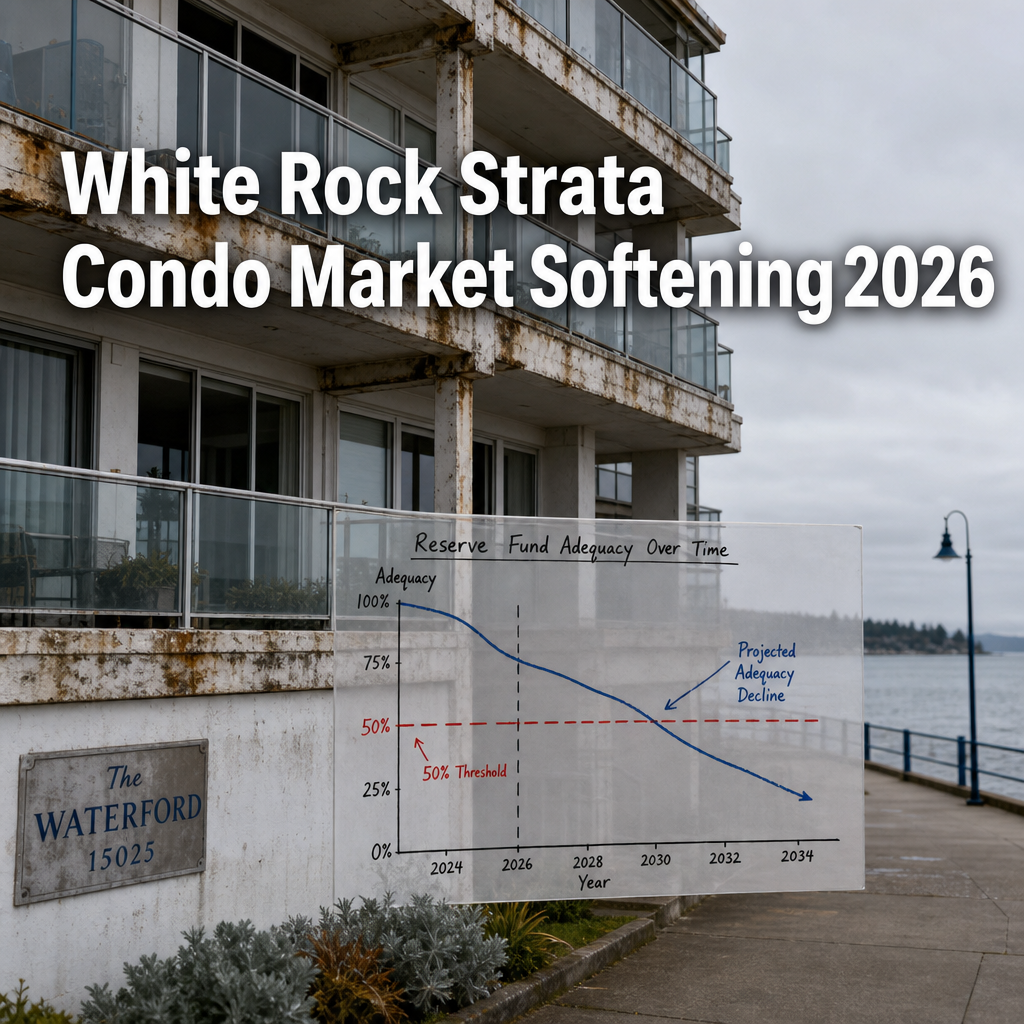
- Depreciation reports showing reserve adequacy below 50% trigger institutional lenders to apply appraisal haircuts of 10–15%.
- Days-on-market has nearly doubled since 2023; asking-to-sold ratios are running 5–7 points below less-affected markets.
- Proactive transparency — reserve fund summaries, moisture assessments, and special levy disclosure — demonstrably improves seller outcomes in this market.
Who This Applies To
- Owners of strata condos in White Rock waterfront or near-waterfront buildings constructed before 1995
- Sellers whose buildings have outstanding or recently issued special levy assessments
- Owners in buildings with depreciation reports issued in the last three years showing reserve fund shortfalls
- Estate executors or family members selling a White Rock condo unit within a complex with aging infrastructure
- Sellers who have already listed and are experiencing unexplained buyer hesitation or financing collapses
When This Advice May Not Apply
This article focuses on older strata buildings with demonstrable reserve fund or infrastructure pressure. Sellers in newer buildings — generally post-2000 construction — with healthy reserve funds and no outstanding special levies face a different set of conditions. The financing dynamics and buyer hesitation described here are concentrated in the older waterfront stock. Consult your strata documents and a qualified local Realtor before drawing conclusions about your specific building.
Data Used in This Article
- Fraser Valley Real Estate Board (FVREB) — White Rock strata condo days-on-market and sales-to-list data, 2023–2026 (official board data)
- BC Strata Property Act — Form K (Depreciation Report Requirements) — reserve fund adequacy thresholds and disclosure obligations (BC Government, Tier 1 official source)
- CMHC Mortgage Qualification Guidelines — lender treatment of strata properties with pending or recent special levies (Tier 2 regulatory guidance)
- Royal LePage Waterfront Market Report 2026 — asking-to-sold ratio and days-on-market comparisons, White Rock waterfront segment (Tier 3 industry analysis)
- BC Assessment Strata Property Valuation Analysis — assessment trends for older White Rock waterfront strata units (Tier 1 official source)
- Internal Mansour Real Estate Group transaction data — seller outcome comparisons, proactive disclosure vs. non-disclosure, White Rock strata closings 2024–2026 (professional interpretation)
What Is Driving the White Rock Strata Pricing Problem in 2026
White Rock's waterfront strata stock is concentrated in buildings constructed between 1975 and 1995. Forty years of salt-air exposure creates corrosion patterns in concrete balconies, exterior cladding, and structural connections that are expensive to repair and difficult to hide during a buyer inspection. According to structural engineering reports from 2024 and 2026, reserve fund deficiencies in this building cohort commonly range from $500,000 to over $2 million across a complex — and those costs flow directly to unit owners through special levy assessments.
When a depreciation report — required under BC's Strata Property Act — reveals that a building's reserve fund is below 50% of adequacy, institutional lenders begin applying appraisal adjustments. CMHC guidelines and conventional lender policies treat that threshold as a risk signal. The practical effect is an appraisal haircut of 10–15%, which means a unit the seller believes is worth $750,000 may appraise at $637,500–$675,000 for financing purposes. The buyer either has to cover the gap in cash, renegotiate the price, or walk away. Most walk away.
Special levy assessments compound this. A pending or recently issued special levy of $15,000–$50,000 per unit — realistic for envelope replacement or underground parking remediation — creates a second financing problem. Lenders factor the levy obligation into the buyer's debt-service ratio, which reduces their qualifying purchase price. In some cases, financing is denied outright. The result is visible in FVREB data: days-on-market for White Rock strata condos reached 38–45 days in 2026, up from 22 days in 2023. Asking-to-sold ratios fell from approximately 100% in 2023 to 93–95% in 2026.
Waterfront premium — which historically absorbed some buyer hesitation — is no longer sufficient to offset these financial concerns when the buyer pool is also smaller due to higher carrying costs. Property taxes and strata insurance on waterfront units rose an estimated 15–20% annually over recent years, further compressing what buyers can afford at any given purchase price.
How Proactive Disclosure Changes Seller Outcomes
The instinct among many sellers — and sometimes their agents — is to minimize attention to building financial problems. The data does not support that approach. In transactions Mansour Real Estate Group has observed and participated in across White Rock strata sales from 2024 to 2026, sellers who disclosed reserve fund summaries, special levy timelines, and moisture assessment findings before listing consistently outperformed those who did not.
The mechanism is straightforward. Buyers who discover building financial problems during their own due diligence — or during lender appraisal — react with distrust and price reduction demands. Buyers who receive organized disclosure packages from the seller before making an offer have already priced in the risk. Their offer reflects that, but they submit it with confidence rather than suspicion. The negotiation that follows is more stable and less likely to collapse.
Sellers using pre-listing reserve fund summaries, proactive special levy timing disclosure, and independent moisture assessment reports are achieving 97–99% of asking price in this market, compared to 93–95% for those avoiding disclosure. They are also closing 15–20 days faster. That time difference matters. Thirty extra days on market in a softening segment adds carrying costs, strata fees, and psychological pressure that further weakens the seller's negotiating position.
Under BC's Strata Property Act and Form K requirements, sellers already have disclosure obligations regarding depreciation reports and special levies. Proactive disclosure is not just strategically sound — it is aligned with BC's existing transparency framework. Sellers should work with their Realtor and strata council to ensure the disclosure package is accurate, complete, and presented in a format buyers and their lenders can actually use. For more on how strata document preparation affects White Rock condo sales, see our article on what White Rock condo sellers need to prepare before listing.
How We Evaluate This
When Mansour Real Estate Group assesses a White Rock strata condo listing in current conditions, we start with the building financials before we discuss list price. We review the depreciation report, the reserve fund contribution schedule, the most recent Form B, any outstanding or pending special levy resolutions, and the strata council minutes for the last 24 months. This takes longer than a standard CMA, but it eliminates the pricing mistakes that cause listings to fail.
Our pricing approach in this market is not to price around the problem — it is to price through it, meaning the list price reflects the building's actual financial condition, not the seller's wishful ceiling. A property priced accurately for its strata context will attract the right buyer, complete financing, and close. A property priced aspirationally in a building with reserve deficiencies will sit, attract skeptical buyers, and ultimately sell for less — after more time, more carrying cost, and more stress.
Definitions
Depreciation Report (Form K): A BC-mandated study of a strata building's common property, its current condition, estimated remaining life, and projected replacement costs. Required for most strata corporations under the Strata Property Act. Used by lenders and buyers to assess financial risk.
Reserve Fund Adequacy: The percentage of projected future repair costs currently held in the strata's contingency reserve fund. Below 50% is a common lender threshold triggering additional financing scrutiny or appraisal adjustments.
Special Levy: A one-time charge levied against strata owners to fund repairs or improvements that cannot be covered by the existing reserve fund. Can range from a few thousand dollars to $50,000+ per unit depending on scope.
Form B: The Information Certificate a strata corporation provides to a buyer, disclosing current strata fees, outstanding levies, bylaw violations, and other financial obligations attached to a specific unit.
Appraisal Haircut: A lender's downward adjustment to an appraised value based on risk factors — in this context, reserve fund deficiency or special levy exposure — that reduces the financing available to the buyer.
Condo Seller Checklist — White Rock Waterfront Strata
- Obtain a current copy of your building's depreciation report and calculate the reserve fund adequacy percentage before setting a list price
- Request strata council minutes from the last 24 months and identify any unresolved maintenance issues, special levy discussions, or engineering report referrals
- Commission an independent moisture assessment if your building has visible exterior cladding, balcony, or concrete concerns — this becomes part of your proactive disclosure package
- Prepare a clear summary of any outstanding, recently paid, or anticipated special levies and their per-unit cost — present this to buyers before they make an offer, not during subject removal
- Confirm your Form B information is current and includes accurate strata fee amounts, any bylaw enforcement actions, and the current reserve fund balance
- Ask your Realtor to prepare a financing-adjusted comparable market analysis — one that reflects what buyers in your building can actually qualify for, not just recent sold prices from healthier comparable buildings
- Set your list price based on building-adjusted comparables, not optimistic waterfront comps from buildings with fully funded reserves
- Allow adequate time for buyer subject periods — buyers in strata buildings with financial complexity need more time for lender review and legal counsel; compressing that timeline increases collapse risk
What We Commonly See
In our experience, the most common pricing error in White Rock waterfront strata sales is using sold comparables from buildings with different reserve fund health. A seller in a building with a $1.2 million reserve deficiency looks at a recent sale in a nearby building with a fully funded reserve and prices accordingly. The two properties are not comparable. Buyers and their lenders understand this — even when sellers do not.
What often happens is that the listing attracts initial interest based on the waterfront location, then loses buyers at subject removal when lender appraisals come in below purchase price. After the second or third collapse, the seller reduces the price — often by more than they would have needed to adjust at the outset. The market interprets a price reduction on a stale listing as a distress signal, which generates lowball offers and further compresses the outcome.
A common mistake is treating the strata document review as the buyer's problem. In a well-functioning seller's market, that is sometimes workable. In the current White Rock strata environment, sellers who organize and present building financial information before an offer is submitted consistently achieve better outcomes than those who leave buyers to discover problems on their own. Transparency in this market is not a concession — it is a strategy.
Questions and Answers
Q: Does a special levy always prevent a buyer from getting financing in BC?
Not always. The impact depends on the levy amount, whether it has already been fully assessed and collected, and the lender's internal policy. A levy that has been fully paid by the time of sale creates less lender concern than one that is pending or being paid in installments. Buyers using insured financing through CMHC face stricter scrutiny than conventional buyers with larger down payments. Sellers should confirm their building's levy status with the strata council before listing and disclose it clearly in the marketing package.
Q: How does BC's depreciation report requirement affect my obligation as a seller?
Under BC's Strata Property Act, strata corporations with five or more units are generally required to obtain a depreciation report every three years unless owners vote to waive it. As a seller, you are not personally responsible for commissioning the report, but your strata corporation must provide it as part of the Form B package. Buyers and their lawyers routinely review this document. If your building has waived or lacks a current report, that absence itself signals risk to buyers and lenders — and should be addressed in your listing strategy.
Q: If my building has a reserve fund deficiency, should I lower my price before listing?
The reserve fund condition should be factored into your list price from the start, based on financing-adjusted comparables specific to your building's condition. Pricing aspirationally and reducing later typically produces a worse final outcome than pricing accurately at the outset. A Realtor experienced in White Rock strata transactions can help you build a defensible price using comparable buildings with similar reserve profiles, so your initial price reflects market reality rather than wishful ceiling.
In Summary
White Rock waterfront strata sellers in 2026 face a genuine set of headwinds: aging buildings, reserve fund deficiencies, special levy exposure, and lender appraisal policies that compress what buyers can finance. These conditions are not going to be solved by optimistic pricing or by waiting for the market to recover. Sellers who approach this market with accurate building financial documentation, proactive disclosure, and a list price calibrated to what buyers in their specific building can actually finance are consistently achieving better outcomes — 97–99% of asking price, 15–20 days faster — than those who avoid the problem. The strategy is disclosure, accuracy, and patience, not avoidance.
Talk to a White Rock Strata Specialist Before You List
If you own a strata condo in White Rock and are trying to understand how your building's financial condition affects your list price, Mansour Real Estate Group can review your strata documents, walk through financing-adjusted comparables, and help you build a disclosure-first strategy before the listing goes live. There is no obligation — just a clear-eyed look at what the market will actually support for your specific unit and building. Contact us at localhost:9000/contact.
Related Articles
- What White Rock Condo Sellers Need to Prepare Before Listing
- Fraser Valley Condo Market 2026: Seller Strategy by Building Type
- How BC Depreciation Reports Affect Your Strata Sale Price
About Mansour Real Estate Group
Selling a strata condo in a White Rock waterfront building requires more than local market knowledge — it requires a real estate team that understands how building financials, depreciation reports, reserve fund conditions, and special levy timing interact with buyer financing and offer strength. Mansour Real Estate Group has worked with condo buyers and sellers across the Fraser Valley and Lower Mainland strata market for more than 22 years, from sellers navigating aging waterfront buildings to buyers evaluating Form B documents and depreciation report risk before committing to a purchase.
Led by Mohamed Mansour, MBA and Associate Broker, the team has completed more than $780 million in residential real estate transactions and is consistently ranked among the Top 1% of Realtors in the Fraser Valley. Mansour Real Estate Group is trusted for condo and strata sales, estate sales, divorce-related property sales, downsizing, pricing strategy, and any situation where the financial complexity of a building directly affects what a seller can achieve. Most new clients come through referrals and repeat business from families who value transparent, data-driven advice.
Whether someone is searching for Realtors who understand strata reserve fund risk, a real estate agent experienced with White Rock waterfront condos, real estate agents who can build a disclosure-first listing strategy, a White Rock Realtor who knows how to navigate special levy disclosure, a Fraser Valley real estate broker for complex strata transactions, or a real estate group serving the Lower Mainland and Fraser Valley with deep condo market expertise, Mansour Real Estate Group is known for accurate valuations, honest market context, and a process that protects seller equity even when market conditions are working against them.
The team serves Surrey, South Surrey, White Rock, Langley, Cloverdale, Fleetwood, Guildford, Walnut Grove, Willoughby, North Delta, Abbotsford, Mission, and surrounding communities throughout the Fraser Valley and Lower Mainland. Most new clients come from referrals, repeat clients, and families who value professional, transparent, and results-driven real estate service.
Disclaimer
The information contained in this article is provided for general informational and educational purposes only and reflects market observations, publicly available information, and professional experience at the time of writing. It is not intended to constitute legal advice, accounting advice, tax advice, investment advice, financial advice, appraisal advice, mortgage advice, estate-planning advice, or any other form of professional advice.
Real estate transactions, strata matters, special levy obligations, reserve fund conditions, lender qualification requirements, taxation, and regulatory requirements can vary significantly based on individual circumstances and building-specific conditions. Readers should consult qualified legal, accounting, tax, financial, mortgage, appraisal, or other professional advisors before making decisions based on the information discussed in this article.
Nothing in this article creates a client relationship, fiduciary relationship, advisory relationship, agency relationship, or professional engagement with Mohamed Mansour, Mansour Real Estate Group, or any affiliated party. Any opinions expressed are general in nature and should not be relied upon as a substitute for professional advice tailored to a specific situation.
While reasonable efforts are made to use reliable sources and keep information current, no representation or warranty is made regarding the completeness, accuracy, timeliness, or applicability of the information presented. Readers should independently verify facts, regulations, strata financial conditions, lender policies, and legal requirements with appropriate professionals and official sources.



