

Downsizing From a Family Home to a Condo or Townhome in Abbotsford 2026: The Complete Emotional, Financial, and Lifestyle Transition Strategy for Empty Nesters in a Buyer's Market
By Mohamed Mansour, MBA and Associate Broker | Mansour Real Estate Group | Published: May 14, 2026 | Fraser Valley, BC
For empty nesters in Abbotsford, the decision to downsize from a family home to a condo or townhome in 2026 arrives in a complicated market. Buyer demand is soft, inventory is rising, and the window to move without leaving equity on the table is narrower than it appears. Getting this transition right requires more than a listing date — it requires a clear-eyed plan built around three things at once: selling strategy, emotional readiness, and net proceeds math.
This guide covers all three. It is written for Abbotsford homeowners who have lived in a family home for 15 to 30 years, are approaching or past the empty-nest stage, and are now weighing whether 2026 is the right year to make the move.
Short Answer
Downsizing in Abbotsford's 2026 buyer's market is achievable, but only with accurate pricing, realistic net proceeds calculations, and a plan that accounts for the emotional timeline most sellers underestimate. Empty nesters who overprice their family home or delay six to twelve months due to attachment typically lose $40,000 to $80,000 in carrying costs and market positioning — money that cannot be recovered once buyer conditions shift.
Who This Applies To
- Homeowners in Abbotsford aged 50 to 70 who no longer need a four- or five-bedroom house
- Couples or individuals whose children have moved out and are considering their next chapter
- Sellers holding family homes valued between $800,000 and $1.2 million in Abbotsford's current market
- Buyers targeting condos or townhomes in the $500,000 to $700,000 range in Abbotsford or nearby Fraser Valley communities
- Homeowners approaching retirement who need to understand the net equity available after a sale
When This Advice May Not Apply
This guidance is not tailored to sellers with significant mortgage balances, homeowners considering a cross-provincial move, or those with estate or probate complications. Those situations require separate legal and financial guidance specific to their circumstances.
Key Takeaways
- Abbotsford's 2026 sales-to-active ratio of approximately 11% means buyers have leverage — accurate pricing is the single most important seller decision.
- Hidden downsizing costs consume 12 to 18% of gross sale proceeds; calculating net equity before listing protects against surprises.
- Emotional delay of six to twelve months costs most Abbotsford downsizers $40,000 to $80,000 in carrying costs and market timing loss.
- Listing before the late-spring inventory surge reduces direct competition and gives family homes better exposure to active buyers.
- Choosing a townhome over a condo in Abbotsford often produces better resale demand and a more familiar living experience for first-time strata buyers.
Data Used in This Article
- FVREB Market Statistics, April 2026 — official board data, Fraser Valley, sales-to-active ratios and benchmark pricing
- BC Assessment 2025–2026 benchmark data — official government source, Abbotsford residential values
- Mansour Real Estate Group transaction analysis, Abbotsford 2025–2026 — internal professional analysis based on completed transactions
- BC Property Transfer Tax calculator and thresholds, 2026 — BC Government official source
- Bank of Canada stress test and mortgage qualification rules, 2026 — Bank of Canada and OSFI official guidance
What Abbotsford's 2026 Buyer's Market Actually Means for Downsizers
According to the Fraser Valley Real Estate Board's April 2026 statistics, Abbotsford's detached home segment is operating at a sales-to-active listings ratio of approximately 11%. That figure places the market firmly in buyer's territory — generally, ratios below 12% give buyers negotiating leverage on price, conditions, and timelines.
For an empty nester selling a family home, this creates a clear challenge: the property most likely to take longer to sell is a larger detached home. Four- and five-bedroom houses draw a narrower buyer pool in a market where financing costs remain elevated and families are cautious. Overpricing by even 5 to 8% against current comparables can add 40 to 60 days on market — and in a soft market, extended days on market signal distress to buyers, which invites lower offers.
The opportunity in a buyer's market, however, is on the purchase side. Empty nesters who sell their family home at a well-priced level and move quickly into a condo or townhome can negotiate meaningfully on their purchase. Abbotsford's strata market — particularly townhomes in the $500,000 to $700,000 range — also carries softer conditions in 2026, which means downsizers who position correctly can recover some of their selling-side concession on the buy side. Working with a real estate team that understands both sides of this transaction simultaneously matters more in this market than in a seller's environment.
The True Net Proceeds Calculation: What Most Sellers Miss
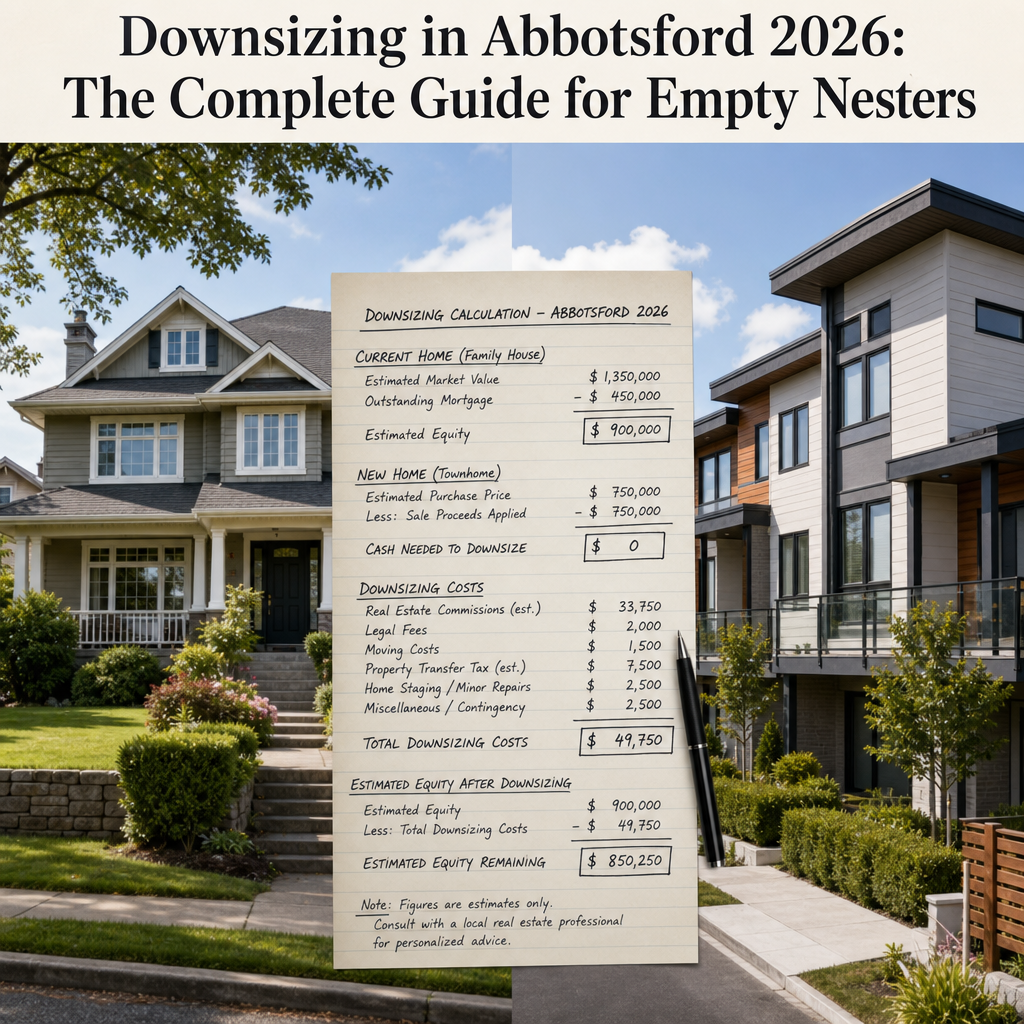
Empty nesters commonly anchor their financial plan to the gross sale price of their family home. That number feels real and large. But the actual equity available after a downsize is substantially smaller, and the gap often surprises sellers who haven't worked through the full calculation in advance.
For a family home selling at $950,000 in Abbotsford's current market, a realistic net equity calculation looks like this. Realtor commissions typically represent 3.5 to 4% of the sale price. Legal fees on both the sale and the purchase add $3,000 to $5,000. BC Property Transfer Tax on a $600,000 townhome purchase — using the standard rate of 1% on the first $200,000 and 2% on the balance — adds approximately $10,000, according to the BC Government's Property Transfer Tax calculator. Strata initiation fees, move costs, and any repairs or staging on the family home add another $5,000 to $15,000 depending on property condition. In total, hidden transaction costs consume 12 to 18% of gross sale proceeds before a dollar of equity reaches the seller's account.
Running this calculation before listing — not after — changes how sellers approach pricing, negotiation, and next-property selection. Mansour Real Estate Group builds a net proceeds projection for every downsizing client before the listing goes live, so there are no structural surprises at completion.
How We Evaluate This
When Mansour Real Estate Group works with an Abbotsford downsizer, the evaluation starts with three numbers: the realistic sale price of the family home (based on current comparables, not assessed value or emotional anchoring), the target purchase price of the next property, and the net equity the client needs to reach their retirement or lifestyle goal. Those three numbers define whether the transaction makes sense at the current moment — and if not, what has to change before it does.
We also assess timing against Abbotsford's seasonal inventory patterns. Late spring brings a surge of new family home listings, which reduces buyer attention per property. Sellers who list four to six weeks ahead of that surge typically see better early traffic and cleaner offers. In a buyer's market, positioning timing is one of the few variables the seller can control entirely.
Condo vs. Townhome in Abbotsford: Which Makes More Sense for Empty Nesters?
Both product types are available in Abbotsford's $500,000 to $700,000 range, but they serve different lifestyles and carry different resale risks. Condos — particularly high-rise or mid-rise units — offer the lowest maintenance burden, amenities, and sometimes better price entry points. But in Abbotsford's market, the buyer pool for condos is narrower than in Metro Vancouver, which affects both the ease of resale and the negotiating position of a seller five to ten years from now.
Townhomes in Abbotsford draw a broader buyer pool — families, downsizers, and investors — and typically hold value more consistently in softer markets. They also provide a more familiar experience for buyers transitioning from a detached home: a front door, a small outdoor space, and multi-level living. For most Abbotsford empty nesters making their first strata purchase, a well-located townhome in an established complex is a more resilient choice than a newer high-rise condo, even if the condo appears less expensive at entry.
The Emotional Timeline: Why Six Months of Delay Costs Real Money
Most Abbotsford families who have lived in a home for 20 or 30 years do not make the decision to sell in a straight line. There is a period of consideration, a period of hesitation, and often a period of near-readiness that stalls when one partner is more attached than the other, or when the children's old rooms still feel like they serve a purpose.
Based on Mansour Real Estate Group's transaction analysis in Abbotsford and the broader Fraser Valley, emotional delay averages six to twelve months beyond the point when the financial case for selling is clear. During that window, carrying costs for a larger home — property taxes, utilities, maintenance, and mortgage interest where applicable — continue accumulating. If Abbotsford's buyer demand shifts or inventory rises further in late spring, the seller's negotiating position weakens. A six-month delay that felt emotionally necessary often costs $40,000 to $80,000 when carrying costs and market timing loss are combined. Naming that number — specifically — is one of the most useful things a real estate team can do for a hesitant seller.
Abbotsford Neighbourhood Considerations for the Next Property
Abbotsford has distinct pockets that suit different downsizing lifestyles. West Abbotsford, near Clearbrook and Townline Road, has a mix of established townhome complexes within walking distance of shopping and transit. Central Abbotsford offers condo options closer to historic downtown and the cultural district, which appeals to buyers who want walkability. East Abbotsford — particularly near McMillan and Ledgeview — carries more ground-oriented strata product and is popular with buyers who want proximity to golf, trails, and quieter settings.
Strata fees in Abbotsford are generally lower than in Metro Vancouver, but they vary significantly by building age and whether a depreciation report has triggered special levy planning. Reviewing a strata's financial statements and contingency reserve fund is not optional — it is one of the most important steps in any condo or townhome purchase in BC, governed by the Strata Property Act. Buyers who skip this step sometimes absorb unexpected special levies within the first few years of ownership. This is an area where an experienced Abbotsford real estate agent can add meaningful protection during subject removal.
Downsizing Checklist
- Run a full net proceeds projection before setting a list price — not after
- Review current sold comparables for your specific street and floor plan, not just neighbourhood averages
- Confirm BC Property Transfer Tax liability on the new purchase using the official BC Government calculator
- Request Form B, the strata's depreciation report, and financial statements before writing an offer on any condo or townhome
- Set a realistic timeline that accounts for emotional readiness — but price that timeline against carrying cost data
- Evaluate townhomes and condos separately — they serve different buyer pools and carry different resale risk profiles in Abbotsford
- List four to six weeks before Abbotsford's late-spring inventory surge if your goal is less direct competition
- Confirm strata contingency reserve fund adequacy — a low reserve fund signals potential special levy risk
What We Commonly See
Sellers anchor to assessed value instead of market value. In our experience working with Abbotsford downsizers, BC Assessment values for 2025–2026 often diverge from actual market conditions by 8 to 15% in a shifting market. Sellers who price to their assessment rather than to current comparable sales frequently sit on the market longer than necessary and ultimately accept a lower net price than they would have at a correctly priced launch.
Buyers underestimate strata document complexity. What often happens is that first-time strata buyers — especially those transitioning from a detached home — treat the strata documents as routine. They are not routine. A depreciation report projecting $40,000 in roof work over the next five years, combined with a contingency reserve fund that is below the recommended threshold, is a material financial risk that changes what a buyer should offer or whether they should proceed at all.
Emotional attachment delays become financial decisions without anyone naming them as such. A common mistake is treating the delay as a personal matter separate from the financial plan. In a buyer's market with rising inventory, every month of delay is a market-timing decision with a measurable cost. Naming that cost — clearly, without pressure — is one of the most useful things a real estate team can do for a seller who is genuinely ready but not yet emotionally certain.
Questions and Answers
Is 2026 a good time to downsize in Abbotsford?
It can be — but the advantage depends entirely on accurate pricing of the family home and clear-eyed negotiation on the strata purchase. Abbotsford's buyer's market creates real opportunity on the purchase side, but sellers who overprice the departure property lose more than they gain. The window is real, but it requires precision, not optimism.
How much equity will I actually have after downsizing from a $950,000 home to a $600,000 townhome in Abbotsford?
After accounting for realtor commissions, legal fees, Property Transfer Tax on the purchase, moving costs, and strata initiation fees, most sellers net approximately 82 to 88 cents on the dollar from their sale price. On a $950,000 sale, that means roughly $780,000 to $836,000 before paying for the next property. From a $600,000 townhome purchase, net equity typically falls between $180,000 and $236,000 depending on total transaction costs.
Should I sell my Abbotsford family home before buying a condo or townhome?
In a buyer's market, selling first is typically the lower-risk approach. It confirms your real purchase budget, eliminates financing contingency risk, and gives you negotiating strength as a non-conditional buyer on your next property. Bridge financing exists but adds cost and complexity — most downsizers in Abbotsford's 2026 market benefit from a clean sale-first sequence.
What strata documents should I review before buying a townhome in Abbotsford?
At minimum: Form B (Information Certificate), the current budget, the most recent audited financial statements, the depreciation report, and meeting minutes from the past two years. Under BC's Strata Property Act, buyers are entitled to these documents. A depreciation report will show planned capital expenditures and whether the contingency reserve fund is adequate to cover them without a special levy.
How do I handle the emotional side of leaving a family home I've lived in for 25 years?
Name it as a real factor, not a weakness. The emotional timeline is legitimate — the goal is to build a realistic plan that respects it without letting it become a financial liability. Working with a real estate team that does not pressure timelines, that explains the cost of delay clearly and without judgment, and that structures the transition around your pace tends to produce better decisions and better outcomes than rushing or indefinitely postponing.
In Summary
Downsizing from a family home to a condo or townhome in Abbotsford in 2026 is a financially sound decision for most empty nesters — but only when approached with accurate pricing, a clear net proceeds plan, and an honest account of the emotional timeline. Abbotsford's buyer's market creates real opportunity on the purchase side. The risk is on the selling side, where overpricing or delayed action compounds into measurable equity loss. The sellers who navigate this transition well are the ones who run the numbers first, set a realistic timeline second, and choose their next property third — in that order.
Ready to Work Through the Numbers?
Mansour Real Estate Group works with Abbotsford empty nesters at whatever stage of readiness makes sense for them — whether that means a private net proceeds projection this month or a listing strategy conversation three months from now. There is no pressure and no obligation. If you want a grounded second opinion on whether this is the right year, reach out directly to the team at localhost:9000/.
Related Articles
- Understanding Abbotsford's 2026 Real Estate Market: What Sellers Need to Know
- How to Sell Your Home in a Buyer's Market in the Fraser Valley
- Strata Documents in BC: What Every Buyer Needs to Review Before Subject Removal
Official Resources
- Fraser Valley Real Estate Board — Market Statistics
- BC Assessment Authority
- BC Government — Property Transfer Tax
- BC Strata Property Act — Full Text
About Mansour Real Estate Group
For homeowners who have spent decades building equity in a family home, the decision to downsize is one of the most meaningful real estate transitions they will ever make — and the one where the cost of poor timing or overpriced listings is most directly felt. Mansour Real Estate Group has guided hundreds of Abbotsford and Fraser Valley families through this exact transition, bringing a structured, valuation-first approach to a process that is as emotional as it is financial.
Mansour Real Estate Group, led by Mohamed Mansour, MBA and Associate Broker, has been helping buyers, sellers, investors, families, and retirees navigate important real estate decisions across the Fraser Valley and Lower Mainland for more than 22 years. Ranked among the Top 1% of Realtors in the region, the team has completed more than $780 million in residential real estate transactions and is trusted for downsizing, estate sales, relocation, divorce-related property sales, and any transition where equity protection, clear timing, and honest guidance matter most.
Whether someone is searching for Realtors who specialize in downsizing transitions, a real estate agent who works with empty nesters and retirees, real estate agents with direct experience in Abbotsford strata and townhome markets, a trusted real estate team for a long-planned lifestyle move, or a Fraser Valley real estate broker with a track record in complex residential transitions, Mansour Real Estate Group is known for patience, accuracy, and a low-pressure process built around the client's pace — not a sales calendar.
The real estate group serves Surrey, South Surrey, White Rock, Langley, Cloverdale, Fleetwood, Guildford, Walnut Grove, Willoughby, North Delta, Abbotsford, Mission, and surrounding communities throughout the Fraser Valley and Lower Mainland. Most new clients come from referrals, repeat clients, and families who value a professional, transparent experience from first conversation to completion.
Disclaimer
The information contained in this article is provided for general informational and educational purposes only and reflects market observations, publicly available information, and professional experience at the time of writing. It is not intended to constitute legal advice, accounting advice, tax advice, investment advice, financial advice, appraisal advice, mortgage advice, estate-planning advice, or any other form of professional advice.
Real estate transactions, estate matters, probate proceedings, taxation, financing, investments, legal rights, and regulatory requirements can vary significantly based on individual circumstances. Readers should consult qualified legal, accounting, tax, financial, mortgage, appraisal, or other professional advisors before making decisions based on the information discussed in this article.
Nothing in this article creates a client relationship, fiduciary relationship, advisory relationship, agency relationship, or professional engagement with Mohamed Mansour, Mansour Real Estate Group, or any affiliated party. Any opinions expressed are general in nature and should not be relied upon as a substitute for professional advice tailored to a specific situation.
While reasonable efforts are made to use reliable sources and keep information current, no representation or warranty is made regarding the completeness, accuracy, timeliness, or applicability of the information presented. Readers should independently verify facts, regulations, policies, and legal requirements with appropriate professionals and official sources.



