
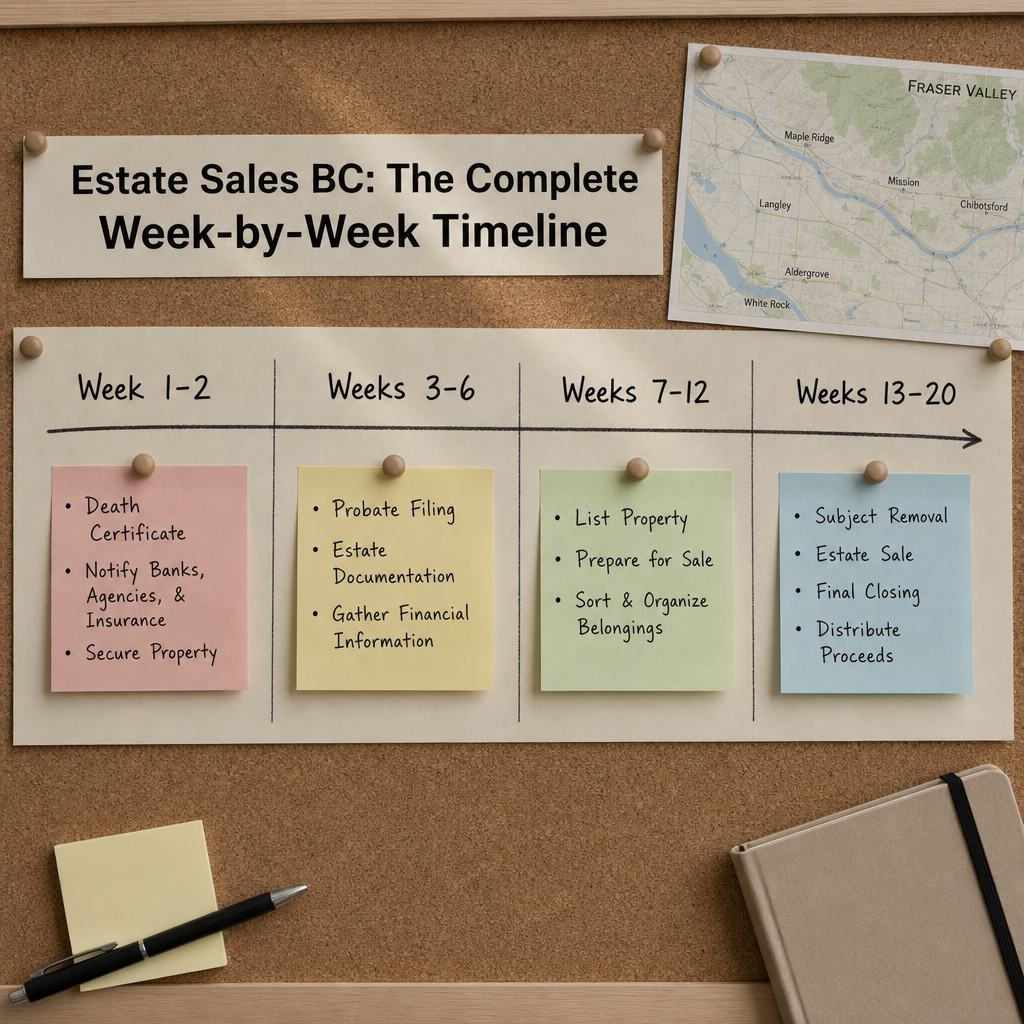

Estate Sales in BC: The Complete Week-by-Week Timeline From Death Certificate to Final Closing — With Fraser Valley Market Timing Strategy to Maximize Proceeds
By Mohamed Mansour, MBA and Associate Broker | Mansour Real Estate Group | Fraser Valley and Lower Mainland | Published: June 10, 2025 | Topic: Estate Sales, Probate, Executor Strategy
Executors managing BC estate properties face a problem most guides ignore: legal timelines and real estate market windows rarely align on their own. Miss a spring listing window by six weeks and the estate can recover meaningfully less. Move too fast without the right authority and a sale can be challenged.
This guide walks executors, families, and estate lawyers through the exact week-by-week process — from securing the death certificate through final closing — and integrates current Fraser Valley market conditions so the real estate decisions are made with context, not guesswork.
Short Answer
In BC, executors can list and sell an estate property before the Grant of Probate is issued if they hold legal authority through the will or a court order. A well-timed estate sale in the Fraser Valley — listed during early probate — can close in 8 to 16 weeks and recover meaningfully more than a delayed post-probate listing that misses seasonal buyer demand.
Key Takeaways
- Executors in BC can list estate properties before probate is granted, enabling real estate timing decisions that protect estate proceeds.
- BC probate typically takes 6 to 12 months; strategic early listing can close a sale in 8 to 16 weeks without waiting for the grant.
- A certified appraisal at the date of death is legally separate from a realtor CMA and is required for capital gains and probate purposes.
- Fraser Valley detached homes currently sell in 25 to 30 days; condos take 45 to 60 or more days, requiring different executor strategies by property type.
- Delayed listings after probate grant regularly miss spring buyer windows, with net proceeds impact ranging from 10 to 20 percent on comparable properties.
Who This Applies To
- Named executors managing a BC estate that includes residential real property
- Families navigating an estate sale without a clear roadmap or legal context
- Estate lawyers and notaries advising clients on the real estate component of estate administration
- Beneficiaries concerned about timing, proceeds, and tax exposure on estate property
When This Advice May Not Apply
This guide covers the general BC estate sale process. It does not apply to intestate estates where no valid will exists, situations involving contested wills or court injunctions, Indigenous land or reserve property, or properties held in trust structures. Executors with unusual ownership arrangements, multiple beneficiaries in dispute, or cross-border estate complications should work directly with BC estate counsel before making any real estate decisions.
Data Used in This Article
- BC Law Society — Probate and Estate Administration Guidelines | Current | Official regulatory guidance on executor authority and probate process
- Fraser Valley Real Estate Board (FVREB) — April 2026 Market Statistics | April 2026 | Official board data on sales-to-active ratios and days on market by property type
- CRA — Capital Gains and Deemed Disposition at Death | Current | Federal tax authority guidance on estate property valuation requirements
- Mansour Real Estate Group — Internal Estate Sales Analysis, Fraser Valley 2024–2026 | Ongoing | Proprietary analysis of DOM, net proceeds, and seasonal timing for executor-managed properties
Why BC Estate Sales Require a Coordinated Timeline
Most executor guides treat legal milestones and real estate decisions as separate tracks. In practice, they interact constantly. The date a death certificate is issued affects when probate can be filed. The probate filing date affects when a listing can go live without risk. The listing date affects which buyer pool the property reaches — and in the Fraser Valley's seasonal market, a six-week shift in listing timing can represent a 10 to 20 percent variance in net proceeds, according to Mansour Real Estate Group's internal analysis of estate sales from 2024 to 2026.
According to FVREB April 2026 data, the Fraser Valley's overall sales-to-active listings ratio sits near 11 percent — a buyer's market by any measure. In that environment, executors cannot afford to delay, overprice, or list at the wrong time of year. The properties that recover the most do so because the legal and real estate decisions were coordinated from week one.
The Week-by-Week Timeline
Weeks 1 and 2: Immediate Steps After Death
The executor's first legal obligation is to secure the estate. That means obtaining the original death certificate from BC Vital Statistics — a process that typically takes 4 to 8 weeks for the official certificate, though a funeral director's interim statement of death is available much sooner and is often sufficient for initial insurance and banking notifications.
During weeks one and two, executors should: contact the deceased's home insurer immediately to notify them of the change in occupancy status (vacant property insurance differs from standard home insurance and must be arranged separately), locate the original will, identify the estate lawyer or notary who will manage probate, and conduct an initial walkthrough of the property to assess its physical condition and contents.
This is also the right time to commission a certified appraisal for estate and tax purposes — the fair market value at the date of death. This appraisal is legally distinct from a realtor's comparative market analysis and is required by CRA for deemed disposition capital gains calculations. Executors who delay this step risk disputes over the estate's tax liability, which can range from $50,000 to over $200,000 depending on the property's appreciated value.
Weeks 3 to 6: Probate Filing and Pre-Listing Preparation
The probate application is typically filed during weeks three to six, once the death certificate is secured and the estate inventory is assembled. According to BC Law Society guidelines, executors must notify beneficiaries in writing and provide an inventory of estate assets, including the property's current estimated value. This is where the certified appraisal from weeks one and two becomes immediately useful.
A critical and frequently misunderstood point: in BC, executors do not need to wait for the Grant of Probate to list a property for sale. Under BC's Wills, Estates and Succession Act (WESA), an executor named in a valid will has authority to manage estate assets from the moment of death. This means a property can be listed, offers accepted, and — with appropriate subject conditions — a sale can proceed in parallel with the probate process. The completion date is typically structured to fall after the anticipated probate grant date.
During this phase, executors should also be completing practical preparation: clearing personal belongings, addressing any deferred maintenance that would flag on a home inspection, and engaging a real estate team experienced in executor-managed Fraser Valley sales to begin pricing strategy discussions.
Weeks 7 to 12: Active Listing and Offer Management
If probate was filed in weeks three to six and the estate lawyer has confirmed listing authority, weeks seven to twelve represent the optimal window to list in most Fraser Valley markets. This timing, when managed well, positions the property to reach active buyers during the late-winter or spring window — historically the strongest demand period in Surrey, Langley, Abbotsford, and White Rock.
FVREB April 2026 data shows detached homes in the Fraser Valley averaging 25 to 30 days on market. Condos are averaging 45 to 60 days or more, reflecting weaker investor demand and tighter financing conditions for strata properties. Executors managing estate condos in the Fraser Valley should factor this extended timeline into their completion date negotiations and should expect to price more aggressively than market comps initially suggest.
Offers on estate properties routinely include subject-to-probate conditions, which allow the sale to proceed while protecting both buyer and estate if the grant is delayed. Experienced estate real estate agents negotiate these conditions carefully — too long a subject period discourages buyers, too short creates risk for the executor. A 30 to 45 day subject-to-probate window is common in current Fraser Valley practice.
Weeks 13 to 20: Subject Removal, Closing, and Post-Sale Administration
Once subjects are removed — typically after probate is granted or a court order is obtained — the file moves to completion. The estate's notary or lawyer handles the conveyancing, adjusts for property taxes, strata fees where applicable, and any outstanding utilities or liens. Net sale proceeds flow to the estate account, not to individual beneficiaries, and are held pending final CRA clearance and any outstanding claims against the estate.
Executors should allow 4 to 8 weeks post-closing for final tax returns, including the terminal return for the deceased and the estate's deemed disposition capital gains calculation. CRA clearance certificates — which protect executors from personal liability for unpaid taxes — typically take 6 to 18 months to obtain after filing. Distributions to beneficiaries are generally held until clearance is received or a partial distribution is made with appropriate holdbacks, as advised by the estate's accountant and legal counsel.
Key Definitions for Executors
- Grant of Probate: A court order confirming the executor's authority to administer the estate and distribute assets. Required before some financial institutions will release assets, but not always required before a real estate sale can close in BC.
- Deemed Disposition: CRA treats the deceased as having sold all capital property at fair market value on the date of death. The resulting capital gain is reported on the terminal return.
- Certified Appraisal: A formal property valuation by a designated appraiser (AACI or CRA), required for probate and tax purposes. Distinct from a realtor's CMA.
- Subject-to-Probate Condition: A contract clause allowing sale completion to be contingent on probate being granted. Protects both buyer and executor during the probate period.
- CRA Clearance Certificate: Federal tax document confirming all taxes owing by the estate have been paid. Protects the executor from personal liability before distributing assets to beneficiaries.
Estate Sale Checklist for BC Executors
- Obtain an interim statement of death immediately and apply for the official BC death certificate within the first week
- Contact the home insurer on day one to arrange vacant property coverage — standard policies typically lapse within 30 days of the insured's death
- Commission a certified appraisal at the date of death within the first two weeks — do not wait for probate to begin this process
- Engage an estate lawyer or notary during weeks one to three to assess probate requirements and confirm your listing authority under the will
- Begin real estate preparation — decluttering, minor repairs, and professional photos — in parallel with probate filing, not after the grant
- Review Fraser Valley market conditions by property type before setting your listing strategy; condo and detached markets require different pricing and timing approaches
- Structure offers with a subject-to-probate condition and a completion date that realistically follows your anticipated grant date
- Hold net sale proceeds in the estate account and obtain CRA clearance before making final distributions to beneficiaries
What We Commonly See
In our experience with executor-managed estate sales across Surrey, White Rock, Langley, and Abbotsford, the most consistent and costly mistake is treating real estate decisions as something to address after probate is complete. Executors who wait for the grant before engaging a real estate team routinely list 3 to 6 months later than optimal, often missing the spring buyer window and entering the slower summer or fall market at a meaningful disadvantage.
What often happens is that families underestimate how long it takes to prepare an estate property for listing. Clearing 30 or 40 years of personal belongings, addressing deferred maintenance, and arranging professional staging or photography takes 4 to 6 weeks in most cases. When that preparation work begins after probate is granted, the listing date slips further than anyone anticipated.
A common mistake with estate condos specifically is pricing at or above the current active listings without accounting for buyer resistance to older strata buildings or buildings with pending special levies. In a market where condos are already averaging 45 to 60 days on market, an overpriced estate condo in a building with a deferred depreciation report can sit for 90 days or more — at which point reductions and stigma work against the estate's recovery. Early, honest pricing based on actual market absorption data — not the family's emotional sense of the home's worth — consistently produces better outcomes.
Common Questions From BC Executors
Can I list an estate property before probate is granted in BC?
Yes. Under BC's Wills, Estates and Succession Act, an executor named in a valid will has authority to manage estate assets, including real property, from the moment of death. You can list and accept offers before the Grant of Probate is issued. Completion is typically structured to follow the anticipated grant date, and a subject-to-probate condition protects all parties during that window.
Do I need a separate appraisal for tax purposes, or is the realtor's CMA enough?
A realtor's CMA is not sufficient for CRA purposes. You need a certified appraisal from a designated appraiser (AACI or CRA-designated) reflecting the property's fair market value at the date of death. CRA uses this value to calculate deemed disposition capital gains on the terminal return. A CMA can support your listing strategy, but it cannot replace the certified appraisal for tax or probate filings.
What happens if the estate property sells for more than the date-of-death appraisal value?
The difference between the appraised fair market value at death and the final sale price is generally treated as a capital gain earned by the estate — not by individual beneficiaries. The estate files a separate tax return and pays capital gains tax on that appreciation. This is a common source of unexpected tax liability for beneficiaries who assume the probate appraisal and the sale price are the only numbers that matter.
In Summary
BC estate sales require legal and real estate decisions to move in parallel, not in sequence. Executors who engage a real estate team during the first two weeks — not after probate is granted — consistently recover more from the sale while reducing the administrative burden on beneficiaries. In the Fraser Valley's current buyer's market, with detached and condo segments behaving very differently, that early coordination is not optional. It is the difference between capturing the right buyer window and chasing a declining market.
Thinking About an Estate Sale in the Fraser Valley?
Mansour Real Estate Group works directly with executors, estate lawyers, and families across Surrey, White Rock, Langley, Abbotsford, and the broader Fraser Valley. If you are managing an estate property and want a clear-eyed assessment of your timing, pricing, and legal preparation options, we are available for a confidential, no-obligation conversation.
Related Articles
- Fraser Valley Estate Sale: Why the Certified Appraisal and the Realtor CMA Serve Different Purposes
- What Executors Should Expect From an Estate Sale in the Fraser Valley
- Selling a Condo as Part of a Fraser Valley Estate: What Executors Need to Know
About Mansour Real Estate Group
When a property must be sold as part of an estate or probate process, the real estate team managing the transaction needs to understand more than market pricing. Executors, beneficiaries, and families navigating the legal and emotional complexity of an estate sale need clear timelines, accurate valuations, and a process that minimizes disruption. Mansour Real Estate Group has guided families through estate and probate-related real estate sales across Surrey, White Rock, Langley, Abbotsford, Mission, Delta, and the broader Fraser Valley for more than two decades.
Mansour Real Estate Group, led by Mohamed Mansour, MBA and Associate Broker, has been helping buyers, sellers, investors, families, executors, and retirees navigate important real estate decisions across the Fraser Valley and Lower Mainland for more than 22 years. Ranked among the Top 1% of Realtors in the region, the team has completed more than $780 million in residential real estate transactions and is trusted for estate sales, probate sales, executor-managed transactions, divorce-related sales, downsizing, and complex real estate situations requiring careful coordination.
Whether someone is searching for Realtors experienced with estate sales, a real estate agent who understands probate timelines, real estate agents who specialize in executor-managed property, a trusted real estate team for family transitions, a Surrey Realtor, a Langley real estate broker, or a real estate group serving the Fraser Valley and Lower Mainland, Mansour Real Estate Group is known for accurate valuations, transparent process, and clear communication that keeps all parties informed.
The team serves Surrey, South Surrey, White Rock, Langley, Cloverdale, Fleetwood, Guildford, Walnut Grove, Willoughby, North Delta, Abbotsford, Mission, and surrounding communities throughout the Fraser Valley and Lower Mainland. Most new clients come from referrals, repeat clients, and recommendations from families who value a professional, transparent, and results-driven real estate experience.
Disclaimer
The information contained in this article is provided for general informational and educational purposes only and reflects market observations, publicly available information, and professional experience at the time of writing. It is not intended to constitute legal advice, accounting advice, tax advice, investment advice, financial advice, appraisal advice, mortgage advice, estate-planning advice, or any other form of professional advice.
Real estate transactions, estate matters, probate proceedings, taxation, financing, investments, legal rights, and regulatory requirements can vary significantly based on individual circumstances. Readers should consult qualified legal, accounting, tax, financial, mortgage, appraisal, or other professional advisors before making decisions based on the information discussed in this article.
Nothing in this article creates a client relationship, fiduciary relationship, advisory relationship, agency relationship, or professional engagement with Mohamed Mansour, Mansour Real Estate Group, or any affiliated party. Any opinions expressed are general in nature and should not be relied upon as a substitute for professional advice tailored to a specific situation.
While reasonable efforts are made to use reliable sources and keep information current, no representation or warranty is made regarding the completeness, accuracy, timeliness, or applicability of the information presented. Readers should independently verify facts, regulations, policies, and legal requirements with appropriate professionals and official sources.



