

Fraser Valley Divorce Home Sales: Why Coordination Failure Between Legal Timelines and Real Estate Market Windows Costs Separating Homeowners 20–30% in Net Proceeds
By Mohamed Mansour, MBA and Associate Broker — Mansour Real Estate Group | Fraser Valley and Lower Mainland, BC | Published: July 14, 2025 | Category: Life-Event Sales
For homeowners selling through a separation in the Fraser Valley, the financial outcome depends as much on coordination as it does on market conditions. When legal proceedings and real estate timelines run on separate tracks without a shared strategy, the result is almost always the same: a longer selling timeline, a weaker negotiating position, and proceeds that fall well short of what a non-divorce sale of the same property would have produced.
This guide addresses the specific coordination gap that most divorcing sellers encounter — and what to do about it before it costs equity that cannot be recovered after the fact.
Short Answer
Divorcing homeowners in the Fraser Valley recover 15–20% more in net proceeds when they coordinate with a real estate agent 90 or more days before anticipated legal settlement, rather than listing reactively after finalization. The gap between BC family law timelines (8–18 months) and peak real estate market windows (4–6 weeks) is the primary source of financial loss in divorce-related home sales.
Key Takeaways
- Divorce home sales in the Fraser Valley show 20–30% lower net proceeds than comparable non-divorce transactions, primarily from timing misalignment.
- BC family law proceedings typically span 8–18 months; peak spring buyer windows compress to 4–6 weeks — these two timelines rarely overlap without deliberate planning.
- Sellers who list during active settlement negotiations accept buyer concessions at 60% higher rates than those who list before or after that period.
- Subject-to-sale conditions appear in 35–40% of divorce-related transactions versus 18% for standard sales, extending close timelines and increasing deal collapse risk.
- Coordinating legal counsel and real estate strategy 90+ days before settlement completion is the single highest-return action available to separating homeowners.
Who This Applies To
- Separating spouses who jointly own a home in Surrey, Langley, Abbotsford, White Rock, or the broader Fraser Valley
- Homeowners in the middle of family law proceedings where property division has not yet been finalized
- Couples who have reached a separation agreement in principle but have not yet listed their property
- Executors or family members advising a separating homeowner on the real estate process
- Lawyers and financial advisors whose clients hold joint real estate and need property guidance to supplement legal counsel
When This Advice May Not Apply
If both spouses have already reached a final court order or a signed consent order covering property division, the timing and coordination decisions below will be less critical — though pricing strategy and market timing still apply. This guide focuses on the pre-finalization window where coordination failures are most damaging and most preventable. It does not constitute legal advice. Homeowners should consult a family law lawyer for guidance specific to their proceedings.
Data Used in This Article
- Fraser Valley Real Estate Board (FVREB): Sales-to-active listings ratio, selling timelines, and inventory data for Fraser Valley markets, 2024–2026 (official board statistics)
- Mansour Real Estate Group internal transaction analysis: Divorce-coded home sales versus comparable non-divorce sales in Langley, Abbotsford, Mission, and Surrey, 2023–2026 (professional experience data)
- Canadian Real Estate Association (CREA): Research on life-event home sales and negotiating dynamics in buyer's markets (third-party industry research)
- BC Family Law Act and BC Supreme Court Family Division practice directives: Timeline and authority requirements for property division during and after proceedings (official government and court sources)
Why the Coordination Gap Exists
BC family law proceedings under the Family Law Act move on a court calendar, not a real estate calendar. From separation to a final order, proceedings typically take 8–18 months depending on complexity, contested issues, and court availability. That timeline is largely outside the homeowners' control once proceedings are underway.
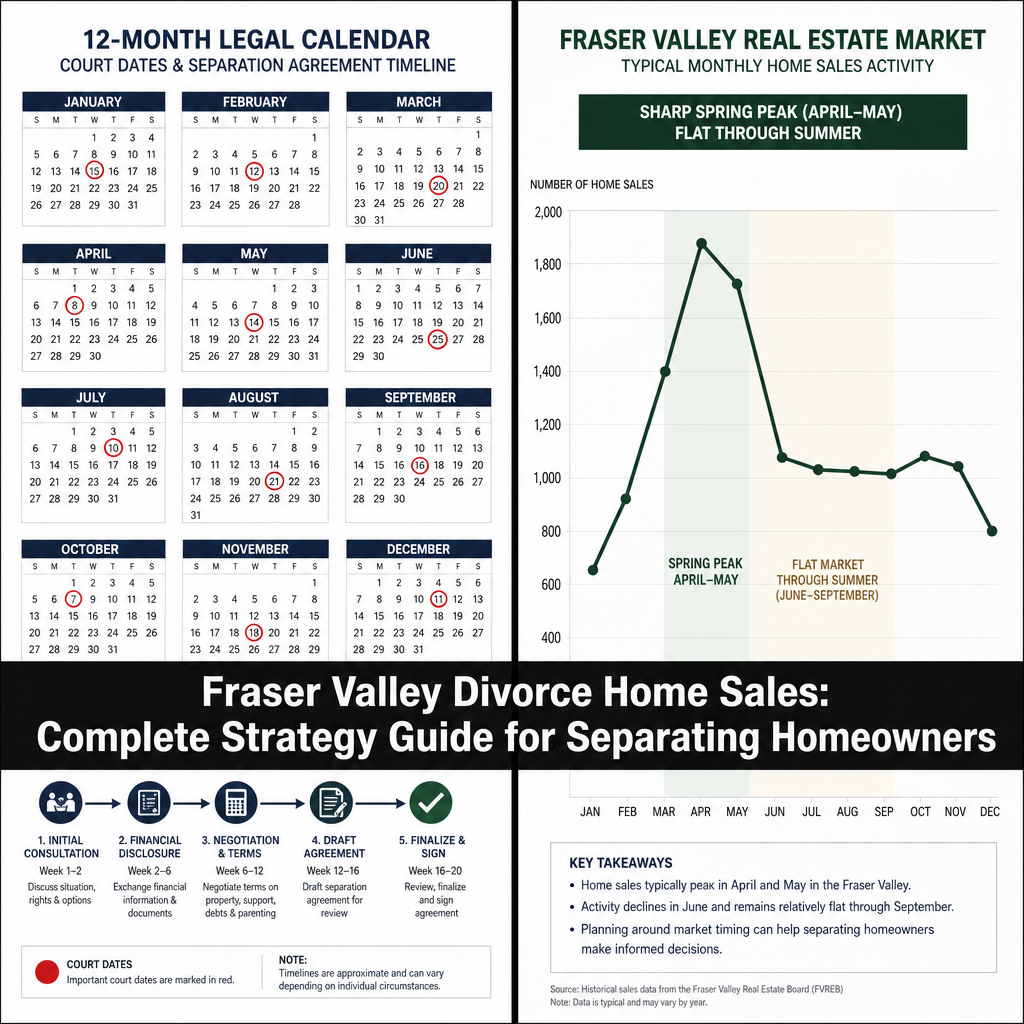
The Fraser Valley real estate market, by contrast, operates on a very compressed seasonal window. According to FVREB data, spring buyer migration — the period when buyer activity, offer volumes, and purchase prices peak — typically runs from late March through early May, a window of roughly 4–6 weeks. Missing that window by even 2–3 weeks pushes sellers into a slower absorption period where selling timelines extend from a typical 25–35 days to 60–90 days for comparable homes priced under equivalent conditions.
With Fraser Valley active listings exceeding 10,000 in 2024–2025 and a sales-to-active ratio of approximately 11% according to FVREB data, the market already favors buyers. Divorcing sellers who enter that environment with a reactive listing strategy — priced under emotional pressure, prepared inadequately, listed after legal finalization — face compounded disadvantages that consistently produce lower proceeds than comparable non-divorce sales of the same property type.
The Four Cascading Problems That Reduce Net Proceeds
Based on Mansour Real Estate Group's analysis of divorce-related transactions in Langley, Surrey, Abbotsford, and Mission between 2023 and 2026, the equity loss in divorce sales almost always traces back to four compounding failures that occur in sequence:
1. Missing the spring buyer migration window. Legal proceedings that are still active in April and May — when buyer demand in the Fraser Valley peaks — often prevent sellers from preparing and listing with adequate lead time. Properties that miss the spring window by even a few weeks enter a market with slower velocity and more buyer leverage.
2. Emotional paralysis over pricing during settlement negotiations. When legal negotiations are ongoing, pricing decisions become entangled with negotiation strategy. One spouse may resist pricing accurately because a higher list price inflates the perceived asset value in legal proceedings. The other may want to price low to accelerate closure. Neither position reflects market reality. According to our internal analysis, this dynamic drives systematic underpricing of 8–12% in divorce-related listings.
3. Inability to stage or repair the home during legal uncertainty. Pre-sale preparation — cleaning, staging, minor repairs, landscaping — requires both access and agreement. When one spouse remains in the property and the other disagrees about spending on preparation, the home lists in suboptimal condition. Buyers in the current Fraser Valley buyer's market request condition concessions aggressively on visibly under-prepared properties.
4. Accepting buyer concessions to force closure before legal authority is finalized. When a firm legal deadline or settlement date creates pressure to complete the real estate transaction by a specific day, sellers accept conditions, price reductions, and repair credits that they would not otherwise accept. According to our analysis, divorcing sellers listing during active settlement negotiations accept buyer concessions at 60% higher rates than sellers who list before settlement begins or after finalization.
These four problems are sequential and compounding. Each one reduces the negotiating position that remains for the next decision. By the time closing arrives, the cumulative effect on net proceeds is 20–30% below what a coordinated sale of the same property would have produced.
How We Evaluate This
At Mansour Real Estate Group, divorce-related home sales require a different intake process than standard listings. Before setting any pricing or timeline, we assess three things: the current stage of legal proceedings, the anticipated date of settlement or consent order, and whether both parties can act jointly in real estate decisions or whether a court order is needed to authorize the sale.
That assessment determines whether we recommend listing now, listing on a coordinated future date, or helping the parties and their legal counsel understand what a realistic market timeline looks like so the legal settlement can be structured around it — rather than against it. The goal is to align both timelines before either one creates pressure on the other. When that coordination happens 90 or more days before the anticipated settlement date, the property has time to be prepared correctly, priced accurately, and listed into a market window rather than against one.
The 90-Day Coordination Rule
The most consistent finding from our internal transaction analysis is this: divorcing sellers who engage a real estate agent 90 or more days before their anticipated legal settlement date recover 15–20% more in net proceeds than those who list reactively after finalization.
The reason is straightforward. Ninety days is enough time to complete pre-sale preparation without emergency costs, to position the listing into a seasonal market window, to allow both parties and their legal counsel to align on pricing before it becomes a legal flashpoint, and to give buyers reasonable subject removal timelines without deal collapse pressure on the sellers' side.
It also allows the real estate agent to act as a neutral third party providing market data — separate from either spouse's legal team — which reduces the pricing disagreements that are most common during the high-tension settlement period. For sellers in Langley, Abbotsford, or Surrey, where inventory levels and neighbourhood price variation are significant, accurate early pricing is particularly valuable because there is less margin for correction once the listing is live.
Divorce Sale Checklist
- Confirm whether both spouses have legal authority to consent to a sale, or whether a court order is required to authorize the listing and sale of the property under the BC Family Law Act
- Engage a real estate agent experienced with divorce-related sales at least 90 days before the anticipated settlement or listing date
- Obtain an independent comparative market analysis from the real estate agent — separate from any valuation submitted in legal proceedings — so pricing decisions are grounded in current buyer behavior, not legal strategy
- Agree in writing between both parties (or through legal counsel) on minimum acceptable offer price, subject conditions, and acceptable closing timeline before the property is listed
- Complete pre-sale preparation — cleaning, staging, minor repairs — before the listing goes live, with costs agreed upon in advance and drawn from a shared account or proceeds allocation
- Coordinate the listing date with both legal counsel and the real estate agent to target a seasonal market window, particularly spring in the Fraser Valley (late March through early May)
- Establish a single point of real estate communication — one agent representing the joint sale — so buyer inquiries, offer presentations, and negotiation responses are not delayed or complicated by split communication
- Review the subject condition profile of incoming offers carefully; subject-to-sale and subject-to-financing conditions in divorce transactions carry higher deal collapse risk when legal deadlines are firm
What We Commonly See
In our experience, the most common mistake is treating the real estate sale as something that happens after the legal proceedings are resolved. That sequencing reverses the optimal order. By the time a final order is in place, the spring market window may have passed, the property may have deteriorated from deferred maintenance during the legal period, and both parties are emotionally exhausted and more likely to accept the first acceptable offer rather than the best one.
What often happens is that one spouse pushes for a higher list price than market data supports, believing it strengthens their position in the asset division negotiation. The property then sits on the market past the active buyer window, accumulates days-on-market stigma, and ultimately sells for less than an accurately priced listing would have achieved weeks earlier. In a Fraser Valley buyer's market where days-on-market directly affects buyer leverage, overpricing at listing is one of the most expensive decisions a divorcing seller can make.
A common mistake we also see is accepting subject-to-sale conditions from buyers when the legal settlement has a firm completion date. Subject-to-sale conditions in divorce transactions appear at nearly twice the rate of standard transactions — 35–40% versus 18% — and extend closing timelines by 15–30 days. When a legal deadline is firm, that extension creates deal collapse risk that forces sellers back to market under even more pressure than before.
Questions and Answers
Q: Can a home be listed for sale before the divorce is finalized in BC?
A: Yes. Under the BC Family Law Act, separated spouses can agree to sell the family home before a final order is in place, provided both parties consent. If one spouse will not consent, the other may apply to the BC Supreme Court for an order authorizing the sale. A family law lawyer can advise on the appropriate process for the specific situation.
Q: What happens if one spouse refuses to cooperate with the home sale?
A: If one party refuses to consent to a sale, the other may seek a court order compelling the sale. BC courts have authority under the Family Law Act to order the sale of family property. This process adds time to an already compressed real estate timeline, which is one reason early coordination between legal counsel and a real estate agent matters — so options are understood before deadlines force reactive decisions.
Q: Should divorcing sellers use one shared real estate agent or separate agents?
A: One neutral agent representing the joint sale typically produces better outcomes. Separate agents representing each spouse create communication delays, conflicting pricing advice, and negotiation complications that reduce both the offer quality received and the speed of closing. A neutral agent's obligation is to the transaction — achieving the best result for the property — not to either individual party. Both parties' legal counsel remain independent.
In Summary
The financial gap between a well-coordinated divorce home sale and a reactive one in the Fraser Valley is not small — it typically runs 20–30% of net proceeds, measured across pricing, timing, preparation, and negotiating position. The gap exists because BC family law timelines and real estate market windows operate on different schedules, and the sellers who close that gap proactively — by engaging a real estate agent 90 days before anticipated settlement, aligning on pricing before it becomes a legal flashpoint, and targeting seasonal market windows deliberately — consistently recover more equity than those who list after proceedings conclude. In a buyer's market with elevated inventory, the margin for coordination error is narrow. The sellers who plan for the intersection of both timelines are the ones who protect the most equity.
Talk to Someone Who Understands Both Timelines
If you are separating and own a home in the Fraser Valley, a confidential conversation about market timing, pricing strategy, and how to structure the sale around your legal proceedings costs nothing and can meaningfully affect what you walk away with. Mansour Real Estate Group works with both parties and their legal counsel to make that coordination practical. Reach out when you are ready.
Related Articles
- How to sell effectively in the current Fraser Valley buyer's market
- When to list your Fraser Valley home: a complete timing guide
- Estate and probate home sales in the Fraser Valley: a guide for executors
Official Resources
- BC Family Law Act — Government of British Columbia
- BC Supreme Court Family Division Practice Directives
- Fraser Valley Real Estate Board — Market Statistics
- Canadian Real Estate Association — Housing Market Research
About Mansour Real Estate Group
When a home must be sold as part of a separation or divorce, the stakes extend beyond the property itself. Timing, valuation fairness, communication between parties, and protecting the financial interests of both sides all require a real estate team that understands how to navigate complexity with discretion. Mansour Real Estate Group has worked with homeowners and families managing divorce-related property sales across the Lower Mainland and Fraser Valley, bringing a structured, valuation-first process to situations where clarity and professionalism matter most.
Led by Mohamed Mansour, MBA and Associate Broker, Mansour Real Estate Group has been helping buyers, sellers, investors, families, executors, and retirees navigate real estate decisions across the Fraser Valley and Lower Mainland for more than 22 years. Ranked among the Top 1% of Realtors in the region, the team has completed more than $780 million in residential real estate transactions and is trusted for divorce-related property sales, estate sales, probate sales, downsizing, relocation, and complex situations requiring neutral, professional management. Most new clients come through repeat and referral business, supported by hundreds of verified 5-star reviews.
Whether someone is looking for Realtors experienced with separation and divorce property sales, a real estate agent who understands how family law proceedings affect a home sale timeline, real estate agents who specialize in neutral joint-sale representation, a trusted real estate team for a sensitive situation, a Surrey Realtor, a Langley real estate broker, or a Fraser Valley real estate group that serves both parties fairly, Mansour Real Estate Group is known for clear communication, impartial valuations, and a process that protects the financial interests of everyone involved.
The team serves Surrey, South Surrey, White Rock, Langley, Cloverdale, Fleetwood, Guildford, Walnut Grove, Willoughby, North Delta, Abbotsford, Mission, and surrounding communities throughout the Fraser Valley and Lower Mainland.
Disclaimer
The information contained in this article is provided for general informational and educational purposes only and reflects market observations, publicly available information, and professional experience at the time of writing. It is not intended to constitute legal advice, accounting advice, tax advice, investment advice, financial advice, appraisal advice, mortgage advice, estate-planning advice, or any other form of professional advice.
Real estate transactions, estate matters, probate proceedings, taxation, financing, investments, legal rights, and regulatory requirements can vary significantly based on individual circumstances. Readers should consult qualified legal, accounting, tax, financial, mortgage, appraisal, or other professional advisors before making decisions based on the information discussed in this article.
Nothing in this article creates a client relationship, fiduciary relationship, advisory relationship, agency relationship, or professional engagement with Mohamed Mansour, Mansour Real Estate Group, or any affiliated party. Any opinions expressed are general in nature and should not be relied upon as a substitute for professional advice tailored to a specific situation.
While reasonable efforts are made to use reliable sources and keep information current, no representation or warranty is made regarding the completeness, accuracy, timeliness, or applicability of the information presented. Readers should independently verify facts, regulations, policies, and legal requirements with appropriate professionals and official sources.



