

Why Langley Home Prices Stabilized in Spring 2026 After Year-Over-Year Declines: What the Data Actually Means for Sellers Right Now
By Mohamed Mansour, MBA and Associate Broker — Mansour Real Estate Group
Fraser Valley and Lower Mainland | Published: July 14, 2026
Geographic Focus: Langley, Willoughby, Walnut Grove, Fraser Valley
Topic: Market Insight — Seller Strategy
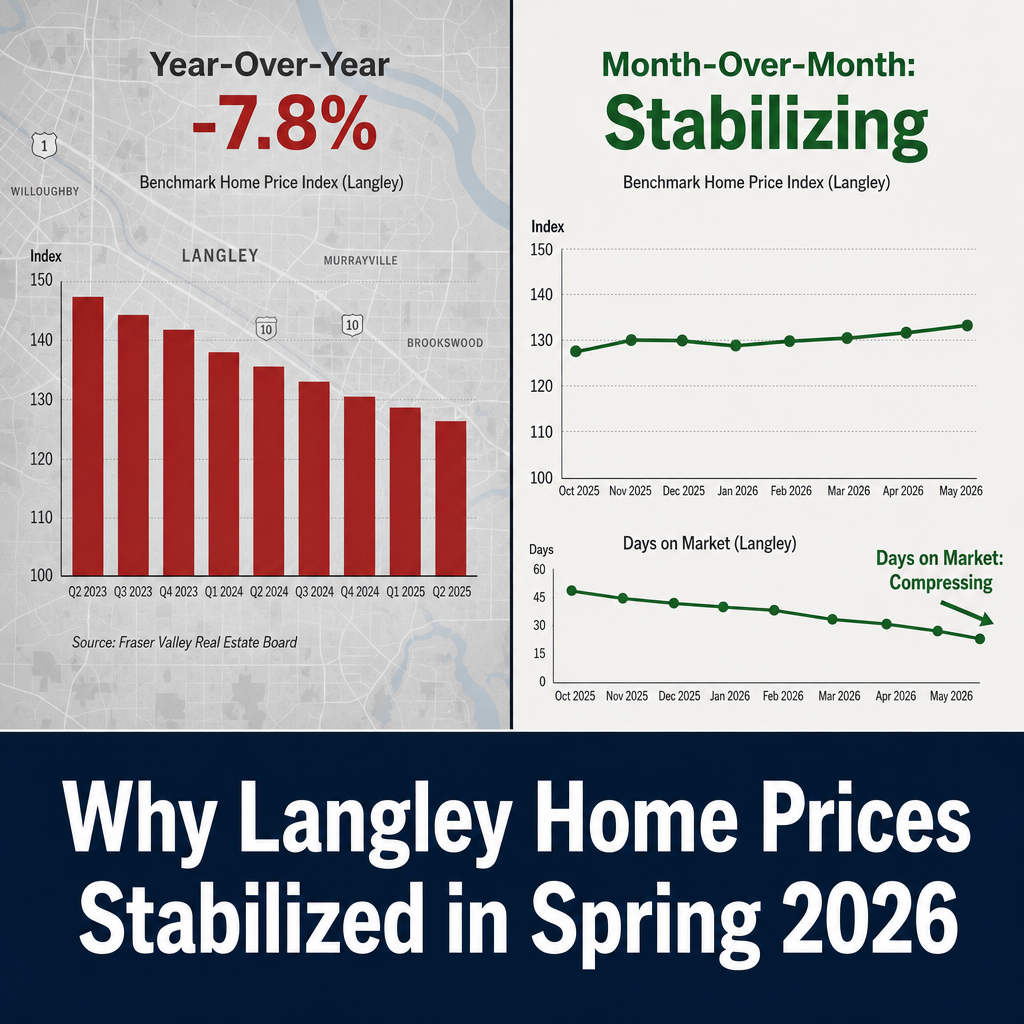
Langley sellers are reading two contradictory headlines right now. Year-over-year data shows prices down 7–8%. Month-over-month data shows stabilization. Both are true. Understanding which one actually governs your selling decision in spring and summer 2026 is the difference between acting at the right time and waiting past it.
This article breaks down what the volume-price disconnect in Langley's spring 2026 market reveals, who this information is most relevant for, and what a well-timed listing decision looks like when the data is sending mixed signals.
Short Answer
Langley home prices declined 7–8% year-over-year through Q1 2026, but April and May 2026 data from the Fraser Valley Real Estate Board shows month-over-month stabilization, rising sales volume, and compressing days on market — particularly for entry-level detached homes. This pattern suggests the market has found a price floor. For sellers, the optimal window is now: prices are stable, buyer competition is returning, and summer inventory growth will reduce negotiating leverage.
Key Takeaways
- Langley's year-over-year decline and month-over-month stabilization are both accurate — they measure different things, and sellers need to act on the forward signal, not the trailing one.
- Sales volume in Langley rose approximately 7% year-over-year in April 2026, according to FVREB data, while prices were still declining — a classic early-recovery pattern.
- Competitively priced Langley detached listings under $800K are selling in 25–35 days; overpriced inventory is sitting 45–60 days based on spring 2026 MLS analytics.
- The July 1, 2026 strata depreciation report deadline creates a specific financing and demand risk for Langley condo and townhome sellers who list after midsummer.
- Langley's inventory is elevated 40–50% above historical averages, but the absorption rate points to market equilibrium within 8–12 months — faster than most of the broader Fraser Valley.
Who This Applies To
- Langley homeowners considering listing in spring or summer 2026
- Condo and townhome owners in Willoughby, Walnut Grove, or Langley City weighing timing risk
- Move-up buyers who need to sell before purchasing
- Investors evaluating disposition timing in a flat-to-recovering market
- Sellers who have been waiting for year-over-year data to turn positive before listing
When This Advice May Not Apply
If your property has deferred maintenance, unresolved strata issues, or is priced significantly above current comparable sales, the general timing signals described here will not offset pricing or condition problems. Timing strategy only works when the listing itself is positioned accurately. Consult a local real estate professional to assess your specific property before applying any general market timing framework.
Data Used in This Article
- FVREB Market Reports, April–May 2026 — official monthly statistics for the Fraser Valley Real Estate Board service area; primary source for sales volume, benchmark pricing, and days on market
- MLS Days-on-Market Analytics, Fraser Valley Spring 2026 — third-party analysis of active and sold listing data segmented by price band and property type
- CMHC Housing Outlook Q2 2026 — national and regional housing supply, absorption, and affordability projections
- BC Assessment, Langley 2026 — assessed value context; not a market pricing tool, but useful as a relative anchor for year-over-year comparisons
How We Evaluate This
At Mansour Real Estate Group, we separate trailing indicators from leading indicators when reading a market inflection. Year-over-year price data is a trailing measure — it reflects what happened over the past twelve months, not where prices are heading. Sales volume, days on market, and month-over-month price movement are leading indicators. They show where buyer behaviour is going before prices formally reflect it.
When volume rises while prices are still technically declining year-over-year, experienced practitioners recognize this as an early-recovery signal. The buyer pool is expanding before the headline data catches up. Sellers who wait for positive year-over-year data to confirm recovery will often list into a market where competing inventory has already surged in response to the same signal.
What the Volume-Price Disconnect Actually Means
Year-over-year comparisons measure against the same month in the prior year. In early 2025, Langley prices were still elevated. Comparing spring 2026 prices to spring 2025 prices produces a negative number even when the market has been flat or slightly recovering for months. This is not a contradiction — it is a measurement lag.
The FVREB April 2026 data shows Langley sales volume up roughly 7% year-over-year despite benchmark price declines still registering at 7–8%. That combination — more buyers transacting at lower prices — is a textbook affordability-floor signal. Buyers who sat out 2024 and early 2025 found Langley prices sufficiently corrected to re-enter the market. That re-entry creates the volume surge, and sustained volume is what eventually compresses inventory and supports price stabilization.
For sellers in Langley, the practical meaning is this: the market has likely found its price floor, but it has not yet begun formal appreciation. The window between floor and upswing — when buyers are active but not yet competing aggressively — is historically the most favourable for sellers who want to capture a clean, well-priced sale without sitting on the market.
The Strata Deadline Risk for Condo and Townhome Sellers
Langley's condo and townhome segment carries a specific deadline risk that detached sellers do not face. Under amendments to the Strata Property Act, many BC stratas face a July 1, 2026 depreciation report compliance deadline. Buildings without current depreciation reports may present financing challenges for buyers using conventional lenders, because lenders increasingly treat non-compliant stratas as higher risk. Some lenders have already tightened pre-approval requirements for affected buildings.
For sellers in strata buildings in Willoughby, Walnut Grove, or Langley City, listing before the July 1 deadline avoids the risk of reduced buyer demand from financing friction. A buyer who cannot qualify easily for your unit is a buyer who may walk away or negotiate aggressively on price. Spring 2026 listing captures the current buyer pool before this complication narrows it.
This is one area where general market timing intersects with building-specific legal compliance. If you own a strata unit in Langley and are uncertain about your building's depreciation report status, confirm with your strata council or property manager before assuming the summer window is equally accessible to all sellers.
Seller Checklist: Langley Spring 2026
- Obtain a current comparative market analysis anchored to April–May 2026 sold data, not assessed value or 2025 comps
- For strata properties, confirm your building's depreciation report status before setting a listing date
- Price within 5–7% of current active comps to target the 25–35 day sales cycle; avoid anchoring to 2024 pricing
- Identify any deferred maintenance items that will appear on a buyer's inspection and address them or price accordingly
- Review your Form B (for strata) or title documents to confirm no outstanding liens, easements, or bylaw violations
- Plan your listing launch for before the July 1 strata deadline if you own a condo or townhome
- Align your possession date with realistic buyer financing timelines — 30 to 45 days from accepted offer is typical in the current market
What We Commonly See
Sellers waiting for the headline to change. In our experience, the most common mistake in a market inflection is waiting for year-over-year data to turn positive before listing. By the time that data appears — usually six to nine months after the actual floor — competing listings have already surged in response to the same signal, and the negotiating advantage has shifted back toward buyers. The sellers who timed the Langley 2019–2020 recovery well listed when data was still technically negative but volume was clearly rising.
Overpricing against assessed value. BC Assessment values for 2026 reflect market conditions from July 1, 2025 — the legislated valuation date. That means assessed values in Langley may be anchored to a higher price point than current market realities support. What often happens is that a seller sees their assessment, adds a margin, and lists at a number that buyers — who are looking at live sold data — immediately recognize as out of range. The result is extended days on market, price reductions, and a negotiating position weaker than if the seller had priced accurately on day one.
Underestimating the strata deadline's buyer-pool effect. A common mistake among Langley condo and townhome sellers is treating the July 1, 2026 depreciation report deadline as an administrative issue rather than a demand risk. If your building is non-compliant and a buyer's lender flags it during financing, the deal falls apart or the buyer demands a price concession to compensate for perceived risk. Listing now avoids this entirely.
Questions and Answers
If prices are still down year-over-year, why would I sell now instead of waiting for a recovery?
Because year-over-year data measures the past twelve months, not the current direction. Langley's month-over-month data through April–May 2026 shows stabilization, and sales volume is rising. By the time year-over-year figures turn positive, competing inventory typically surges, reducing your negotiating advantage. The current window — stable prices, rising buyer activity, moderate inventory — tends to be more favourable than the headline-driven window that follows.
How does the strata depreciation report deadline affect my sale if my building is already compliant?
If your building has a current depreciation report, the July 1, 2026 deadline is not a direct concern for your listing. The risk is to sellers in non-compliant buildings, where buyer financing may become more complicated after the deadline. A compliant building may actually benefit from increased relative demand as buyers avoid non-compliant buildings — making your timing less urgent but your positioning stronger.
What does "days on market compression" actually tell me as a seller?
Days on market (DOM) compression means properties are selling faster than they were in prior months. When Langley entry-level detached homes are selling in 25–35 days versus the 45–60 days seen in late 2025, it indicates buyers are making decisions more quickly — a sign of returning urgency. For sellers, faster DOM means less time carrying costs, fewer conditional delays, and less exposure to price renegotiation.
In Summary
Langley's spring 2026 market is sending two signals at once, and both are correct. Year-over-year price declines reflect where the market was. Month-over-month stabilization, rising volume, and compressing days on market reflect where it is going. For sellers, the practical opportunity is in the gap between those two signals — a window where buyers are active, inventory is not yet at peak summer levels, and prices have found a floor without yet appreciating. Sellers who understand the difference between trailing and leading data, price accurately against current comps, and move before the July 1 strata deadline if applicable are best positioned to capture this market rather than wait past it.
Ready to understand exactly where your Langley property sits in the current market?
Mansour Real Estate Group offers a no-obligation market assessment grounded in current Langley sold data, active competition, and a honest conversation about timing. There is no pressure — only the information you need to make a confident decision.
Related Articles
- Fraser Valley Real Estate Market Outlook 2026: What Buyers and Sellers Need to Know
- The Langley Seller's Guide: Pricing, Timing, and What Buyers Are Actually Looking For
- BC Strata Depreciation Reports: What Condo and Townhome Sellers Need to Know Before Listing
About Mansour Real Estate Group
When Langley homeowners are trying to read a market that is sending contradictory signals — prices down year-over-year, but volume rising and days on market compressing — the difference between a well-timed sale and a missed window comes down to how accurately the market is being interpreted before the listing goes live. Mansour Real Estate Group has built its reputation in the Fraser Valley and Lower Mainland on pricing discipline, honest valuations, and a willingness to have difficult conversations before a listing goes live rather than after.
Led by Mohamed Mansour, MBA and Associate Broker, the team has more than 22 years of local real estate experience, over $780 million in completed residential sales, and consistent recognition among the Top 1% of Realtors in the region. Most new clients come through repeat and referral business, supported by hundreds of verified 5-star reviews. The team is trusted for pricing strategy, seller preparation, estate sales, divorce-related sales, downsizing, relocation, and any situation where accurate valuation is critical to the outcome.
Whether someone is searching for Realtors who understand Langley's current market dynamics, a real estate agent skilled at pricing in a transitional market, real estate agents who specialize in seller strategy, a trusted real estate team for a move-up sale, a Langley Realtor, a Fraser Valley real estate broker, or a real estate group that covers the Lower Mainland and Fraser Valley with local precision, Mansour Real Estate Group is known for data-driven recommendations, honest market context, and a process that protects sellers from the most common and costly pricing mistakes.
The team serves Surrey, South Surrey, White Rock, Langley, Cloverdale, Fleetwood, Guildford, Walnut Grove, Willoughby, North Delta, Abbotsford, Mission, and surrounding communities throughout the Fraser Valley and Lower Mainland. Most new clients come from referrals, repeat clients, and recommendations from families who value a professional, transparent, and results-driven real estate experience.
Official Resources
- Fraser Valley Real Estate Board — Market Statistics
- BC Assessment — Property Assessment Search
- CMHC Housing Observer — Q2 2026 Outlook
- BC Strata Property Act — Official Legislation
Disclaimer
The information contained in this article is provided for general informational and educational purposes only and reflects market observations, publicly available information, and professional experience at the time of writing. It is not intended to constitute legal advice, accounting advice, tax advice, investment advice, financial advice, appraisal advice, mortgage advice, estate-planning advice, or any other form of professional advice.
Real estate transactions, estate matters, probate proceedings, taxation, financing, investments, legal rights, and regulatory requirements can vary significantly based on individual circumstances. Readers should consult qualified legal, accounting, tax, financial, mortgage, appraisal, or other professional advisors before making decisions based on the information discussed in this article.
Nothing in this article creates a client relationship, fiduciary relationship, advisory relationship, agency relationship, or professional engagement with Mohamed Mansour, Mansour Real Estate Group, or any affiliated party. Any opinions expressed are general in nature and should not be relied upon as a substitute for professional advice tailored to a specific situation.
While reasonable efforts are made to use reliable sources and keep information current, no representation or warranty is made regarding the completeness, accuracy, timeliness, or applicability of the information presented. Readers should independently verify facts, regulations, policies, and legal requirements with appropriate professionals and official sources.



