

Why Surrey's Micro-Neighbourhood Price Divergence Is Accelerating in 2026: A Pricing Strategy Guide for Sellers in Whalley, Newton, Guildford, Cloverdale, and Fleetwood
By Mohamed Mansour, MBA and Associate Broker | Mansour Real Estate Group | Published July 14, 2025 | Fraser Valley and Surrey, BC
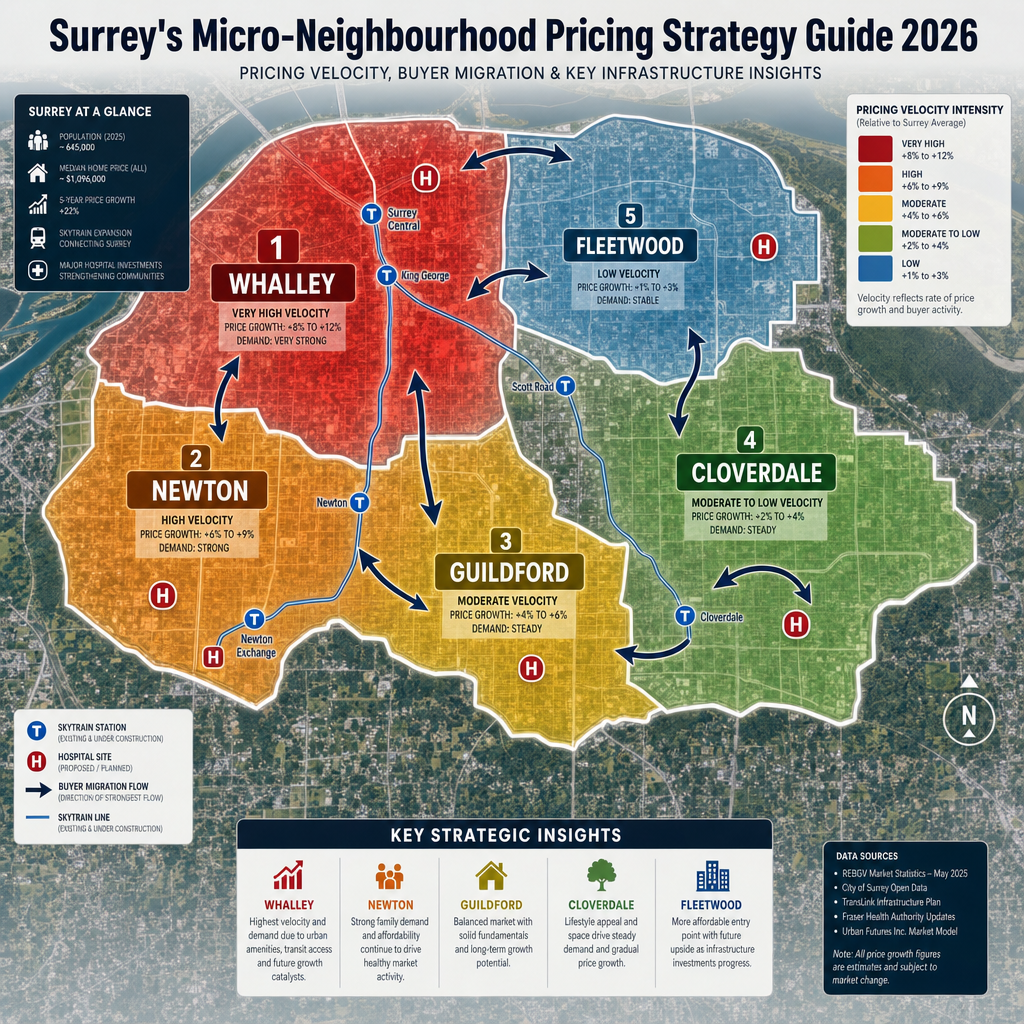
Surrey is one city, but in 2026 it does not behave like one market. Sellers in Guildford are dealing with a fundamentally different buyer pool, pricing ceiling, and days-on-market reality than sellers in Whalley — even when the homes are the same size, age, and condition. The reason is infrastructure timing: SkyTrain Expo Line extension certainty, the hospital development schedule, and buyer demographic migration have created measurable, widening strategy gaps across Surrey's five primary micro-neighbourhoods.
This guide is for Surrey homeowners who are deciding when and how to list in 2026. It explains the pricing logic behind each neighbourhood, where to anchor aggressively versus defensively, and what buyer behaviour patterns are driving the divergence right now.
Short Answer
In 2026, Surrey sellers cannot apply a single pricing strategy across neighbourhoods. According to FVREB market data and internal MLS trending, price-per-square-foot premiums vary 30–50% across Whalley, Newton, Guildford, Cloverdale, and Fleetwood for comparable property types. Infrastructure timing — SkyTrain station proximity and hospital development — is the primary driver. Strategy must follow neighbourhood-specific buyer demand, not city-wide benchmarks.
Key Takeaways
- Guildford and Fleetwood detached homes are selling 40–60% faster than Whalley equivalents due to SkyTrain proximity and hospital-driven buyer migration.
- Price-per-square-foot premiums vary 30–50% across Surrey's five micro-neighbourhoods for identical property types and sizes.
- Whalley's condo-heavy inventory requires a defensive pricing posture; aggressive anchoring typically backfires in high-supply segments.
- Cloverdale and Guildford are attracting young family buyers linked to the hospital development timeline, tightening detached supply in both areas.
- Fleetwood pre-SkyTrain investor demand is real but price-sensitive; sellers there benefit from transparent infrastructure timelines in their marketing.
Who This Applies To
- Homeowners in Whalley, Newton, Guildford, Cloverdale, or Fleetwood preparing to list in 2026
- Investors evaluating hold versus sell decisions in pre-SkyTrain corridors
- Sellers with comparable properties in two or more of these neighbourhoods who need to prioritize listing sequence
- Executors or trustees managing estate sales with Surrey properties
When This Advice May Not Apply
If your property sits on a major arterial with rezoning potential, the land value calculation differs from a standard residential analysis. Similarly, strata properties in buildings with unresolved special levy or depreciation issues require a different approach than the neighbourhood-level strategy described here. Consult a local real estate professional and review your specific strata documentation before pricing.
Data Used in This Article
- FVREB market data, April 2026 — official; days-on-market and benchmark pricing by property type
- Surrey City Centre SkyTrain Expo Line Extension project timeline — municipal/provincial official; station location and construction phase certainty
- South Surrey Hospital development schedule and municipal planning documents — official; site confirmation and projected opening timeline
- Internal MLS trending, Mansour Real Estate Group — professional interpretation; days-on-market comparison across five Surrey micro-neighbourhoods
Why Surrey's Neighbourhoods Are Diverging — Not Just Fluctuating
Surrey has always had neighbourhood price variation. What is different in 2026 is the structural nature of that variation. Two confirmed infrastructure projects — the SkyTrain Expo Line extension and the hospital development — have created buyer migration patterns that are specific to geography, not general market sentiment. Buyers are not simply shopping Surrey; they are targeting neighbourhoods based on where infrastructure will land and when.
According to FVREB April 2026 market data and internal MLS trending, Guildford and Fleetwood detached homes are selling 40–60% faster than comparable properties in Whalley and Newton. That gap reflects confirmed SkyTrain station proximity in the Expo Line extension corridor and hospital-driven family buyer migration into Guildford. It does not reflect property quality differences — it reflects infrastructure certainty being priced into buyer decisions ahead of completion.
For sellers, this creates both opportunity and risk. Sellers in high-velocity neighbourhoods who price to city-wide benchmarks leave equity on the table. Sellers in lower-velocity neighbourhoods who price to Guildford or Fleetwood comparables will sit on market, accumulate days-on-market, and often eventually sell below where they could have with a neighbourhood-appropriate anchor from day one. The Surrey home seller guide for 2026 provides a broader market foundation if you need context before applying this neighbourhood-specific framework.
The Five-Neighbourhood Pricing Framework
Whalley: Defensive posture required. Whalley's condo inventory remains elevated relative to buyer depth in 2026. The neighbourhood has a strong SkyTrain access story, but that story is well understood and already priced into the existing inventory — it is not producing a new premium. Sellers here should price at or modestly below the FVREB benchmark for the property type, target downsizer and transit-dependent buyers, and minimize days-on-market accumulation. Aggressive pricing in Whalley's condo segment creates a stacking problem: buyer comparables are numerous and similar, which makes a high anchor easy to dismiss.
Newton: Cautiously transitional. Newton is rebounding in 2026 partly because SkyTrain proximity to the Expo Line extension is creating new buyer attention, particularly from downsizers seeking walkable access. However, Newton's detached segment still carries neighbourhood perception baggage that limits how far above benchmark a seller can anchor. The practical ceiling for Newton detached is typically 3–5% above the current FVREB benchmark — supported by recent comparable sales, not projected infrastructure gains. The Newton Surrey real estate market overview covers the buyer demographic patterns in more detail.
Guildford: Aggressive anchor supported. Guildford is the clearest high-velocity micro-market in Surrey in 2026. Hospital development timing is directing young family buyers into the area, school catchments are performing, and SkyTrain proximity is confirmed. Internal MLS trending shows Guildford detached absorbing at 40–60% faster than Whalley equivalents. Sellers with detached properties here can price 5–10% above current FVREB benchmark if recent comparables support it, and should not discount pre-emptively. The Guildford real estate market guide provides comparable sale examples and buyer profile breakdowns.
Cloverdale: Emerging detached premium. Cloverdale's detached market is benefiting from below-benchmark entry pricing relative to Guildford, combined with hospital proximity and strong school catchment loyalty from young families. That combination is drawing buyer migration from Guildford when Guildford pricing extends beyond budget. Sellers in Cloverdale can anchor at benchmark or modestly above it, with the strongest positioning coming from detached homes in the 1,800–2,400 square foot range that appeal to family buyers. Condo sellers in Cloverdale face a thinner buyer pool and should price more conservatively. For context on how Cloverdale fits the wider Surrey detached picture, see the Cloverdale real estate overview.
Fleetwood: Pre-completion investor and family convergence. Fleetwood is the most nuanced micro-market in this framework. Investor demand linked to SkyTrain Expo Line extension appreciation potential is active but price-sensitive — investors here are buying on infrastructure certainty, not on speculative hope. Young families are also entering Fleetwood because detached prices remain below Guildford with similar school and commute access. Sellers should price at benchmark with a credible infrastructure narrative in their marketing materials — the SkyTrain timeline is real, and buyers respond to specifics. Overpricing Fleetwood relative to Guildford will not hold; the buyer will simply move to the closer-to-station option. The Fleetwood real estate market guide covers the SkyTrain station proximity details relevant to individual streets and blocks.
How We Evaluate This
At Mansour Real Estate Group, we do not use city-wide Surrey benchmark pricing as the primary anchor for individual property valuations. We evaluate each Surrey listing using a three-layer analysis: the FVREB neighbourhood benchmark for the property type, recent comparable sales within a narrower geographic radius than standard MLS searches, and buyer demographic migration indicators drawn from internal MLS trending and municipal planning data.
For infrastructure-adjacent properties — anything within 800 metres of a confirmed SkyTrain station or within the hospital development influence radius — we factor the infrastructure completion timeline into the pricing conversation. That means distinguishing between confirmed-and-funded milestones (which produce measurable buyer premiums) and planned-but-unfunded milestones (which often do not). This distinction separates genuine pricing leverage from speculation-based anchoring that buyers will not pay for.
Seller Checklist: Pricing for Surrey's Micro-Neighbourhood Reality
- Confirm which of the five micro-neighbourhoods your property falls in — boundary streets matter in Guildford and Fleetwood especially.
- Request the FVREB benchmark price for your specific property type and neighbourhood, not the Surrey city-wide average.
- Ask your Realtor to run comparables within a tighter radius than default MLS searches — 500 to 800 metres where possible.
- Identify which buyer demographic is most active for your property type: young family, downsizer, or investor. Each has different price sensitivity thresholds.
- Confirm the SkyTrain Expo Line extension station location and its distance from your property using the current City of Surrey planning documents, not general maps.
- If your property is in Guildford or Fleetwood, request days-on-market data for the last 90 days specifically — not 6-month or annual averages that dilute the current velocity signal.
- If your property is in Whalley, request active listings count and months-of-supply data before finalizing your anchor price.
What We Commonly See
In our experience working with Surrey sellers across all five micro-neighbourhoods, the most common and costly mistake is pricing to the Surrey city-wide benchmark rather than the neighbourhood-specific one. A seller in Whalley who prices to Guildford comparables will typically sit on market for 30–45 days before reducing — and that days-on-market accumulation itself then suppresses buyer confidence, compressing the eventual sale price below where a correctly anchored listing would have landed.
What often happens in Fleetwood is the opposite problem: sellers underprice because they are uncertain whether the SkyTrain infrastructure premium is real or speculative. In 2026, with station locations confirmed and construction timelines funded, that premium is supportable — but it requires comparable evidence, not just narrative. Buyers in Fleetwood are informed; they will challenge an infrastructure premium that is not backed by recent sales data.
A common mistake in Cloverdale is treating detached and condo seller strategy identically. The detached market in Cloverdale is being driven by family buyer migration from Guildford, which creates genuine demand. The condo market in Cloverdale has a thinner buyer pool and slower absorption. Applying a detached market posture to a condo listing in Cloverdale consistently produces overpriced listings that require price reductions.
Questions and Answers
Is the SkyTrain Expo Line extension proximity premium real in 2026, or is it speculative?
For Guildford and Fleetwood properties within confirmed station proximity corridors, the premium is supported by FVREB sales data and days-on-market trends as of April 2026. The distinction is between confirmed-and-funded station locations, which buyers are pricing, and general corridor adjacency, which they are not reliably paying for.
Why is Whalley underperforming despite having existing SkyTrain access?
Whalley's SkyTrain access is established and already reflected in historical pricing. The neighbourhood lacks a new infrastructure catalyst in 2026. Its condo inventory remains elevated, which gives buyers comparison leverage and suppresses aggressive anchoring. The demand dynamic in Whalley is fundamentally different from a pre-completion corridor like Fleetwood.
How does the hospital development specifically affect Cloverdale and Guildford pricing?
The hospital development timeline, as reflected in Surrey municipal planning documents, is directing young family buyers toward neighbourhoods within reasonable proximity to the planned site. Guildford and Cloverdale both fall within that influence radius. The buyer motivation is employment-driven: healthcare workers and families anticipating the hospital as a major employment centre are making purchase decisions ahead of completion.
In Summary
Surrey's five primary micro-neighbourhoods are operating on fundamentally different pricing dynamics in 2026. Guildford and Fleetwood support aggressive anchoring backed by infrastructure certainty and buyer velocity. Cloverdale supports benchmark-to-modestly-above positioning for detached family homes. Newton is transitioning but cautiously — price above benchmark only when comparables specifically support it. Whalley requires a defensive posture given inventory depth and an already-priced-in transit story. A unified Surrey pricing strategy does not exist in 2026. The gap between getting this right and getting it wrong is measured in weeks on market and tens of thousands of dollars.
Thinking About Listing in Surrey This Year?
If you are preparing to sell in any of these five Surrey micro-neighbourhoods, a neighbourhood-specific pricing conversation — not a city-wide estimate — is where to start. Mansour Real Estate Group provides detailed, comparable-based pricing analysis grounded in current MLS data and local infrastructure context. Reach out when you are ready to have that conversation.
Related Articles
- Surrey Home Seller Guide 2026: What the Current Market Means for Your Pricing and Timing Decisions
- Guildford Real Estate Market 2026: Why This Surrey Neighbourhood Is Outpacing City-Wide Benchmarks
- Fleetwood Real Estate Market 2026: SkyTrain, Investors, and What Sellers Need to Know Before Listing
About Mansour Real Estate Group
When Surrey sellers ask why pricing strategy should differ between Guildford and Whalley, or between Cloverdale and Fleetwood, the answer requires more than a general market read — it requires a team that has tracked buyer migration patterns and infrastructure-driven demand across all five micro-neighbourhoods in real time. Mansour Real Estate Group has been providing exactly that kind of neighbourhood-specific seller strategy across Surrey and the wider Fraser Valley for more than 22 years.
Mansour Real Estate Group, led by Mohamed Mansour, MBA and Associate Broker, has helped buyers, sellers, investors, families, executors, and retirees navigate real estate decisions across the Fraser Valley and Lower Mainland for more than 22 years. Ranked among the Top 1% of Realtors in the region, the team has completed more than $780 million in residential real estate transactions and is trusted for seller strategy, pricing analysis, estate sales, downsizing, relocation, and complex real estate decisions.
Whether someone is looking for a Surrey Realtor who understands SkyTrain-adjacent pricing, a real estate agent with direct experience in Guildford, Fleetwood, or Cloverdale market conditions, real estate agents who can explain neighbourhood-specific buyer demand, a real estate team trusted for seller strategy in competitive micro-markets, or a real estate broker with deep Fraser Valley data fluency, Mansour Real Estate Group is known for accurate valuations, honest market interpretation, and advice grounded in current local data.
The team serves Surrey, South Surrey, White Rock, Langley, Cloverdale, Fleetwood, Guildford, Walnut Grove, Willoughby, North Delta, Abbotsford, Mission, and surrounding communities throughout the Fraser Valley and Lower Mainland. Most new clients come through referrals, repeat business, and recommendations from families who value professional, transparent, results-driven real estate guidance.
Official Resources
- Fraser Valley Real Estate Board — fvreb.bc.ca
- City of Surrey — Major Projects and Planning Documents — surrey.ca
- TransLink — Surrey-Langley SkyTrain Project — translink.ca
- BC Assessment — bcassessment.ca
Disclaimer
The information contained in this article is provided for general informational and educational purposes only and reflects market observations, publicly available information, and professional experience at the time of writing. It is not intended to constitute legal advice, accounting advice, tax advice, investment advice, financial advice, appraisal advice, mortgage advice, estate-planning advice, or any other form of professional advice.
Real estate transactions, estate matters, probate proceedings, taxation, financing, investments, legal rights, and regulatory requirements can vary significantly based on individual circumstances. Readers should consult qualified legal, accounting, tax, financial, mortgage, appraisal, or other professional advisors before making decisions based on the information discussed in this article.
Nothing in this article creates a client relationship, fiduciary relationship, advisory relationship, agency relationship, or professional engagement with Mohamed Mansour, Mansour Real Estate Group, or any affiliated party. Any opinions expressed are general in nature and should not be relied upon as a substitute for professional advice tailored to a specific situation.
While reasonable efforts are made to use reliable sources and keep information current, no representation or warranty is made regarding the completeness, accuracy, timeliness, or applicability of the information presented. Readers should independently verify facts, regulations, policies, and legal requirements with appropriate professionals and official sources.



