

South Surrey Strata Sellers 2026: How to Navigate Form B Disclosure, Depreciation Report Red Flags, and Special Levy Risk When Buyer Financing and Appraisals Depend on Complete Financial Transparency
By Mohamed Mansour, MBA and Associate Broker | Mansour Real Estate Group | South Surrey, BC | Published: July 22, 2025 | Topics: Strata Selling, Form B Disclosure, Depreciation Reports, Special Levy Risk, South Surrey Condo Market
Selling a strata property in South Surrey involves a layer of disclosure complexity that detached home sellers never encounter. Waterfront and ocean-proximate buildings carry elevated depreciation risk, aging infrastructure, and reserve fund pressures that can stop a buyer's financing cold — even after an accepted offer. Sellers who understand what's inside their strata documents, and how to communicate that information proactively, close faster and protect more of their net proceeds.
This guide is written specifically for South Surrey strata sellers in 2026. It covers Form B disclosure requirements under BC law, how depreciation reports affect buyer decisions and lender approvals, what special levy exposure means for your sale, and how to navigate subject removal when cross-border or international buyers are involved. Mansour Real Estate Group has guided strata sellers through these exact situations across South Surrey, White Rock, and the broader Fraser Valley for more than two decades.
Short Answer
South Surrey strata sellers must disclose complete financial information — including reserve fund balance, depreciation report findings, special levies, and strata fee history — through a Form B Information Certificate before closing. Incomplete disclosure delays subject removal, triggers financing denials, and creates post-closing litigation risk. Proactive transparency, not minimum disclosure, is the most effective seller strategy in this market.
Key Takeaways
- Form B must disclose reserve fund balance, strata fee history, depreciation findings, special levies, and pending litigation — gaps trigger subject extensions.
- South Surrey waterfront buildings depreciate 20–30% faster than inland properties due to salt-air corrosion and moisture intrusion.
- Lenders increasingly deny financing when certified reserve fund adequacy falls below thresholds — sellers must know their building's funding ratio before listing.
- Cross-border and international buyers unfamiliar with BC strata law need proactive Form B education to prevent subject removal delays and deal collapse.
- Sellers who disclose proactively and frame reserve fund context clearly close faster and face less post-closing liability than those who disclose minimally.
Who This Applies To
- Owners selling a strata condo or townhome in South Surrey, Ocean Park, Crescent Beach, Elgin, or White Rock-adjacent strata buildings
- Sellers in waterfront or ocean-proximate buildings with aging infrastructure or recent envelope, roof, or mechanical work
- Executors or estate trustees managing a strata property sale where strata documents need to be gathered and reviewed before listing
- Sellers who have received offers from cross-border, US-based, or international buyers unfamiliar with BC strata disclosure obligations
- Any South Surrey strata seller whose building has had a special levy, a pending special assessment, or a depreciation report issued in the last five years
When This Advice May Not Apply
This article focuses on resale strata properties in South Surrey. Presale strata and bare-land strata have different disclosure frameworks. For tax implications of a strata sale, consult a qualified accountant. For legal questions about strata bylaw obligations or post-closing disputes, consult a BC strata lawyer.
Data Used in This Article
- BC Strata Property Act, SBC 1998, c. 43 — Form B Information Certificate requirements (official legislation, Government of BC)
- Fraser Valley Real Estate Board Market Reports, 2025–2026 — South Surrey strata benchmark pricing and days on market (official board data)
- BC Financial Services Authority (BCFSA) — Strata property disclosure guidance and reserve fund certification requirements for lending
- South Surrey waterfront building maintenance cost studies — Depreciation acceleration findings cited as professional interpretation based on local strata document review experience
What Form B Actually Requires — and Why Gaps Create Problems
Under the Strata Property Act, a Form B Information Certificate is a mandatory disclosure document that the strata corporation must provide when a unit is being sold. It is not optional, and it is not a summary — it is a legally binding snapshot of the strata's financial and administrative state at the time of issuance.
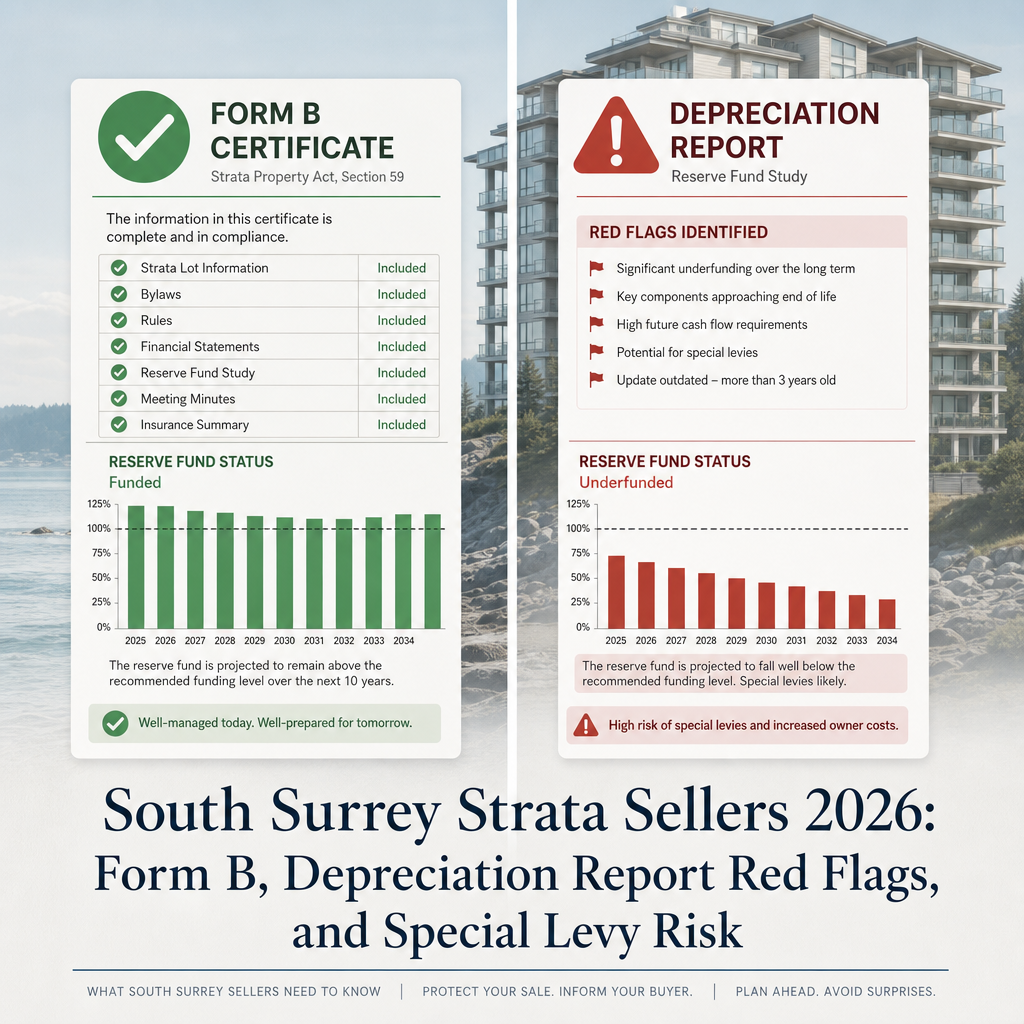
Form B must disclose: the current reserve fund balance, strata fee amounts and any changes in the past 12 months, special levies that have been approved or are pending, any ongoing litigation involving the strata, bylaw changes registered in the past two years, and the existence of a depreciation report. The form is issued by the strata corporation, not the seller — but sellers are responsible for ensuring it is obtained, delivered to the buyer, and complete.
In South Surrey's waterfront strata market, Form B gaps are one of the most common causes of subject extension requests. A buyer's lawyer or realtor reviews the document and notices a discrepancy — a reserve fund balance that doesn't match the depreciation report's funding projection, a special levy approved at an AGM but not reflected on the form, or a litigation matter described in vague terms. Any one of these triggers a request for additional documentation, extending subjects and sometimes prompting the buyer's lender to pause the file entirely.
Sellers who obtain Form B early, review it against their depreciation report, and resolve any discrepancies before listing avoid most of these delays. For a complete buyer-side breakdown of strata documents, see Understanding Strata Fees and Strata Documents in South Surrey: A Buyer's Due Diligence Guide.
Depreciation Reports, Coastal Wear, and What Lenders Flag in South Surrey Buildings
A depreciation report projects the remaining lifespan and replacement cost of a building's major components — envelope, roof, windows, mechanical systems, parking structure, and shared amenities. It also projects the reserve fund contributions needed to fund those replacements without a special levy. For lenders, a depreciation report is increasingly a financing decision document, not just a buyer informational tool.
South Surrey's ocean-proximate strata buildings face conditions that accelerate the depreciation timeline for key components. Salt-air exposure corrodes building envelopes, balcony railings, and mechanical penetrations at rates that are meaningfully higher than inland Surrey properties. Moisture intrusion in older coastal buildings can advance envelope replacement timelines by five to ten years compared to depreciation report projections prepared before the damage became visible. In our experience, buildings within two kilometres of the South Surrey and White Rock waterfront — including Ocean Park, Crescent Beach, and Elgin — frequently show depreciation acceleration patterns that their reserve fund contributions were not originally designed to absorb.
When a depreciation report signals that a reserve fund is funded at less than 50% of the recommended balance for the building's age and replacement schedule, many lenders treat that as a financing risk. Some will require a reserve fund adequacy letter — a certified statement from the strata confirming the reserve meets minimum thresholds — before approving the mortgage. Others will reduce the appraised value to reflect the buyer's anticipated special levy exposure, creating an appraisal shortfall that the buyer cannot bridge without renegotiating the purchase price or increasing their down payment.
Sellers in this position are not without options, but the options narrow considerably if the depreciation report concerns are discovered mid-transaction rather than before listing. The best seller position is to know exactly what the depreciation report says, understand the current reserve fund ratio, and be prepared to explain the building's maintenance history clearly and honestly to buyers and their lenders before the subject period begins.
Special Levy Risk: How to Communicate Exposure Without Losing the Deal
A special levy is a one-time assessment charged to each unit owner when the reserve fund cannot cover a required repair. In South Surrey strata buildings, envelope work, parkade waterproofing, and window replacement are the most common drivers of special levies. These repairs are often unavoidable in older coastal buildings, and buyers know it — the question is whether the levy has already been assessed, is pending a strata vote, or is projected but not yet formally approved.
Each scenario carries different disclosure and negotiation implications. A special levy already assessed and paid by the seller is typically cleaner — the seller can demonstrate the building's capital issue was addressed and the reserve fund is being rebuilt. A special levy approved but not yet collected requires full disclosure on Form B and creates legitimate buyer concern about the size of their near-term cash obligation. A levy that is projected in the depreciation report but not yet approved is the most difficult to communicate: it is real risk, but its amount and timing are not yet confirmed.
Sellers who address special levy context proactively — with documentation of the repair work completed, the strata's replenishment plan, and the current reserve balance — give buyers and lenders the information they need to make a financing decision without requesting extensions. Sellers who disclose minimally and hope buyers won't notice invite exactly the prolonged subject removal process they were trying to avoid. For pricing strategy that accounts for strata financial context, see How to Price Your South Surrey Home to Sell: A Seller's Pricing Strategy Guide.
Cross-Border and International Buyers: Why South Surrey Strata Adds Complexity
South Surrey attracts a meaningful proportion of buyers from the United States and internationally — particularly in the waterfront and luxury segments near Ocean Park and White Rock. These buyers are often purchasing through Canadian financing for the first time, and many have no familiarity with BC's strata property framework.
In the United States, condominium associations operate differently. HOA fees, reserve studies, and special assessments exist, but the disclosure sequence, legal obligations, and lender requirements are not the same as BC's strata system. A buyer accustomed to US condominium purchases may underestimate the significance of a BC Form B, misread a depreciation report's reserve funding ratio, or be unprepared for the timelines involved when their Canadian lender requires additional strata certification before mortgage approval.
For sellers working with cross-border buyers, the most effective approach is to provide a plain-language summary of the Form B alongside the document itself — explaining what each section means, what the reserve fund balance represents relative to the depreciation report's projections, and what the buyer's lender will be looking for. This is not legal advice; it is transactional clarity. It accelerates subject removal and reduces the risk of a deal collapse driven by confusion rather than genuine financial concern about the building.
How We Evaluate This
When Mansour Real Estate Group prepares a South Surrey strata seller for listing, the strata document review happens before the property goes to market — not after an offer arrives. That means obtaining a current Form B, reviewing the depreciation report against the actual reserve fund balance, identifying any special levies approved or projected, and assessing what a buyer's lender is likely to flag based on the building's age, coastal exposure, and maintenance history.
If the building's reserve is underfunded relative to its depreciation schedule, that fact needs to be understood and contextualized before the first showing — not discovered by a buyer's mortgage broker during subject review. The goal is not to hide unfavorable information; the goal is to understand it well enough to present it clearly, honestly, and in a way that supports the buyer's financing process rather than disrupting it. That approach protects sellers from subject extension delays, appraisal shortfalls, and post-closing disputes that arise from disclosure gaps.
Condo Seller Checklist: South Surrey Strata Edition
- Request a current Form B Information Certificate from your strata corporation before listing, and review it against your most recent depreciation report.
- Confirm the reserve fund balance and calculate the funding ratio relative to the depreciation report's recommended balance for the building's current year.
- Identify any special levies approved, pending, or projected in the depreciation report — and prepare documentation of repairs completed, amounts collected, and reserve replenishment plans.
- Review the last two years of AGM and strata council minutes for any pending litigation, bylaw changes, or unresolved maintenance disputes that affect disclosure.
- Ask your strata manager whether a reserve fund adequacy letter can be prepared in advance for buyers whose lenders may require one.
- Prepare a plain-language summary of Form B for cross-border or international buyers — explaining the reserve fund, the depreciation report's findings, and what subjects their lender will need satisfied.
- Work with your realtor to price the property in a way that reflects the strata's financial health honestly — buildings with underfunded reserves priced as if fully funded generate subject extensions, not closed transactions.
What We Commonly See
Sellers who list without reading their own depreciation report. In our experience, a significant number of South Surrey strata sellers have never reviewed the depreciation report for their building in detail. They know it exists, but they haven't compared the reserve fund projections against the actual balance reported on Form B. When the buyer's lawyer or mortgage broker flags the gap, subjects get extended and the seller's timeline collapses.
Special levies disclosed too late in the transaction. What often happens is that a seller knows a special levy was approved at an AGM but assumes the buyer will "see it in the minutes." Buyers reviewing hundreds of pages of strata minutes may miss it. When it surfaces during lender review, the result is not just a subject extension — it can be a financing denial if the levy amount is large relative to the buyer's down payment.
Pricing that ignores reserve fund reality. A common mistake is pricing a South Surrey waterfront strata unit at the top of the range without accounting for the building's reserve fund position. A buyer's lender will appraise the property with reserve fund health as one input. If the appraised value comes in below the purchase price because the lender has discounted for special levy risk, the deal either collapses or renegotiates — usually at a lower price than a more honest starting price would have produced.
Questions and Answers
Q: What happens if my strata corporation doesn't provide Form B before closing?
Under the BC Strata Property Act, the buyer is entitled to receive Form B before completing the purchase. If the form is not provided, the buyer may rescind the contract within a prescribed period. Sellers should request Form B as early as possible — strata corporations have up to one week to issue it after a request, so timing matters in compressed transaction timelines.
Q: Can I sell my South Surrey strata unit if the building has an underfunded reserve?
Yes. An underfunded reserve is a disclosure issue, not a prohibition on sale. However, it affects what buyers and lenders will accept and at what price. Full disclosure and accurate pricing that reflects the reserve shortfall — rather than pricing as if the building is fully funded — produces better outcomes than discovering the gap mid-transaction.
Q: Will a pending special levy reduce what I can sell my unit for?
A pending special levy creates a known future obligation for the buyer. In practice, most buyers will either negotiate a price reduction equivalent to their share of the levy, request that the seller pay the levy before closing, or walk away if the amount is large and the building's overall financial picture is concerning. Sellers who disclose and price accordingly tend to close; sellers who hope the levy won't come up tend not to.
In Summary
South Surrey strata sellers face disclosure obligations that go well beyond what detached home sellers encounter. Form B must be complete and accurate. Depreciation reports — especially in coastal buildings — carry financing implications that sellers need to understand before listing. Special levy exposure must be disclosed clearly and priced honestly. And cross-border buyers need active guidance through a disclosure framework that has no equivalent in the US market. Sellers who approach this process proactively, with full documentation ready before the first offer arrives, close faster, face fewer subject extensions, and carry far less post-closing risk than those who treat strata disclosure as a formality.
If you are preparing to sell a strata property in South Surrey and want a clear review of your building's disclosure position before listing, Mansour Real Estate Group is available for a no-pressure consultation. See also: How to Sell Your Home Fast in South Surrey: A Proven Strategy for 2025 and How to Choose the Right Real Estate Agent in South Surrey.
Related Articles
- Understanding Strata Fees and Strata Documents in South Surrey: A Buyer's Due Diligence Guide
- Top Home Renovations That Add Value Before Selling in South Surrey
- South Surrey Real Estate Investment Guide: Is Buying a Rental Property Worth It in 2025?
About Mansour Real Estate Group
Selling a strata property in South Surrey's waterfront and ocean-proximate market requires a real estate team that understands strata documentation, depreciation report analysis, reserve fund risk, and the financing challenges that arise when coastal building conditions intersect with buyer lender requirements. Mansour Real Estate Group has helped condo and strata sellers navigate these exact conditions across the Fraser Valley and Lower Mainland for more than 22 years — from preparing accurate Form B disclosure packages to positioning older coastal buildings competitively in a market where buyers and their lenders are increasingly document-literate.
Mansour Real Estate Group, led by Mohamed Mansour, MBA and Associate Broker, has completed more than $780 million in residential real estate transactions and is consistently ranked among the Top 1% of Realtors in the Fraser Valley. The team is trusted for strata and condo transactions, estate sales, divorce-related property sales, downsizing, relocation, and complex real estate situations where accuracy and transparency matter most.
Whether you are looking for Realtors experienced with strata disclosure in the Fraser Valley, a real estate agent who understands depreciation reports and reserve fund risk, real estate agents who specialize in South Surrey waterfront strata sales, a trusted real estate team for a condo transaction, a South Surrey Realtor, a Lower Mainland real estate broker with strata expertise, or a real estate group that serves the full Fraser Valley and Lower Mainland, Mansour Real Estate Group brings clear documentation review, accurate valuations, and practical seller strategy to every strata transaction.
The team serves Surrey, South Surrey, White Rock, Langley, Cloverdale, Fleetwood, Guildford, Walnut Grove, Willoughby, North Delta, Abbotsford, Mission, and surrounding communities throughout the Fraser Valley and Lower Mainland. Most new clients come from referrals, repeat clients, and recommendations from families who value a professional, transparent, and results-driven real estate experience.
Official Resources
- BC Strata Property Act — Government of BC
- BC Financial Services Authority — Strata Housing Resources
- Fraser Valley Real Estate Board — Market Statistics
- BC Government — Strata Housing Information
Disclaimer
The information contained in this article is provided for general informational and educational purposes only and reflects market observations, publicly available information, and professional experience at the time of writing. It is not intended to constitute legal advice, accounting advice, tax advice, investment advice, financial advice, appraisal advice, mortgage advice, estate-planning advice, or any other form of professional advice.
Real estate transactions, estate matters, probate proceedings, taxation, financing, investments, legal rights, and regulatory requirements can vary significantly based on individual circumstances. Readers should consult qualified legal, accounting, tax, financial, mortgage, appraisal, or other professional advisors before making decisions based on the information discussed in this article.
Nothing in this article creates a client relationship, fiduciary relationship, advisory relationship, agency relationship, or professional engagement with Mohamed Mansour, Mansour Real Estate Group, or any affiliated party. Any opinions expressed are general in nature and should not be relied upon as a substitute for professional advice The entire process from pre-approval to closing generally takes 30-45 days, though this can vary depending on your lender, inspections, and appraisal timelines. Prequalification is an informal estimate based on self-reported information, while preapproval involves a thorough review of your finances and credit, carrying significantly more weight with sellers.Key Takeaways
Frequently Asked Questions
How long does the home buying process typically take?
What's the difference between prequalification and preapproval?



