
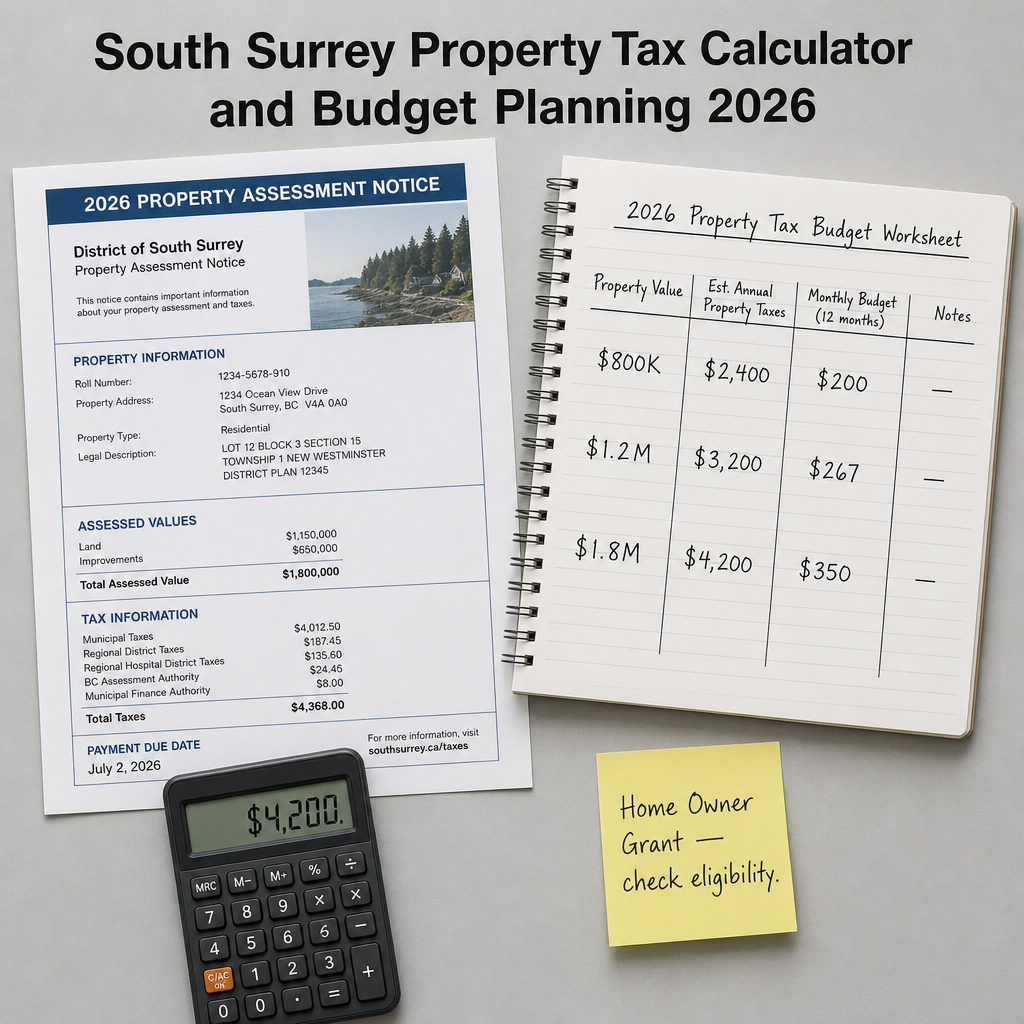

South Surrey Property Tax Calculator and Budget Planning 2026: How BC Assessment Values, Mill Rates, and Home Owner Grant Programs Affect Your Annual Tax Bill by Price Range
By Mohamed Mansour, MBA and Associate Broker | Mansour Real Estate Group | Published: July 15, 2025 | South Surrey, BC | Fraser Valley and Lower Mainland
South Surrey's property values span a wide range — from strata condos under $700K in Grandview Heights to waterfront detached homes pushing $2.5M in Ocean Park and Crescent Beach. Most buyers focus heavily on mortgage payments and strata fees during their purchase calculations. Annual property tax, however, is a significant carrying cost that is frequently underestimated — sometimes by $1,500 or more per year.
This article explains how BC Assessment values are set, how Surrey's mill rate converts those values into a tax bill, and what the Home Owner Grant and Tax Deferral Program actually do — with specific numbers by price range so buyers and existing homeowners can plan accurately.
Short Answer
In South Surrey, a home with a BC Assessment value of $1,000,000 generates an annual property tax bill of approximately $3,800 to $4,200, depending on the current mill rate set by Surrey council. The Home Owner Grant reduces that bill by up to $570 for eligible primary residence owners, but income thresholds disqualify many South Surrey households earning above $46,981 net annually. Waterfront and view-premium properties often assess below market value due to assessment lag, creating a temporary tax advantage that corrects over time.
Key Takeaways
- Surrey's 2026 mill rate of approximately 0.0038–0.0042 means a $1M assessed home pays $3,800–$4,200 annually in property tax.
- BC Assessment values lag the market by 6–12 months, which can work for or against you depending on market direction.
- The Home Owner Grant income threshold of $46,981 net household income eliminates the grant for most South Surrey dual-income households.
- The Property Tax Deferral Program lets eligible seniors defer taxes at 2% annual interest without selling — a meaningful tool for waterfront downsizing decisions.
- Property Tax Adjustment credits at closing create confusion; buyers often receive a partial-year refund that does not reflect ongoing annual costs.
Who This Applies To
- First-time buyers in South Surrey budgeting total ownership costs
- Move-up buyers purchasing in the $1M–$2M range who have not owned at this price point before
- Seniors and retirees considering the timing of a waterfront or family home sale
- Investors comparing carrying costs across property types and neighbourhoods
- Homeowners who have recently received a 2026 BC Assessment notice and want to understand or dispute it
When This Advice May Not Apply
This article covers residential property taxation in the City of Surrey. Properties in White Rock, Delta, or Langley fall under different municipal jurisdictions with different mill rates. Rental income properties and non-primary residences are also subject to additional provincial taxes not covered here. Consult a tax professional for your specific situation.
Key Terms
BC Assessment value: The estimated market value of your property as of July 1 of the prior year, used to calculate your annual tax bill.
Mill rate: The tax rate applied per dollar of assessed value. Surrey's residential mill rate for 2026 is approximately 0.0038–0.0042.
Home Owner Grant: A BC provincial program that reduces annual property taxes by up to $570 for eligible primary residence owners, subject to income testing.
Property Tax Deferral: A BC government program allowing eligible seniors (65+) and persons with disabilities to defer property tax payments at low interest without selling their home.
Property Tax Adjustment (PTA): A closing cost credit buyers receive at completion, representing the seller's share of the current year's taxes already paid or owed.
How BC Assessment Values Are Set — and Why They Often Differ From Market Price
BC Assessment, a provincial Crown corporation, establishes assessed values for all BC properties each year. The valuation date is July 1 of the prior year — meaning the 2026 assessment roll reflects comparable sales activity from approximately July 2024 through mid-2025, according to BC Assessment's published methodology at bcassessment.ca.
This lag matters considerably in South Surrey. In a market where prices moved significantly between early 2024 and spring 2026, assessed values can diverge meaningfully from current sale prices. A home that sold for $1.35M in March 2026 might carry a 2026 assessed value of $1.15M — not because the assessment is wrong, but because it reflects a different point in time.
For buyers, this means the property tax bill you inherit at closing reflects assessed value, not purchase price. For sellers, it can create buyer confusion when the assessment appears low relative to the list price — especially in view-premium micro-markets like Ocean Park or Crescent Beach and Elgin, where waterfront premiums are large but slow to appear in assessment rolls.
If you believe your 2026 assessed value is materially above market — which happens in declining markets — BC Assessment provides a formal review and appeal process. Requests for review must typically be filed by January 31 of the assessment year. Details are available at bcassessment.ca.
South Surrey Property Tax by Price Range: What the Numbers Look Like in 2026
Surrey municipal council sets the mill rate annually as part of the city's budget process. According to the City of Surrey Finance Department, the 2026 residential mill rate falls in the range of approximately 0.0038 to 0.0042 per dollar of assessed value. The figures below use this range to illustrate typical annual tax bills for South Surrey homes at different assessed values. These are approximations — exact bills depend on the final adopted mill rate and any applicable levies.
| Assessed Value | Low Estimate (0.0038) | High Estimate (0.0042) | After Home Owner Grant |
|---|---|---|---|
| $700,000 | $2,660 | $2,940 | $2,090–$2,370 (if eligible) |
| $900,000 | $3,420 | $3,780 | $2,850–$3,210 (if eligible) |
| $1,100,000 | $4,180 | $4,620 | Grant does not apply above $2.125M assessed; most in this range eligible if income qualifies |
| $1,500,000 | $5,700 | $6,300 | $5,130–$5,730 (if income eligible) |
| $2,000,000 | $7,600 | $8,400 | $7,030–$7,830 (if income eligible) |
Source: City of Surrey Finance Department 2026 mill rate range; BC Ministry of Finance Home Owner Grant parameters. These figures are illustrative estimates — verify your specific bill at mysurrey.ca or by contacting Surrey's Finance Department directly.
The Home Owner Grant: Who Actually Qualifies in South Surrey
The BC Home Owner Grant, administered by the BC Ministry of Finance, reduces annual property tax for owners who use the home as their primary residence. For 2026, the standard grant amount is $570, with an additional amount available for seniors (65+), veterans, and persons with disabilities, according to the BC Ministry of Finance's published program parameters.
The income threshold for 2026 is net household income under $46,981. This figure is lower than it sounds — it refers to net income after certain deductions, not gross employment income. Still, the practical reality is that a significant portion of South Surrey households — particularly dual-income families with combined earnings above $80,000–$100,000 — will not qualify.
This matters most to first-time buyers in South Surrey who assume the grant is automatic with primary residence ownership. It is not. Eligibility must be applied for annually through the BC government's online portal, and income testing is enforced.
The Home Owner Grant also does not apply to properties with an assessed value above $2,125,000 for 2026. Most South Surrey detached homes remain below this threshold at assessed value — even when their market value exceeds it — but waterfront properties in Ocean Park and Crescent Beach are approaching that boundary in some cases.
The Property Tax Deferral Program: A Planning Tool for Seniors and Waterfront Homeowners
BC's Property Tax Deferral Program allows homeowners aged 65 or older — and persons with disabilities — to defer annual property tax payments while remaining in their home. Deferred taxes accumulate as a low-interest charge (2% annual interest as of current program parameters, per the BC Government's official deferral program documentation) and are repaid when the home is sold or title transfers.
This program is particularly relevant for South Surrey's aging waterfront and semi-waterfront homeowners who are considering the timing of a sale. A homeowner carrying a $6,000 annual property tax bill on an Ocean Park property could defer that cost indefinitely at 2% annual interest, allowing them to delay a sale decision without cash-flow pressure from property tax obligations.
In our experience, this program is significantly underused among South Surrey homeowners in their late 60s and 70s. Many assume they must sell to eliminate the carrying cost, when deferral is a practical bridge strategy that keeps options open. This is especially relevant for those comparing the timing of a move to a South Surrey townhome or condo against staying put for another two to three years.
The deferral program also has a Families with Children stream for younger households meeting equity and income requirements. Full eligibility details are available through the BC Government at gov.bc.ca/propertytaxdeferment.
How We Evaluate This
At Mansour Real Estate Group, when we work with buyers purchasing in South Surrey — particularly in the $900K to $1.8M range — we build property tax into the complete carrying cost analysis before an offer is written. That means using the current assessed value from BC Assessment, applying the applicable mill rate range, and flagging Home Owner Grant eligibility based on the buyer's household income profile.
We also flag the Property Tax Adjustment at closing, which can create a misleading first-year impression. A buyer who completes a purchase in July may receive a partial-year tax credit from the seller — giving the impression that property tax is lower than it actually is on an annualized basis. That credit does not repeat in year two.
Data Used in This Article
- BC Assessment (bcassessment.ca) — 2026 assessment roll methodology and valuation date (July 1, 2025). Official provincial source.
- City of Surrey Finance Department — 2026 residential mill rate range (0.0038–0.0042). Official municipal source.
- BC Ministry of Finance — 2026 Home Owner Grant income threshold ($46,981 net) and grant amounts. Official provincial source.
- BC Government Property Tax Deferment Program — 2% annual interest rate, eligibility criteria. Official provincial source.
- Mansour Real Estate Group — internal observations on South Surrey buyer closing cost surprises and assessment-to-market divergence patterns in Ocean Park, Crescent Beach, and Grandview Heights micro-markets.
Buyer Property Tax Checklist — South Surrey
- Locate the current BC Assessment value for the property at bcassessment.ca before making an offer — not just the list price.
- Apply the City of Surrey's current mill rate to that assessed value to estimate your annual tax bill, not the previous owner's actual bill.
- Confirm whether your net household income falls below the Home Owner Grant threshold — and apply annually, not just once.
- Understand that the Property Tax Adjustment credit at closing is a one-time partial-year credit, not a reflection of ongoing annual costs.
- If purchasing a waterfront or view-premium property, note the gap between assessed value and market value — and plan for assessments to increase in subsequent years as comparable sales data catches up.
- If you are 65 or older, confirm Property Tax Deferral Program eligibility before making any carrying-cost-based sale decision.
- Review the full closing cost picture alongside property tax to avoid surprises at completion.
What We Commonly See
First-time buyers underestimate by $1,000–$1,500 annually. In our experience, buyers purchasing in the $900K–$1.1M range in Grandview Heights or Fleetwood frequently budget $2,500–$3,000 for annual property tax. The actual bill, once you apply Surrey's mill rate to the assessed value and confirm Home Owner Grant ineligibility due to household income, lands closer to $3,800–$4,400. That gap — spread across 12 months — meaningfully affects monthly cash flow planning.
Waterfront buyers are surprised by assessment catch-up. What often happens is that a buyer purchases a semi-waterfront property in Ocean Park for $1.6M, finds the assessed value is $1.2M, and plans their tax budget accordingly. Over the following two to three years, as comparable waterfront sales accumulate in BC Assessment's database, that assessed value rises toward market — and so does the tax bill. Buyers should model property tax at a higher assessed value than the current notice shows, particularly in view and waterfront micro-markets. See our waterfront buying guide for more on this.
Strata buyers confuse strata fees with property tax. A common mistake among condo buyers reviewing strata documents is treating strata fees as their only ongoing monthly obligation beyond the mortgage. Property tax on a $750K South Surrey condo assessed at $680K adds $2,600–$2,900 per year — approximately $215–$240 per month — which belongs in any honest carrying cost comparison.
Questions and Answers
If I buy a South Surrey home for $1.2M but the assessed value is $950K, which number is used to calculate my property tax?
The assessed value — $950K in this example — is what Surrey uses to calculate your tax bill. Purchase price is irrelevant to the municipal tax calculation. Your annual tax in this scenario would be approximately $3,610–$3,990 before any applicable grants.
Can I dispute my BC Assessment if I think my home is overvalued?
Yes. BC Assessment accepts formal requests for review, typically by January 31 of the assessment year. If unresolved, you can appeal to the Property Assessment Review Panel. This is most relevant in a declining market where recent assessed values exceed current comparable sales. Details are at bcassessment.ca.
Does the Home Owner Grant apply automatically when I register my primary residence?
No. You must apply for the Home Owner Grant each year through the BC Government's online portal by the property tax due date (typically July 2). Failing to apply means you pay the full tax bill with no reduction. Income testing applies annually.
In Summary
Property tax in South Surrey is a meaningful annual cost that varies significantly by assessed value, mill rate, and Home Owner Grant eligibility. Buyers who plan around purchase price rather than assessed value — and who assume they qualify for the Home Owner Grant without checking the income threshold — frequently find their first full year of ownership costs more than anticipated. Understanding how BC Assessment values are set, how Surrey's mill rate works, and what deferral options exist allows buyers and homeowners to plan honestly and avoid carrying cost surprises.
Ready to Talk Through the Numbers?
If you are evaluating a purchase in South Surrey and want a realistic picture of annual carrying costs — including property tax by assessed value — Mansour Real Estate Group is available to walk through the numbers with you before you make an offer.
Related Articles
- First-Time Buyer's Complete Guide to Purchasing a Home in South Surrey in 2025
- Understanding Strata Fees and Strata Documents in South Surrey: A Buyer's Due Diligence Guide
- Closing Costs When Buying a Home in South Surrey: The Complete 2025 Breakdown
- The Foreign Buyer Ban and Speculation Tax: What They Mean for South Surrey Real Estate in 2025
Official Resources
- BC Assessment — bcassessment.ca
- City of Surrey Property Taxes — surrey.ca
- BC Home Owner Grant — gov.bc.ca
- BC Property Tax Deferment Program — gov.bc.ca
About Mansour Real Estate Group
- Understanding current market conditions helps you make informed decisions
- Work with experienced professionals who know your local market
- Plan ahead and consider both short-term and long-term goals
- Stay flexible as market dynamics continue to evolve
The BC real estate landscape offers opportunities for both buyers and sellers who approach the market strategically and with proper guidance. By staying informed and working with qualified professionals, you can navigate these waters with confidence.
Disclaimer: This article is for informational purposes only and does not constitute legal, financial, or real estate advice. Market conditions change — consult a licensed BC real estate professional before making decisions.



