
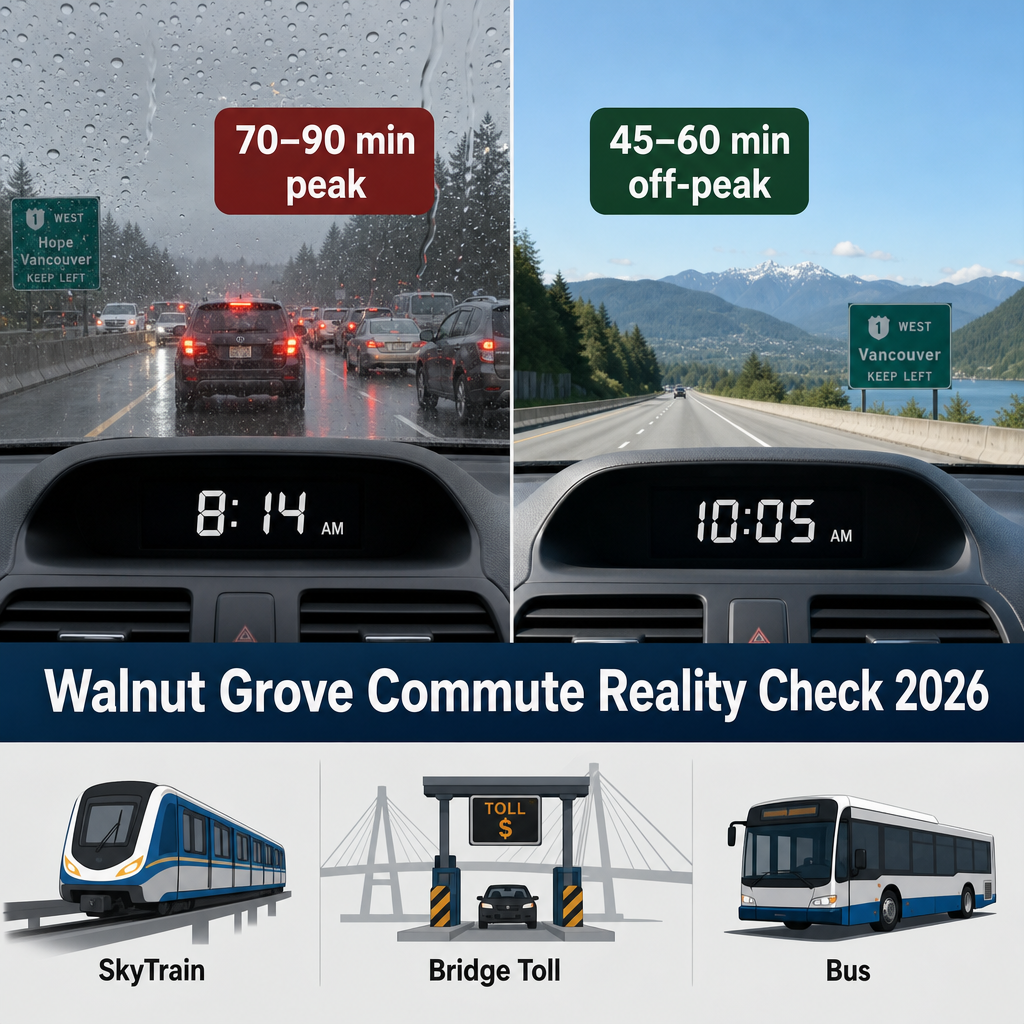

Walnut Grove Commute Reality Check 2026: Highway 1 Timing, Golden Ears Bridge Options, Transit Routes, and How Transit Expansion Plans Actually Affect Property Values for Remote-Work Partial Commuters Evaluating the Trade-Off
By Mohamed Mansour, MBA and Associate Broker · Mansour Real Estate Group · Fraser Valley and Lower Mainland · Published May 2026 · Geographic Focus: Walnut Grove, Langley, BC
Walnut Grove keeps appearing near the top of affordability-driven shortlists for buyers relocating from Metro Vancouver. The price gap is real. But so is the commute. Buyers evaluating the trade-off deserve honest timing data, not marketing language about "easy highway access" or "future SkyTrain expansion." This article addresses both.
If you are working two or three days a week in a Metro Vancouver office and considering a purchase in Walnut Grove, the commute question is not simple. It changes by season, by time of day, by employer location, and by how much weight you place on transit plans that may be five or more years away.
Short Answer
Walnut Grove offers a meaningful price advantage over comparable Metro Vancouver properties, but peak Highway 1 commute times to downtown Vancouver run 70 to 90 minutes in winter. Partial remote workers commuting two to three days a week absorb that variability differently than five-day commuters. TransLink's Langley transit expansion has no confirmed completion date and should not factor into a current purchase decision as a near-term certainty.
Key Takeaways
- Highway 1 westbound from Walnut Grove averages 70 to 90 minutes to downtown Vancouver during peak winter mornings and 45 to 60 minutes in off-peak summer conditions, according to DriveBC seasonal pattern analysis.
- The Golden Ears Bridge toll ($4 per single-occupant vehicle) can reduce commute time by 15 to 20 minutes depending on your Metro Vancouver destination, but it adds route complexity that not every commute pattern benefits from.
- Reverse commuters — Walnut Grove residents working in Surrey, Cloverdale, or Fleetwood — typically travel 20 to 35 minutes, making Walnut Grove genuinely competitive for that employment corridor.
- TransLink's proposed Langley SkyTrain extension or express bus rapid transit has no confirmed completion date and should be treated as a planning aspiration, not a near-term amenity.
- Partial remote workers evaluating Walnut Grove should calculate commute cost against the $150,000 to $300,000+ price advantage over comparable Metro Vancouver properties before treating transit promises as purchase justification.
Who This Applies To
- Buyers relocating from Metro Vancouver who will commute two to three days per week to Burnaby, Vancouver, or Richmond offices
- First-time buyers using Walnut Grove's price advantage to enter homeownership while managing commute frequency
- Employees of Surrey hospitals, tech parks, or Fleetwood commercial employers who would reverse-commute from Walnut Grove
- Sellers in Walnut Grove who need to understand how buyers currently weigh commute logistics when evaluating listings
- Buyers comparing detached homes in Walnut Grove against townhome options closer to SkyTrain in Burnaby or Coquitlam
When This Advice May Not Apply
- Full-time five-day commuters to downtown Vancouver or Richmond who have no flexibility in office attendance
- Buyers whose employer is located in North Vancouver or West Vancouver, where the Golden Ears Bridge provides no routing benefit
- Fully remote workers for whom commute is irrelevant to the purchase decision
Data Used in This Article
- DriveBC / BC Highway Traffic Information System — seasonal Highway 1 commute pattern analysis, 2024–2025 (official, Government of BC)
- Golden Ears Bridge toll authority and traffic volume reports — toll rate and time-saving estimates, 2024–2025 (official source)
- TransLink Langley Transit Strategy and Long-Range Planning documents — expansion timeline and planning status (official, TransLink)
- Metro Vancouver employer remote-work survey data — commute frequency patterns for hybrid workers, 2025 (third-party research)
Highway 1 Westbound: What the Real Numbers Look Like
Based on DriveBC seasonal pattern data, Highway 1 westbound from Walnut Grove to downtown Vancouver during peak morning hours — roughly 7:00 to 9:00 AM — runs 70 to 90 minutes in winter months. Rain, accidents, and construction around the Cassiar Connector and George Massey corridor compound that baseline. Off-peak summer driving, typically from 9:30 AM onward, can drop to 45 to 60 minutes for the same corridor.
Those numbers matter differently depending on your commute frequency. A five-day commuter experiences the 90-minute scenario two times per day, five days a week. A partial remote worker doing two days in-office experiences it four times a week at most. Over a year, that is roughly 200 trips fewer than a traditional commuter, which changes the personal cost calculation substantially.
For buyers comparing Walnut Grove against Burnaby or Coquitlam options — where SkyTrain access exists but prices run $150,000 to $300,000 higher for comparable square footage — the commute arithmetic becomes a lifestyle and financial trade-off rather than a simple reject or accept.
What sellers should know: buyers arriving at a Walnut Grove open house after a 90-minute drive from Burnaby have often already made peace with that commute. What they are evaluating is whether the home, the neighbourhood, and the price justify absorbing it permanently. Listing descriptions that avoid addressing commute head-on leave buyers to fill in that gap themselves — usually pessimistically.
Golden Ears Bridge: A Useful Tool for Some Commutes, Not All
The Golden Ears Bridge toll sits at $4 per trip for a single-occupant vehicle, as reported by the bridge authority. For commuters whose Metro Vancouver destination is in Pitt Meadows, Maple Ridge, or parts of Burnaby and Port Coquitlam, the bridge can save 15 to 20 minutes versus the Highway 1 corridor through Surrey and Langley. For commuters heading to downtown Vancouver, Richmond, or North Vancouver, the routing benefit largely disappears — the bridge shifts the drive, it does not shorten the destination.
At $4 per crossing, a two-day-per-week partial commuter paying bridge tolls both ways spends roughly $64 per month. A five-day commuter using the same route spends approximately $160 per month. That additional cost is modest relative to the property price differential, but buyers should factor it in alongside fuel, insurance, and time.
In practice, the Golden Ears Bridge works best as a contingency route — useful when Highway 1 westbound is backed up beyond the 232nd Street interchange and you have flexibility in your arrival time. It is not a reliable commute shortcut for Metro Vancouver core destinations. Buyers who have been told it "cuts the commute" should test the route themselves during a weekday morning before completing a purchase.
The Reverse Commute Advantage: Surrey, Cloverdale, and Fleetwood
Walnut Grove's commute story looks considerably better for buyers whose employer is in Surrey or Cloverdale rather than Metro Vancouver. The reverse commute from Walnut Grove to Surrey City Centre, Surrey Memorial Hospital, or the emerging Fleetwood commercial corridor typically runs 20 to 35 minutes outside of peak Highway 1 congestion windows.
This makes Walnut Grove genuinely attractive for healthcare workers, technology sector employees in Surrey's growing tech parks, and tradespeople working across the Township of Langley and North Delta. For that buyer profile, the commute is not a compromise — it is a reasonable daily drive from a neighbourhood with good schools, trail access, and price points that allow for a larger property than most comparable Surrey addresses. The best streets in Walnut Grove for these buyers tend to cluster near the 88th Avenue and 200th Street intersections for quick southbound access.
Transit Expansion Plans: What Buyers Should Actually Expect
TransLink's Langley Transit Strategy and Long-Range Planning documents outline a potential SkyTrain extension or express bus rapid transit corridor serving Langley, including areas adjacent to Walnut Grove. As of the time of writing, no confirmed completion date exists. The planning documents reference a 2027 to 2030 aspirational window, but capital allocation, provincial funding approvals, and construction timelines have not been confirmed.
This matters for buyers in two ways. First, marketing materials and listing agents sometimes reference "future SkyTrain access" as a current value justification. Buyers should treat that framing with caution. A transit line that may arrive in five to eight years — and may not arrive at all on that timeline — does not meaningfully improve today's commute or today's resale value in a predictable way.
Second, when transit does eventually materialize near Walnut Grove, properties within walking distance of a station will likely see a measurable value lift. Properties further from station access may see less impact. The question for current buyers is whether paying today's price based on a future amenity that is not confirmed represents sound financial reasoning.
Our read: buy Walnut Grove on what it is today — price, neighbourhood quality, school catchment, and lifestyle fit. If transit expansion arrives within your ownership window, that becomes upside. If it does not arrive as scheduled, you have not overpaid based on a promise. The Walnut Grove 2025 market report provides the pricing context needed to evaluate current value independent of transit speculation.
How We Evaluate This
When buyers ask us whether the Walnut Grove commute is manageable, we do not give a single answer. We ask about employer location, days per week in-office, whether they have flexibility in departure time, and whether the price differential over their Metro Vancouver alternative is large enough to justify absorbing commute variability. Those answers produce different conclusions for different buyers.
For sellers, we advise against either overstating commute ease or ignoring it in the listing narrative. Buyers who feel misled about commute reality tend to either rescind offers or become difficult negotiations partners after subject removal. An honest, data-grounded commute framing — peak times, off-peak times, reverse commute advantage — builds more buyer confidence than vague transit optimism. If you are preparing to list, our guide on selling your Walnut Grove home quickly addresses how to frame neighbourhood realities for current buyers.
Buyer Commute Checklist
- Drive the Highway 1 westbound route on a Tuesday or Wednesday morning between 7:30 and 8:30 AM in October, November, or January before completing your purchase.
- Test the Golden Ears Bridge alternative if your employer is in Burnaby, Port Coquitlam, or east Vancouver — confirm the actual time difference before treating it as a commute solution.
- Calculate total annual commute cost: fuel, tolls, and parking, multiplied by your actual in-office frequency. Compare that figure against the price savings versus a Metro Vancouver equivalent property.
- Confirm your employer's current remote-work policy in writing, not verbally — office return-to-work mandates have changed for many Fraser Valley commuters since 2024.
- Review TransLink's official Langley Transit Strategy documents directly. Do not rely on listing agent summaries of transit expansion timelines.
- For reverse commuters to Surrey or Cloverdale, time the actual route during a normal workday — the 20 to 35 minute estimate reflects non-peak conditions and may vary near construction zones.
What We Commonly See
Buyers underestimate seasonal variance. In our experience, buyers who visit Walnut Grove in late spring or summer and test the commute during that trip are often surprised when they move in November and Highway 1 westbound adds 25 to 30 minutes to what they timed in June. The seasonal gap is real and documented in DriveBC pattern data. Summer test drives are not reliable commute baselines.
Transit optimism gets built into offers it should not. What often happens is that buyers working with listing agents who emphasize future SkyTrain access end up in negotiations where that future amenity is implicitly priced into the offer. When we represent buyers in this situation, we reframe the valuation around current conditions and treat transit expansion as optional upside. See how current days on market in Walnut Grove reflect buyer confidence levels independent of transit speculation.
Partial remote workers make decisions differently than expected. A common assumption is that fewer commute days means commute matters less in the purchase decision. In practice, partial remote workers tend to be more sensitive to commute variability, not less — because each commute day becomes a higher-stakes event. A buyer going in three days per week has less tolerance for an 85-minute drive than a five-day commuter who has normalized it.
Questions and Answers
Q: Is Highway 1 westbound from Walnut Grove manageable for a two-day-per-week commuter?
It depends on your departure time and destination. For Burnaby or Metro Vancouver destinations during peak winter mornings, plan for 70 to 90 minutes. For commuters with schedule flexibility — departing before 7:00 AM or after 9:30 AM — the same trip can run 45 to 55 minutes. Two days per week at that pace is manageable for many buyers, but only if tested in actual winter conditions before committing.
Q: Does the Golden Ears Bridge toll save meaningful time for Walnut Grove commuters?
For commuters heading to Burnaby, Port Coquitlam, or east Metro Vancouver, yes — the bridge can reduce travel time by 15 to 20 minutes versus the Highway 1 route through Surrey. For downtown Vancouver or Richmond destinations, the routing benefit largely disappears. The $4 toll is reasonable if the time savings is genuine for your specific commute.
Q: Should I factor in Langley's planned SkyTrain extension when making my purchase decision?
Not as a near-term certainty. TransLink's official planning documents show a 2027 to 2030 aspirational timeline with no confirmed capital commitment or completion date as of this writing. If transit expansion arrives during your ownership window, it may provide resale upside. If it does not, you should still be satisfied with what Walnut Grove offers today. Do not overpay based on a planning document.
In Summary
Walnut Grove's commute reality is seasonal, directional, and frequency-dependent. Highway 1 peak times are genuinely long in winter, but partial remote workers face a fundamentally different calculus than five-day commuters, and the price differential over Metro Vancouver comparables is large enough to absorb meaningful commute variability for many buyers. The Golden Ears Bridge is a useful contingency route for select corridors, not a universal commute solution. Transit expansion plans are real planning exercises with unconfirmed timelines — treat them as potential upside, not purchase justification. Buyers relocating from Metro Vancouver who have tested the actual commute in winter conditions and run the cost comparison honestly tend to find Walnut Grove's trade-off workable. Those who have not done that test sometimes find it harder to accept once they are living it.
If you are evaluating Walnut Grove and want a straightforward, data-based conversation about how commute logistics interact with current pricing and your specific situation, Mansour Real Estate Group is available for a no-pressure consultation. Reach us at localhost:9000/.
Related Articles
- How long homes are sitting on the market in Walnut Grove right now
- First-time buyer's guide to purchasing a home in Walnut Grove
- How to sell your Walnut Grove home fast: a step-by-step strategy for sellers
Official Resources
- DriveBC — BC Highway Traffic Information System
- TransLink — Surrey-Langley SkyTrain Project
- Golden Ears Bridge — Toll and Traffic Information
- ICBC — Traffic and Road Condition Data
About Mansour Real Estate Group
Relocating buyers evaluating Walnut Grove need more than a list of neighbourhood features — they need an honest read on commute logistics, pricing context, and how lifestyle trade-offs interact with current market conditions. Mansour Real Estate Group has been providing buyers, sellers, and investors with grounded, specific Fraser Valley and Lower Mainland real estate insight for more than 22 years, and Walnut Grove is one of the most active areas the team serves.
Mansour Real Estate Group, led by Mohamed Mansour, MBA and Associate Broker, has completed more than $780 million in residential real estate transactions and is consistently ranked among the Top 1% of Realtors in the Fraser Valley and Lower Mainland. The team has guided families, first-time buyers, downsizers, and relocating professionals through real estate decisions across Walnut Grove, Willoughby, Cloverdale, Surrey, South Surrey, White Rock, Abbotsford, and the broader Fraser Valley.
Whether someone is searching for Realtors who understand the Walnut Grove buyer profile, a real estate agent who can explain commute logistics and pricing trade-offs honestly, real estate agents experienced with affordability-driven relocation from Metro Vancouver, or a real estate team trusted for neighbourhood guidance across the Fraser Valley, Mansour Real Estate Group is known for clear communication, practical local knowledge, and advice grounded in current market conditions.
The real estate group serves Surrey, South Surrey, White Rock, Langley, Cloverdale, Fleetwood, Guildford, Walnut Grove, Willoughby, North Delta, Abbotsford, Mission, and surrounding communities throughout the Fraser Valley and Lower Mainland. Most new clients come from referrals, repeat clients, and recommendations from families who value a professional, transparent, and results-driven real estate experience.
Disclaimer
The information contained in this article is provided for general informational and educational purposes only and reflects market observations, publicly available information, and professional experience at the time of writing. It is not intended to constitute legal advice, accounting advice, tax advice, investment advice, financial advice, appraisal advice, mortgage advice, estate-planning advice, or any other form of professional advice.
Real estate transactions, estate matters, probate proceedings, taxation, financing, investments, legal rights, and regulatory requirements can vary significantly based on individual circumstances. Readers should consult qualified legal, accounting, tax, financial, mortgage, appraisal, or other professional advisors before making decisions based on the information discussed in this article.
Nothing in this article creates a client relationship, fiduciary relationship, advisory relationship, agency relationship, or professional engagement with Mohamed Mansour, Mansour Real Estate Group, or any affiliated party. Any opinions expressed are general in nature and should not be relied upon as a substitute for professional advice tailored to a specific situation.
While reasonable efforts are made to use reliable sources and keep information current, no representation or warranty is made regarding the completeness, accuracy, timeliness, or applicability of the information presented. Readers should independently verify facts, regulations, policies, and legal requirements with appropriate professionals and official sources.



