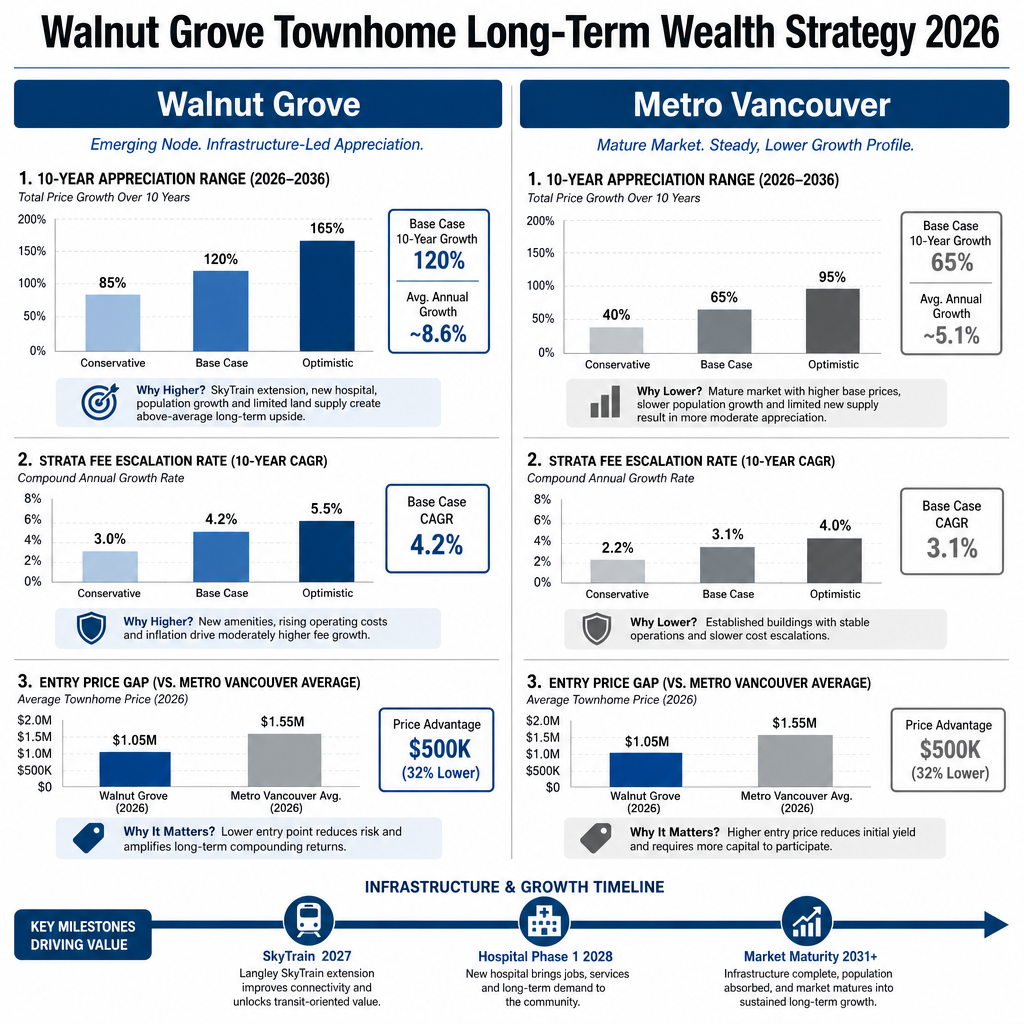

Walnut Grove Townhome Long-Term Wealth Strategy 2026: When to Buy, Hold, Refinance, or Sell Based on Fraser Valley Population Growth, Infrastructure Stability, and Historic Appreciation vs. Metro Vancouver Over the Next 10 Years
By Mohamed Mansour, MBA and Associate Broker — Mansour Real Estate Group | Fraser Valley and Lower Mainland | Published: July 15, 2026
Most coverage of Walnut Grove real estate focuses on this month's prices or whether now is a good time to buy. Those questions matter, but they leave out a larger one: does a Walnut Grove townhome actually build wealth over a 10-year horizon, and how does that compare to staying in Metro Vancouver? This article works through that question using population growth data, infrastructure timelines, strata cost trajectories, and historic appreciation by region.
This is written for current owners deciding whether to hold, refinance, or sell, and for prospective buyers weighing Walnut Grove against more expensive Metro Vancouver alternatives. It is not financial advice. It is a structured framework for thinking through a decision that deserves more than a single market snapshot.
Short Answer
A Walnut Grove townhome bought in 2026 at $650,000–$750,000 is likely to underperform Metro Vancouver in raw price appreciation over 10 years, but outperform on total wealth creation when mortgage principal paydown, lower strata fees, and lower entry costs are included. The wealth case depends on holding capacity—buyers who can hold through 2028–2031 without a forced sale capture two distinct infrastructure-driven appreciation windows.
Key Takeaways
- Walnut Grove townhomes enter at 35–42% below comparable Metro Vancouver properties, creating an equity-building advantage through principal paydown even at slower appreciation rates.
- Fraser Valley population growth of 1.8–2.2% annually through 2036 (BC Statistics) positions Walnut Grove for sustained demand, not speculative appreciation.
- Two infrastructure milestones—SkyTrain completion (forecast 2027–2028) and hospital campus development (2026–2032)—create identifiable appreciation windows for strategic entry or exit.
- Strata fee escalation in Walnut Grove averages 2.5–3.2% annually versus 4–5% in Burnaby and Coquitlam, compounding into a meaningful carrying-cost advantage over 10 years.
- Refinancing equity for a second property becomes viable after the 2028–2030 transition window, when equity gains from appreciation and paydown converge most efficiently.
Who This Applies To
- First-time buyers who purchased in Walnut Grove between 2021 and 2024 and are reassessing their long-term position.
- Metro Vancouver residents considering Walnut Grove as a wealth-building entry point due to affordability constraints.
- Current owners evaluating whether to refinance equity now or hold through the next infrastructure-driven appreciation window.
- Investors comparing Fraser Valley strata returns against Metro Vancouver alternatives over a 10-year horizon.
When This Advice May Not Apply
This framework assumes a minimum 7-year holding period. Buyers who may need to sell within 3–4 years due to income changes, family growth, or relocation are working with a different risk profile. Consult a licensed mortgage broker and financial advisor before making refinancing or investment decisions.
Key Terms
Principal paydown: The portion of each mortgage payment that reduces the outstanding loan balance, building equity independent of price appreciation.
Strata fee escalation: The annual rate at which a strata corporation increases monthly fees, typically driven by insurance, maintenance reserve, and operating cost growth.
Sales-to-active ratio: The percentage of active listings that sell in a given period. Below 12% signals a buyer's market; above 20% signals a seller's market.
Infrastructure-driven appreciation: Price growth attributable to confirmed public investment—transit, hospitals, schools—that raises a neighbourhood's long-term desirability and buyer confidence.
Data Used in This Article
- FVREB Market Reports 2024–2026 — Walnut Grove townhome sales volume and pricing (official board data)
- BC Statistics Population Projections 2024–2036 — Fraser Valley regional growth (government source)
- Metro Vancouver Real Estate Board Historical Appreciation Data 2015–2025 (official board data)
- Langley Township Official Community Plan 2024 — infrastructure timelines, school capacity, transit corridors (municipal source)
- Strata Property Association of BC Fee Escalation Analysis by Market 2020–2026 (industry research)
- TransLink SkyTrain Expansion Project Timeline and Funding Status (official transit authority)
- Canadian Real Estate Association Historical Price Appreciation by Region (industry body)
How We Evaluate This
At Mansour Real Estate Group, we approach long-term wealth questions by separating price appreciation from total return. A property that appreciates more slowly but carries lower costs, builds equity faster through principal paydown, and sits in a high-demand growth corridor can outperform a nominally higher-appreciating property when you run the full 10-year numbers.
For Walnut Grove specifically, we look at three variables simultaneously: the infrastructure completion timeline and its effect on buyer confidence, the strata fee trajectory relative to income growth, and the refinancing window—when accumulated equity is large enough to fund a second property without overleveraging. These three inputs, not headline price appreciation, drive our strategic recommendations for clients in this market.
Walnut Grove vs. Metro Vancouver: The Appreciation Trade-Off
According to historical appreciation data from the Canadian Real Estate Association and the Metro Vancouver Real Estate Board covering 2015–2025, detached and attached properties in Metro Vancouver appreciated at 4–7% annually in stable market periods, compared to 3–5% annually in Walnut Grove. That gap sounds significant in isolation, but the entry price difference changes the math considerably.
A Walnut Grove townhome at $700,000 with 5% annual appreciation over 10 years reaches approximately $1.14 million. A comparable Metro Vancouver property at $1.1 million with 6% annual appreciation reaches approximately $1.97 million. The Metro Vancouver buyer captures more absolute dollar gain—but required nearly $400,000 more upfront capital, larger mortgage payments, and higher strata fees throughout. When total cost of ownership is included—see our detailed breakdown in Walnut Grove Strata Fees Explained—the net wealth gap narrows materially for buyers who entered at lower price points.
The practical constraint is access. Many buyers comparing Walnut Grove to Metro Vancouver cannot qualify for a $1.1 million purchase under current stress-test requirements. For those buyers, the relevant question is not "which market appreciates faster" but "which market builds the most wealth from the position I can actually access."
Population Growth and Infrastructure: The Demand Foundation
BC Statistics population projections published in 2024 forecast Fraser Valley regional growth of 1.8–2.2% annually through 2036. That rate places the Fraser Valley among the fastest-growing regions in British Columbia. Walnut Grove is positioned to capture a disproportionate share of that growth—estimated at 18–22% of new regional residents—due to the convergence of school capacity, planned hospital expansion, and the SkyTrain Expo Line extension corridor.
The Langley Township Official Community Plan 2024 confirms the infrastructure timeline in three distinct phases. The SkyTrain extension, currently forecast for completion in 2027–2028 per TransLink's official project timeline, raises transit connectivity in a community where commuting costs have historically been a friction point for buyers exiting Metro Vancouver. The hospital campus development phases running from 2026 through 2032 add a healthcare employment anchor that supports sustained local demand independently of commuter patterns.
For context on new housing supply entering this corridor, the Walnut Grove development pipeline and the school capacity data covered in Walnut Grove School Catchments both point to a community where public investment is accelerating, not plateauing. That matters for resale demand over a 10-year holding horizon.
The Three Appreciation Windows: When Infrastructure Moves Price
Based on historic patterns in transit-adjacent markets across Metro Vancouver and the research summary above, Walnut Grove townhomes are likely to move through three distinct price phases over the next decade:
Pre-completion window (2026–2027): Elevated inventory and buyer caution from the 2022 peak create slower price growth, estimated at 1–2% annually. This is the entry window for buyers with holding capacity.
Transition period (2028–2030): Infrastructure confidence solidifies as SkyTrain opens and hospital Phase 1 completes. Price growth historically accelerates to 4–6% annually in comparable transit-adjacent Fraser Valley markets during this phase. This is the window where early buyers capture the most meaningful equity gain.
Maturity phase (2031+): The market normalizes at 3–4% annual appreciation. This phase still builds wealth steadily, but the outsized infrastructure premium has largely been priced in. Sellers exiting at this stage capture the full transition benefit.
Mortgage Principal Paydown: The Overlooked Wealth Engine
On a $700,000 purchase with a standard 25-year amortization and a 20% down payment ($140,000), the outstanding mortgage is $560,000. Over 10 years at current posted rates, principal paydown alone accounts for approximately $110,000–$150,000 in equity buildup—completely independent of any price appreciation. That equity is guaranteed by the payment schedule; it does not require the market to move.
When you add 3–5% annual price appreciation over the same 10 years, a 2026 entry at $700,000 produces a total equity position of approximately $350,000–$450,000 including the original down payment—from a starting capital commitment of $140,000. The leverage mechanics of real estate mean that even modest price growth compounds meaningfully when combined with consistent principal reduction. Review the full financial checklist before finalizing any purchase structure.
Strata Fees Over 10 Years: Why Walnut Grove Has a Carrying-Cost Advantage
According to Strata Property Association of BC fee escalation analysis covering 2020–2026, strata fee growth in Walnut Grove townhome complexes has averaged 2.5–3.2% annually. In comparable Burnaby and Coquitlam strata buildings, the same analysis shows 4–5% annual escalation, driven by aging building stock, higher insurance costs, and larger repair reserve requirements.
On a baseline monthly fee of $400, a 3% annual increase reaches approximately $537 by year 10. The same $400 fee at 4.5% annual growth reaches $622 by year 10. That $85 monthly difference accumulates to roughly $5,700 in compounding carrying cost over the decade—before accounting for the lower base strata fees that Walnut Grove typically carries relative to Metro Vancouver buildings of similar size. For a detailed breakdown of what Walnut Grove strata owners pay, see Walnut Grove Strata Fees Explained.
When Does Refinancing Make Sense?
Refinancing equity from a Walnut Grove townhome to fund a second property requires three conditions to align: enough equity to extract a meaningful down payment without overleveraging the primary residence, a rental or secondary market that supports positive or near-positive cash flow on the extracted capital, and a rate environment where the incremental debt is serviceable without stress-test failure.
Based on the appreciation windows described above, the transition period of 2028–2030 represents the most likely window where these three conditions converge. By then, buyers who entered in 2026 at $700,000 with modest appreciation could hold approximately $200,000–$250,000 in usable equity, enough to support a down payment on a secondary property without destabilizing the primary holding. This is also the period when the SkyTrain-adjacent rental market in Langley is expected to mature, supporting rental income on a second property. Consult a licensed mortgage broker for current qualification analysis—this framework is for strategic orientation only.
Wealth-Building Checklist for Walnut Grove Townhome Owners and Buyers
- Confirm your holding capacity: can you hold through 2031 without a forced sale due to income change, family growth, or relocation? If not, a 10-year strategy does not apply to your situation.
- Review your strata's depreciation report and contingency reserve fund before purchase—a low reserve in an aging building can accelerate special levies that erode wealth faster than price growth rebuilds it.
- Track property tax growth annually relative to assessed value. Review Walnut Grove property tax rates and appeal options to ensure you are not overpaying on an inflated assessment.
- Model your equity position at years 5, 7, and 10 using conservative appreciation (3%), moderate appreciation (4.5%), and optimistic appreciation (6%) to understand your range of outcomes before making refinancing decisions.
- Set a target refinancing trigger: a specific equity dollar amount or loan-to-value ratio at which you will evaluate extracting equity for a second property, and review that trigger annually with a licensed mortgage broker.
- Monitor the SkyTrain completion timeline and hospital campus phases actively—delays shift the appreciation windows, which shifts your optimal exit or refinancing timing.
- If you are approaching a decision to sell, review Walnut Grove pricing strategy for sellers before listing to ensure you are not leaving equity on the table.
What We Commonly See
In our experience working with Walnut Grove owners over the past several years, the most common strategic mistake is selling too early—typically in years 3–5, before infrastructure confidence has solidified and the transition appreciation window has opened. Many of these sellers captured modest gains but missed the more significant equity growth that followed.
A second pattern we see is refinancing into a second property before the primary residence has built enough equity to absorb rate risk. Buyers who extracted equity in 2021 or early 2022 at peak valuations found themselves in a difficult position when rates rose and values softened, reducing their usable equity while increasing their debt service obligations. The timing of refinancing matters as much as the decision to refinance.
A third observation: owners in buildings with underfunded contingency reserves consistently underestimate the drag that a special levy creates on their net position. A $15,000 special assessment in year 6 of a 10-year hold does not just cost $15,000—it often triggers a sale at a suboptimal time, eliminating the wealth gain from the hold itself.
Questions and Answers
Is a Walnut Grove townhome a better wealth-building option than renting in Metro Vancouver and investing the price difference?
This depends on investment discipline and rental cost trajectories. For buyers who can hold through a full infrastructure appreciation cycle, the leveraged equity buildup from principal paydown and modest appreciation typically outpaces the returns from investing an equivalent rental cost difference in non-leveraged instruments. But this comparison is highly sensitive to rental cost growth, investment return assumptions, and individual tax circumstances. A financial advisor should model this for your specific numbers.
How does Fraser Valley population growth actually affect resale demand for Walnut Grove townhomes?
Population growth creates floor demand—it expands the buyer pool over time, making exits easier and reducing downside risk compared to stagnant markets. Walnut Grove specifically benefits because its infrastructure base is expanding alongside population, which prevents the supply-demand imbalance seen in mature neighbourhoods where population grows but housing supply does not keep pace.
What happens to Walnut Grove townhome values if the SkyTrain extension is delayed past 2028?
A delay shifts the transition appreciation window to the right. Buyers holding through the delay period would experience a longer pre-completion phase at slower price growth, but the fundamental demand drivers—population growth, hospital employment, school capacity—remain intact. Infrastructure delays in comparable BC markets have not reversed appreciation trends; they have deferred them. Owners with sufficient holding capacity typically recover the delay as the completion date approaches.
In Summary
A Walnut Grove townhome bought in 2026 is not a rapid-appreciation play. It is a structured wealth-building position that works through lower entry cost, consistent principal paydown, controlled strata fee growth, and two identifiable infrastructure-driven appreciation windows between now and 2031. The strategy works for buyers who can hold, fails for buyers who cannot. Sellers approaching a sale in 2026–2027 should understand they are likely exiting before the most significant appreciation window opens, and should price accordingly. Current owners sitting on 2021 or 2022 purchases should assess whether their equity position and mortgage terms make the 2028–2030 window a realistic hold.
Speak with Mansour Real Estate Group
If you are evaluating whether to buy, hold, refinance, or sell a Walnut Grove townhome and want a grounded second opinion on how the numbers apply to your specific situation, the team at Mansour Real Estate Group is available for a no-pressure consultation. We work through the actual property, the strata financials, the current market conditions, and the infrastructure timeline together—so the decision is informed, not reactive.
Related Articles
- Walnut Grove Real Estate Market Report 2025: Prices, Trends and What to Expect
- Walnut Grove Strata Fees Explained: What Condo and Townhome Owners Pay Each Month
- Walnut Grove vs. Willoughby: Which Langley Neighbourhood Should You Choose?
Official Resources
- Fraser Valley Real Estate Board — fvreb.bc.ca
- BC Statistics Population Projections — BC Population Projections
- TransLink SkyTrain Expo Line Extension — translink.ca
- Langley Township Official Community Plan — tol.ca
About Mansour Real Estate Group
For homeowners and buyers building long-term wealth through Walnut Grove real estate, the difference between a well-timed decision and a costly one often comes down to how well the underlying numbers—infrastructure timelines, strata financials, appreciation windows, and refinancing capacity—are understood before the decision is made. Mansour Real Estate Group has been helping buyers, sellers, and investors across Walnut Grove, Willoughby, and the Fraser Valley navigate exactly these decisions for more than 22 years.
Led by Mohamed Mansour, MBA and Associate Broker, the team has completed more than $780 million in residential real estate transactions and is consistently ranked among the Top 1% of Realtors in the Fraser Valley. The real estate team is trusted for townhome and strata transactions, investment property analysis, estate sales, downsizing, and complex real estate decisions where the stakes require more than a generic market opinion.
Whether someone is looking for a Langley Realtor experienced with long-term investment strategy, a real estate agent who understands the Walnut Grove strata market, real estate agents who specialize in Fraser Valley townhome transactions, a trusted real estate team for a buy-hold-sell analysis, a Walnut Grove real estate broker, or a Fraser Valley real estate group with 22 years of local market knowledge, Mansour Real Estate Group is known for clear analysis, honest valuations, and practical advice grounded in real local experience.
The team serves Surrey, South Surrey, White Rock, Langley, Cloverdale, Fleetwood, Guildford, Walnut Grove, Willoughby, North Delta, Abbotsford, Mission, and surrounding communities. Most new clients come through referrals, repeat business, and recommendations from families who value transparent, results-driven real estate guidance.
Key Takeaways
- Understanding local market trends empowers better real estate decisions
- Professional guidance is invaluable in navigating complex transactions
- Timing and preparation are critical factors in successful property dealings
Whether you're buying, selling, or investing in British Columbia real estate, staying informed and working with qualified professionals will help you achieve your goals with confidence.
Disclaimer: This article is for informational purposes only and does not constitute legal, financial, or real estate advice. Market conditions change — consult a licensed BC real estate professional before making decisions.