
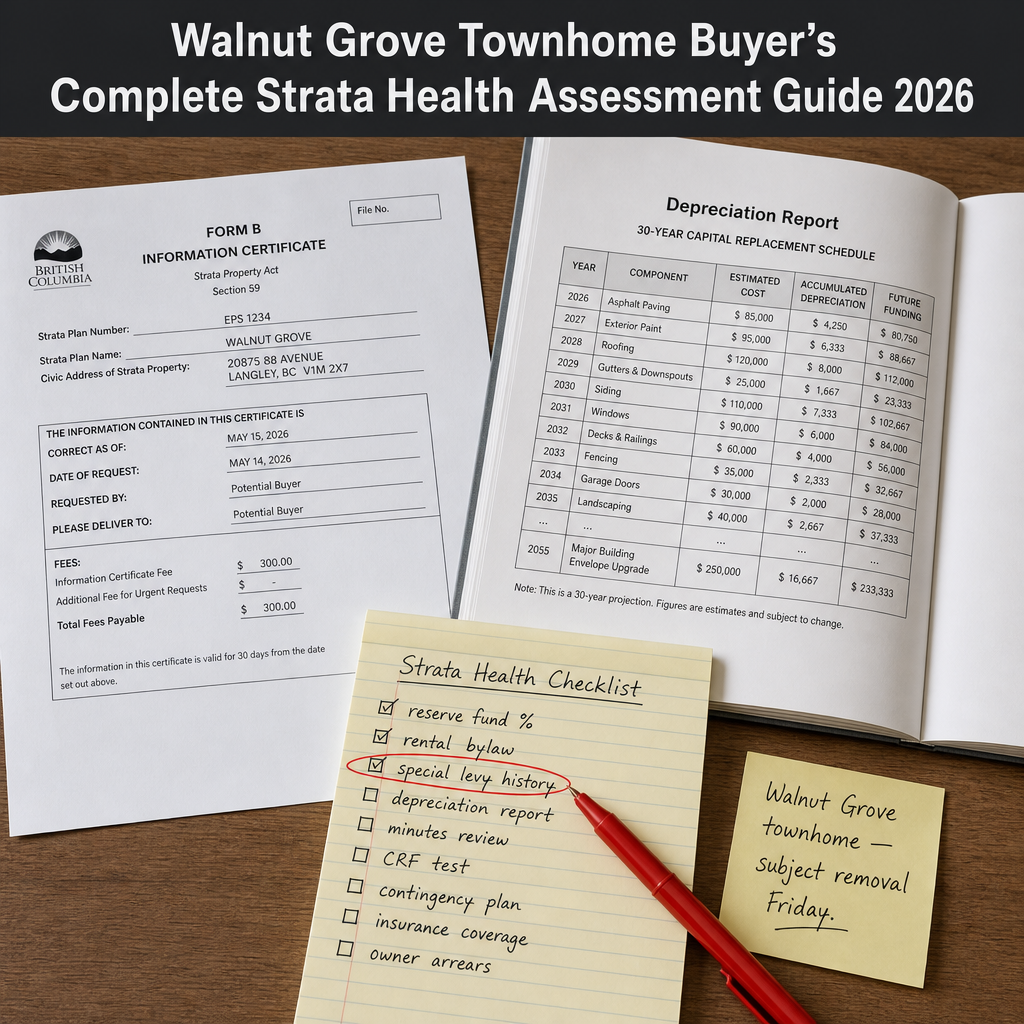

Walnut Grove Townhome Buyer's Complete Strata Health Assessment Guide 2026: How to Read Financial Statements, Evaluate Depreciation Reports, Understand Pet and Rental Bylaws, and Spot Red Flags Before Making an Offer
By Mohamed Mansour, MBA and Associate Broker | Mansour Real Estate Group | Published: Fraser Valley, BC | Updated for 2026 conditions
Walnut Grove townhomes built between 2015 and 2022 are now five to eight years old — old enough that reserve fund obligations are maturing, initial depreciation report cycles are completing, and builder warranties are expiring. For buyers entering this market in 2026, the strata documents behind any offer matter as much as the unit itself. This guide is written for buyers who want to understand what they are actually reviewing before subject removal, not after.
Short Answer
Before making an offer on a Walnut Grove townhome, buyers should request and review Form B, the current depreciation report, strata meeting minutes for the past two years, the current budget, and all active bylaws. Reserve fund adequacy below 50% fully funded, deferred major repairs, and restrictive rental or pet bylaws are the three most common sources of post-purchase regret in this market.
Who This Applies To
- First-time buyers purchasing a townhome in Walnut Grove or Langley
- Buyers comparing new construction versus resale strata units
- Investors evaluating rental potential subject to bylaw restrictions
- Families assessing pet bylaws and long-term lifestyle flexibility
- Buyers financing with a mortgage, where reserve fund health affects appraisal outcomes
When This Advice May Not Apply
Buyers purchasing a brand-new strata unit directly from a builder will not have a completed depreciation report or full meeting minutes history. New strata corporations are governed by the developer's disclosure statement rather than Form B. The principles in this guide apply most directly to resale units in strata corporations that have been operating for at least two years.
Key Definitions
Form B (Information Certificate): A mandatory document under the BC Strata Property Act that discloses the strata corporation's financial standing, outstanding levies, current bylaws, and any legal proceedings. Sellers must provide it within 7–10 days of an accepted offer.
Depreciation Report: A 30-year capital replacement cost forecast prepared by a qualified engineer or financial planner. It identifies when major components (roof, windows, mechanical, parkade) will need replacement and estimates the cost.
Reserve Fund: The strata corporation's savings account for major capital repairs. Adequacy is typically measured as a percentage of the fully funded target identified in the depreciation report.
Special Levy: A one-time charge assessed to all unit owners when the reserve fund is insufficient to cover a major repair. Special levies are not refunded on resale and can range from a few thousand dollars to tens of thousands depending on the repair.
Data Used in This Article
- BC Strata Property Act (RSBC 1996, c.433) — Form B requirements, depreciation report obligations, reserve fund rules. Official legislation.
- BCFSA Strata Governance and Reserve Fund Adequacy Guidelines 2025 — reserve fund benchmarks and strata financial health standards. Official regulator.
- FVREB Sales Data 2026 — Walnut Grove townhome market conditions and builder inventory context. Industry board data.
- Mansour Real Estate Group field observations — strata document review patterns and buyer experience across Walnut Grove townhome transactions. Internal professional analysis.
How to Read Form B Before You Remove Subjects
Under the BC Strata Property Act, a seller must deliver Form B within seven to ten days of an accepted offer. That compressed window is often the only time a buyer has to assess the strata's financial position before removing subjects. Most buyers skim it. Informed buyers read every line.
Form B discloses the current strata fees, whether any special levies have been approved or are pending, whether there are any legal proceedings against the strata corporation, and the current bylaws in force. It also states the balance of the contingency reserve fund as of the statement date.
The reserve fund balance alone is not enough information. A balance that looks healthy at first glance may represent only 30% of the fully funded target when compared against the depreciation report forecast. For Walnut Grove townhomes in the 2015–2022 build range, many strata corporations are completing their first full depreciation report cycle, which often surfaces deferred capital replacement costs for the first time.
Look specifically at: approved but uncollected special levies, any line referencing legal action, and whether the strata is professionally managed or self-managed. Self-managed stratas in smaller complexes carry higher governance risk for buyers who are unfamiliar with how decisions get made and recorded.
How to Evaluate a Depreciation Report for a Walnut Grove Townhome
A depreciation report prepared under BC regulations must project 30-year capital replacement costs for all major common property components. For a Walnut Grove townhome strata, that typically includes the roof, building envelope, windows and doors, parkade membrane, elevator systems if present, landscaping infrastructure, and mechanical systems.
The benchmark the real estate and lending industry uses for reserve fund adequacy is 50% to 70% fully funded relative to the depreciation report's current year target. Below 50% is a flag that lenders and appraisers will notice — and that buyers should weigh carefully before committing. An underfunded reserve increases the probability of a special levy within the next three to seven years.
Pay specific attention to the depreciation report's three funding scenarios. Most reports model a minimum contribution scenario, a threshold scenario, and a full funding scenario. A strata operating on the minimum contribution path is deferring risk onto future owners — which in a resale context means you.
Also check the report date. Under amended BC strata regulations, depreciation reports must be renewed at least every five years. A report that is four or five years old may not reflect current component conditions, especially for roofs and building envelopes that have experienced wear since the last inspection. For context on how strata fees relate to reserve fund contributions in Walnut Grove, review the strata's current budget alongside the depreciation report to understand whether monthly contributions are tracking toward the funded target.
Pet and Rental Bylaws in Walnut Grove Townhome Developments
Bylaw variance across Walnut Grove townhome developments is significant. Strata corporations built by Polygon, Brookfield, and Concord during the 2015–2022 period registered different standard bylaws at the time of incorporation, and amendments since then have not followed a consistent pattern. What is permitted in one complex two blocks away may be restricted in another.
Pet bylaws commonly restrict the number of pets, the size or weight of dogs, and in some cases prohibit pets entirely in ground-floor or upper-floor units. Before assuming a development is pet-friendly based on a listing description, confirm the actual bylaw language from Form B. "Pets allowed" in marketing materials does not override a bylaw that restricts to one pet under 25 pounds.
Rental bylaws matter for two categories of buyers: investors who plan to rent from day one, and families who may need to rent the unit temporarily during a life transition. Under the Strata Property Act, strata corporations can restrict rentals to a percentage of total units — and once that cap is met, new owners cannot rent regardless of their need. Check Form B for the current rental disclosure statement and whether the rental cap has been met or is close to it.
Some Walnut Grove developments built before 2022 contain short-term rental prohibitions that were added by bylaw amendment. If short-term rental income is part of your ownership plan, confirm that no such bylaw is in effect and that the strata has not passed a resolution restricting it. As part of understanding the investment value of Walnut Grove townhomes, rental bylaw status is one of the most consequential variables.
How We Evaluate This
When Mansour Real Estate Group works with buyers on a Walnut Grove townhome offer, strata document review is treated as a separate analytical step, not a checkbox. The team reads the full depreciation report funding model, compares the reserve fund balance against the current-year fully funded target, flags any pending or recently approved special levies, and reviews the past two years of meeting minutes for patterns — not just individual votes.
Meeting minutes are often where the real story of a strata corporation lives. Repeated discussions about the same deferred repair, contentious votes on special levies, or frequent bylaw amendment attempts signal community friction that is unlikely to resolve after you purchase. A strata that has been arguing about the same parkade issue for three years is a different risk profile than one with clean, routine minutes.
Townhome Buyer Strata Health Checklist
- Request Form B immediately upon offer acceptance and read every disclosure line
- Compare the reserve fund balance against the depreciation report's current-year fully funded target
- Check the depreciation report date — flag any report older than four years for a renewal status inquiry
- Read all three funding scenarios in the depreciation report and confirm which path the strata is currently following
- Review meeting minutes for the past two years for repeated repair discussions, special levy votes, and bylaw disputes
- Confirm pet bylaw language, weight or number restrictions, and whether exemptions require council approval
- Check rental disclosure for current rental cap percentage and whether the cap is active or has been met
- Ask whether any special levies have been approved but not yet collected, and confirm whether they transfer to the buyer
What We Commonly See
Buyers accept Form B without reading the depreciation report. In our experience, the Form B disclosure and the depreciation report are two different documents. Form B states the reserve fund balance. The depreciation report tells you whether that balance is adequate. Buyers who only read Form B are missing the most important financial variable.
Pet and rental bylaw assumptions cost buyers flexibility. What often happens is a buyer assumes a development is pet-friendly or rental-eligible based on a neighbour's situation, only to discover that a bylaw amendment was passed after the neighbour purchased. Bylaws change. Confirm from the current registered bylaw document, not from asking around.
Reserve fund deficits in newer strata corporations are underestimated. A common mistake is assuming that a five-to-eight-year-old building has minimal capital risk. In Walnut Grove's 2015–2022 build cohort, some strata corporations set initial reserve fund contributions based on developer-era assumptions that no longer reflect actual component replacement costs. A higher-than-expected deficit in the first depreciation renewal is not unusual — but it is not priced into the listing unless buyers ask.
Questions and Answers
How long does a buyer have to review strata documents in BC?
The seller must deliver Form B within seven to ten days of an accepted offer. Buyers typically have a subject removal period of five to ten business days in which to review all strata documents. Negotiating a longer subject period before signing is the safest approach for complex or older strata corporations.
What reserve fund adequacy percentage should a Walnut Grove townhome buyer look for?
Industry and lender benchmarks typically flag reserve funds below 50% fully funded as a risk indicator. Between 50% and 70% is considered adequate. Above 70% reflects a well-managed strata. These benchmarks are not legislated — they reflect lender appraisal practice and professional standards used by depreciation report preparers across BC.
Can a Walnut Grove strata restrict me from renting my unit after I purchase?
Yes. Under the BC Strata Property Act, strata corporations can adopt rental restriction bylaws. If a rental cap is in the bylaws and is fully subscribed at the time of your purchase, you may be unable to rent even if the listing did not disclose this clearly. Confirm the rental disclosure statement in Form B before removing subjects.
In Summary
Buying a Walnut Grove townhome in 2026 means entering a strata market where the buildings are mature enough to have real capital obligations, but new enough that some owners have not yet felt them. Form B opens the door. The depreciation report, meeting minutes, and current bylaws tell you what is actually behind it. Buyers who read all four documents before subject removal are in a materially different position than those who do not. The goal is not to find a perfect strata — it is to buy with accurate information about what you are taking on.
If you are evaluating a Walnut Grove townhome and want a second perspective on the strata documents, Mansour Real Estate Group offers a structured review as part of its buyer representation process. Contact the team before subject removal, not after.
Related Articles
- The Best Pockets and Streets to Buy in Walnut Grove: A Neighbourhood-Within-a-Neighbourhood Guide
- Buying a Townhome in Walnut Grove: Strata Rules, Fees and What to Watch For
- Understanding BC Assessment Values for Walnut Grove Properties: What They Mean for Buyers and Sellers
About Mansour Real Estate Group
Buying a townhome in Walnut Grove involves a level of strata document analysis that most buyers have never done before — and the window between subject acceptance and removal rarely gives enough time to figure it out alone. Mansour Real Estate Group has helped townhome and condo buyers across Walnut Grove, Langley, Surrey, and the broader Fraser Valley navigate Form B disclosures, depreciation reports, and bylaw restrictions for more than two decades, protecting buyers from the most common strata purchase risks.
Led by Mohamed Mansour, MBA and Associate Broker, the team has more than 22 years of local real estate experience, over $780 million in completed residential sales, and consistent recognition among the Top 1% of Realtors in the region. Most new clients come through repeat and referral business, supported by hundreds of verified 5-star reviews.
Whether someone is searching for a Realtor experienced with strata transactions in Walnut Grove, a real estate agent who can interpret depreciation reports and reserve fund adequacy, a trusted real estate team for a first townhome purchase in Langley, a Fraser Valley real estate broker who understands BC strata law, or real estate agents who can review strata documents before subject removal, Mansour Real Estate Group is known for clear analysis, honest advice, and a structured buying process that accounts for long-term ownership risk — not just today's transaction.
The team serves Walnut Grove, Willoughby, Langley, Surrey, South Surrey, White Rock, Cloverdale, Fleetwood, Guildford, North Delta, Abbotsford, Mission, and surrounding communities throughout the Fraser Valley and Lower Mainland. Most new clients come from referrals and families who value a transparent, results-driven real estate experience.
Official Resources
- BC Strata Property Act (RSBC 1996, c.433) — BC Laws
- BCFSA — Strata Housing Governance and Reserve Fund Guidelines
- BC Government — Strata Housing Information
- Fraser Valley Real Estate Board — Market Statistics
Disclaimer
The information contained in this article is provided for general informational and educational purposes only and reflects market observations, publicly available information, and professional experience at the time of writing. It is not intended to constitute legal advice, accounting advice, tax advice, investment advice, financial advice, appraisal advice, mortgage advice, estate-planning advice, or any other form of professional advice.
Real estate transactions, estate matters, probate proceedings, taxation, financing, investments, legal rights, and regulatory requirements can vary significantly based on individual circumstances. Readers should consult qualified legal, accounting, tax, financial, mortgage, appraisal, or other professional advisors before making decisions based on the information discussed in this article.
Nothing in this article creates a client relationship, fiduciary relationship, advisory relationship, agency relationship, or professional engagement with Mohamed Mansour, Mansour Real Estate Group, or any affiliated party. Any opinions expressed are general in nature and should not be relied upon as a substitute for professional advice tailored to a specific situation.
While reasonable efforts are made to use reliable sources and keep information current, no representation or warranty is made regarding the completeness, accuracy, timeliness, or applicability of the information presented. Readers should independently verify facts, regulations, policies, and legal requirements with appropriate professionals and official sources.



