
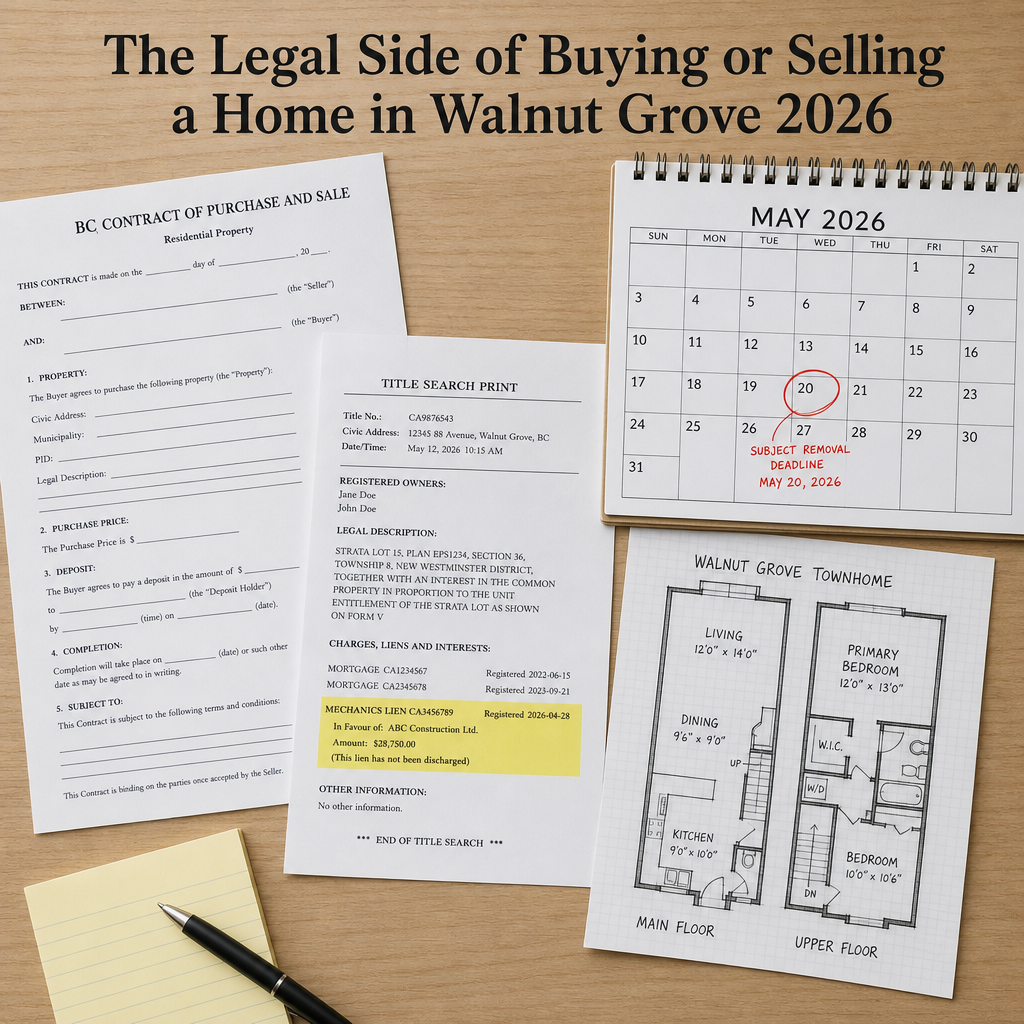

The Legal Side of Buying or Selling a Home in Walnut Grove 2026: Complete Guide to Contracts of Purchase and Sale, Subject Removal Timeline, Title Searches, Conveyancing, and Common Disputes
By Mohamed Mansour, MBA and Associate Broker — Mansour Real Estate Group | Published: May 6, 2025 | Fraser Valley and Langley, BC
Most buyers and sellers in Walnut Grove understand the broad shape of a real estate transaction. An offer is made, accepted, and eventually a deal closes. What is less understood — and what causes the most anxiety and the most costly mistakes — is what happens legally between accepted offer and completed title transfer. This guide is written for homeowners and buyers in Walnut Grove who want to understand exactly what they are signing, when the critical deadlines fall, and what can go wrong.
Walnut Grove's spring 2026 market adds specific legal complexity. Elevated new construction inventory, builder incentive phase-outs, and strata depreciation report cycles mean more transactions here involve builder liens, presale assignments, and Form B timing issues than in most established Fraser Valley neighbourhoods. Understanding those mechanics before signing protects both sides.
Short Answer
In BC, a signed and accepted Contract of Purchase and Sale is legally binding. Buyers typically have 5 to 14 days to satisfy subject conditions — financing, inspection, strata document review — before the deal becomes firm. A title search will reveal builder liens, easements, and tax arrears. A notary or lawyer then handles conveyancing to transfer title at the Land Title Office. In Walnut Grove specifically, builder liens and depreciation report timing are the two issues most likely to delay or complicate closing.
Who This Applies To
- Buyers purchasing a new construction or recently completed townhome in Walnut Grove
- Sellers listing a strata property with an upcoming depreciation report or special levy
- Buyers reviewing a Contract of Purchase and Sale for the first time and unsure what subjects to include
- Buyers entering subject removal in a compressed timeline with financing not yet confirmed
- Anyone dealing with a presale assignment, builder lien, or incomplete title registration
When This Advice May Not Apply
Commercial properties, leasehold titles, bare land strata, and presale contracts with developer-specific terms operate under different legal frameworks. Any transaction involving active litigation, estate administration, or court-ordered sale requires independent legal advice tailored to those circumstances. Nothing in this article substitutes for advice from a BC notary or lawyer on your specific contract.
Key Takeaways
- A signed Contract of Purchase and Sale in BC is binding — subjects give buyers limited escape windows, not unlimited time to decide.
- Subject removal deadlines of 5 to 14 days require buyers to move fast on financing, inspections, and Form B review simultaneously.
- Title searches in Walnut Grove frequently reveal builder mechanics' liens that must be resolved before or at closing.
- Conveyancing involves Property Transfer Tax, mortgage registration, and Land Title Office filing — delays in any step can trigger penalties.
- Strata depreciation report timing and special levy disputes are the most common post-offer legal friction points in Walnut Grove strata sales.
Definitions
Contract of Purchase and Sale (CPS): The legally binding agreement between buyer and seller setting out price, terms, subjects, and completion date. Once accepted, both parties are bound.
Subject conditions: Clauses that allow a buyer to exit the contract if a specific condition — financing approval, satisfactory inspection, acceptable strata documents — is not met by a stated deadline.
Subject removal: The buyer's written confirmation that all conditions are satisfied and the contract is now firm. Missing this deadline means the offer collapses and the deposit is returned.
Title search: A search of the Land Title Office records for a specific property, revealing registered owners, mortgages, liens, easements, and encumbrances.
Mechanics' lien (builder's lien): A legal claim registered against a property title by a contractor or supplier who has not been paid. Common in Walnut Grove's new construction market.
Conveyancing: The legal process of transferring ownership from seller to buyer, handled by a notary or lawyer, involving title transfer, mortgage registration, tax calculation, and fund disbursement.
Form B: A standard BC strata document package required in every strata sale, disclosing financial status, bylaws, meeting minutes, insurance, and depreciation report availability.
Property Transfer Tax (PTT): A provincial tax paid by the buyer on completion. First-time buyer exemptions may apply. As of 2026, the general rate is 1% on the first $200,000, 2% on the portion up to $2 million, and 3% above that. Consult a notary or the BC government for current thresholds and exemptions.
Data Used in This Article
- BC Land Title Act — Official / Government of BC — Land Title Office procedures and lien registration
- Strata Property Act (BC) — Official / Government of BC — Form B requirements and depreciation report obligations
- BC Financial Services Authority (BCFSA) — Regulator — Contract standards and subject removal protocols
- Mansour Real Estate Group market analysis — Internal / professional experience — Walnut Grove strata and builder lien patterns, spring 2026
What the Contract of Purchase and Sale Actually Commits You To
The Contract of Purchase and Sale is not a letter of intent. Under BC law, once a seller accepts a buyer's offer in writing, both parties are legally bound to its terms. The contract specifies the purchase price, the completion date, the possession date, the deposit amount, and any subject conditions. The deposit — typically 5% in Walnut Grove transactions — is held in trust by the listing brokerage and is at risk if a buyer defaults on a firm contract.
Subject conditions are the safety valves. A financing subject gives the buyer an exit if their lender declines the mortgage. An inspection subject allows exit if the home inspection reveals material defects. A strata documents subject — essential for any Walnut Grove townhome purchase — allows exit if the Form B, depreciation report, or meeting minutes reveal financial risk the buyer cannot accept.
What subjects do not do is extend indefinitely. Each is tied to a written deadline. If that deadline passes without the buyer either removing the subject or issuing a written notice that the condition was not met, the legal outcome depends on the exact wording of the contract — and the situation becomes a dispute. This is one of the most common errors we see in spring markets when buyers are managing multiple offers simultaneously.
Subject Removal in Walnut Grove: Why the Window Is Tighter Than Buyers Expect
Subject removal windows in BC are negotiated — but in practice, sellers in Walnut Grove's spring 2026 market are pushing for 5 to 7 days, not the 10 to 14 days that was common in slower conditions. That compressed window means a buyer must confirm financing approval, book and complete a home inspection, and receive and review the full strata document package — all within the same week.
Strata document review deserves particular attention. Under BC's Strata Property Act, the strata corporation must provide the Form B Information Certificate and associated documents within 7 days of a written request. If the request goes in the day after offer acceptance, the documents may not arrive until day 7 or 8 — and the subject removal deadline may be day 7. Buyers and their agents need to request strata documents immediately after offer acceptance, not after several days of other due diligence.
For new construction or recently completed buildings in Walnut Grove, the depreciation report cycle adds another layer. BC strata corporations with five or more strata lots must obtain a depreciation report at least every three years, or pass a waiver resolution annually. The July 1 annual deadline for depreciation report updates means that a purchase completed in spring 2026 may be working from a report that is close to its renewal date. Buyers should note the report date, whether it has been waived, and whether major capital expenditures are flagged in the near term. For more detail on what these fees mean month to month, see Walnut Grove strata fees explained.
Title Searches and Builder Liens in Walnut Grove's New Construction Market
A title search is conducted through the BC Land Title Office and reveals everything registered against a specific property: the current owner, any mortgages or lines of credit, easements, rights-of-way, covenants, and any liens or encumbrances. In an established detached neighbourhood, title searches are generally clean. In Walnut Grove's new construction and recently completed inventory, mechanics' liens are a recurring issue.
Under BC's Builders Lien Act, contractors and suppliers who have not been paid for work on a property can register a lien against title. These liens take priority and must be discharged before a buyer can take clean title. In practice, this means a lien discovered at the pre-closing title search must be resolved by the seller's lawyer — either by paying the claim or by holding funds in trust pending resolution — before the Land Title Office will register the transfer. If the lien amount is disputed or the seller refuses to address it, closing is delayed or the deal collapses.
Walnut Grove's current wave of new construction completions — documented in the neighbourhood development overview — means buyers should ask their notary or lawyer to conduct a title search early in the subject period, not only at the pre-closing stage. Discovering a lien after subject removal, on a firm contract, puts the buyer in a significantly weaker position.
Other title issues that appear in Walnut Grove transactions include property tax arrears (the seller is responsible for these up to the adjustment date), easements for utility access, and building scheme covenants registered by the developer that restrict future alterations or use. None of these are necessarily deal-breakers, but buyers need to understand what is on title before they remove subjects.
How Conveyancing Works and Where Delays Happen
Conveyancing is the process by which a BC notary or lawyer transfers legal ownership from seller to buyer. It begins once subjects are removed and the contract is firm. The conveyancer for the buyer orders a title search, calculates Property Transfer Tax, prepares the mortgage documents, coordinates with the seller's notary, and files the transfer at the Land Title Office on the completion date.
The completion date is when money moves and title transfers. The possession date — typically one to three days later in Walnut Grove transactions — is when the buyer gets the keys. Both dates are set in the contract and are legally binding. If the buyer's mortgage instructions are late, if the bank wire is delayed, or if a title issue is discovered the day before closing, the completion date is at risk. Sellers can charge penalty interest on delayed closings, and in extreme cases, a defaulting buyer can lose their deposit.
For buyers reviewing the full legal and financial checklist for a Walnut Grove purchase, the key conveyancing deadlines are: notary/lawyer retained within 48 hours of subject removal, mortgage instructions confirmed at least 5 business days before closing, and final title search confirmed clear 24 to 48 hours before completion.
Common Disputes in Walnut Grove Transactions
Builder warranty disputes: Walnut Grove's newer strata buildings are covered by BC Housing's 2-5-10 new home warranty (2 years on labour and materials, 5 years on building envelope, 10 years on structural defects). When buildings approach warranty expiration — particularly the 5-year building envelope milestone — buyers may discover that a claim is in progress, disputed, or expired without repairs being completed. Sellers are obligated to disclose known defects, but disputes arise over what was known and when. Buyers purchasing near warranty expiration should review any open warranty claims as part of their strata document review.
Special levy surprises: Under BC's Strata Property Act, a seller must disclose a special levy that has been voted on by the strata corporation before the contract date. What sellers sometimes fail to understand — and what buyers sometimes fail to verify — is whether a special levy is under discussion but not yet voted on. That distinction matters legally. If a levy is approved after subject removal on a firm contract, the buyer is generally responsible for it unless the contract specifically addresses this scenario.
Incomplete title registration from the developer: Some recently completed Walnut Grove strata units have delayed strata plan registration — meaning the unit does not yet have its own legal title parcel at the time of purchase. This is a specific legal situation requiring a presale assignment contract rather than a standard CPS and carries different completion mechanics. Buyers in this situation need a lawyer, not a notary, and the process is more complex than a standard resale purchase.
Deposit disputes on collapsed deals: When a buyer removes subjects and then cannot complete — most often because financing falls apart at the last stage — the deposit held in trust is at risk. BC's rules on deposit release in disputed situations require either mutual release signed by both parties or a court order. Sellers cannot simply direct the brokerage to release a deposit without the buyer's consent or a legal ruling. These disputes can take months to resolve and are genuinely costly for both sides.
How We Evaluate This
When working with buyers and sellers in Walnut Grove, Mansour Real Estate Group approaches the legal mechanics of a transaction as preparation work, not paperwork. Before an offer is drafted, we review what is publicly known about the building's title history, any open strata litigation, and the depreciation report status. We recommend buyers retain a notary or lawyer before subject removal — not after — so that a title search can be ordered during the subject period. For sellers, we review the strata's financial documents and any outstanding work orders before listing, so there are no surprises in the disclosure package that could give a buyer cause to exit. Early preparation consistently reduces the friction between accepted offer and clean close.
Buyer Checklist: From Accepted Offer to Completed Title
- Retain a notary or real estate lawyer within 48 hours of offer acceptance — not after subject removal
- Request the full strata document package (Form B, depreciation report, meeting minutes, financial statements) immediately after offer acceptance
- Ask your notary or lawyer to order a title search during the subject period — confirm no builder liens, tax arrears, or incomplete registration
- Confirm mortgage approval in writing, not just verbal pre-approval, before removing the financing subject
- Review the depreciation report date and any flagged capital expenditures before removing the strata documents subject
- Confirm whether any special levies have been voted on or are under discussion with the strata council
- Ensure mortgage instructions reach your notary or lawyer at least 5 business days before the completion date
- Confirm a clean final title search 24 to 48 hours before completion
What We Commonly See
In our experience, the most preventable delay in Walnut Grove strata transactions is a buyer who waits until day five or six of a seven-day subject period to request strata documents. The strata corporation has up to seven days to respond under the Strata Property Act, which means the documents may arrive after the subject deadline has already passed — forcing the buyer to either extend subjects (if the seller agrees) or remove them without completing their review.
A common mistake is treating subject removal as the finish line rather than the starting gun for conveyancing. Once subjects are removed, the deal is firm and the clock on the completion date is running. Buyers who wait a week after subject removal to retain a notary or confirm mortgage instructions often find themselves in a compressed closing where errors become more likely and lender timelines become tight.
What often happens with builder lien discoveries is that buyers panic and assume the deal is dead. In most cases, a lien registered against a Walnut Grove new construction property can be resolved by the seller's lawyer holding the disputed amount in trust at closing, allowing title to transfer cleanly. The deal can still close — but only if everyone communicates quickly and the lawyers have enough time to coordinate. Discovering a lien three days before closing leaves very little room.
Questions and Answers
If a buyer misses the subject removal deadline in BC, what happens?
Legally, if the buyer neither removes subjects nor provides written notice that a condition was not met, the contract may be considered lapsed or in breach depending on the exact wording. This is a disputed area that can result in deposit loss or litigation. Always issue written notice in writing before the deadline if you cannot proceed.
Who is responsible for a special levy approved after an accepted offer in BC?
If a special levy is voted on by the strata after the contract date but before completion, responsibility depends on the contract's specific terms. Some contracts include clauses allocating post-offer levies to the seller. Without such a clause, the buyer typically inherits the levy. This is worth clarifying in writing before removing strata document subjects.
Can a builder's lien prevent a home from closing in BC?
Yes. The Land Title Office will not register a title transfer if an unresolved lien is registered against the property. In most cases, the seller's lawyer can resolve this by paying the lien claim at closing or holding disputed funds in trust under a court order or agreement. Early discovery — during the subject period — gives the seller time to resolve it without delaying closing.
In Summary
A BC Contract of Purchase and Sale is a legal commitment from the moment of acceptance. Subject conditions give buyers a defined window — typically 5 to 14 days in Walnut Grove's current market — to verify financing, inspect the property, and review strata documents before the deal becomes firm. Title searches during the subject period protect buyers from inheriting builder liens, tax arrears, and registration gaps. Conveyancing must be set in motion immediately after subject removal, with mortgage instructions and a clear title confirmed before the completion date. In Walnut Grove specifically, the issues most likely to delay or derail a transaction are builder liens on new construction titles, depreciation report timing conflicts, and special levy surprises discovered after subjects are removed. Early legal engagement — before subject removal, not after — is the single most effective protection for both buyers and sellers.
Ready to Talk Through Your Walnut Grove Transaction?
If you have questions about a specific contract, a subject removal timeline, or a title issue in Walnut Grove, Mansour Real Estate Group can provide honest, grounded guidance based on real experience in this market. There is no pressure and no obligation — just practical help when you need it.
Related Articles
- How to Sell Your Walnut Grove Home Fast: A Step-by-Step Strategy for Sellers
- Legal and Financial Checklist for Buying a Home in Walnut Grove: From Offer to Completion
- Understanding BC Assessment Values for Walnut Grove Properties: What They Mean for Buyers and Sellers
Official Resources
- BC Land Title Act — Government of BC
- Strata Property Act — Government of BC
- BCFSA — Contracts and Forms for BC Real Estate Licensees
- Builders Lien Act — Government of BC
About Mansour Real Estate Group
When a buyer or seller in Walnut Grove encounters a contract subject deadline, a title issue, or a strata disclosure they do not fully understand, the quality of guidance they receive from their real estate team shapes the outcome. The legal mechanics of a BC transaction — contracts, subject removal, title transfers, and conveyancing — are manageable when you have a team that has been through them hundreds of times. Mansour Real Estate Group has been guiding buyers and sellers through Walnut Grove and Langley real estate transactions for more than 22 years, with direct experience in new construction closings, strata documentation review, and the builder lien and depreciation report issues specific to this neighbourhood.
Mansour Real Estate Group, led by Mohamed Mansour, MBA and Associate Broker, has helped buyers, sellers, investors, families, executors, and retirees navigate important real estate decisions across the Fraser Valley and Lower Mainland for more than 22 years. Ranked among the Top 1% of Realtors in the region, the team has completed more than $780 million in residential real estate transactions and is trusted for seller strategy, strata transactions, estate sales, downsizing, relocation, and complex real estate decisions throughout Langley, Walnut Grove, and the Fraser Valley.
Whether someone is searching for a Walnut Grove real estate agent who understands strata document review and builder lien risk, a
Final Thoughts
Navigating the British Columbia real estate market requires knowledge, patience, and the right support. Whether you're a first-time buyer, seasoned investor, or seller, understanding market trends and local conditions empowers you to make confident decisions. Connect with experienced professionals who know your community and can guide you through every step of your real estate journey.
Disclaimer: This article is for informational purposes only and does not constitute legal, financial, or real estate advice. Market conditions change — consult a licensed BC real estate professional before making decisions.



