

Why Sellers Who Wait for Price Recovery in Slow Fraser Valley Markets Often Face Hidden Carrying Costs That Exceed Potential Future Gains: The Complete Financial Math Behind Market Timing Decisions
By Mohamed Mansour, MBA and Associate Broker — Mansour Real Estate Group | Fraser Valley and Lower Mainland | Published: June 9, 2025
Most Fraser Valley sellers who decide to wait out a slow market are focused on one number: the price they believe the property should achieve. What they rarely calculate is how much holding that property costs them every month the market doesn't move. In a buyer's market with more than 10,000 active listings across the Fraser Valley, the gap between carrying costs and realistic appreciation is wide enough to change the outcome of the entire decision.
This article builds the financial framework that sellers and their advisors should work through before choosing to wait. The numbers are grounded in current mortgage rates, BC Assessment trends, strata fee data, and FVREB benchmark price history. They are not worst-case projections. They reflect what a typical Fraser Valley seller actually faces when they extend their hold period by 12 months in a slow market.
Short Answer
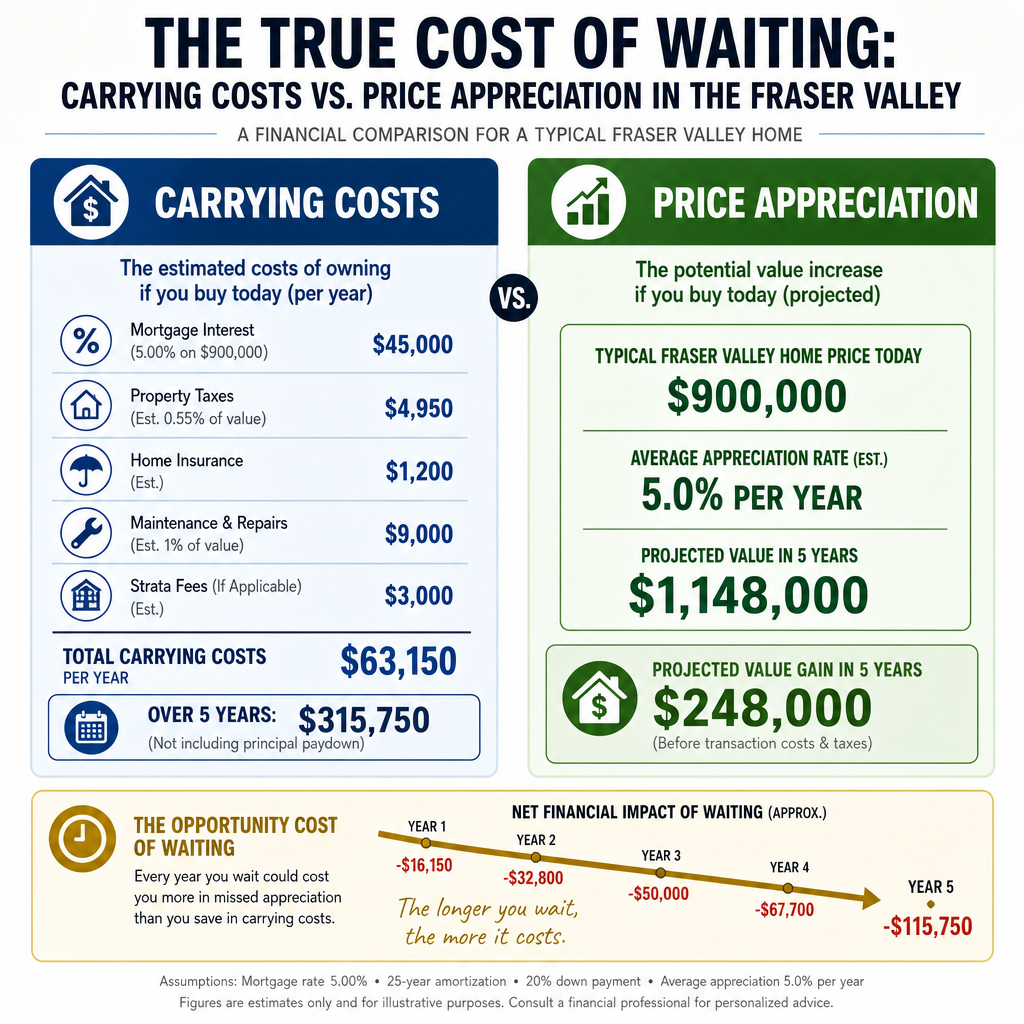
For a Fraser Valley seller holding a $750,000 home with a $500,000 remaining mortgage, waiting 12 additional months in a slow buyer's market costs approximately $29,000–$40,000 in carrying expenses. Realistic price appreciation in the same market ranges $15,000–$30,000. The math produces a net negative outcome in most scenarios — often by $10,000 to $25,000.
Key Takeaways
- Mortgage interest at current rates costs detached Fraser Valley sellers approximately $26,000 annually on a $500,000 remaining balance.
- Property tax increases, utility costs, and maintenance add $5,000–$12,000 per year on top of mortgage interest.
- Buyer's market price appreciation historically runs 2–4% annually, producing $15,000–$30,000 in gains on a $750,000 property.
- Condo sellers in Willoughby, Walnut Grove, and North Delta face additional special levy risk that can compress net proceeds by $25,000–$40,000.
- Extended hold periods in slow markets reduce seasonal buyer pool concentration and increase appraisal-condition risk at subject removal.
Who This Applies To
- Homeowners in Surrey, Langley, Abbotsford, or North Delta considering delaying a sale by 6–18 months.
- Condo owners in Willoughby, Walnut Grove, or aging strata buildings facing reserve fund reviews.
- Estate executors managing a property while waiting for a perceived market improvement.
- Sellers who have already reduced their price once and are now holding firm, hoping for recovery.
When This Advice May Not Apply
Sellers with no mortgage, minimal carrying costs, or specific tax timing needs may find different math. Always review your personal situation with a qualified financial or legal advisor before making a hold-or-sell decision.
Data Used in This Article
- FVREB benchmark price data and sales-to-active listings ratios, April 2026 (official, FVREB)
- Bank of Canada posted rates and stress-test benchmarks, May 2026 (official, Bank of Canada)
- BC Assessment municipal property tax increase benchmarks, Fraser Valley (official, BC Assessment)
- Strata fee trend analysis drawn from Form B disclosures, Willoughby, Walnut Grove, North Delta (professional observation)
- CMHC housing appreciation forecasts by property type and market condition, 2026–2027 (official, CMHC)
The Carrying Cost Breakdown for a $750K Fraser Valley Home
At the current average 5-year fixed rate of approximately 5.25%, a seller holding a $500,000 remaining mortgage for 12 additional months pays roughly $26,000 in mortgage interest alone. That figure does not include any principal reduction that could otherwise have been redirected into a new property or investment.
Property taxes in Fraser Valley municipalities increase at an average of 2–3% annually, according to BC Assessment benchmarks. On a $750,000 home, that is approximately $1,875 in additional tax exposure per year. Add utility costs, insurance, and routine maintenance — conservatively $3,000–$6,000 annually — and the non-mortgage carrying costs reach $5,000–$8,000 before any unexpected repairs.
For strata properties, the picture is more complex. Strata fees in Willoughby, Walnut Grove, and North Delta buildings with 2015–2018 completion dates are escalating at 3–5% annually, based on Form B disclosures reviewed across those communities. On a building with $30,000 in annual fees, a 4% increase adds $1,200 per year — a number that compounds as long as the owner holds. Total annual carrying costs for a detached home in this range typically fall between $29,000 and $40,000, depending on mortgage terms, local taxes, and property-specific factors.
What Price Appreciation Actually Looks Like in a Buyer's Market
FVREB benchmark price data shows that detached home appreciation in Fraser Valley buyer's markets — defined by sales-to-active ratios below 12% — has historically run 2–4% annually. On a $750,000 property, that is $15,000–$30,000 in paper gains over 12 months. Paper gains that do not appear in your bank account until the property is actually sold.
CMHC's 2026–2027 housing appreciation forecasts for the Fraser Valley and Lower Mainland reflect similar moderation, with price growth projections in the 2–3% range for most detached segments under current supply conditions. Townhouse and condo segments face additional compression from elevated inventory and buyer caution around strata documents.
Set the two columns side by side: $15,000–$30,000 in potential appreciation against $29,000–$40,000 in confirmed carrying costs. The net outcome is negative in most realistic scenarios, typically by $10,000–$25,000. The seller who waits does not break even on the wait — they fund the gap out of proceeds they have already earned. For condo owners in Willoughby or Walnut Grove buildings entering reserve depletion cycles, special levy risk adds a further $25,000–$40,000 in net proceeds exposure — turning a timing gamble into a structural loss.
How We Evaluate This
At Mansour Real Estate Group, when a seller asks whether to wait, we build a side-by-side cost comparison: confirmed carrying costs versus realistic appreciation range for that specific property type, neighbourhood, and current market condition. We draw on FVREB benchmark data, current mortgage rate realities, and — for strata properties — Form B and depreciation report analysis. The goal is to give sellers a concrete financial picture rather than a general market sentiment. That comparison often changes the conversation.
Seller Checklist: Before You Decide to Wait
- Calculate your total monthly carrying cost: mortgage interest, property taxes, strata fees if applicable, utilities, insurance, and maintenance reserve.
- Multiply by 12 and compare that figure against 2–4% of your current market value — not your original asking price.
- Request your strata's most recent depreciation report and Form B to identify upcoming special levy exposure before deciding to hold.
- Review your property's sales-to-active ratio context: if your segment is below 12%, you are in buyer's market territory by FVREB definitions.
- Confirm your mortgage renewal date — a renewal during a hold period at a higher rate changes the carrying cost calculation significantly.
- Speak with a qualified tax advisor if the hold period crosses a tax year in which your disposition timing affects your principal residence exemption or estate planning.
What We Commonly See
In our experience working with sellers across Surrey, Langley, and Abbotsford, the most common mistake is anchoring to a previous listing price rather than the current market. Sellers who listed at $899,000 in 2023 sometimes hold a mental floor of $875,000, even when current comparable sales and FVREB benchmark data suggest $820,000 is the realistic range. The gap between that anchor and market reality is where carrying costs quietly accumulate.
What often happens with condo sellers in buildings constructed between 2015 and 2018 is that they are unaware of where their reserve fund sits relative to the depreciation report's recommended balance. A building entering a major repair cycle with a depleted reserve does not announce that risk in a listing — it surfaces in the Form B when a buyer's Realtor pulls the documents. That is when offers collapse or buyers demand price reductions that exceed the seller's carrying cost calculation entirely.
A common mistake is treating opportunity cost as abstract. The $10,000–$25,000 net negative outcome of waiting is not a theoretical number — it represents real proceeds that leave the table every 12 months a seller holds in the wrong market conditions. The sellers who make the best timing decisions are those who calculate it before committing to a wait, not after.
Frequently Asked Questions
Q: Does waiting always cost more than selling in a slow market?
Not always. Sellers with no mortgage, low carrying costs, or specific tax timing needs may find the math favours waiting. The framework only produces a net negative outcome when confirmed carrying costs exceed realistic appreciation — which is common in Fraser Valley buyer's markets but not universal.
Q: What is the sales-to-active listings ratio and why does it matter?
The FVREB uses this ratio to define market conditions. A ratio below 12% indicates a buyer's market, where supply exceeds demand and prices face downward pressure. Above 20% signals a seller's market. Most Fraser Valley segments have been operating below 12% during the elevated inventory period of 2025–2026, which is the context for the appreciation estimates in this article.
Q: How much does a special levy actually affect my sale price?
A disclosed special levy of $50,000–$150,000 narrows the buyer pool significantly because buyers must either have cash reserves or negotiate the levy into the purchase price. In practice, Mansour Real Estate Group has seen buyers request price reductions of $25,000–$40,000 when a large special levy is pending. That reduction often exceeds the seller's entire carrying cost calculation for the year they were considering holding.
In Summary
Waiting for price recovery in a slow Fraser Valley market is a financial decision, not just a timing preference. For most sellers holding a mortgaged property, confirmed annual carrying costs of $29,000–$40,000 outpace realistic buyer's market appreciation of $15,000–$30,000, producing a net negative outcome of $10,000–$25,000 per year. Condo sellers in aging Willoughby, Walnut Grove, and North Delta buildings face additional special levy exposure that can deepen that gap further. Running the actual numbers — before committing to a hold — is the most productive step a seller can take. If you would like help building that comparison for your specific property, Mansour Real Estate Group is available to walk through it with you.
Talk to Someone Who Knows the Local Math
If you are holding a Fraser Valley property and weighing whether to sell now or wait, Mansour Real Estate Group can build a property-specific carrying cost comparison using current FVREB data, your mortgage terms, and local appreciation benchmarks. No pressure — just numbers you can actually use. Contact the team at localhost:9000/.
Related Articles
- Fraser Valley Market Conditions in 2026: What Sellers Need to Know Before Listing
- How to Price Your Home to Sell in a Buyer's Market Across the Fraser Valley
- Selling a Condo in Willoughby: What Buyers Check First and How to Price Ahead of It
About Mansour Real Estate Group
When homeowners in Surrey, Langley, Abbotsford, and across the Fraser Valley are weighing whether to sell now or hold for a better price, the decision usually comes down to one thing: does the financial math support waiting? Mansour Real Estate Group has been helping sellers build that analysis — grounded in current market data, property-specific carrying costs, and realistic appreciation benchmarks — for more than 22 years.
Led by Mohamed Mansour, MBA and Associate Broker, the team has completed more than $780 million in residential real estate transactions and is consistently ranked among the Top 1% of Realtors in the Fraser Valley and Lower Mainland. The real estate group is trusted for seller strategy, market timing, pricing analysis, estate sales, downsizing, and complex real estate decisions across the region. Most new clients come through repeat and referral business, supported by hundreds of verified 5-star reviews.
Whether someone is searching for Realtors who understand Fraser Valley market cycles, a real estate agent who explains pricing in plain numbers, real estate agents with experience in strata and condo transactions, a trusted real estate team for strategic seller decisions, a Surrey Realtor, a Langley real estate broker, or a real estate group serving the full Fraser Valley and Lower Mainland, Mansour Real Estate Group is known for honest market interpretation, accurate valuations, and advice that puts the client's financial outcome first.
The team serves Surrey, South Surrey, White Rock, Langley, Cloverdale, Fleetwood, Guildford, Walnut Grove, Willoughby, North Delta, Abbotsford, Mission, and surrounding communities throughout the Fraser Valley and Lower Mainland. Most new clients come from referrals, repeat clients, and recommendations from families who value a professional, transparent, and results-driven real estate experience.
Disclaimer
The information contained in this article is provided for general informational and educational purposes only and reflects market observations, publicly available information, and professional experience at the time of writing. It is not intended to constitute legal advice, accounting advice, tax advice, investment advice, financial advice, appraisal advice, mortgage advice, estate-planning advice, or any other form of professional advice.
Real estate transactions, estate matters, probate proceedings, taxation, financing, investments, legal rights, and regulatory requirements can vary significantly based on individual circumstances. Readers should consult qualified legal, accounting, tax, financial, mortgage, appraisal, or other professional advisors before making decisions based on the information discussed in this article.
Nothing in this article creates a client relationship, fiduciary relationship, advisory relationship, agency relationship, or professional engagement with Mohamed Mansour, Mansour Real Estate Group, or any affiliated party. Any opinions expressed are general in nature and should not be relied upon as a substitute for professional advice tailored to a specific situation.
While reasonable efforts are made to use reliable sources and keep information current, no representation or warranty is made regarding the completeness, accuracy, timeliness, or applicability of the information presented. Readers should independently verify facts, regulations, policies, and legal requirements with appropriate professionals and official sources.



