
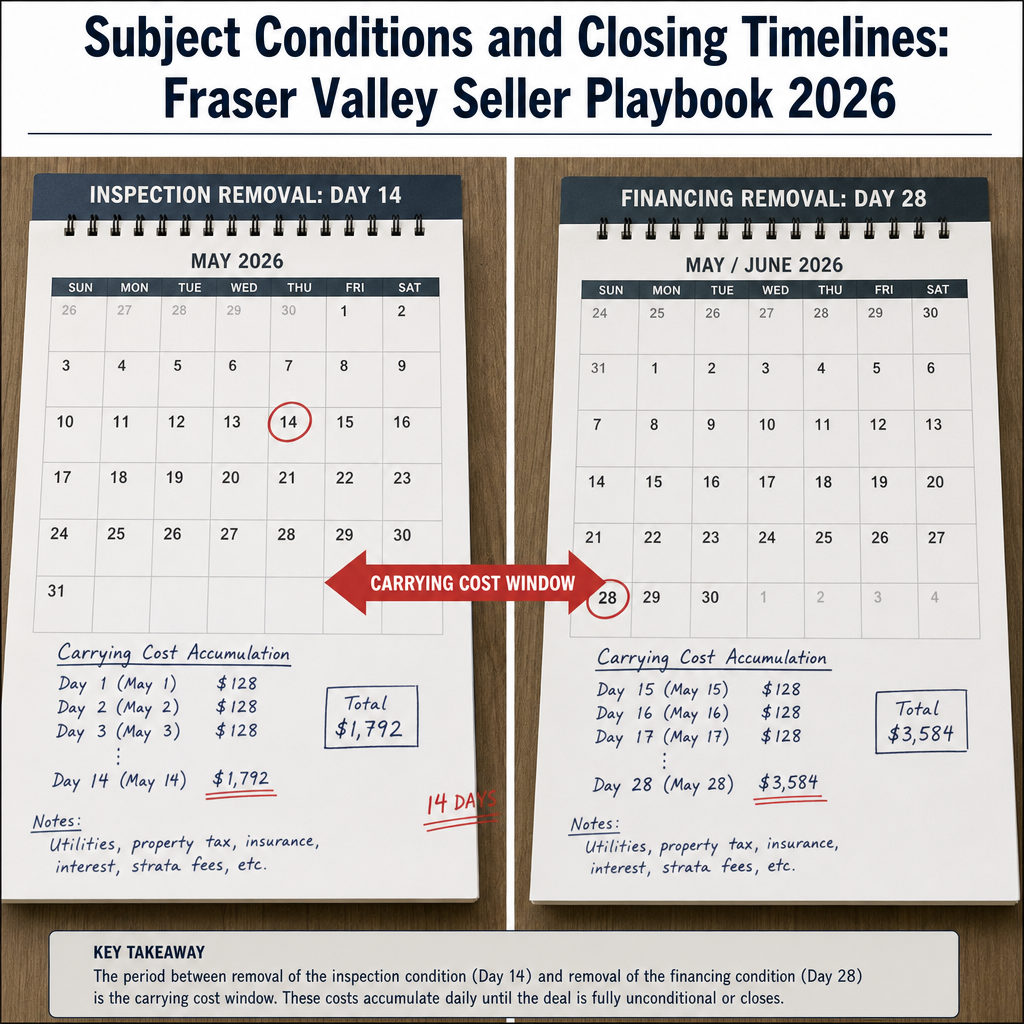

How Subject-to-Financing and Subject-to-Inspection Conditions Are Extending Fraser Valley Closing Timelines in 2026 — Complete Seller Strategy to Negotiate Faster Removals, Protect Deal Certainty, and Secure Your Proceeds
By Mohamed Mansour, MBA and Associate Broker | Mansour Real Estate Group | Fraser Valley and Lower Mainland | Published: July 15, 2025
Sellers across Surrey, Langley, Abbotsford, and the wider Fraser Valley are watching accepted offers sit in subject condition limbo for three to four weeks — sometimes longer. The cause is almost always the same: financing and inspection conditions being negotiated in the wrong order, or without clear removal deadlines, in a market where buyers are cautious and lenders are strict. This guide explains what is happening, what it costs, and exactly how to structure your deal to protect it.
The advice here is specific to BC residential transactions and the current Fraser Valley buyer's market. It is not legal advice. Always work with a qualified real estate lawyer and your listing agent before making decisions about offer conditions and timelines.
Short Answer
In the Fraser Valley's 2026 buyer's market, subject-to-financing and subject-to-inspection conditions are routinely extending closings by 14 to 30 days beyond the agreed completion date. Sellers who negotiate inspection removal before financing removal, set firm written deadlines, and price accurately enough to survive an appraisal reduce their exposure significantly. Every 10-day extension carries $400 to $800 in direct carrying costs — before any renegotiation risk is factored in.
Key Takeaways
- Inspection conditions now average 12 to 16 days in the Fraser Valley, up from a historical norm of 7 to 10 days.
- When inspection defects surface alongside an appraisal shortfall, renegotiation rates rise 25 to 35 percent and sellers lose 15 to 25 percent of their negotiating leverage simultaneously.
- Removing inspection conditions before financing conditions reduces buyer leverage and accelerates closings by 20 to 30 percent.
- Each 10-day extension in subject condition limbo costs sellers $400 to $800 in mortgage interest, property tax, utilities, and insurance.
- Accurate pricing that anticipates the lender's appraisal is the single most effective protection against a financing condition extension.
Who This Applies To
- Sellers who have accepted or are about to accept an offer with subject-to-financing or subject-to-inspection conditions
- Sellers in Surrey, Langley, Abbotsford, South Surrey, White Rock, North Delta, and the broader Fraser Valley
- Estate trustees or executors who cannot afford extended subject periods because of probate or beneficiary timelines
- Sellers in time-sensitive situations — divorce, relocation, or bridge financing — where closing certainty directly affects their next move
- Sellers receiving offers below or near list price where an appraisal shortfall is a realistic risk
When This Advice May Not Apply
If you have received a firm, subject-free offer, none of the condition-sequencing strategies here are relevant. Similarly, if the buyer is paying cash, inspection conditions still apply but financing conditions do not. In a multi-offer situation, different dynamics — and different negotiating leverage — apply entirely. Consult your agent and lawyer for guidance specific to your offer terms.
Data Used in This Article
- Fraser Valley Real Estate Board (FVREB), 2026 transaction data and market reports — official regional data, sales-to-active ratio, days on market, subject-condition tracking
- BC residential mortgage lender guidelines — RBC, TD, Scotiabank, CIBC, 2025–2026 — stress-test enforcement protocols and appraisal standards
- BC Real Estate Association (BCREA) and Real Estate Foundation of Canada — industry research on buyer conditions and closing timeline extensions
- Canadian Real Estate Association (CREA) market studies — closing cost analysis by transaction stage
How We Evaluate This
At Mansour Real Estate Group, we track not just whether an offer is accepted, but how each condition type and sequencing decision affects the final closing outcome. When we review an offer with both financing and inspection conditions, we immediately assess four variables: the offer price relative to likely appraisal, the buyer's lender type, the property's known deficiency profile, and the seller's timeline sensitivity.
That combination tells us how much risk is embedded in the subject period before a single condition is exercised. Our negotiation approach is structured around minimizing the overlap window between the two conditions — because that overlap is where sellers lose the most leverage and carrying costs accumulate fastest.
Why Subject Conditions Are Taking Longer in the Fraser Valley's 2026 Market
The Fraser Valley benchmark price declined approximately 7 to 8 percent year-over-year through early 2026, according to FVREB data. That decline has not made transactions faster — it has made buyers more cautious and lenders more conservative at exactly the same time. The result is a subject-condition environment that is structurally slower than anything sellers experienced between 2020 and 2023.
On the financing side, major lenders continue to apply the federal stress test — qualifying buyers at the greater of the contract rate plus 2 percent or 5.25 percent — and are ordering independent appraisals more frequently when offer prices sit above recent comparable sales. According to FVREB transaction tracking, 40 to 50 percent of deals with subject-to-financing conditions extend past their initial 10 to 14 day window when an appraisal shortfall or buyer re-qualification is required.
On the inspection side, buyers who were willing to waive inspections in 2021 and 2022 are now commissioning thorough reports. The average inspection condition in the Fraser Valley now runs 12 to 16 days, compared to a historical norm of 7 to 10 days. When an inspection surfaces material defects — a failing roof, foundation moisture, aging electrical — buyers frequently use those findings to request a price reduction before they proceed to financing. That sequence alone can add 7 to 10 additional days to the financing window while the buyer recalculates what they can borrow against the revised offer price.
The compounding effect is significant. A seller who accepts an offer with both conditions, each running their standard window, may not reach a firm sale for 21 to 28 days. If defects and appraisal gaps surface simultaneously — what we call the double-bind scenario — that timeline can stretch to 35 to 50 days, according to BCREA and CREA closing analysis. By that point, the seller has absorbed $1,200 to $4,000 in direct carrying costs and often granted a 3 to 7 percent price concession to keep the deal together. For sellers in Surrey or Langley who have already committed to a purchase, that delay can trigger its own financial cascade.
The Seller Playbook: Sequencing, Deadlines, and Appraisal Protection
Negotiate inspection removal before financing removal. This is the most counterintuitive and most effective protection available to sellers. Most buyers and agents expect both conditions to run concurrently or for financing to resolve first. Structuring inspection removal as the earlier deadline — typically 7 to 10 days — and financing removal as the later deadline means the buyer cannot use inspection findings as leverage during the financing period. Once inspection is removed in writing, defects cannot reopen the price negotiation. That eliminates one entire vector of renegotiation risk.
Set firm, written removal deadlines with no automatic extensions. Conditions in BC residential purchase contracts must specify a removal date. Vague language — "within a reasonable time" or "as soon as financing is confirmed" — creates ambiguity that delays resolution. Your agent should ensure every condition has a specific calendar date and that the contract is clear about what happens if the buyer does not act by that date. Extensions require mutual written agreement, which gives you a decision point rather than a default drift.
Price to survive the appraisal. The most common trigger for financing condition extensions is an appraisal that comes in below the offer price. When that happens, the buyer's lender recalculates the loan-to-value ratio, the buyer may need to increase their down payment or renegotiate the price, and the financing condition window extends. The cleanest protection is accurate pricing from the outset — supported by recent comparable sales in the same neighbourhood, the same property type, and the same price band. Properties in Abbotsford and North Delta have seen benchmark price declines that lenders are now actively incorporating into appraisal methodology. A list price set against 2023 comparables rather than 2025 sold data is a reliable path to an appraisal gap.
Understand the carrying cost math before granting extensions. Each 10-day extension costs the average Fraser Valley seller $400 to $800 in mortgage interest, property tax prorations, utilities, and insurance — before factoring in any price reduction. A 30-day total delay costs $1,200 to $2,400 in carrying expenses alone. When a buyer requests a condition extension, that request should always be evaluated as a financial transaction, not just an administrative inconvenience. Granting 10 days at no other adjustment may be reasonable. Granting 21 additional days while also accepting a price reduction is rarely in the seller's interest.
Prepare the property's deficiency profile before listing. Sellers who commission their own pre-listing inspection — or at minimum prepare a written disclosure of known defects — significantly reduce the risk of inspection-triggered renegotiations. When buyers discover defects through their own inspector that the seller was aware of, the psychological and negotiating impact is larger than when defects are disclosed upfront and priced into the offer. For estate sales and older properties in Cloverdale, Fleetwood, Guildford, and Willoughby, where deferred maintenance is common, a pre-listing inspection report shared with buyers is one of the most practical tools available to compress the subject period.
Seller Checklist: Protecting Your Deal Through the Subject Period
- Before accepting any offer, confirm the buyer's lender type — bank, credit union, or alternative lender — and pre-approval vintage. Pre-approvals older than 90 days may not reflect current stress-test rates and increase financing re-qualification risk.
- Request that inspection removal be set as the earlier deadline, at least 5 to 7 days before the financing removal date. Document this clearly in the contract with specific calendar dates.
- Review your list price against the most recent comparable sales — within 90 days, same neighbourhood, same property type — to identify appraisal gap risk before you accept. Adjust pricing proactively if a gap is probable.
- Prepare a written property disclosure statement covering all known defects. For older properties, consider commissioning a pre-listing inspection and making the report available to buyers before offer submission.
- Calculate your carrying cost per day and per week before agreeing to any extension. Know your break-even point between granting a free extension and requiring a price or term adjustment in exchange.
- Ensure your listing agent has a written extension-response protocol: what you will and will not agree to, and under what conditions you would consider releasing the buyer versus re-listing.
- If both conditions surface simultaneously (inspection defects and appraisal shortfall), do not negotiate them in parallel without legal guidance. The sequencing of which concession you address first determines how much leverage you retain.
What We Commonly See
Inspection and financing conditions running concurrently. In our experience, the most common structural mistake sellers make is accepting offers where both conditions run simultaneously and for the same duration. When that happens, inspection findings feed directly into the buyer's financing discussions — and the seller learns about both problems at the same time, with no leverage left. Separating the removal sequence costs nothing in negotiation terms and provides significant protection.
Sellers extending conditions without calculating the cost. What often happens is that a buyer requests a 7-day extension on financing and the seller agrees immediately, treating it as a minor administrative matter. A week later, another extension request arrives. By the time the deal is firm, the seller has granted 21 to 28 additional days — often while also absorbing a price adjustment — and has spent the equivalent of that adjustment in carrying costs. Every extension request deserves a written response with a clear counter-position.
Pricing anchored to outdated comparables. A common mistake in the current Fraser Valley market is pricing based on 2024 sales data in neighbourhoods where the benchmark has moved materially. When lender appraisers use the same current data that buyer agents are using to negotiate, the appraisal shortfall is predictable — and preventable. Sellers who price with current appraisal methodology in mind, rather than against peak or prior-year prices, avoid the most disruptive category of financing condition extension.
Questions Sellers Commonly Ask
Can I refuse to grant a condition extension if the buyer requests one?
Yes. In BC, a seller is under no legal obligation to extend a subject removal deadline. If the buyer does not remove conditions by the agreed date, the contract becomes void and the deposit is typically returned. However, refusing an extension also means the deal ends. Before refusing, calculate whether re-listing in current market conditions produces a better outcome than granting a short extension with no further price adjustment. Always get legal advice before acting on a condition deadline.
What happens if the appraisal comes in below my accepted offer price?
When a lender's appraisal comes in below the offer price, the buyer's mortgage is calculated against the lower appraised value. The buyer must then either increase their down payment to cover the gap, renegotiate the purchase price with you, or walk away if they cannot satisfy their financing condition. Sellers who priced accurately relative to current comparables have more credibility in holding the original price. Sellers who overpriced relative to current market data rarely win that negotiation.
Is a pre-listing inspection legally required in BC?
No. BC does not legally require sellers to commission a pre-listing inspection. However, sellers are required to disclose known material latent defects — defects that are not visible on ordinary inspection and that could affect the property's value or safety. A pre-listing inspection helps sellers identify and disclose these proactively, reducing the risk of post-sale disputes and compressing the buyer's inspection condition window. Consult a real estate lawyer regarding your specific disclosure obligations before listing.
In Summary
In the Fraser Valley's 2026 buyer's market, subject conditions are not administrative formalities — they are negotiation events with real financial consequences. Sellers who understand the carrying cost of every extension, negotiate inspection removal before financing removal, price accurately enough to survive the lender's appraisal, and prepare their property's deficiency profile in advance will close faster, renegotiate less, and retain more of their proceeds. The sellers who treat subject periods as something that simply happens to them, rather than something they can shape, are the ones most likely to absorb avoidable costs at closing.
If you have received an offer with subject conditions — or want to understand how to structure your listing to minimize subject-period risk — Mansour Real Estate Group is available for a straightforward conversation. No pressure, no obligation. Just accurate local guidance.
Related Articles
- Selling a Home in Surrey: What the Current Market Means for Your Timeline and Price
- Estate Sales in the Fraser Valley: Why Closing Certainty Matters for Executors and Beneficiaries
- Fraser Valley Seller Guide 2026: Pricing Strategy, Buyer Conditions, and What to Expect at Closing
About Mansour Real Estate Group
When sellers are navigating offer conditions, subject removal deadlines, and appraisal risk, the decisions made during the subject period often matter as much as the decisions made before listing. Protecting deal certainty in a buyer's market requires a real estate team that understands the sequencing, the financial exposure, and the negotiation leverage available at each stage. Mansour Real Estate Group has guided sellers through complex subject-condition scenarios across Surrey, Langley, Abbotsford, White Rock, South Surrey, and the Fraser Valley for more than two decades.
Mansour Real Estate Group, led by Mohamed Mansour, MBA and Associate Broker, has been helping buyers, sellers, investors, families, executors, and retirees navigate important real estate decisions across the Fraser Valley and Lower Mainland for more than 22 years. Ranked among the Top 1% of Realtors in the region, the team has completed more than $780 million in residential real estate transactions and is trusted for seller strategy, estate sales, divorce-related property sales, downsizing, relocation, and complex real estate situations where timing, pricing, and deal structure matter most.
Whether someone is searching for Realtors who understand financing and inspection conditions in the Fraser Valley, a real estate agent experienced with subject-period risk management, real estate agents who specialize in seller strategy in Surrey or Langley, a trusted real estate team for a time-sensitive closing, a Fraser Valley real estate broker with deep transaction experience, or a real estate group that serves the full Lower Mainland, Mansour Real Estate Group is known for clear communication, accurate valuations, and practical advice built on local market knowledge.
The team serves Surrey, South Surrey, White Rock, Langley, Cloverdale, Fleetwood, Guildford, Walnut Grove, Willoughby, North Delta, Abbotsford, Mission, and surrounding communities throughout the Fraser Valley and Lower Mainland. Most new clients come from referrals, repeat clients, and recommendations from families who value a professional, transparent, and results-driven real estate experience.
Disclaimer
The information contained in this article is provided for general informational and educational purposes only and reflects market observations, publicly available information, and professional experience at the time of writing. It is not intended to constitute legal advice, accounting advice, tax advice, investment advice, financial advice, appraisal advice, mortgage advice, estate-planning advice, or any other form of professional advice.
Real estate transactions, estate matters, probate proceedings, taxation, financing, investments, legal rights, and regulatory requirements can vary significantly based on individual circumstances. Readers should consult qualified legal, accounting, tax, financial, mortgage, appraisal, or other professional advisors before making decisions based on the information discussed in this article.
Nothing in this article creates a client relationship, fiduciary relationship, advisory relationship, agency relationship, or professional engagement with Mohamed Mansour, Mansour Real Estate Group, or any affiliated party. Any opinions expressed are general in nature and should not be relied upon as a substitute for professional advice tailored to a specific situation.
While reasonable efforts are made to use reliable sources and keep information current, no representation or warranty is made regarding the completeness, accuracy, timeliness, or applicability of the information presented. Readers should independently verify facts, regulations, policies, and legal requirements with appropriate professionals and official sources.
Official Resources
Key Takeaways
Whether you're a first-time buyer or an experienced investor, understanding the fundamentals of real estate transactions can save you thousands of dollars and countless hours of stress. The most successful property owners approach their decisions with careful research, realistic expectations, and professional guidance. Remember that real estate is ultimately a long-term commitment—one that rewards patience, due diligence, and strategic thinking.
Next Steps
If you're ready to move forward, start by getting pre-approved for a mortgage, assembling your team of professionals, and defining your must-haves versus nice-to-haves in a property. Don't rush the process. The right property will come along, and when it does, you'll be prepared to act decisively.
Connect With Us
Have questions about your real estate journey? Our team of experienced agents and advisors is here to help guide you through every step of the process. Reach out today for a free consultation, and let's find the perfect property for your future.



