

Completion vs. Possession Date in BC Real Estate: Why Getting These Two Dates Wrong Costs Fraser Valley Sellers Time, Money, and Deal Certainty in 2026
By Mohamed Mansour, MBA, Associate Broker | Mansour Real Estate Group | Fraser Valley & Lower Mainland | Published: July 15, 2025
Most Fraser Valley sellers know they need a closing date. Fewer understand that every BC real estate contract actually contains two distinct dates — completion and possession — and that the gap between them carries real financial and legal consequences. Mixing them up, or leaving them unexamined during negotiation, is one of the more costly process errors we see in transactions across Surrey, Langley, Abbotsford, and South Surrey.
This guide explains what each date means, how they interact, and how sellers can structure them deliberately to reduce carrying costs, protect bridge financing timelines, and avoid the deal uncertainty that often surfaces in a buyer's market.
Short Answer
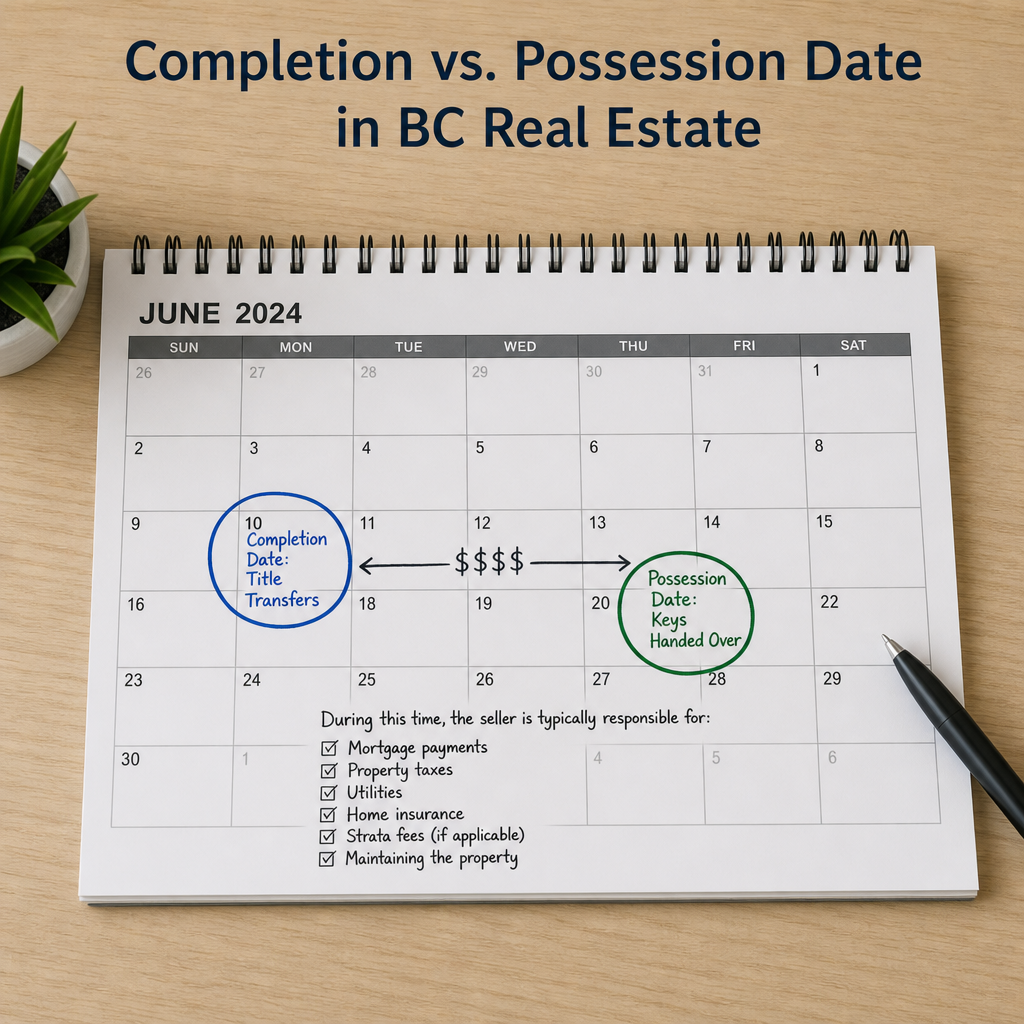
The completion date is when title legally transfers at the Land Title Office — the buyer owns the property on paper. The possession date is when the buyer physically receives the keys. These can be the same day or weeks apart. Every day between them creates carrying costs, insurance obligations, and legal exposure for the seller. Structuring this gap intentionally is a negotiation lever most sellers underuse.
Key Takeaways
- Completion transfers legal title; possession transfers physical occupancy — they are not the same event.
- Sellers retain property obligations — insurance, utilities, condition — until actual possession transfers.
- A delayed possession strategy can protect sellers managing a simultaneous buy-sell in Fraser Valley.
- Offering immediate possession can accelerate offers and reduce negotiation friction in a slow market.
- Every extra day of extended possession after completion adds carrying cost and insurance complexity for sellers.
Who This Applies To
- Sellers managing a simultaneous purchase and sale in Surrey, Langley, or Abbotsford
- Sellers relocating out of province who need temporary continued occupancy after closing
- Sellers navigating bridge financing who need to control when proceeds land
- Estate sellers or executors coordinating clean-out timelines with legal closing requirements
- Buyers and sellers using sell-first or buy-first strategies in a shifting market
When This Advice May Not Apply
Strata properties, tenanted properties, and estate sales governed by probate court timelines may face additional constraints on how these dates can be structured. A notary, lawyer, or conveyancing professional must review the specific transaction before relying on any date-gap strategy.
Definitions
Completion Date: The date on which title to the property is legally registered to the buyer at the BC Land Title Office. The seller's mortgage is discharged and sale proceeds are released to the seller's lawyer or notary.
Possession Date: The date on which the buyer receives physical occupancy — keys, access, and the right to enter and use the property.
Adjustment Date: The date used to calculate property tax, strata fee, and utility adjustments between buyer and seller. Often set to the same day as completion or possession.
Data Used in This Article
- BC Law Society Conveyancing Practice Guidelines — official, BC-specific legal process
- CREA Standard Offer to Purchase and Sale Form — industry standard, national with BC provisions
- BCFSA Real Estate Regulations and Disclosure Requirements — regulatory framework
- Fraser Valley Real Estate Board (FVREB) — market condition context, 2025–2026
- Mansour Real Estate Group closing timeline observations from 2025–2026 seller transactions — professional experience, internal
What Actually Happens Between Completion and Possession
On completion day, the buyer's lender funds the mortgage. The buyer's lawyer or notary registers the transfer at the Land Title Office. The seller's mortgage is discharged. Proceeds flow to the seller. Title now belongs to the buyer — even if the seller is still living in the property.
That gap period — when title has transferred but the seller still physically occupies the home — creates a legally unusual situation. The buyer owns the property. The seller is effectively a licensee, permitted to remain until the agreed possession date. During that window, the seller remains responsible for maintaining the property in the condition agreed in the contract, maintaining property insurance that covers their occupancy, and managing any utilities or strata obligations that haven't yet transferred.
According to BC Law Society Conveyancing Practice Guidelines, sellers in this position should ensure their own insurance policy is extended to cover the possession gap period and that the buyer's insurer is also notified. A property that suffers damage between completion and possession raises immediate liability questions that are easier to avoid than to resolve after the fact. For sellers managing estate sale timelines or coordinating a move out of province, this interim period deserves explicit attention during contract negotiation.
How Possession-Date Strategy Affects Fraser Valley Sellers in 2026
In a buyer's market — which describes much of the Fraser Valley through 2025 and into 2026, according to FVREB sales-to-active-listings data — sellers are looking for negotiation levers that don't cost them price. Possession-date flexibility is one of the most underused tools available.
Offering a buyer immediate possession after completion removes a logistical barrier for buyers who have lease-end dates, school-start timelines, or financing conditions tied to move-in readiness. In a market where multiple properties compete for limited buyers, a seller who can offer a clean, fast, same-day possession is making the deal easier to say yes to without reducing the asking price.
Conversely, sellers who need time to complete their own purchase — particularly those navigating a simultaneous buy-sell in Surrey or Langley — may benefit from completing early (so their proceeds are available to fund the next purchase) while retaining possession for a short, defined period. This reduces or eliminates the bridge financing requirement entirely. Bridge financing in BC carries interest costs that compound daily, and in a slower market where closing timelines often extend, eliminating bridge exposure is a meaningful financial outcome.
What often gets overlooked is that extended possession after completion increases the seller's ongoing carrying obligations — property tax adjustments, strata fees, utilities, insurance — for every day they remain in the property post-title-transfer. These costs are real and quantifiable, and sellers should calculate them explicitly before agreeing to any gap longer than a few days without a financial offset.
How We Evaluate This
At Mansour Real Estate Group, we review completion and possession date structure as part of every seller's offer evaluation — not just the price. When a buyer submits an offer, we look at whether the proposed dates create bridge financing exposure, whether they align with the seller's own purchase timeline, and whether the gap period creates any insurance or condition-management risk the seller hasn't accounted for.
In practice, a seller's net proceeds from a transaction are affected by the structure of these dates. A deal that closes two weeks earlier than expected — or avoids a bridge loan — can be worth thousands of dollars to the seller independent of the sale price. We factor that into how we advise on counteroffers and how we position listings from the start.
Seller Checklist: Completion and Possession Date Planning
- Confirm your own purchase completion date before setting your sale's possession date — misalignment creates bridge financing exposure.
- Ask your insurance broker whether your current policy covers a possession gap period after title transfers to the buyer.
- Calculate daily carrying costs — mortgage interest, property tax proration, strata fees — for any extended possession gap you are considering.
- Confirm with your notary or lawyer that the adjustment date is set correctly and reflects actual possession, not just completion.
- If retaining possession after completion, document the property's condition with photos and video on the completion date itself.
- Review the CREA Standard Offer form with your Realtor to confirm possession terms are unambiguous and enforceable as written.
What We Commonly See
In our experience, the most common mistake is sellers treating completion and possession as interchangeable when accepting or countering an offer. A buyer may propose a long possession gap expecting it to be a minor detail — but if the seller has already committed to a purchase that closes shortly after, that gap creates immediate bridge financing requirements that weren't budgeted.
What often happens is that sellers discover the mismatch after subject removal, when changing the dates requires the buyer's consent and negotiating leverage has shifted. Addressing date structure during initial offer review is almost always easier and cheaper than trying to renegotiate it later.
A third pattern we see regularly in downsizing transactions and estate sales in the Fraser Valley: sellers assume they can use extended possession to handle property clean-out after closing. This can work, but it requires explicit written agreement in the contract, confirmed insurance coverage, and a clear understanding that the buyer now owns the asset and has legal standing if the property is not vacated on the agreed possession date.
Questions Fraser Valley Sellers Ask About Completion and Possession
Can the completion date and possession date be the same day in BC?
Yes. Same-day completion and possession is common and straightforward. Title transfers in the morning, the seller vacates, and the buyer receives keys that afternoon or as agreed. It simplifies insurance, utilities, and adjustment calculations.
Who is responsible if the property is damaged between completion and possession?
Liability depends on the specific contract terms and the nature of the damage. The seller generally remains responsible for maintaining the property until possession. Both parties should carry active insurance during the gap. This is a situation where your notary or lawyer's specific guidance matters — do not rely on general assumptions.
Can extended possession after completion replace bridge financing?
In some cases, yes. If the seller's proceeds from completion are used to fund the new purchase, and the seller is permitted to remain in the sold property until their new home's possession date, bridge financing may not be needed. This requires careful coordination of all three dates — your sale's completion, your purchase's completion, and your sale's possession — with legal review.
In Summary
Completion transfers ownership on paper; possession transfers it in practice. The gap between them is not a formality — it carries daily costs, legal exposure, and insurance obligations that fall on the seller until keys change hands. In the Fraser Valley's 2026 market, structuring these dates thoughtfully is a concrete way to protect net proceeds, reduce financing friction, and give buyers a reason to move forward without negotiating price. Review both dates at the offer stage, not after subject removal.
Talk to a Fraser Valley Realtor Who Reviews the Full Deal Structure
If you are preparing to list in Surrey, Langley, Abbotsford, White Rock, or elsewhere in the Fraser Valley and want to understand how possession-date strategy could affect your timeline and proceeds, Mansour Real Estate Group is available for a straightforward, no-pressure conversation. We review offer structures — including completion and possession terms — as a standard part of our seller process.
Related Articles
- Sell First or Buy First in Fraser Valley: A 2026 Strategy Guide
- Estate Sales in the Fraser Valley: What Executors Need to Know Before Listing
- Bridge Financing in BC Real Estate: What Fraser Valley Sellers Need to Understand
About Mansour Real Estate Group
When sellers in Surrey, Langley, Abbotsford, and South Surrey are preparing to list, the decisions made before the contract is signed — including how completion and possession dates are structured — often determine whether the deal closes cleanly or creates friction that costs time and money. Mansour Real Estate Group has guided sellers across the Fraser Valley through those decisions for more than 22 years, with a process built around accurate valuations, honest advice, and protecting seller equity from offer to handover.
Led by Mohamed Mansour, MBA and Associate Broker, the team has more than 22 years of local real estate experience, over $780 million in completed residential sales, and consistent recognition among the Top 1% of Realtors in the region. Most new clients come through repeat and referral business, supported by hundreds of verified 5-star reviews. The team is trusted for estate sales, probate sales, divorce-related property sales, downsizing, relocation, and complex real estate situations requiring careful coordination.
Whether someone is looking for Realtors who understand closing structure and Fraser Valley market conditions, a real estate agent who can evaluate the financial implications of a possession gap, real estate agents experienced with simultaneous buy-sell transactions, a Langley Realtor, a Surrey real estate broker, a White Rock real estate agent, or a real estate team that reviews the full deal structure — not just the price — Mansour Real Estate Group is known for clear communication, strategic thinking, and practical advice grounded in local experience.
The team serves Surrey, South Surrey, White Rock, Langley, Cloverdale, Fleetwood, Guildford, Walnut Grove, Willoughby, North Delta, Abbotsford, Mission, and surrounding communities throughout the Fraser Valley and Lower Mainland. Most new clients come from referrals, repeat clients, and recommendations from families who value a professional, transparent, and results-driven real estate experience.
Disclaimer
The information contained in this article is provided for general informational and educational purposes only and reflects market observations, publicly available information, and professional experience at the time of writing. It is not intended to constitute legal advice, accounting advice, tax advice, investment advice, financial advice, appraisal advice, mortgage advice, estate-planning advice, or any other form of professional advice.
Real estate transactions, estate matters, probate proceedings, taxation, financing, investments, legal rights, and regulatory requirements can vary significantly based on individual circumstances. Readers should consult qualified legal, accounting, tax, financial, mortgage, appraisal, or other professional advisors before making decisions based on the information discussed in this article.
Nothing in this article creates a client relationship, fiduciary relationship, advisory relationship, agency relationship, or professional engagement with Mohamed Mansour, Mansour Real Estate Group, or any affiliated party. Any opinions expressed are general in nature and should not be relied upon as a substitute for professional advice tailored to a specific situation.
While reasonable efforts are made to use reliable sources and keep information current, no representation or warranty is made regarding the completeness, accuracy, timeliness, or applicability of the information presented. Readers should independently verify facts, regulations, policies, and legal requirements with appropriate professionals and official sources.



