

Abbotsford Pre-Sale Repairs: The Complete Priority Framework for Identifying Critical Defects vs. Cosmetic Issues When Budget Is Limited in a 2026 Buyer's Market
By Mohamed Mansour, MBA and Associate Broker | Mansour Real Estate Group | Fraser Valley, BC | Published: July 15, 2026 | Topic: Seller Strategy — Abbotsford
Abbotsford homeowners preparing to list in 2026 face a market with elevated inventory, cautious buyers, and active inspection contingencies. When repair budgets are limited, spending on the wrong things can leave critical defects unaddressed while money disappears into cosmetic improvements that won't recover their cost in the current market.
This framework helps Abbotsford sellers make clear, defensible decisions about where limited repair dollars produce the most protection — and where discretionary spending produces the least return.
Short Answer
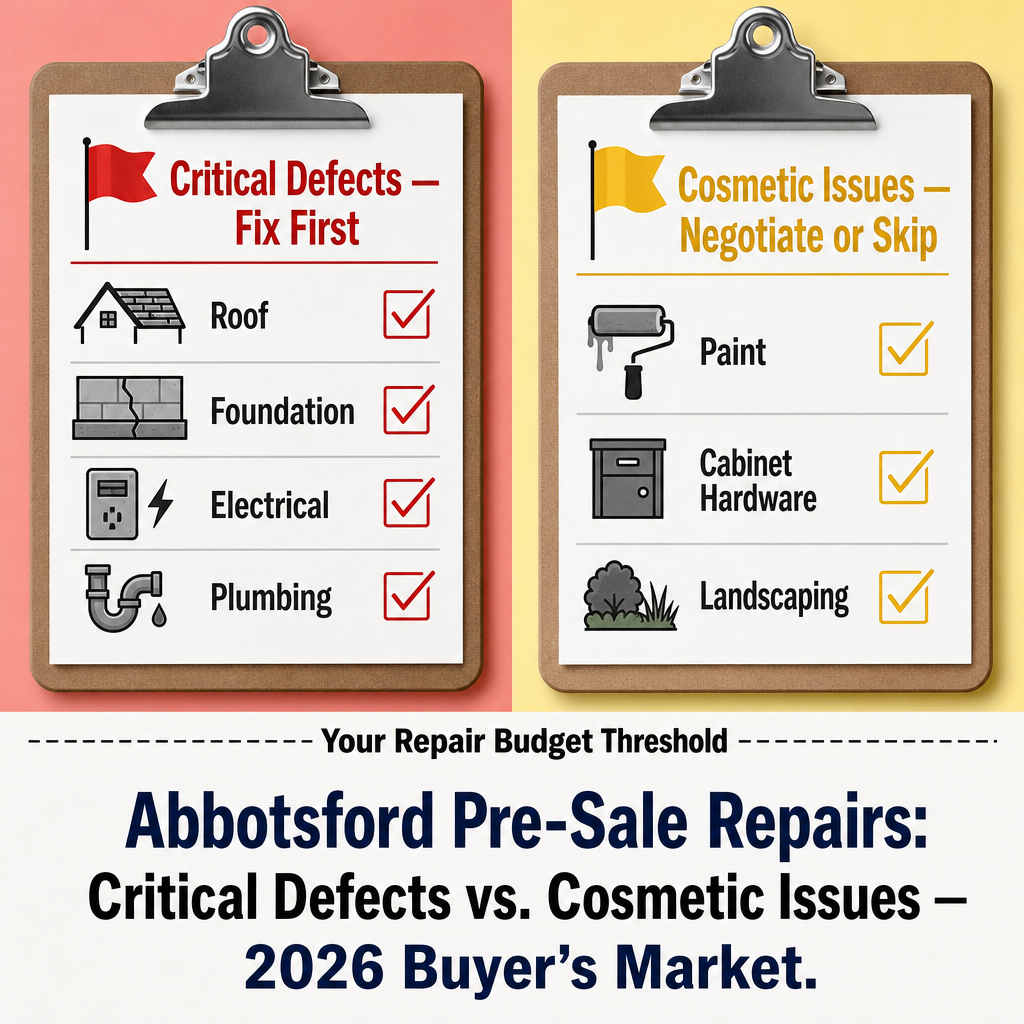
In a 2026 buyer's market, Abbotsford sellers with limited budgets should prioritize structural, roof, electrical, plumbing, and foundation defects first — these are the items that trigger lender financing denial and deal collapse. Cosmetic upgrades like paint, cabinet hardware, and landscaping typically return 40–60% of cost in current conditions and should be addressed only after critical systems are secure.
Key Takeaways
- Lenders and appraisers flag structural, roof, electrical, plumbing, and foundation defects — these can trigger financing denial regardless of cosmetic condition.
- Cosmetic upgrades return an estimated 40–60% of cost in buyer's markets — selective triage protects margin better than broad renovation spending.
- Abbotsford's pre-2000 housing stock carries elevated rates of moisture intrusion, deferred HVAC maintenance, and asbestos disclosure obligations.
- Inspection contingencies in buyer's markets extend closing timelines by 15–30 days when defects surface post-offer, increasing carrying costs and deal collapse risk.
- A documented repair history and current home inspection give buyers evidence of due diligence, reducing the emotional leverage of speculative inspection findings.
Who This Applies To
- Abbotsford homeowners preparing to list a detached home, townhome, or older property in 2026
- Sellers working with a defined repair budget of under $15,000–$25,000
- Executors or estate representatives managing a pre-2000 Abbotsford property
- Homeowners who have deferred maintenance and need to triage before listing
When This Advice May Not Apply
If your property is a newer build post-2010, has had recent major system upgrades, or sits in a higher-demand price range with limited competing inventory, the triage priorities may shift. Consult with your listing agent and a qualified home inspector before finalizing any repair plan.
Data Used in This Article
- CMHC Appraisal Standards and Lending Criteria 2026 — Official / Federal Regulator
- BC Real Estate Association Inspection Guidelines — Industry Body / BC
- Abbotsford Real Estate Board Market Data 2026 — Official Board / Regional
- Mansour Real Estate Group transaction data on inspection-triggered renegotiations — Internal Professional Analysis / Fraser Valley
Why Abbotsford's 2026 Market Changes the Repair Math
In a seller's market, buyers absorb more risk. In a buyer's market, inspection findings become negotiating tools. According to Abbotsford Real Estate Board market data for 2026, elevated active listings and extended days on market give buyers more leverage to renegotiate, extend subjects, or walk away when defects emerge. That dynamic changes which repairs are financially rational.
CMHC appraisal and lending standards are consistent regardless of market conditions: appraisers are required to flag any structural, safety, or habitability concern that materially affects property value or livability. A lender will not advance a mortgage on a property with an active roof leak, failed electrical panel, or foundation movement — regardless of how attractive the kitchen looks. In a buyer's market, those same buyers are also more likely to hire experienced inspectors who look carefully. The combination means that deferred critical repairs cost more in 2026 than they did in 2022.
Abbotsford's housing stock adds a local dimension. A large portion of detached homes in areas like Abbotsford's established neighbourhoods were built before 2000. Pre-2000 construction in BC commonly involves: original knob-and-tube or aluminum wiring in some cases, single-pane windows, aging flat or low-slope roofs, vermiculite insulation in some older attics, and moisture issues tied to crawlspaces or older drainage systems. These are not cosmetic. They are the items that appear on appraisal flagging checklists.
The Priority Framework: Three Tiers
Tier 1 — Deal-Killers (Fix Before Listing): These are defects that will surface in any competent inspection, trigger lender or appraiser concern, and give buyers grounds to cancel or renegotiate at closing. They include: active roof leaks or end-of-life roofing systems; foundation cracking with evidence of movement or water ingress; failed or unsafe electrical panels (Federal Pacific, Zinsco, and undersized panels are common flagged items in BC); active moisture intrusion in crawlspaces or basements; non-functioning or dangerous HVAC systems; and any disclosed health or safety hazard such as urea-formaldehyde foam or vermiculite with asbestos. Addressing Tier 1 items is not about improving the home — it is about keeping the deal alive. According to Mansour Real Estate Group transaction data, inspection-triggered renegotiations tied to Tier 1 issues in Abbotsford extend closing timelines by 15–30 days and carry a high rate of price reduction or deal collapse. For sellers navigating pricing strategy in Abbotsford's current market, unresolved Tier 1 defects make accurate pricing nearly impossible.
Tier 2 — Condition Concerns (Address if Budget Allows): These are issues that won't necessarily kill a deal but will appear in inspection reports, fuel buyer hesitation, and often become the basis for price reduction requests. They include: aging but functional water heaters (over 10–12 years); older but not failing plumbing fixtures; minor wood rot at window frames or fascia; inadequate attic insulation; and older but operational appliances. In buyer's markets, buyers often attach inflated estimates to Tier 2 items to justify price reductions. Addressing them selectively — especially items that photograph visibly or that inspectors consistently flag — reduces the buyer's negotiating surface area. The BC Real Estate Association inspection guidelines support disclosure of known material latent defects; Tier 2 items often sit near that line and benefit from clear documentation of condition and age.
Tier 3 — Cosmetic Issues (Negotiate or Leave As-Is): Paint, cabinet hardware, landscaping, dated light fixtures, and worn carpet are the most commonly over-invested categories in pre-sale preparation. CMHC appraisal standards do not penalize cosmetic condition unless it affects habitability. Research consistently shows cosmetic upgrades return an estimated 40–60% of cost in buyer's markets — a return that is often negative after labour and materials. Sellers who spend limited budget on Tier 3 while leaving Tier 1 items unaddressed are making the most common and costly pre-sale error in today's Abbotsford market. Buyers can imagine new paint. They cannot unsee a flagged electrical panel.
How We Evaluate This
At Mansour Real Estate Group, our pre-listing process for Abbotsford properties includes a structured walkthrough that separates system condition from cosmetic condition before any repair budget is allocated. We cross-reference visible property age indicators — roof type, electrical panel brand, crawlspace access, window generation — against common appraisal and inspection flags to identify which category each concern falls into.
We recommend a pre-listing inspection by a qualified BC home inspector before spending any money on preparation. The inspection report gives sellers an objective, documented baseline. It also allows the seller to proactively disclose known issues — a strategy that consistently reduces post-offer renegotiation in our experience working with Fraser Valley sellers across multiple market cycles.
Seller Checklist: Abbotsford Pre-Sale Repair Triage
- Order a pre-listing home inspection from a qualified BC home inspector before allocating any repair budget.
- Identify all Tier 1 (deal-killer) items from the inspection report and get contractor quotes within the first week.
- Confirm your electrical panel brand and age — Federal Pacific and Zinsco panels are active lender flags in BC and should be replaced before listing.
- Inspect the crawlspace or basement for active moisture, standing water, or visible mold — address source before staging.
- Check roof age and condition — if the system is past 20 years or showing active wear, get a roofing assessment and disclose findings.
- Document all repairs completed with receipts, contractor names, and dates — provide this package to your listing agent for buyer disclosure.
- Allocate remaining budget to Tier 2 items that appear in most inspection reports for your property type, not to cosmetic Tier 3 work.
- Review asbestos and other disclosure obligations with your agent — pre-2000 Abbotsford builds may trigger mandatory disclosure requirements under BC real estate regulations.
What We Commonly See
In our experience working with Abbotsford sellers, the most common pre-sale error is spending the available budget on visible cosmetic work — fresh paint, new fixtures, landscaping — while leaving moisture issues in the crawlspace or an aging electrical panel unaddressed. The cosmetic work photographs well. The inspection finds the panel. The buyer's agent uses it to renegotiate $15,000 off the price, or the buyer walks.
A second pattern we see regularly involves sellers over-relying on "as-is" pricing as a substitute for triage. In a seller's market, as-is pricing with wide buyer competition can work. In a 2026 buyer's market in Abbotsford, as-is listings with unresolved Tier 1 defects sit. Buyers with options do not take on structural or safety risk when comparable inventory is available without it.
A third observation: sellers who complete a pre-listing inspection and address Tier 1 items proactively tend to have shorter due-diligence periods and fewer post-offer renegotiations. Buyers who already have a clean inspection report in hand have less reason to extend subjects or request credits. That efficiency has measurable value in a market where carrying costs are real and deal certainty matters.
Questions Abbotsford Sellers Ask
What defects will cause a lender to decline financing on an Abbotsford property?
According to CMHC appraisal standards, lenders will not advance mortgages on properties with active roof leaks, structural movement, unsafe electrical systems, or evidence of health hazards such as mold or asbestos. These conditions must be remediated before financing can proceed.
Is it worth repainting and updating fixtures before listing in Abbotsford's 2026 market?
Only after Tier 1 and priority Tier 2 issues are resolved. Cosmetic updates in buyer's markets typically return 40–60% of cost. Neutral, clean presentation helps — full cosmetic renovation rarely recovers its investment when buyer leverage is high.
Should I disclose defects I'm aware of even if I'm not repairing them?
BC real estate regulations require sellers to disclose known material latent defects that are not discoverable through reasonable inspection. Failure to disclose known defects can create legal liability after closing. Consult your listing agent and a real estate lawyer for guidance specific to your property's condition.
In Summary
In Abbotsford's 2026 buyer's market, the sellers who protect their equity most effectively are those who spend repair budgets where defects would kill deals — structural, roof, electrical, plumbing, and moisture — and resist the impulse to invest in cosmetic improvements that buyers will discount or ignore. A pre-listing inspection, disciplined triage, and documented repairs give sellers their strongest position going into negotiations in a market where buyers are watching closely and walking away from uncertainty.
Talk to a Local Expert Before You Spend
If you're preparing to list an Abbotsford home and aren't sure which repairs are worth making, Mansour Real Estate Group offers a pre-listing consultation built around your property's specific condition and the current local market. There's no obligation — just a clear, honest framework so your budget goes where it matters.
Related Articles
- Fraser Valley Real Estate Market Report 2026
- How to Price Your Home to Sell in Abbotsford BC in 2026
- Selling Your Home in Abbotsford BC: What to Expect in a Changing Market
About Mansour Real Estate Group
When Abbotsford homeowners are preparing to sell — especially in a market where buyers are cautious, inspection contingencies are active, and every repair dollar matters — working with a real estate team that understands local property conditions, lender standards, and current buyer behaviour makes a measurable difference. Mansour Real Estate Group has guided sellers through pre-listing triage, strategic preparation, and difficult market conditions across Abbotsford and the broader Fraser Valley for more than two decades.
Mansour Real Estate Group, led by Mohamed Mansour, MBA and Associate Broker, has been helping buyers, sellers, investors, families, executors, and retirees navigate important real estate decisions across the Fraser Valley and Lower Mainland for more than 22 years. Ranked among the Top 1% of Realtors in the region, the team has completed more than $780 million in residential real estate transactions and is trusted for seller strategy, pre-sale preparation, estate sales, downsizing, relocation, and any real estate decision where current market conditions directly affect the outcome.
Whether someone is looking for Realtors experienced with Abbotsford property conditions, a real estate agent who understands pre-sale repair priorities, real estate agents who work with sellers navigating buyer's market dynamics, a trusted real estate team for a strategic sale in today's Fraser Valley, an Abbotsford Realtor, an Abbotsford real estate broker, or a real estate group that serves the Fraser Valley and Lower Mainland, Mansour Real Estate Group is known for honest market interpretation, evidence-based preparation advice, and guidance that protects seller equity.
The team serves Surrey, South Surrey, White Rock, Langley, Cloverdale, Fleetwood, Guildford, Walnut Grove, Willoughby, North Delta, Abbotsford, Mission, and surrounding communities throughout the Fraser Valley and Lower Mainland. Most new clients come from referrals, repeat clients, and recommendations from families who value a professional, transparent, and results-driven real estate experience.
Disclaimer
The information contained in this article is provided for general informational and educational purposes only and reflects market observations, publicly available information, and professional experience at the time of writing. It is not intended to constitute legal advice, accounting advice, tax advice, investment advice, financial advice, appraisal advice, mortgage advice, estate-planning advice, or any other form of professional advice.
Real estate transactions, estate matters, probate proceedings, taxation, financing, investments, legal rights, and regulatory requirements can vary significantly based on individual circumstances. Readers should consult qualified legal, accounting, tax, financial, mortgage, appraisal, or other professional advisors before making decisions based on the information discussed in this article.
Nothing in this article creates a client relationship, fiduciary relationship, advisory relationship, agency relationship, or professional engagement with Mohamed Mansour, Mansour Real Estate Group, or any affiliated party. Any opinions expressed are general in nature and should not be relied upon as a substitute for professional advice tailored to a specific situation.
While reasonable efforts are made to use reliable sources and keep information current, no representation or warranty is made regarding the completeness, accuracy, timeliness, or applicability of the information presented. Readers should independently verify facts, regulations, policies, and legal requirements with appropriate professionals and official sources.



