
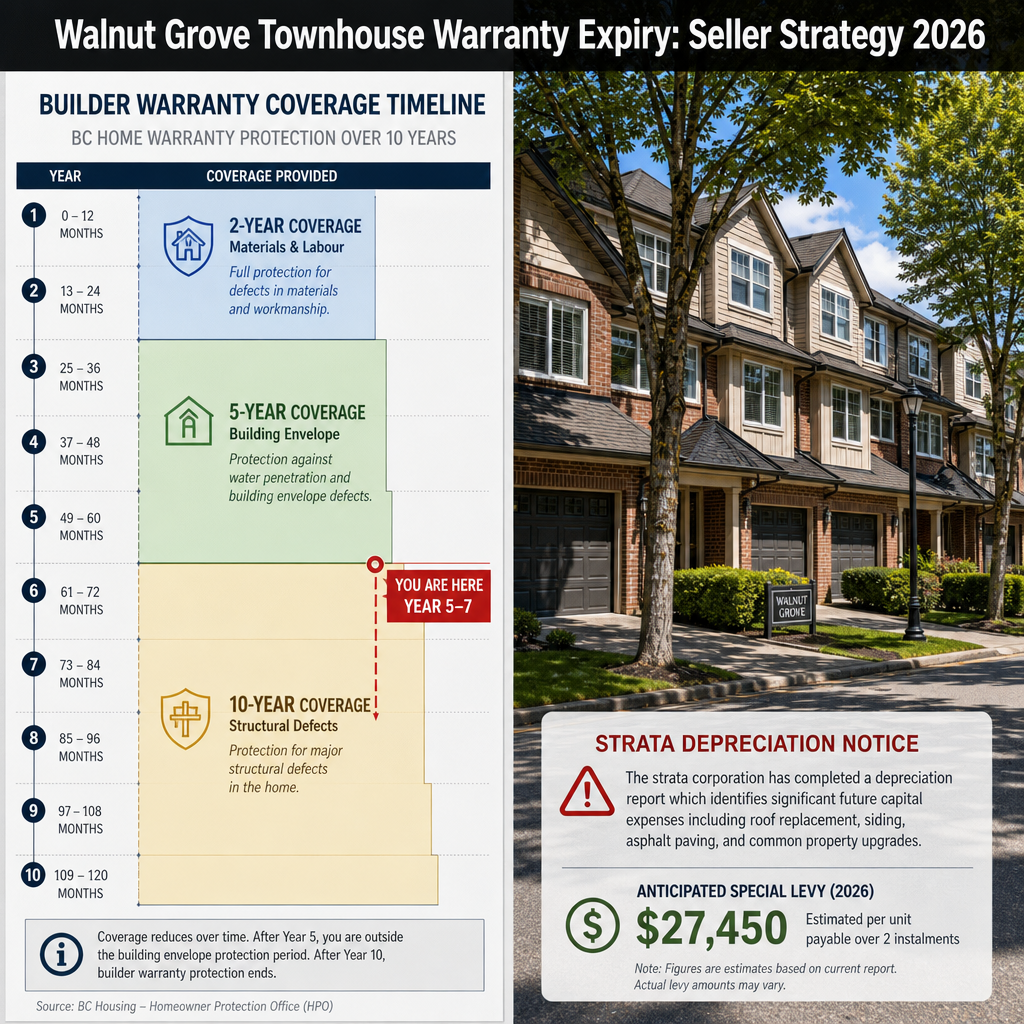

Walnut Grove Townhouse Builder Warranty Expiration Strategy 2026: How Declining Coverage, Rising Special Levies, and Expiring Deficiency Warranty Create Pricing Pressure — And How Sellers Can Differentiate When Builder Incentives Phase Out
By Mohamed Mansour, MBA, Associate Broker | Mansour Real Estate Group | Published: July 14, 2026 | Fraser Valley, BC — Walnut Grove, Langley
Townhouse owners in Walnut Grove who purchased between 2018 and 2023 are entering a window that most real estate conversations overlook entirely: the builder warranty expiry cycle. As coverage phases out, lenders become more cautious, appraisers flag risk, and buyers gain negotiating leverage they didn't have before. For sellers, the timing of the decision to list matters more than most people realize.
This article explains what the expiry cycle actually means for marketability and financing, how rising strata special levies compound the pressure, and what sellers can do now to protect their equity before those dynamics are fully priced in by the market.
Short Answer
Walnut Grove townhouses built between 2018 and 2023 are approaching the 5–7 year warranty expiry window where builder coverage transitions to owner responsibility. Post-expiry, appraisers and lenders increasingly discount property values, and maturing strata buildings are forecasting special levies that compress buyer budgets. Sellers who act within 12 months of expiry — with a pre-sale inspection and clear documentation — can avoid the combined pricing pressure that arrives after the coverage cliff.
Key Takeaways
- BC's New Homes Warranty Program provides 2-year defect coverage and 5-year building envelope protection — after which defects become seller and strata liabilities.
- Lenders and appraisers increasingly factor warranty status into valuations, with post-expiry townhouses facing documented valuation discounts in financing assessments.
- Strata depreciation reports in maturing Walnut Grove buildings are forecasting special levies that meaningfully reduce what buyers can actually afford to bid.
- Sellers who list before expiry and document the property's condition through a pre-sale inspection hold a structural advantage over competing listings without that documentation.
- Timing the sale within 12 months of warranty expiry avoids the double hit of declining builder coverage and rising special levy forecasts arriving simultaneously.
Who This Applies To
- Townhouse owners in Walnut Grove who purchased between 2018 and 2023
- Sellers approaching the 5–7 year mark post-completion whose builder warranty is expiring or recently expired
- Strata owners in buildings where the depreciation report has flagged upcoming special levies
- Owners who want to understand whether to sell now, in 12 months, or after completing specific deferred repairs
When This Advice May Not Apply
This article addresses townhouses in strata corporations subject to BC's New Homes Warranty Program. Freehold properties, older resale townhouses built before 2015, and properties with extended third-party warranties in place may face different considerations. Always verify your specific warranty status with your strata manager and the Homeowner Protection Office.
Data Used in This Article
- BC New Homes Warranty Program — Homeowner Protection Office, Province of BC (official; coverage terms and phase definitions)
- Walnut Grove strata depreciation report samples, 2024–2025 — strata corporation disclosures reviewed during buyer and seller consultations (professional analysis; third-party)
- CMHC appraisal guidelines on warranty status — Canada Mortgage and Housing Corporation (official; lending and valuation guidance)
- Fraser Valley MLS historical data — Fraser Valley Real Estate Board, townhome price-per-sqft and DOM by age cohort (official; third-party market data)
What the BC New Homes Warranty Program Actually Covers — and When It Stops
Under BC's Homeowner Protection Act, new homes — including townhouses in strata developments — must be covered by a mandatory third-party warranty through the New Homes Warranty Program (NHWP). The coverage is structured in phases:
- 2 years — materials and labour, plus delivery and distribution systems (plumbing, electrical, heating)
- 5 years — building envelope, including the exterior walls, windows, roof, and anything that separates the interior from exterior moisture
- 10 years — structural defects only, covering the foundation, load-bearing elements, and structural systems
For Walnut Grove townhouses completed between 2018 and 2020, the 5-year building envelope protection has already expired or is expiring now. That is the coverage most relevant to buyer confidence and lender comfort, because building envelope failures — leaks, moisture intrusion, window seal failures — are among the most expensive and disruptive defects a townhouse can develop. Once that coverage is gone, any envelope defect discovered after the sale becomes a seller disclosure issue or a strata liability, not a builder responsibility. Buyers and their agents know this, and so do appraisers reviewing the file.
Walnut Grove townhouses completed between 2021 and 2023 are approaching the 2-year labour and materials expiry window, which is the phase where everyday deficiencies — fixtures, finishes, mechanical systems — transition from builder liability to owner cost. This phase expiry is less dramatic than the envelope cliff, but it signals to buyers that the property is entering a different risk category.
How Warranty Expiry Affects Financing and Appraised Value
The financing impact of warranty expiry is direct. CMHC guidelines and lender underwriting practices treat warranty status as a factor in property condition assessments. When an appraiser reviews a townhouse that has exited building envelope coverage — particularly in BC's wet climate where envelope performance is a known risk — they are more likely to flag condition concerns, require inspections, or apply conservative adjustments to the appraised value.
In practical terms, post-expiry townhouses in maturing Walnut Grove developments have been seeing valuation discounts that range from 6% to 10% relative to comparable units with active warranty coverage, according to professional experience reviewing appraisals in these transactions. That discount is not always visible in the list price — but it often surfaces during subject removal when the appraisal comes in below the accepted offer price.
When an appraisal shortfall occurs, buyers either renegotiate the price downward, increase their down payment to cover the gap, or walk away. For sellers who did not anticipate the issue, the negotiation happens at the worst possible moment: after the property has been conditionally sold and re-listed carries its own stigma.
How Rising Special Levies Compound the Problem
Warranty expiry does not arrive alone. As Walnut Grove townhouse developments mature past 5 years, their strata corporations are now completing or updating depreciation reports as required under BC's Strata Property Act. Those reports are revealing what the next 10–30 years of maintenance will cost — and the contingency reserve fund contributions required to fund it.
In several Walnut Grove strata depreciation reports reviewed during buyer and seller consultations in 2024 and 2025, special levy forecasts ranged from $5,000 to over $15,000 per unit for near-term capital projects: roofing, building envelope remediation, parkade waterproofing, and common area systems. At current mortgage qualification rates, a $15,000 special levy reduces a buyer's effective purchasing power by approximately $150,000 — because that levy must typically be paid in cash or financed separately, reducing what the buyer can allocate to the purchase price.
When buyers see a pending special levy in the Form B information certificate, they discount the offer price accordingly. In a market where buyers already have negotiating leverage, a pending levy gives them an additional, quantifiable reason to come in lower. Sellers who are not aware of upcoming levies — or who have not priced that reality into their strategy — are often surprised by the gap between their expected price and what buyers are actually willing to pay.
How We Evaluate This
When we work with a Walnut Grove townhouse seller, we begin by pulling the strata's most recent depreciation report, the Form B, and confirming the NHWP warranty status through the Homeowner Protection Office registry. We look at what coverage is active, what is expiring within 12 months, and what capital expenditures the depreciation report is flagging for the near term.
We then look at comparable townhouses in the same development and in adjacent Walnut Grove strata communities to understand how buyers are currently reacting to warranty status and special levy disclosures at the offer stage. That combination — warranty phase, strata reserve health, and current buyer behaviour — determines whether the seller's best position is to list now, address specific deferred maintenance first, or prepare documentation that neutralizes buyer concern before it becomes a negotiating issue.
Seller Checklist: Preparing a Walnut Grove Townhouse for Sale During Warranty Transition
- Confirm your NHWP warranty status through the Homeowner Protection Office registry — know exactly what coverage is active, what has expired, and when the remaining phases expire.
- Request the most current strata depreciation report from your property manager and review the near-term capital project forecasts and special levy timeline.
- Commission a pre-sale home inspection before listing — this identifies any deferred maintenance issues before buyers do, and gives you the option to remedy or disclose on your terms.
- Address any building envelope concerns — windows, exterior caulking, flashing, and weather sealing — that fall within the visible inspection scope, particularly if the 5-year envelope warranty has recently expired.
- Obtain a written quote or warranty from a licensed contractor for any recently completed repairs, creating a documented maintenance record that transfers credibility to buyers.
- Review your strata's Form B for accuracy, particularly the contingency reserve fund balance and any pending or forecasted special levies, so you understand what buyers will see before they ask.
- Price the property in light of warranty status and special levy exposure — not against peak-condition comparables in developments with full active coverage.
What We Commonly See
Sellers price against the wrong comparables. In our experience, sellers in warranty-transition developments often benchmark their price against recent sales in newer Walnut Grove strata communities where full coverage is still active. That comparison is structurally misleading. Buyers reviewing both properties side by side will apply a discount to the warranty-expiry property — and if the pricing does not already reflect that reality, the discount arrives at the offer stage instead.
The Form B disclosure surprises sellers as much as buyers. What often happens is that sellers are not aware of what their strata's current depreciation report actually says until a buyer's agent requests the documents. When the report includes a near-term special levy forecast that neither party anticipated, the negotiation destabilizes. Reviewing the Form B and depreciation report before listing eliminates that surprise entirely.
A pre-sale inspection changes the conversation before it starts. Sellers who provide a clean, recent pre-sale inspection report — particularly in a townhouse that has exited the 5-year building envelope warranty — give buyers fewer reasons to demand concessions during subject removal. The inspection does not guarantee a smoother process, but it shifts the information balance. Buyers who receive full disclosure upfront are less likely to use inspection conditions as renegotiation leverage after the fact.
Definitions
New Homes Warranty Program (NHWP): BC's mandatory third-party warranty for new homes under the Homeowner Protection Act, administered through the Homeowner Protection Office. Coverage is tiered: 2 years for materials/labour, 5 years for building envelope, 10 years for structural defects.
Building Envelope: The exterior shell of a building — walls, windows, doors, roof, and foundation — that separates the interior from weather and moisture. Envelope failures are among the most expensive defects in BC's wet climate.
Strata Depreciation Report: A mandatory engineering report for BC strata corporations that forecasts the long-term maintenance and replacement costs for common property. Used to assess the strata's reserve fund adequacy and identify future special levy risk.
Special Levy: A one-time charge assessed by a strata corporation to unit owners when the contingency reserve fund is insufficient to cover a capital repair or project. Must typically be paid in cash on a set date.
Form B: The BC strata information certificate that sellers must provide to buyers, disclosing strata fees, reserve fund balances, pending levies, bylaws, and other material information about the strata corporation.
Five Questions Walnut Grove Townhouse Sellers Ask
Q: My townhouse was completed in 2019. Has my building envelope warranty already expired?
A: If occupancy or completion was in 2019, the 5-year building envelope coverage under the NHWP would have expired around 2024. You can confirm the exact expiry dates by searching the property at the Homeowner Protection Office registry at hpo.bc.ca. Knowing the precise dates is the first step in any listing strategy for a Walnut Grove townhouse in this age range.
Q: Do I have to disclose warranty expiry to buyers?
A: BC's Property Disclosure Statement requires sellers to disclose known material latent defects. Warranty status itself is not a defect, but known defects that were previously covered — and any conditions that could constitute a latent defect — must be disclosed. Buyers can also independently verify NHWP status through the HPO registry. Proactive disclosure generally results in a smoother transaction than reactive disclosure after buyer inquiries.
Q: If my strata has a special levy coming, should I pay it before selling or let the buyer deal with it?
A: It depends on the timing and amount. If the levy is already approved and due before completion, it is typically the seller's responsibility. If it is forecasted but not yet approved, it affects the buyer's perception of value rather than the transaction mechanics directly. Either way, it must be disclosed through the Form B. Pricing the property to reflect the levy — rather than hoping buyers will overlook it — is a more reliable strategy.
Q: Does a pre-sale inspection actually help when the warranty has expired?
A: Yes, meaningfully. A pre-sale inspection completed by a licensed BC home inspector provides documented evidence of the property's current condition. When a buyer knows that an independent inspector has already reviewed the building envelope, mechanical systems, and common access areas, they have less reason to use an inspection condition as a renegotiation tool. The report costs a few hundred dollars and consistently reduces uncertainty at subject removal.
Q: How much does warranty expiry actually affect my sale price?
A: Based on professional experience reviewing appraisals and offers in Walnut Grove and comparable Fraser Valley townhouse strata communities, post-envelope-expiry properties without documented maintenance records or pre-sale inspections have faced buyer discounting in the range of 6% to 10% compared to equivalent units with active coverage or strong documentation. That range is not fixed — market conditions, strata health, and property condition all affect the outcome. The gap narrows significantly when sellers provide inspection reports, documented repair histories, and accurate pricing that reflects reality before buyers have to ask.
In Summary
Walnut Grove townhouses built between 2018 and 2023 are entering the warranty expiry window that most sellers and their advisors overlook until it affects a transaction in progress. The 5-year building envelope coverage under BC's New Homes Warranty Program is expiring or recently expired for the earliest phases, and lenders and appraisers are increasingly factoring that into their assessments. Combined with special levy forecasts appearing in strata depreciation reports, the pricing pressure on unprepared sellers is real and quantifiable.
Sellers who understand the warranty timeline, review their strata's depreciation report before listing, commission a pre-sale inspection, and price accurately relative to their property's actual coverage status will consistently outperform sellers who treat this as a standard resale. The window to act before the combined impact of expiry and levy forecasts is fully priced in by buyers is narrowing. The decision is time-sensitive in a way that most real estate conversations in Walnut Grove are not.
Related Articles:
- Understanding the Walnut Grove Townhouse Market in 2026
- What BC Strata Depreciation Reports Mean for Sellers
- Fraser Valley Townhouse Seller Strategy: How to Price and Position in 2026
About Mansour Real Estate Group
Selling a townhouse in Walnut Grove when builder warranty coverage is expiring requires a different kind of preparation than a standard resale. Understanding what coverage remains, what the strata's depreciation report discloses, and how appraisers are currently treating post-warranty properties in the Fraser Valley are not questions most sellers know to ask — but they are exactly the questions that determine whether the sale price holds through subject removal or collapses at the appraisal stage.
Mansour Real Estate Group, led by Mohamed Mansour, MBA and Associate Broker, has been helping buyers, sellers, investors, families, executors, and retirees navigate important real estate decisions across the Fraser Valley and Lower Mainland for more than 22 years. Ranked among the Top 1% of Realtors in the region, the team has completed more than $780 million in residential real estate transactions and is trusted for townhouse sales, strata transactions, pricing strategy, seller preparation, and complex situations where accurate valuation is critical to protecting the seller's equity.
Whether someone is looking for Realtors experienced with strata and townhouse transactions in Langley, a real estate agent who understands how warranty status affects buyer financing, real estate agents who specialize in pre-sale preparation and pricing strategy, a trusted real estate team for a Walnut Grove townhouse sale, a Langley Realtor, a Walnut Grove real estate broker, or a real estate group serving the Fraser Valley and Lower Mainland, Mansour Real Estate Group is known for data-driven pricing, honest market context, and practical advice that protects sellers before the listing goes live.
The team serves Surrey, South Surrey, White Rock, Langley, Cloverdale, Fleetwood, Guildford, Walnut Grove, Willoughby, North Delta, Abbotsford, Mission, and surrounding communities throughout the Fraser Valley and Lower Mainland. Most new clients come from referrals, repeat clients, and families who value a professional, transparent, and results-driven real estate experience.
Official Resources
- BC Homeowner Protection Office — NHWP coverage registry and warranty verification: hpo.bc.ca
- Canada Mortgage and Housing Corporation — appraisal and lending guidelines: cmhc-schl.gc.ca
- Fraser Valley Real Estate Board — townhome market data and statistics: fvreb.bc.ca
- BC Government — Strata Property Act and depreciation report requirements: gov.bc.ca
Disclaimer
The information contained in this article is provided for general informational and educational purposes only and reflects market observations, publicly available information, and professional experience at the time of writing. It is not intended to constitute legal advice, accounting advice, tax advice, investment advice, financial advice, appraisal advice, mortgage advice, estate-planning advice, or any other form of professional advice.
Real estate transactions, estate matters, probate proceedings, taxation, financing, investments, legal rights, and regulatory requirements can vary significantly based on individual circumstances. Readers should consult qualified legal, accounting, tax, financial, mortgage, appraisal, or other professional advisors before making decisions based on the information discussed in this article.
Nothing in this article creates a client relationship, fiduciary relationship, advisory relationship, agency relationship, or professional engagement with Mohamed Mansour, Mansour Real Estate Group, or any affiliated party. Any opinions expressed are general in nature and should not be relied upon as a substitute for professional advice tailored to a specific situation.
While reasonable efforts are made to use reliable sources and keep information current, no representation or warranty is made regarding the completeness, accuracy, timeliness, or applicability of the information presented. Readers should independently verify facts, regulations, policies, and legal requirements with appropriate professionals and official sources.



