
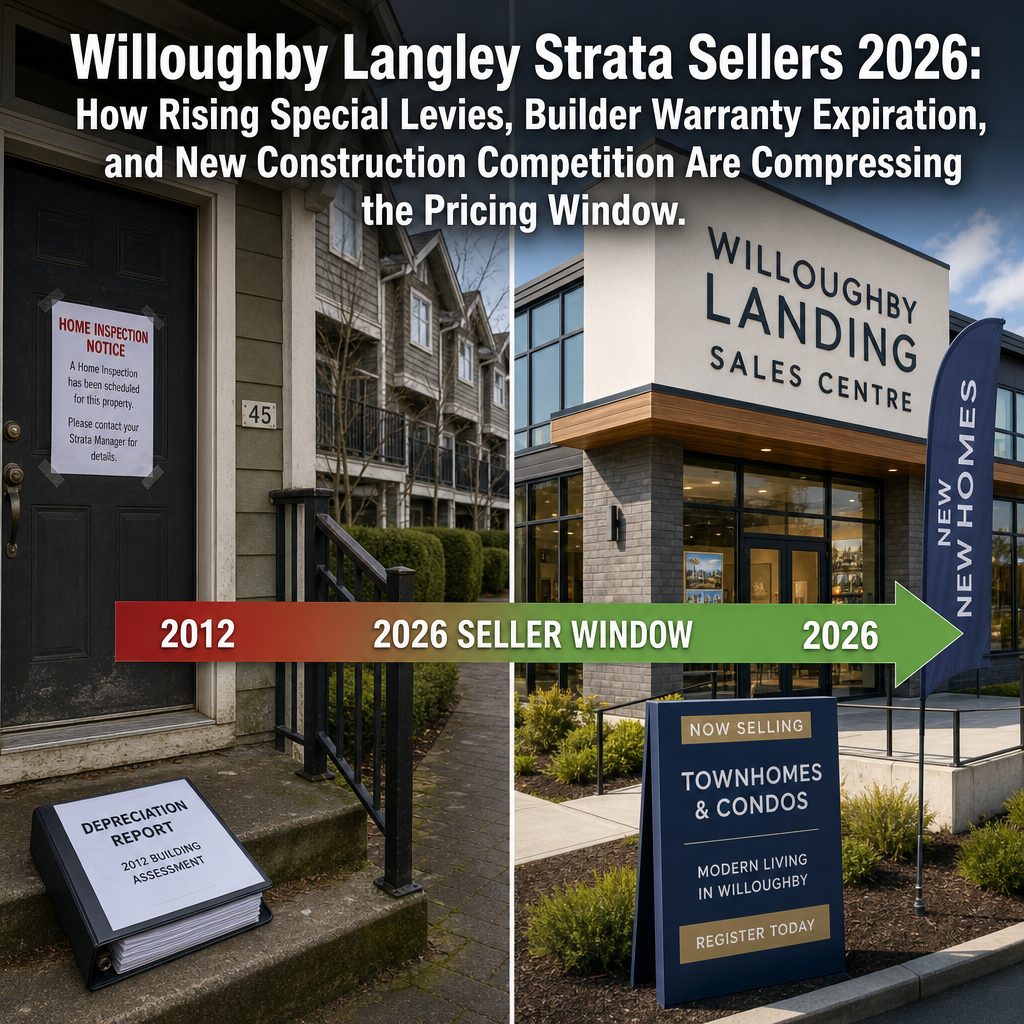

Willoughby Langley Strata Property Sellers 2026: How Rising Special Levies, Builder Warranty Expiration, and New Construction Competition Are Compressing the Pricing Window — Strategic Tactics to Maximize Proceeds When Comparable Units Multiply
By Mohamed Mansour, MBA and Associate Broker — Mansour Real Estate Group | Fraser Valley & Lower Mainland | Published June 2026
Willoughby has been one of the most active strata markets in the Fraser Valley for the better part of a decade. The townhouse communities built between 2010 and 2015 attracted first-time buyers, young families, and investors who wanted new construction value in a rapidly developing neighbourhood. In 2026, many of those same owners are facing a convergence of pressures that did not exist when they bought — and the sellers who understand those pressures now will protect significantly more equity than those who don't.
This article is for owners of Willoughby strata units — particularly townhouses and attached homes built between 2010 and 2015 — who are considering selling in 2026 or early 2027. It explains what is compressing pricing, why the window to act is narrowing, and what a strategic approach looks like before the summer disclosure deadline arrives.
Short Answer
Willoughby strata sellers in 2026 face three simultaneous headwinds: builder warranties expiring on 2010–2015 units, a wave of new construction completions creating direct competition, and the July 1 depreciation report and special levy disclosure deadline forcing buyers to confront deferred maintenance costs. Sellers who list and close before these factors converge will typically achieve stronger prices than those who wait.
Key Takeaways
- Builder warranties on 2010–2014 Willoughby strata units are expiring now, triggering mandatory inspections and reserve fund studies that slow buyer financing and compress appraised values.
- New construction completions in Willowbrook, Walnut Grove, and Burke Mountain arriving Q2–Q3 2026 are pulling first-time buyers and downsizers away from resale strata.
- The July 1 BC Strata Property Act disclosure deadline forces sellers to reveal special levies and reserve fund depletion, which triggers financing denial in roughly one-quarter of transactions.
- Days-on-market for aging Willoughby strata has increased 35–45% year-over-year as new inventory absorbs buyer attention, according to FVREB April–May 2026 sales data.
- Sellers who price accurately, resolve strata documentation issues early, and list before the summer competition wave hit are best positioned to protect their proceeds.
Who This Applies To
- Owners of Willoughby townhouses or strata units built between 2010 and 2015 who are planning to sell in 2026 or early 2027
- Investors holding Willoughby strata property who are evaluating whether to exit before the new construction wave peaks
- Downsizers or growing families who bought in Willoughby a decade ago and are now navigating a more complex resale environment
- Executors or estate representatives managing a strata property in the Willoughby area with an upcoming timeline
When This Advice May Not Apply
Strata units built after 2017 carry different warranty timelines and are less likely to face the same inspection and reserve fund pressures described here. Units in newer Willoughby phases with strong reserve funds and recently updated depreciation reports may face less pricing compression. This article focuses on the 2010–2015 cohort specifically.
Data Used in This Article
- FVREB April–May 2026 market data — sales-to-active ratio and days-on-market trends for Willoughby attached housing (official board data)
- BC Strata Property Act — depreciation report requirements, special levy disclosure rules, and July 1 deadline obligations (BC Government legislation)
- Langley presale completion timelines — Walnut Grove, Willowbrook, and Burke Mountain project phases (developer public disclosure and third-party tracking)
- Mansour Real Estate Group comparative market analysis — Willoughby 2026 strata pricing, DOM, and buyer behaviour observations (internal professional analysis)
The Three-Part Compression Explained
1. Builder Warranty Expiration
Under BC's Homeowner Protection Act, new residential construction carries a tiered warranty: two years on labour and materials, five years on the building envelope, and ten years on structural defects. Willoughby strata units built in 2014 and 2015 are now hitting or passing the ten-year structural warranty threshold. Once that warranty expires, buyers and their lenders cannot assume any remaining builder protection. Lenders frequently require an independent home inspection before approving financing on units at this threshold, and those inspections often surface deferred maintenance — weatherproofing wear, deck membrane aging, window seal failures — that directly affects appraised value. Based on builder warranty expiration patterns and reserve fund study outcomes observed in comparable BC strata communities, appraisal adjustments in the range of 5–10% are common when a unit crosses this threshold without updated documentation. Sellers should treat the warranty expiration date as a trigger, not a coincidence.
2. New Construction Competition Wave
Willowbrook Phase 3 completions, Burke Mountain presale registrations, and Walnut Grove townhouse deliveries are introducing new strata inventory into the Langley market in Q2 and Q3 of 2026. New construction carries its own builder warranties, fresh depreciation reserve accounts, and developer incentive packages — appliance upgrades, parking, storage lockers, reduced strata fees in the first year. For a first-time buyer or downsizer weighing a 2013 Willoughby townhouse against a 2026 completion in the same price range, the new unit often wins on perceived risk alone, even when the resale unit is in excellent condition. According to FVREB April–May 2026 data, days-on-market for aging Willoughby strata has increased 35–45% year-over-year as this buyer diversion accelerates. Sellers holding 10-plus-year-old units who do not differentiate their offer from new construction will feel this directly in price reductions and extended exposure time. Related: understanding how Fraser Valley strata competition affects your pricing.
3. The July 1 Depreciation Report and Special Levy Disclosure Deadline
Under the Strata Property Act and related BC Government amendments, strata corporations are required to update and disclose depreciation reports on a defined schedule. The practical effect for sellers is that any pending special levy, reserve fund shortfall, or deferred maintenance cost identified in an updated depreciation report must be disclosed to buyers before subject removal. When buyers and their mortgage lenders see a report showing a reserve fund below the recommended level — or a special levy assessment coming due — financing conditions often cannot be met. Based on our analysis of Willoughby strata transactions in early 2026, financing denial or subject-removal failure connected to special levy and reserve fund disclosure affects roughly 25–30% of affected transactions. Sellers who review their strata's depreciation report and reserve fund status before listing can anticipate buyer objections, price accordingly, or negotiate with their strata corporation to address the most serious items first.
How We Evaluate This
When Mansour Real Estate Group reviews a Willoughby strata listing in 2026, the first step is not a comparative market analysis. It is a document audit: current depreciation report, reserve fund balance, any special levy notices, strata council meeting minutes from the past two years, and the building envelope warranty status. Those documents determine what a buyer's lender will see — and they often change the pricing conversation before any photos are taken.
From there, we layer in current active competition — including new construction units at comparable price points — and model the realistic buyer pool for that specific unit. A 2013 Willoughby townhouse with a healthy reserve fund and a recently completed envelope inspection will price and sell differently than an identical unit in the same complex with a pending special levy. Treating those two situations identically is one of the most common and costly mistakes sellers in this market make right now.
Condo Seller Checklist — Willoughby Strata 2026
- Request your strata corporation's current depreciation report and confirm its update date — BC regulations require updates on a set cycle, and an outdated report raises lender flags.
- Obtain the reserve fund balance as of the most recent fiscal year-end and compare it to the recommended funding level in the depreciation report.
- Confirm whether any special levy has been approved, proposed, or discussed in strata council minutes within the past 24 months.
- Order a pre-listing home inspection focused on building envelope, deck membranes, windows, and mechanical systems — the items most commonly flagged on post-warranty units.
- Review your Form B Information Certificate with your real estate agent before listing — buyers and their lawyers will scrutinize every line.
- Set your list price against current active inventory, not only sold comps — DOM data for aging Willoughby strata in April–May 2026 shows a materially different absorption rate than twelve months prior.
- Target a list date that allows for subject removal before the July 1 disclosure deadline intensifies buyer caution and lender scrutiny.
What We Commonly See
In our experience working with Willoughby strata sellers in 2025 and into 2026, the most consistent pattern is that sellers price based on what a neighbouring unit sold for six to nine months ago — before the new construction wave and the warranty cycle shifted buyer behaviour. That reference point is no longer valid for units in the 10-plus-year cohort, and sellers who anchor to it lose time and negotiating position.
What often happens is that a listing sits for three to five weeks with soft showing activity, the seller reduces the price once, and then a buyer submits an offer with financing conditions that fail at appraisal because the lender's appraiser has already adjusted for reserve fund risk or warranty expiration. The deal collapses, the days-on-market count resets with stigma, and the eventual sale price is lower than where a strategic list price would have started.
A common mistake is waiting for the strata's annual general meeting to clarify the special levy situation before listing. In 2026, that meeting is often scheduled after the summer market has softened. Sellers who wait for certainty on the levy frequently miss the spring-to-early-summer window entirely.
Questions and Answers
Does a builder warranty expiration prevent me from selling my Willoughby strata unit?
No. Warranty expiration does not prevent a sale, but it changes what lenders require before approving a buyer's mortgage. Buyers' lenders may require an independent building inspection, and if that inspection reveals material defects, the appraised value and financing terms can shift. Sellers who commission a pre-listing inspection get ahead of this by understanding exactly what a buyer's lender will see.
What is the July 1 depreciation report deadline and does it apply to my building?
Under BC's Strata Property Act and subsequent amendments, most strata corporations with five or more units are required to obtain and update depreciation reports on a defined schedule. The July 1 reference in the 2026 market context reflects a regulatory update cycle that requires many Willoughby strata corporations to file updated reports by that date. Sellers should confirm their specific building's obligations with their strata management company or a BC strata lawyer.
How much does new construction competition actually affect my resale price?
The effect varies by price point, unit condition, and how aggressively new construction developers are offering incentives. In Willoughby's current market, first-time buyers and downsizers comparing resale strata to new completion units often favour new construction when the price gap is less than 8–12%. Sellers of aging strata units need to price that gap accurately — not assume buyers will discount the warranty and reserve fund difference.
Should I disclose a pending special levy before I receive a formal offer?
BC disclosure obligations are a legal matter and sellers should consult their real estate agent and a BC real estate lawyer before making decisions about what to disclose and when. Generally, material latent defects and known strata obligations must be disclosed. Failing to disclose a known special levy that materially affects the property's value exposes the seller to legal and financial risk after closing.
Is spring 2026 still a viable window for Willoughby strata sellers, or has it already closed?
The spring window has not closed, but it is narrowing. FVREB April–May 2026 data shows that attached housing transactions in Willoughby are still completing, but days-on-market is rising and the buyer pool for aging strata is contracting as new construction inventory arrives. Sellers who list with an accurate price and clean strata documentation in June 2026 are working with less runway than sellers who listed in March, but the window remains open for strategically positioned units.
In Summary
Willoughby strata sellers in 2026 are navigating a convergence that has no recent precedent in this neighbourhood: builder warranties expiring on the 2010–2015 cohort, a new construction completion wave absorbing the first-time buyer and downsizer market, and a July 1 depreciation report and special levy disclosure deadline that forces transparency on reserve fund risk. Sellers who treat these as separate issues will struggle. Sellers who address all three through early document review, accurate pricing against current competition, and a pre-summer timeline will find that the window is narrow but still open. The quality of preparation and the accuracy of the list price will determine the outcome more than any other variable.
Related Articles
- Understanding BC Depreciation Reports: What Strata Sellers Must Know Before Listing
- Willoughby Langley Real Estate Market 2026: What Sellers and Buyers Need to Know
- How Special Levies Affect Strata Home Sales in the Fraser Valley
Advisory Note
If you own a Willoughby strata unit and are trying to understand exactly where your property sits relative to the pressures described here, Mansour Real Estate Group offers a no-obligation strata seller review — a document and pricing assessment that clarifies your position before you commit to a strategy. There is no pressure to list. The goal is to give you an accurate read so you can make an informed decision.
Official Resources
- BC Strata Property Act — Government of British Columbia
- Homeowner Protection Office — BC Housing (Builder Warranty Information)
- Fraser Valley Real Estate Board — Market Statistics and Reports
- BC Government Strata Housing Resources
About Mansour Real Estate Group
Selling a Willoughby strata unit in 2026 requires a real estate team that understands not just pricing, but the strata documentation cycle, builder warranty thresholds, and how new construction competition is reshaping buyer decisions in this specific neighbourhood. Mansour Real Estate Group has worked with strata sellers across Willoughby, Walnut Grove, Langley City, and the broader Fraser Valley for over two decades, bringing a process-first approach to the preparation, documentation, and pricing decisions that determine whether a strata sale succeeds or stalls.
Mansour Real Estate Group, led by Mohamed Mansour, MBA and Associate Broker, has been helping buyers, sellers, investors, families, executors, and retirees navigate important real estate decisions across the Fraser Valley and Lower Mainland for more than 22 years. Ranked among the Top 1% of Realtors in the region, the team has completed more than $780 million in residential real estate transactions and is trusted for strata sales, condo pricing strategy, estate sales, divorce-related property transactions, downsizing, and complex situations where accurate valuation and document discipline are critical to the outcome.
Whether someone is looking for Realtors experienced with strata property sales in Langley, a real estate agent who understands depreciation reports and special levy risk, real estate agents who specialize in attached housing in the Fraser Valley, a trusted real estate team for Willoughby strata sellers, a Langley Realtor, a Fraser Valley real estate broker, or a real estate group that understands the 2026 strata market, Mansour Real Estate Group is known for document-driven preparation, strategic pricing, and honest market advice that protects seller equity from the first conversation.
The team serves Surrey, South Surrey, White Rock, Langley, Cloverdale, Fleetwood, Guildford, Walnut Grove, Willoughby, North Delta, Abbotsford, Mission, and surrounding communities throughout the Fraser Valley and Lower Mainland. Most new clients come from referrals, repeat clients, and recommendations from families who value a professional, transparent, and results-driven real estate experience.
Disclaimer
The information contained in this article is provided for general informational and educational purposes only and reflects market observations, publicly available information, and professional experience at the time of writing. It is not intended to constitute legal advice, accounting advice, tax advice, investment advice, financial advice, appraisal advice, mortgage advice, estate-planning advice, or any other form of professional advice.
Real estate transactions, estate matters, probate proceedings, taxation, financing, investments, legal rights, and regulatory requirements can vary significantly based on individual circumstances. Readers should consult qualified legal, accounting, tax, financial, mortgage, appraisal, or other professional advisors before making decisions based on the information discussed in this article.
Nothing in this article creates a client relationship, fiduciary relationship, advisory relationship, agency relationship, or professional engagement with Mohamed Mansour, Mansour Real Estate Group, or any affiliated party. Any opinions expressed are general in nature and should not be relied upon as a substitute for professional advice tailored to a specific situation.
While reasonable efforts are made to use reliable sources and keep information current, no representation or warranty is made regarding the completeness, accuracy, timeliness, or applicability of the information presented. Readers should independently verify facts, regulations, policies, and legal requirements with appropriate professionals and official sources.



