
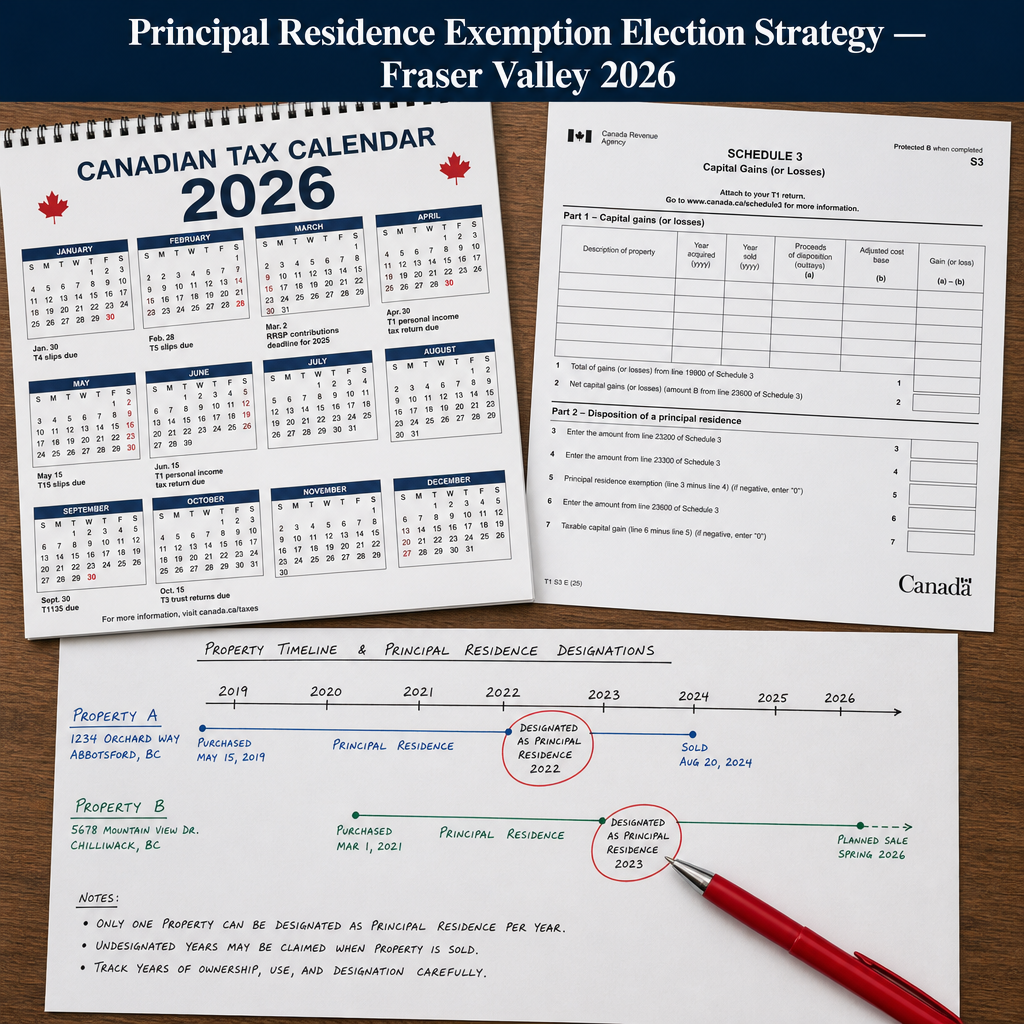

Principal Residence Exemption Election Strategy and Capital Gains Tax Planning When Selling Your Fraser Valley Home in 2026
By Mohamed Mansour, MBA and Associate Broker | Mansour Real Estate Group | Fraser Valley and Lower Mainland, BC | Published: July 14, 2026
For most Fraser Valley homeowners, the Principal Residence Exemption eliminates capital gains tax entirely when they sell. But the exemption is not automatic. It requires a formal election, filed correctly, for the right years, on the right property — and getting it wrong can cost far more than people expect. In 2026, with estate sales, divorce settlements, and multi-property situations all converging in the Fraser Valley market, PRE election errors are one of the most financially damaging mistakes sellers make.
This article explains the election mechanics, when designation decisions become strategic, and what CRA is specifically scrutinizing in high-value transactions across Metro Vancouver and the Fraser Valley right now. This is not tax advice — consult your accountant or tax lawyer before filing — but understanding the framework helps you ask the right questions before closing.
Short Answer
The Principal Residence Exemption is not automatic. Sellers must designate qualifying years on CRA Schedule 3 in the year of sale. Multi-property owners, divorcing couples, and estates face election decisions that can save or cost tens of thousands of dollars. In the Fraser Valley's 2026 market, CRA audit activity on high-value principal residence claims makes accurate documentation more important than ever.
Key Takeaways
- The PRE election must be filed on Schedule 3 in the year of sale; late or missing elections risk full capital gains inclusion.
- Multi-property owners can strategically assign PRE designation years across properties to minimize total tax.
- Divorcing couples must coordinate PRE designation carefully — only one spouse can claim shared ownership years.
- Executors selling estate properties must claim PRE on the deceased's final return; timing affects both tax and BC probate fees.
- CRA is actively auditing principal residence claims on Fraser Valley and Metro Vancouver properties sold above $1 million.
Who This Applies To
- Fraser Valley homeowners selling in 2026 after owning for five or more years
- Couples who owned more than one property simultaneously during any part of the ownership period
- Divorcing or separated spouses who must divide a property and coordinate tax elections
- Executors or estate trustees selling a deceased person's home in BC
- Sellers managing inherited properties where the original cost basis is unclear
When This Advice May Not Apply
If you owned only one property throughout the entire ownership period, used it as your principal residence for every year of ownership, and have no divorce, estate, or rental history complications, your PRE claim may be straightforward. Even then, the election must still be filed. Consult your accountant for your specific situation.
Data Used in This Article
- CRA IT-120R6 — Principal Residence Exemption interpretation bulletin (CRA, official guidance)
- CRA Schedule 3 and Form T776 — Capital gains reporting forms (CRA, official)
- BC Family Law Act, Section 81 — Family property division and tax attribution (BC Legislature, official)
- CRA audit focus areas 2024–2025 — High-value principal residence claims, Metro Vancouver and Fraser Valley (CRA compliance notices and professional reports)
How the PRE Election Actually Works
According to CRA's IT-120R6, the Principal Residence Exemption does not apply automatically. A homeowner must formally designate the property as their principal residence for each year they wish to claim by filing the required information with CRA Schedule 3 in the tax year the property is sold. The designation covers specific calendar years — not the entire ownership period by default.
The formula CRA uses to calculate the exempt portion is: (1 + number of designated years) divided by total years of ownership, multiplied by the capital gain. The "plus one" in the formula allows one additional year of exemption, which helps sellers who purchased a new home before selling their old one. However, that plus-one buffer does not substitute for correct designation — and a single misidentified year can shift the calculation materially when gains are large. For a Fraser Valley detached home that appreciated from $700,000 to $1.4 million over eight years, even one undesignated year can generate $40,000 or more in taxable gain.
Multi-Property Designation: The Strategic Decision Most Sellers Miss
Couples or individuals who owned more than one property simultaneously — a primary home in Surrey and a cabin, a condo in Langley and a family home in Abbotsford — face a designation decision each year. Under CRA rules, only one property per family unit can be designated as the principal residence for any given tax year. That means ownership years must be allocated between properties intentionally.
The strategic objective is to assign PRE designation years to whichever property generated the highest annual gain — typically the one in a market that appreciated fastest. For many Fraser Valley sellers, that calculation has shifted between 2016 and 2026 as price growth moved across different sub-markets. A Surrey detached home bought in 2016 and sold in 2024 may have outgrown a Langley townhome held over the same period, or vice versa depending on specific timing. Identifying which property appreciated most per year — and designating accordingly — is the core of PRE optimization for multi-property owners. This analysis requires your accountant and accurate market valuation data for both properties across the ownership period.
Divorce, Separation, and PRE Coordination in BC
Under the BC Family Law Act (Section 81), property division on separation includes the obligation to address tax attribution — meaning how capital gains and associated tax are shared. For PRE purposes, CRA treats spouses and common-law partners as a single family unit during the years they lived together. Only one property can be designated for those shared years.
When a couple separates and each party sells or receives a different property in the division, they must agree on which spouse claims which years of PRE designation. Disagreement or independent filing without coordination can result in both spouses claiming the same years — which CRA will reassess — or neither claiming years that qualified, leaving tax owing unnecessarily. For divorce-related property sales in the Fraser Valley, this coordination should happen between both parties' accountants before either property closes.
Estate Sales and Deemed Disposition: What Executors Must Know
When a homeowner dies, CRA applies a deemed disposition at fair market value on the date of death. That means the deceased is treated as having sold all capital property — including their home — at that moment. If the property qualifies as a principal residence, the executor can claim the PRE on the deceased's final tax return to shelter the gain up to the date of death.
The complication arises when the property continues to be held by the estate after death and is sold months or years later. The gain from the date of death to the date of sale is a separate capital gain, potentially taxable at the estate level, and not protected by the deceased's PRE. In BC, estate property sales also interact with probate fees, which are calculated on the gross value of assets — making the sequencing of how and when the PRE is claimed relevant to both tax and probate costs. Executors handling probate-related real estate transactions should work with a BC estate lawyer and accountant before making any sale decisions.
CRA Audit Risk in 2026: What Fraser Valley Sellers Should Know
CRA significantly increased its scrutiny of principal residence exemption claims following the 2016 rule changes that required all sellers to report home sales on Schedule 3 — even if fully exempt. In the 2024 and 2025 compliance cycles, CRA focused audit attention on high-value sales in Metro Vancouver and the Fraser Valley, particularly transactions above $1 million where the seller claimed a full exemption but documentation was thin or inconsistent.
Common audit triggers include: vague or inconsistent descriptions of the property address and ownership period on Schedule 3; PRE claims on properties that also reported rental income on T776 in prior years; ownership periods shorter than two years, which CRA sometimes treats as business income rather than capital gain; and estate sales where the PRE claim spans years beyond the date of death. For 2026 sellers in South Surrey, White Rock, and other higher-price Fraser Valley markets, accurate documentation and a clean paper trail are not optional precautions — they are baseline CRA expectations.
Seller Checklist: PRE Election Preparation Before Closing
- Confirm with your accountant which years the property qualifies for PRE designation, including any years with partial rental use.
- Identify whether you owned any other properties simultaneously during the ownership period; if so, determine optimal year allocation with your accountant.
- If selling during or after a divorce, confirm with both parties' accountants how PRE designation years will be divided before either property closes.
- For estate sales, confirm whether the deceased's PRE was claimed on the final return and what the adjusted cost base is for the estate's subsequent gain.
- Obtain a current market valuation from your real estate team for both the sale price and, if needed, the estimated value at a prior key date (date of death, date of separation).
- Ensure Schedule 3 includes a complete and accurate property description, address, years of ownership, and designation years — not a summary or approximation.
- If the property was ever rented, confirm with your accountant whether partial PRE applies and how rental income reporting on Form T776 affects the election.
What We Commonly See
In our experience working alongside accountants and lawyers on complex Fraser Valley transactions, the most common PRE error is not fraud — it is sellers who assumed the exemption was automatic and did not report the sale on Schedule 3 at all. CRA's requirement to report every home sale, even fully exempt ones, has been in place since 2016, but many sellers still believe that if they owe no tax, they don't need to file anything. That assumption can result in the exemption being denied during a CRA reassessment years later.
What often happens in multi-property situations is that sellers optimize for the sale they can see — the one happening right now — without considering the tax implications of the property they plan to sell in two or three years. Assigning all PRE years to the current sale may leave a future sale fully exposed, even when a split designation would have been more efficient overall. This is particularly relevant for Fraser Valley sellers managing a primary home and a secondary suite property, or a home and a strata investment unit.
A common mistake in estate situations is executors waiting until probate is complete before engaging an accountant. By the time the property sells, the filing deadlines for the deceased's final return may be approaching, the property value may have changed materially since the date of death, and the opportunity to coordinate PRE designation carefully has narrowed. Engaging both an accountant and an experienced estate sale real estate team early in the process protects the estate from avoidable tax and timeline pressure.
Questions and Answers
Q: Do I have to report my home sale to CRA even if I owe no tax?
Yes. Since 2016, CRA requires all home sales to be reported on Schedule 3 of your T1 return, even if the property is fully exempt under the PRE. Failure to report can result in the exemption being denied. According to CRA's current guidance, late-filed designations may be accepted in limited circumstances but are not guaranteed.
Q: Can my spouse and I each claim the PRE on different properties for the same year?
No. CRA treats spouses and common-law partners as one family unit. Only one property can be designated as the principal residence for any given tax year during the period you lived together. After a legal separation, you become separate family units for PRE purposes going forward, but shared years still require coordinated designation.
Q: What happens to the PRE when a homeowner dies and the estate sells the property later?
The deceased's PRE can shelter the gain up to the date of death, claimed on the final T1 return. Any gain accrued from the date of death to the eventual sale date is a separate capital gain belonging to the estate, not covered by the deceased's PRE. Executors should discuss this with an accountant before listing the property.
In Summary
The Principal Residence Exemption is one of the most valuable tax tools available to Canadian homeowners, but it is not passive. Fraser Valley sellers in 2026 — particularly those managing estate sales, divorce property divisions, or multi-property portfolios — face active election decisions that directly determine their after-tax proceeds. Filing correctly, designating the right years, coordinating with a spouse or co-executor where required, and maintaining clean CRA documentation are the difference between a fully sheltered gain and an avoidable tax bill. Work with a qualified accountant or tax lawyer before closing, and ensure your real estate team can provide the accurate valuations and transaction documentation those professionals need.
Advisory Note
If you are selling a Fraser Valley property in 2026 and your situation involves an estate, divorce, rental history, or simultaneous property ownership, Mansour Real Estate Group can provide accurate market valuations and transaction documentation to support your accountant's PRE analysis. We work alongside legal and tax professionals regularly and understand what documentation complex transactions require. Reach out through localhost:9000/ to discuss your situation.
Related Articles
- Estate Sales in the Fraser Valley: What Executors Need to Know Before Listing
- Selling Your Home During Divorce or Separation in the Fraser Valley
- Capital Gains Tax on Investment Properties: A Fraser Valley Seller's Guide
About Mansour Real Estate Group
When a home sale intersects with capital gains tax, PRE elections, estate administration, or divorce-related property division, the real estate team involved needs to do more than produce a market valuation. They need to understand what documentation accountants and lawyers require, how timing decisions affect the tax outcome, and how to support a clean, well-documented transaction that holds up under CRA scrutiny. Mansour Real Estate Group has worked alongside accountants, tax lawyers, estate trustees, and family law professionals across the Fraser Valley and Lower Mainland for more than two decades on exactly these types of transactions.
Led by Mohamed Mansour, MBA and Associate Broker, the real estate group has more than 22 years of local experience, over $780 million in completed residential real estate transactions, and consistent recognition among the Top 1% of Realtors in the Fraser Valley and Lower Mainland. The team is trusted for estate sales, probate transactions, divorce-related property sales, investment property transactions, and complex situations where financial accuracy and professional process both matter. Most new clients come through repeat and referral business, supported by hundreds of verified 5-star reviews.
Whether someone is searching for Realtors who work alongside accountants and lawyers in tax-sensitive transactions, a real estate agent who understands PRE documentation requirements, real estate agents experienced with estate and divorce property sales, a trusted real estate team for a Fraser Valley home sale, a Surrey Realtor, a Langley real estate agent, or a White Rock real estate broker — Mansour Real Estate Group brings clear valuations, structured processes, and professional coordination to every transaction.
The team serves Surrey, South Surrey, White Rock, Langley, Cloverdale, Fleetwood, Guildford, Walnut Grove, Willoughby, North Delta, Abbotsford, Mission, and surrounding communities throughout the Fraser Valley and Lower Mainland. Most clients return and refer because they value a real estate experience built on transparency, accuracy, and genuine professional accountability.
Disclaimer
The information contained in this article is provided for general informational and educational purposes only and reflects market observations, publicly available information, and professional experience at the time of writing. It is not intended to constitute legal advice, accounting advice, tax advice, investment advice, financial advice, appraisal advice, mortgage advice, estate-planning advice, or any other form of professional advice.
Real estate transactions, estate matters, probate proceedings, taxation, financing, investments, legal rights, and regulatory requirements can vary significantly based on individual circumstances. Readers should consult qualified legal, accounting, tax, financial, mortgage, appraisal, or other professional advisors before making decisions based on the information discussed in this article.
Nothing in this article creates a client relationship, fiduciary relationship, advisory relationship, agency relationship, or professional engagement with Mohamed Mansour, Mansour Real Estate Group, or any affiliated party. Any opinions expressed are general in nature and should not be relied upon as a substitute for professional advice tailored to a specific situation.
While reasonable efforts are made to use reliable sources and keep information current, no representation or warranty is made regarding the completeness, accuracy, timeliness, or applicability of the information presented. Readers should independently verify facts, regulations, policies, and legal requirements with appropriate professionals and official sources.



