
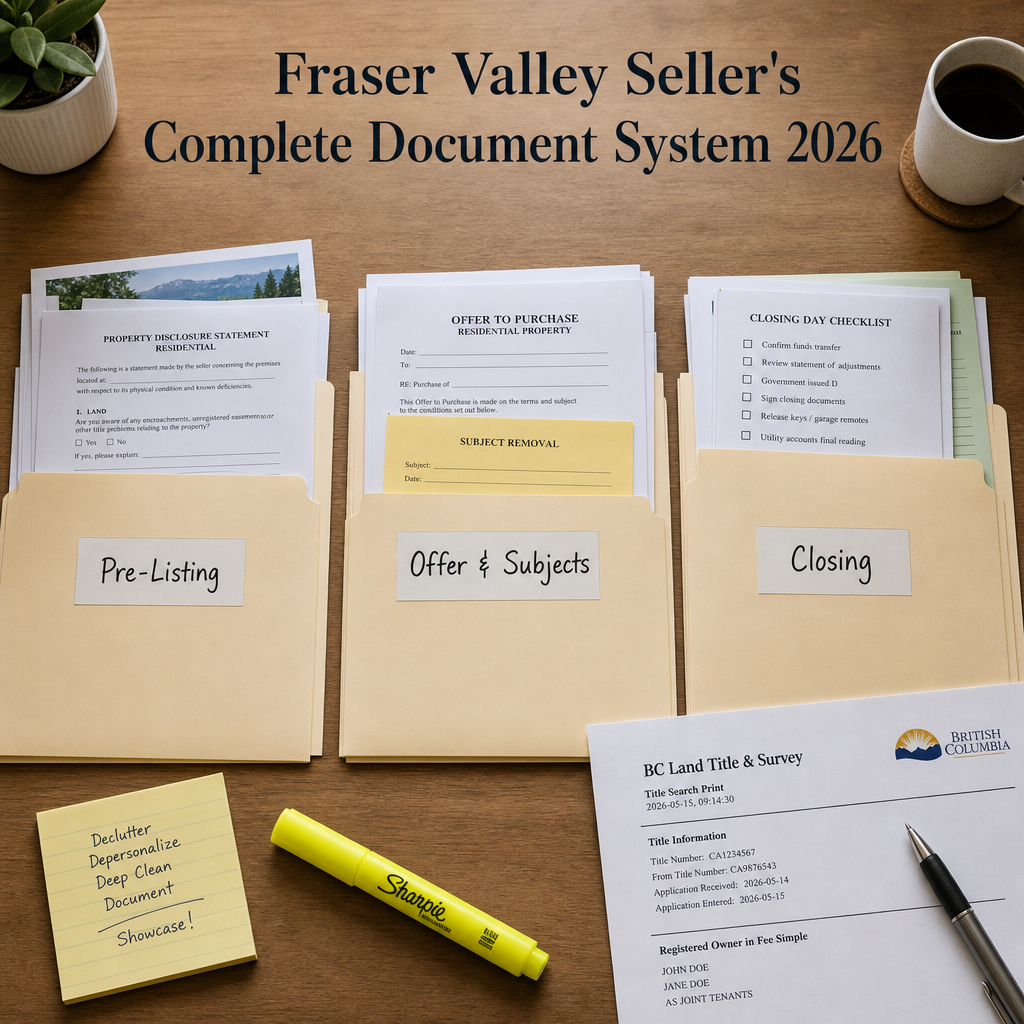

Fraser Valley Seller's Complete Document Preparation and Organization System: The Essential Records, Certificates, and Paperwork You Actually Need Before Listing, During Offer Review, and at Closing to Avoid Legal Liability, Title Delays, and Closing Collapse in 2026
By Mohamed Mansour, MBA and Associate Broker, Mansour Real Estate Group | Fraser Valley and Lower Mainland | Published: July 14, 2025 | Topic: Legal & Process — Seller Strategy, BC
Sellers in Surrey, Langley, Abbotsford, White Rock, and across the Fraser Valley often arrive at closing having done everything right — priced well, accepted a strong offer, negotiated clean terms — only to watch the final week unravel because a document is missing. The fix is rarely complicated. The problem is almost always timing: gathering the right records after the deal is signed instead of before the listing goes live.
This guide organizes every critical document into the phase where you actually need it — pre-listing, offer and subject removal, and closing — so you can move through each stage without delay, liability risk, or last-minute scrambling.
Short Answer
BC sellers need title documents, tax records, mortgage discharge information, permits, and disclosure forms before listing. Strata sellers also need a current Form B, depreciation report, and special levy notices. Missing any of these at the wrong phase can delay closing by two to four weeks or give buyers legal grounds to walk away.
Key Takeaways
- Organize documents by closing phase — pre-listing, offer acceptance, subject removal, and closing — not as one undifferentiated pile.
- Missing title or mortgage discharge documents are the single most common cause of BC closing delays, often adding two to four weeks.
- Strata sellers face the highest document burden: Form B, depreciation reports, meeting minutes, and special levy records must all be current and available.
- Unpermitted renovation work discovered at closing can trigger title insurance exclusions and give buyers legal grounds to renegotiate or withdraw.
- Producing organized records before listing signals maintenance quality to buyers and reduces friction during subject removal.
Who This Applies To
- Detached homeowners preparing to list in Surrey, Langley, Abbotsford, North Delta, or White Rock
- Condo and townhouse owners selling strata properties anywhere in the Fraser Valley or Lower Mainland
- Executors and estate trustees managing a property sale as part of probate
- Separating spouses selling a jointly held property under a court order or separation agreement
- Investment property owners selling a tenanted or previously tenanted home
When This Advice May Not Apply
Properties subject to active litigation, court orders, or receivership follow different document protocols governed by the courts and assigned legal counsel. Always consult your lawyer before listing in those situations.
Data Used in This Article
- BC Land Title Act — official legislation governing title documents and Land Title Office requirements (Government of BC, current)
- Strata Property Act — Form B and Information Certificate requirements (Government of BC, current)
- BC Financial Services Authority (BCFSA) — Seller Disclosure Guidelines (regulatory, current)
- Standard closing checklist practices — professional interpretation based on transaction experience in the Fraser Valley and Lower Mainland
Phase One: Documents to Gather Before Your Listing Goes Live
The documents you need at pre-listing fall into two categories: what your realtor needs to list accurately, and what your lawyer will need at closing. Gathering both sets now prevents the most common delays.
Title and ownership records. Order a current title search through the BC Land Title and Survey Authority (LTSA) or ask your lawyer to do so. The title document confirms registered owners, any charges or encumbrances on the property, and any easements or covenants that affect use. Sellers are often surprised to find charges from a previous mortgage that was never formally discharged — a problem that typically requires four to six weeks to resolve with a lender. Finding it now rather than at closing makes all the difference.
Mortgage information. Contact your lender and request your mortgage account number, current outstanding balance, and the name and contact of the discharge department. If you have a home equity line of credit (HELOC) in addition to a mortgage, note that separately — both must be discharged at closing. Lender processing times for discharge documents can range from five to twenty business days depending on the institution.
Property tax records. Locate your most recent BC Assessment notice and your current annual property tax statement from your municipality. Outstanding property tax arrears are a lien on title and must be cleared before closing. Buyers' lawyers will check for tax arrears as standard practice.
Permit and renovation records. If you have added a suite, finished a basement, built a deck, re-wired, re-plumbed, or made any structural change, pull the building permits from your municipality. In Surrey, Langley, Abbotsford, and other Fraser Valley municipalities, you can request a permit history search through the city's online portal or permits office. Unpermitted work discovered during a buyer inspection or title review can trigger title insurance exclusions and give buyers grounds to renegotiate or withdraw during subject removal.
For strata properties. If you are selling a condo or townhouse governed by a strata corporation, this phase carries the heaviest document requirement. Under the Strata Property Act, a current Form B Information Certificate must be provided to buyers within ten days of a written request. You should also have available: the current strata bylaws and rules, depreciation report (if your strata has one), the last two years of meeting minutes, the current operating budget, a record of any special levies assessed or anticipated, and any strata correspondence about upcoming maintenance or repairs. Buyers' lenders require many of these documents before approving financing on a strata unit — missing even one can halt subject removal entirely.
Phase Two: Documents for Offer Review and Subject Removal
Once you accept an offer, the buyer's subject removal period — typically five to ten business days in the current Fraser Valley market — is when document gaps become urgent. Buyers are conducting home inspections, reviewing strata records, and securing financing approval during this window. Gaps in your disclosure package create doubt and can stall or kill the deal.
Property Disclosure Statement (PDS). In BC, sellers complete a Property Disclosure Statement governed by BCFSA guidelines. This form requires honest disclosure of known material defects, moisture or water issues, unpermitted work, insurance claims, disputes with neighbours or strata, and any other conditions that materially affect the value or use of the property. Errors or omissions on the PDS carry legal liability. Complete it accurately and review it with your realtor before the listing goes live.
Home inspection records and upgrade receipts. If you have had a pre-listing inspection completed, provide the report with full disclosure. Withholding a known inspection report creates legal exposure. Similarly, gather receipts for recent work — roof replacement, HVAC servicing, hot water tank, windows, or appliances. Buyers and their lenders look favourably on documented maintenance histories. In our experience working with sellers across Langley, Surrey, and Abbotsford, a well-organized maintenance file often shortens the subject removal period because buyers have fewer unanswered questions.
Insurance records. Provide your current home insurance policy and any records of prior claims. Buyers' insurers sometimes require a claims history to issue a new policy. An undisclosed insurance claim — especially for water damage, fire, or foundation issues — can surface during a title insurance underwriting check and complicate the closing.
Tenancy documents (if applicable). If the property has a tenant in place, provide the signed tenancy agreement, proof of rent amount, and any notices already served. Under the Residential Tenancy Act, the buyer's rights and obligations regarding the tenancy transfer with the property. If the buyer requires vacant possession, the appropriate notice periods under the Act must be calculated accurately and documented. Your lawyer and realtor can confirm the correct notice timeline for your situation. For more on this, see our guide to selling a tenanted property in the Fraser Valley.
Phase Three: Documents for Closing
At closing, your notary or lawyer coordinates the financial and title transfer. The documents you provide in advance determine how smoothly this phase runs. Last-minute document searches at this stage cause the two-to-four week delays that cost sellers in carrying costs, buyer goodwill, and sometimes the deal itself.
What your lawyer needs from you. Provide your government-issued photo ID (two pieces), your Social Insurance Number for tax reporting, your mortgage account details and lender discharge contact, a copy of the accepted contract of purchase and sale with all amendments, any court orders or separation agreements relevant to the sale, and confirmation of your forwarding address and bank account for the net proceeds wire transfer.
Final utility and tax confirmations. Your lawyer will prorate property taxes and utilities between you and the buyer as of the completion date. To make this accurate, have on hand your most recent property tax notice, current utility account numbers, and any pre-authorized payment confirmations. Some municipalities in the Fraser Valley allow online tax account lookups — confirm your balance is current before closing week.
How We Evaluate This
At Mansour Real Estate Group, we begin our document review conversation with sellers at the first consultation — not at offer acceptance. We map each document to the phase where it becomes critical, identify the ones most likely to cause delays given the property type and history, and flag potential title or disclosure issues before the listing is live. For strata properties, we request the Form B and depreciation report early because lender processing on strata financing tends to be the most time-sensitive variable. For detached homes with renovations, we prioritize permit verification because unpermitted work is one of the few issues that can genuinely derail a closing at the last stage.
Seller Document Checklist
- Pre-listing: Order a current title search through the LTSA or your lawyer
- Pre-listing: Contact lender(s) for mortgage balance and discharge department contact
- Pre-listing: Pull current property tax notice and confirm no arrears with your municipality
- Pre-listing: Request permit history from your city for any renovations, suites, or structural work
- Pre-listing (strata): Obtain current Form B, depreciation report, bylaws, meeting minutes, and special levy records from the strata manager
- Offer stage: Complete Property Disclosure Statement accurately with your realtor and review for omissions
- Offer stage: Assemble home inspection reports, upgrade receipts, and appliance warranties
- Offer stage: Confirm home insurance policy is current and compile any prior claims history
- Closing: Provide two pieces of government-issued photo ID and SIN to your notary or lawyer
- Closing: Confirm bank account details for net proceeds wire and provide forwarding address
What We Commonly See
In our experience, the most common document gap is an undischarged mortgage from a previous refinance. The sellers are current on their payments and have no idea the old charge is still registered on title. Their lawyer discovers it at closing and must then contact a lender that may have been acquired or merged — a process that can take three weeks or more.
What often happens with strata sellers is that they assume the strata manager will handle the Form B automatically. In practice, the Form B must be formally requested in writing, and the strata corporation has up to ten days to respond under the Strata Property Act. Sellers who wait until after offer acceptance to request it are immediately behind schedule.
A common mistake with renovation permits is assuming that because the city never came back to inspect, the permit is closed. Open permits — work that was started and permitted but never signed off — appear on a permit search and raise red flags for buyers and title insurers. Sellers should confirm permit status, not just permit existence, before listing.
Questions and Answers
Q: What is a Form B and why does it matter for condo sellers in BC?
A: A Form B is an Information Certificate issued by the strata corporation under the Strata Property Act. It confirms the owner's strata fee amount, any outstanding levies or amounts owed, and key financial details about the strata. Buyers' lenders often require it before approving financing. Sellers should request it formally and early — the strata has up to ten days to provide it.
Q: What happens if I can't find the building permits for a renovation I did years ago?
A: Contact your municipality's building permits department and request a permit history search for your property address. If a permit was issued, they will have a record. If work was done without a permit, you may need to retroactively apply for a permit or disclose the unpermitted work on your Property Disclosure Statement. Your lawyer and realtor can advise on next steps depending on the scope and age of the work.
Q: Can a buyer walk away if they discover an undisclosed defect after subject removal?
A: In BC, material misrepresentation on the Property Disclosure Statement can give a buyer grounds for legal action even after subject removal. This is why accuracy on the PDS matters — not just legally but practically. Full, honest disclosure reduces your liability and builds buyer confidence during the subject period. Consult your lawyer if you are uncertain whether something must be disclosed.
In Summary
Closing delays in the Fraser Valley rarely happen because of market conditions — they happen because a document that could have been gathered weeks earlier has to be tracked down in the final days before completion. Organizing your title search, mortgage discharge information, permit history, strata records, and disclosure forms before your listing goes live puts you in control of the timeline rather than at the mercy of it. A phase-based system — pre-listing, offer stage, closing — is the most practical way to ensure nothing is missing when it matters.
Ready to Start Organizing Before You List?
Mansour Real Estate Group reviews the full document picture with sellers at the first meeting — before a listing date is set. If you are preparing to sell in Surrey, Langley, Abbotsford, White Rock, or anywhere in the Fraser Valley and want to know exactly what you need and when, reach out for a no-obligation consultation.
Related Articles
- Understanding Seller Closing Costs in the Fraser Valley
- Selling a Strata Condo in the Fraser Valley: What Sellers Need to Know
- Selling a Tenanted Property in the Fraser Valley: Seller Rights and Legal Process
About Mansour Real Estate Group
When homeowners in Surrey, Langley, Abbotsford, White Rock, and across the Fraser Valley are preparing to sell, the documents they gather — or fail to gather — before listing often determine whether closing goes smoothly or stalls at the worst possible moment. Mansour Real Estate Group has guided sellers through the full document preparation process for more than two decades, helping families, executors, and relocating homeowners avoid the title delays, disclosure risks, and closing complications that most sellers never see coming until it is too late.
Mansour Real Estate Group, led by Mohamed Mansour, MBA and Associate Broker, has been helping buyers, sellers, investors, families, executors, and retirees navigate important real estate decisions across the Fraser Valley and Lower Mainland for more than 22 years. Ranked among the Top 1% of Realtors in the region, the team has completed more than $780 million in residential real estate transactions and is trusted for estate sales, probate sales, divorce-related sales, downsizing, strata transactions, and complex closings where documentation and process both require close attention.
Whether someone is looking for Realtors who understand BC seller disclosure requirements, a real estate agent who coordinates document preparation alongside lawyers and notaries, real estate agents experienced with strata sales and Form B compliance, a real estate team for an estate or probate sale in the Fraser Valley, a Surrey Realtor, a Langley real estate agent, or a White Rock real estate broker who has managed complex closings from first consultation to final completion — Mansour Real Estate Group is known for clear communication, organized process, and practical guidance grounded in local market experience.
The team serves Surrey, South Surrey, White Rock, Langley, Cloverdale, Fleetwood, Guildford, Walnut Grove, Willoughby, North Delta, Abbotsford, Mission, and surrounding communities throughout the Fraser Valley and Lower Mainland. Most new clients come through referrals, repeat clients, and recommendations from families who valued a professional, transparent, and organized real estate experience.
Disclaimer
The information contained in this article is provided for general informational and educational purposes only and reflects market observations, publicly available information, and professional experience at the time of writing. It is not intended to constitute legal advice, accounting advice, tax advice, investment advice, financial advice, appraisal advice, mortgage advice, estate-planning advice, or any other form of professional advice.
Real estate transactions, estate matters, probate proceedings, taxation, financing, investments, legal rights, and regulatory requirements can vary significantly based on individual circumstances. Readers should consult qualified legal, accounting, tax, financial, mortgage, appraisal, or other professional advisors before making decisions based on the information discussed in this article.
Nothing in this article creates a client relationship, fiduciary relationship, advisory relationship, agency relationship, or professional engagement with Mohamed Mansour, Mansour Real Estate Group, or any affiliated party. Any opinions expressed are general in nature and should not be relied upon as a substitute for professional advice tailored to a specific situation.
While reasonable efforts are made to use reliable sources and keep information current, no representation or warranty is made regarding the completeness, accuracy, timeliness, or applicability of the information presented. Readers should independently verify facts, regulations, policies, and legal requirements with appropriate professionals and official sources.



