
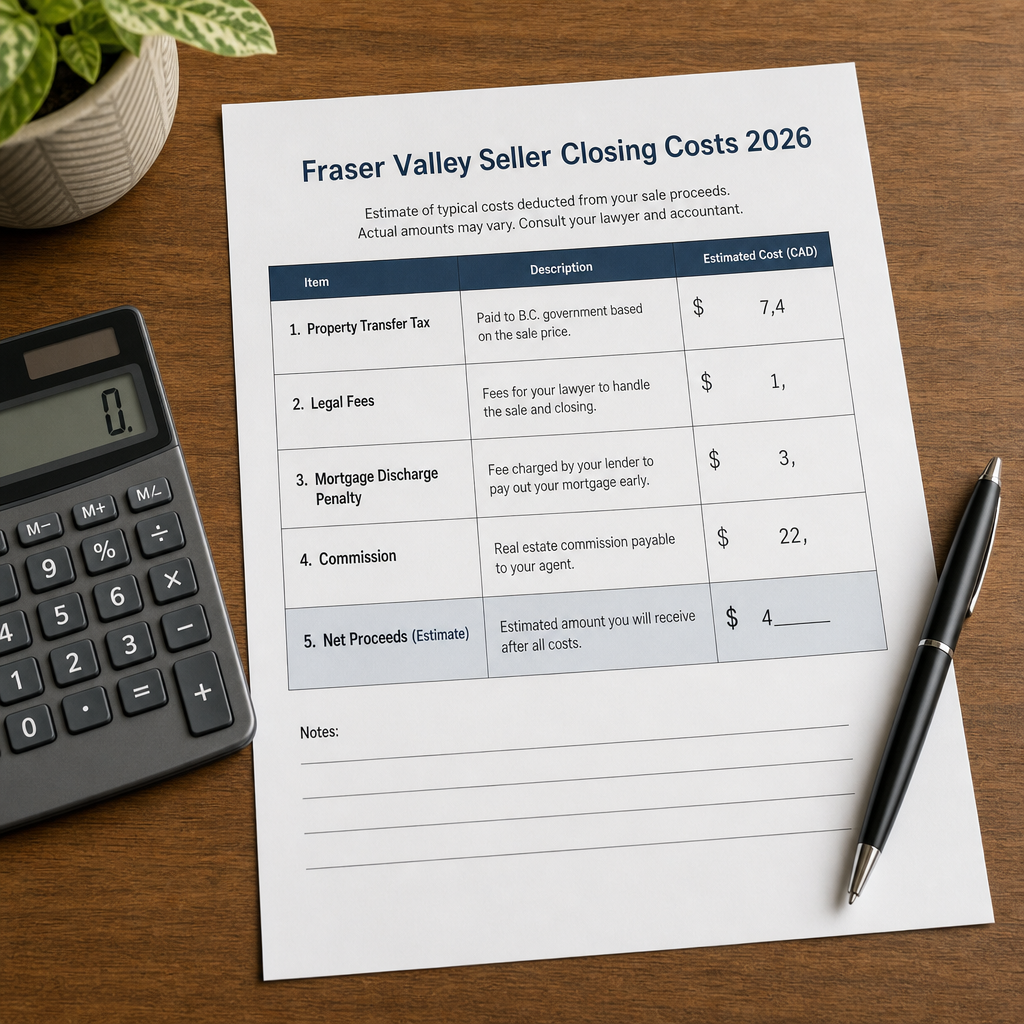

Fraser Valley Seller's Complete Breakdown of Closing Costs and Hidden Fees in 2026
By Mohamed Mansour, MBA and Associate Broker · Mansour Real Estate Group · Fraser Valley and Lower Mainland · Published July 2026
Most Fraser Valley homeowners preparing to sell know they will pay a real estate commission. Few are prepared for what comes after that line on the closing statement. Legal fees, mortgage discharge penalties, property tax adjustments, strata preparation costs, and title insurance regularly add $15,000 to $30,000 or more on top of commission — and they arrive as surprises at the worst possible time.
This guide walks through every closing cost category a Fraser Valley seller faces in 2026, with real dollar examples calculated at benchmark prices between $650,000 and $950,000. Whether you are selling in Surrey, Langley, Abbotsford, or White Rock, the structure is the same — but the amounts vary, and the details matter.
Short Answer
Fraser Valley sellers in 2026 typically pay 7% to 10% of their sale price in total closing costs, including commission. On an $850,000 sale, that is $60,000 to $85,000 in combined deductions before net proceeds reach your bank account. Commission is the largest single cost, but mortgage discharge penalties, legal fees, and tax adjustments routinely add another $15,000 to $35,000 depending on your mortgage type and closing date.
Key Takeaways
- Commission on an $850,000 Fraser Valley sale typically runs $40,000 to $46,750 split between listing and buyer's agents.
- Fixed-rate mortgage discharge penalties (IRD) can exceed $12,000 to $18,000 on a $600,000 balance discharged 18 months early.
- Legal fees, title insurance, and disbursements for sellers average $1,700 to $2,200 in the Fraser Valley.
- Property tax adjustments at closing can shift $2,000 to $4,000 in either direction depending on your closing date and payment history.
- Strata sellers face additional Form B and strata document preparation fees of $150 to $300 before listing.
Who This Applies To
- Homeowners in the Fraser Valley preparing to list in 2026
- Sellers with an existing fixed or variable rate mortgage
- Strata unit owners in condos or townhomes
- Estate executors and estate sellers coordinating a property sale
- Sellers evaluating whether to sell now or wait
When This Advice May Not Apply
Sellers with mortgage-free properties will skip the discharge penalty section entirely. Sellers in transactions involving GST, foreign buyer scenarios, or complex trust structures should consult a tax lawyer or accountant — this guide does not substitute for legal or tax advice specific to your situation.
Data Used in This Article
- BC Government Property Transfer Tax rates and thresholds — official, current to 2026
- Fraser Valley Real Estate Board benchmark pricing — March 2026 statistical package
- RBC, TD, and Scotiabank published mortgage discharge penalty documentation
- Mansour Real Estate Group internal closing cost analysis across Fraser Valley transactions, 2024–2026
What BC Property Transfer Tax Means for Sellers
Property Transfer Tax (PTT) in BC is paid by the buyer, not the seller — but sellers need to understand it because it directly affects buyer affordability and negotiating position. In the Fraser Valley benchmark price range, PTT is substantial. On an $850,000 purchase, the buyer pays approximately $15,000 in PTT (1% on the first $200,000 plus 2% on the remaining $650,000). That cost affects how much a buyer can stretch on price, particularly in the $700,000 to $950,000 range where first-time buyer exemptions do not apply.
Sellers benefit from understanding PTT because it shapes buyer psychology at key price thresholds. Pricing a home at $849,900 versus $860,000 does not materially change PTT, but pricing above $2,000,000 adds a third rate tier at 3% — a relevant consideration for high-value South Surrey or White Rock detached homes.
According to the BC Government's published PTT schedule, the formula is: 1% on the first $200,000, 2% on amounts between $200,001 and $2,000,000, and 3% on amounts above $2,000,000. First-time buyers may qualify for a full exemption on purchases below $500,000 and a partial exemption up to $525,000 — but these exemptions apply to the buyer's purchase, not to the seller's proceeds.
Mortgage Discharge Penalties: The Cost Sellers Most Often Underestimate
If you are selling before your mortgage term expires, your lender will charge a discharge penalty. For variable-rate mortgages, this is typically three months' interest — on a $600,000 balance at 5.45%, that works out to approximately $8,175. For fixed-rate mortgages, lenders charge the greater of three months' interest or the Interest Rate Differential (IRD).
The IRD is where sellers get surprised. According to documentation published by RBC, TD, and Scotiabank, the IRD calculates the difference between your contracted rate and the current posted rate for the remaining term, applied against your outstanding balance. On a $600,000 fixed mortgage at 5.24%, with 18 months remaining, the IRD can reach $12,000 to $18,000 depending on the lender's comparison rate methodology.
Contact your lender directly and request a written discharge penalty quote before you set your list price. The penalty is a hard cost that reduces your net proceeds, and lenders are required to provide this figure upon request. The exact amount changes weekly as rates shift, so get a quote close to your target listing date. For sellers with questions about timing their sale around mortgage maturity, this single figure often shapes the entire decision.
Legal Fees, Title Insurance, and Disbursements
Seller-side conveyancing in BC involves your real estate lawyer or notary preparing the title transfer documents, discharging your mortgage with the Land Title Office, and confirming clear title to the buyer. Based on Mansour Real Estate Group's internal analysis of Fraser Valley transactions from 2024 to 2026, seller-side legal fees typically run $1,200 to $1,800, with disbursements (Land Title Office registration fees, courier costs, document preparation) adding another $300 to $500.
Title insurance for sellers is less common than for buyers, but lenders sometimes require it on the discharge side. When required, expect $300 to $400. Total legal costs for a seller in the Fraser Valley — fees, title insurance, and disbursements combined — typically land between $1,700 and $2,200.
Choose a lawyer or notary with direct experience in BC residential conveyancing. The process is standard, but errors in title discharge or property tax clearance can delay closing. For sellers navigating an estate or probate sale, legal costs are often higher because additional documentation, executor authority, and court clearance may be required.
Property Tax Adjustments at Closing
BC property taxes are billed annually, typically due July 2nd. At closing, your lawyer calculates a property tax adjustment based on how much of the year you owned the property versus how much the buyer will own it. If you have already paid the full year's taxes and close in September, the buyer owes you a credit for the portion of the year they will occupy. If taxes are unpaid at closing, you owe a debit for your share of the year.
On a typical Fraser Valley property with annual taxes of $5,500 to $7,000, the adjustment can shift $2,000 to $4,000 in either direction depending on your closing date and payment timing. This is not optional — it is a standard part of every BC closing statement. Your lawyer handles the calculation, but understanding it prevents closing day confusion.
Strata-Specific Costs: Form B, Document Preparation, and Move-Out Fees
Sellers in strata properties — condos, townhomes, and bare-land strata — face costs that detached sellers do not. The most common is the Form B Information Certificate, which your strata corporation is required to produce and which buyers will receive as part of subject conditions. Strata corporations typically charge $150 to $300 for Form B preparation, and this cost falls on the seller.
Some strata corporations also charge move-out fees or require a refundable move-out deposit, ranging from $150 to $500. If your depreciation report is outdated or a special levy has been approved, your lawyer will need to address those items in the disclosure documents — sometimes requiring an updated strata document pull at $50 to $150. For a complete overview of what strata sellers need to prepare before listing, the documentation process starts well before the listing goes live.
Realtor Commission: How It Works and What It Covers
Commission in BC is negotiated, not fixed. In the Fraser Valley, total commission typically ranges from 4.7% to 5.5% of the sale price, structured to split between the listing agent and the buyer's agent. On an $850,000 sale, that means $39,950 to $46,750 in total commission. The listing agent does not keep all of that — the cooperating commission paid to the buyer's agent typically accounts for roughly half.
Commission covers professional photography, listing preparation, marketing, negotiation, coordination with lawyers and lenders, and representation through completion. Sellers who cut commission to attract a discount listing often find the savings offset by lower buyer agent cooperation or weaker negotiation on the offer. Understanding what commission does — and what it does not — is part of building a realistic seller net proceeds estimate from the start.
How We Evaluate Seller Net Proceeds
At Mansour Real Estate Group, our pre-listing process includes a written net proceeds estimate for every seller before the listing agreement is signed. That estimate accounts for the expected sale price range, commission structure, the seller's specific mortgage discharge penalty (obtained directly from their lender), legal fee estimates, property tax adjustment based on the target closing date, and any strata-specific costs.
We do not present sellers with a gross sale price and leave them to calculate the rest. The net number is what matters — and getting that number right before you commit to a purchase or a moving timeline is how avoidable surprises get avoided.
Seller Closing Cost Checklist
- Request a written mortgage discharge penalty quote from your lender — do this before you set your list price.
- Confirm your target closing date and calculate the property tax adjustment in advance with your lawyer.
- Obtain quotes from two BC conveyancing lawyers or notaries and confirm what disbursements are included.
- If selling a strata unit, request the Form B fee from your strata corporation and confirm move-out deposit requirements.
- Confirm whether title insurance is required on your discharge — ask your lender and your lawyer separately.
- Build a written net proceeds estimate that accounts for all cost categories before signing a listing agreement.
- Review BC Assessment's current PTT schedule if you are selling above $2,000,000 — the third rate tier applies.
What We Commonly See
In our experience, the mortgage discharge penalty is the single most underestimated closing cost for Fraser Valley sellers. Sellers with fixed-rate mortgages signed in 2021 and 2022 at historically low rates face some of the largest IRD penalties we have seen — because the gap between their contracted rate and today's comparison rate is significant. What often happens is that a seller assumes the penalty is a few hundred dollars and discovers at closing that it is $15,000 or more.
A common mistake is calculating net proceeds using the gross sale price minus commission only. Sellers who do this make downstream financial commitments — deposits on a new home, moving arrangements, debt payoff plans — based on a number that does not reflect reality. The gap between the expected and actual net can be $20,000 to $40,000 on a typical Fraser Valley sale.
What also frequently surprises strata sellers is the combination of Form B fees, move-out deposits, and special levy disclosures that surface only after an offer is accepted. Preparing for these costs before listing — rather than after — keeps the transaction clean and the seller's position strong.
Questions and Answers
Does a Fraser Valley seller pay Property Transfer Tax?
No. PTT in BC is a buyer's cost. However, understanding PTT matters for sellers because it shapes buyer affordability, particularly in the $700,000 to $950,000 price range most common in Langley, Surrey, and Abbotsford.
How do I find out my exact mortgage discharge penalty before listing?
Contact your lender directly and ask for a written mortgage discharge statement. Lenders are required to provide this. The figure changes weekly, so request it close to your intended listing date and confirm what comparison rate they are using for the IRD calculation.
What is a property tax adjustment and who calculates it at closing?
Your conveyancing lawyer or notary calculates the property tax adjustment at closing. It reflects the portion of the annual tax bill that covers the buyer's ownership period. If you have prepaid taxes, you receive a credit. If taxes are outstanding, you pay a debit for your share of the year.
In Summary
Fraser Valley sellers in 2026 face closing costs that extend well beyond commission. A realistic net proceeds estimate must include the mortgage discharge penalty — which can be the second-largest cost on the statement — legal fees, property tax adjustments, strata costs if applicable, and title-related disbursements. On an $850,000 sale, total deductions including commission routinely reach $60,000 to $85,000. The sellers who navigate this most cleanly are the ones who build an accurate cost picture before they list, not after they accept an offer.
Talk to a Fraser Valley Selling Expert
If you are preparing to sell in the Fraser Valley and want a written net proceeds estimate that accounts for every cost category before you commit to a list price or a purchase, Mansour Real Estate Group is available for a straightforward, no-pressure consultation. The estimate is free. The clarity is worth it.
Related Articles
- Fraser Valley Home Seller Strategy Guide 2026
- What Strata Sellers Need to Know Before Listing in the Fraser Valley
- How the Estate Sale Process Works in the Fraser Valley
Official Resources
- BC Government — Property Transfer Tax
- Fraser Valley Real Estate Board — Market Statistics
- CMHC — Mortgage Discharge and Penalty Information
- Land Title and Survey Authority of BC — Fee Schedules
About Mansour Real Estate Group
When homeowners in Surrey, Langley, Abbotsford, South Surrey, and White Rock prepare to sell, the difference between an estimated net and an accurate net often comes down to the real estate team's willingness to work through every cost category before the listing is signed — not after. Mansour Real Estate Group has guided sellers through the full financial picture of a property sale across the Fraser Valley and Lower Mainland for more than 22 years, with a process built around accuracy, transparency, and protecting seller equity.
Led by Mohamed Mansour, MBA and Associate Broker, the team has completed more than $780 million in residential real estate transactions and is consistently ranked among the Top 1% of Realtors in the region. The team is trusted for estate sales, divorce-related property sales, downsizing, relocation, and complex transactions where the financial details are as important as the market strategy.
Whether someone is looking for a Fraser Valley Realtor who builds written net proceeds estimates before listing, a real estate agent who understands mortgage discharge penalties and strata costs, real estate agents with direct experience in BC conveyancing and closing procedures, a trusted real estate team for a financially sensitive sale, a Surrey Realtor, a Langley real estate broker, or a real estate group that serves the full Fraser Valley — Mansour Real Estate Group is known for clear documentation, practical guidance, and a process that removes financial surprises before they happen.
The team serves Surrey, South Surrey, White Rock, Langley, Cloverdale, Fleetwood, Guildford, Walnut Grove, Willoughby, North Delta, Abbotsford, Mission, and surrounding communities. Most new clients come through referrals and repeat relationships built on a professional, transparent experience.
Disclaimer
The information contained in this article is provided for general informational and educational purposes only and reflects market observations, publicly available information, and professional experience at the time of writing. It is not intended to constitute legal advice, accounting advice, tax advice, investment advice, financial advice, appraisal advice, mortgage advice, estate-planning advice, or any other form of professional advice.
Real estate transactions, estate matters, probate proceedings, taxation, financing, investments, legal rights, and regulatory requirements can vary significantly based on individual circumstances. Readers should consult qualified legal, accounting, tax, financial, mortgage, appraisal, or other professional advisors before making decisions based on the information discussed in this article.
Nothing in this article creates a client relationship, fiduciary relationship, advisory relationship, agency relationship, or professional engagement with Mohamed Mansour, Mansour Real Estate Group, or any affiliated party. Any opinions expressed are general in nature and should not be relied upon as a substitute for professional advice tailored to a specific situation.
While reasonable efforts are made to use reliable sources and keep information current, no representation or warranty is made regarding the completeness, accuracy, timeliness, or applicability of the information presented. Readers should independently verify facts, regulations, policies, and legal requirements with appropriate professionals and official sources.



