

Pricing Unique and Non-Standard Properties in the Fraser Valley 2026: When Comparable Sales Don't Exist
By Mohamed Mansour, MBA and Associate Broker | Mansour Real Estate Group | Fraser Valley and Lower Mainland | Published: July 22, 2025
Acreage, ALR parcels, hobby farms, legal multi-unit conversions, and heritage character homes represent a meaningful share of Fraser Valley listings — and they are among the most frequently mispriced. Standard comparable sales analysis, the method that works well for detached homes and condos in established neighbourhoods, often fails completely when the property has no close comparables within the same micro-market.
In 2026, that pricing uncertainty carries real consequences. With the Fraser Valley's sales-to-active ratio sitting near 11% according to FVREB market data — a clear buyer's market — overpriced non-standard properties are sitting 100 or more days on the market while standard homes move in 25 to 45 days. This article explains how defensible fair market value is actually established for these property types, and what sellers need to understand before they commit to a list price.
Short Answer
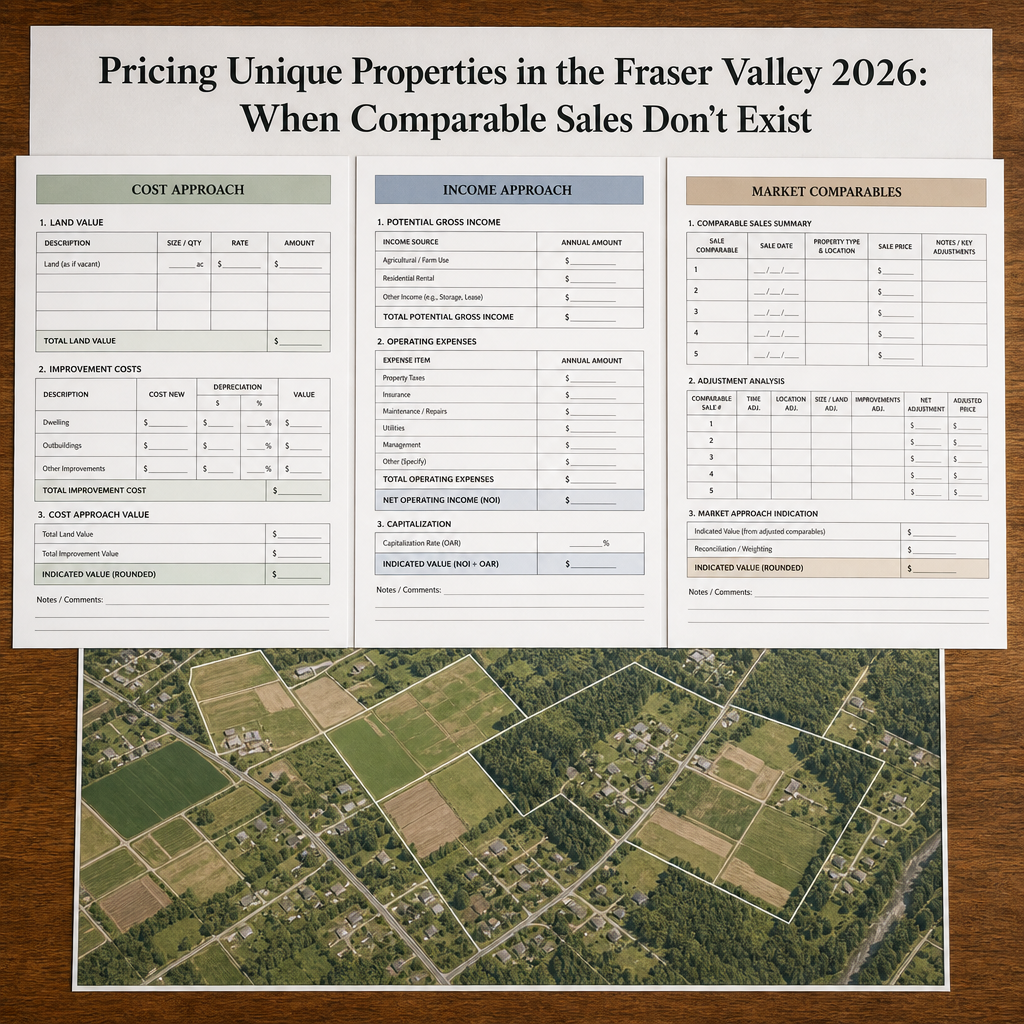
When comparable sales don't exist, fair market value for Fraser Valley acreage, hobby farms, character homes, and multi-unit conversions is typically established using a combination of three appraisal approaches: market data adjusted from geographically similar properties, cost approach for structures requiring renovation, and income capitalization for revenue-generating uses. Relying on a single method — or intuition — typically produces a price that is 10 to 25 percent off a defensible valuation, according to Appraisal Institute of Canada methodology standards.
Key Takeaways
- Standard comparable sales analysis breaks down for ALR land, acreage, and unconventional homes where no close local comps exist.
- Professional appraisers blend three methods — market data, cost approach, and income approach — to establish defensible fair market value.
- In 2026's buyer's market, overpriced unique properties often sit 100-plus days on market, compounding carrying costs and negotiating weakness.
- Fraser Valley micro-market divergence — ALR versus urban-zoned, Mission versus Abbotsford — means comparable properties from adjacent areas must be adjusted carefully.
- Underpricing a unique property leaves real equity behind; accurate valuation requires a structured, multi-method process before listing.
Who This Applies To
- Sellers of ALR-restricted land or mixed-use acreage in the Fraser Valley
- Owners of hobby farms in Langley Township, Abbotsford, Mission, or Maple Ridge
- Sellers of character homes or heritage properties where condition diverges significantly from neighbourhood norms
- Owners of legal basement suite conversions, coach houses, or multi-unit properties not classified as formal investment properties
- Estate executors managing non-standard residential properties in the Fraser Valley
- Sellers in rural or semi-rural communities where MLS comparable sales are sparse or dated
When This Advice May Not Apply
This framework applies to residential and mixed residential-agricultural properties. It is not a substitute for a formal appraisal when a lender, court, estate, or legal process requires one. Sellers of commercial farmland, industrial-zoned properties, or development-ready land should consult a commercial appraiser in addition to a real estate professional.
Data Used in This Article
- Fraser Valley Real Estate Board (FVREB) — 2025–2026 market statistics, days-on-market data, and sales-to-active ratios. Official industry body. Regional scope.
- BC Assessment — Residential and agricultural valuation methodology, hybrid appraisal approaches. Official provincial body.
- Appraisal Institute of Canada — Standards for multi-approach valuation of non-standard properties. Industry regulatory body.
- BC Agricultural Land Commission — ALR land-use rules and restrictions affecting market value. Official provincial body.
Why the Comparable Sales Method Breaks Down
The comparable sales method — finding recently sold properties similar in size, location, and condition — works well in high-turnover suburban markets. In Surrey's Fleetwood neighbourhood or Willoughby in Langley Township, there are typically dozens of relevant sold homes within a few kilometres and a few months. Adjusting for small differences is manageable.
That logic collapses when the property is a five-acre ALR parcel outside Abbotsford with a 1970s farmhouse and a working greenhouse, or a 1912 character home in Mission with a legal carriage house conversion and a heritage designation. There may be no sold comparable within 20 kilometres, or the available comps differ so substantially in land size, structure condition, agricultural use, or revenue potential that the adjustments required exceed what the comparable sales method can reliably support.
The Three Valuation Approaches and When Each Applies
Market Data Approach (Adjusted Comparables)
Even when identical comparables don't exist, market data from geographically or functionally adjacent properties can establish a pricing range — provided the adjustments are explicit and defensible. A hobby farm in Langley Township may be compared to similar hobby farm sales in Abbotsford or Maple Ridge, with adjustments for land size, ALR status, building condition, and access to services. According to BC Assessment valuation methodology, adjustments must be grounded in market evidence of what buyers actually paid for specific differences, not estimated from first principles.
Cost Approach
The cost approach estimates land value separately from structure value, then deducts depreciation for age, condition, and functional obsolescence. It is most useful for character homes, unique custom builds, and properties where the structure's contribution to market value is unclear. For a 1920s character home in White Rock with original millwork and a recent mechanical upgrade, the cost approach helps quantify how much the structure adds to land value — or, in some cases, how much remediation reduces it. This approach is less reliable in isolation but adds important information when combined with adjusted comparables.
Income Approach (Capitalization)
For legal basement suites, coach houses, multi-unit conversions, and hobby farms with revenue-generating operations, the income approach converts annual net operating income into an estimated property value using a capitalization rate. If a legal two-suite property in North Delta generates $36,000 in annual rental income and comparable investor properties in the area are trading at a 4.5% cap rate, the income approach produces an estimated value of approximately $800,000 from the income stream alone — a figure then reconciled with land-and-structure comps. The Appraisal Institute of Canada recognizes income capitalization as a primary method for income-producing residential properties.
How We Evaluate This at Mansour Real Estate Group
For non-standard properties, our pricing process starts with land. We separate the land component — factoring in ALR status, zoning, lot size, development potential, and servicing — from the structure component before we consider any comparables. That separation often reveals where the actual value lies and what class of buyer the property will attract.
We then identify the most applicable valuation method for the property's dominant characteristic. For ALR acreage, that usually means adjusted comparables from the broader agricultural market combined with a land-value extraction. For legal multi-unit conversions, we run income analysis alongside adjusted comps. For character homes, we assess cost-approach figures against what buyers in that area are actually paying for renovation risk. We do not apply one method and call it done — and we recommend a formal appraisal in situations where the valuation uncertainty is high enough that a professional opinion of value will protect the seller's position.
Seller Checklist for Non-Standard Properties
- Confirm the property's legal status: ALR designation, zoning classification, heritage designation, suite legality, or strata status.
- Obtain current income documentation for any rental suites, agricultural leases, or commercial operations on the property.
- Gather all renovation and improvement records, including permits, to support a cost-approach analysis.
- Request a BC Assessment breakdown showing the land-to-improvement ratio for your property.
- Ask your real estate team to identify comparable sales from geographically adjacent micro-markets, not just the same municipality.
- If valuation uncertainty is significant, commission a formal appraisal before setting a list price — particularly for estate or legal-process sales.
- Understand the buyer pool: investors, owner-operators, hobby farmers, and heritage buyers each respond to different pricing signals and presentation strategies.
What We Commonly See
In our experience, the most common pricing mistake for unique properties is reverse-engineering a price from the seller's equity position rather than from market evidence. A seller who purchased a Langley Township hobby farm fifteen years ago and has done extensive improvements often arrives at a number that reflects their investment rather than what current buyers will pay for that specific combination of ALR land, structures, and revenue potential. The market doesn't reimburse for sentiment or sunk costs.
What often happens with overpriced unique properties is a long initial listing period followed by a series of reductions that effectively signal to buyers that the property has a problem. By the time the price reaches fair market value, buyer perception has shifted and negotiations become harder, not easier. The final sale price frequently ends up below where a well-priced initial listing would have landed.
A third pattern we see regularly involves character homes where sellers price based on the home's historical significance or original craftsmanship without accounting for the renovation costs a buyer will face. In a buyer's market, the buyer's lender and inspector will surface those costs clearly — and the negotiated deduction often exceeds what the seller anticipated.
Questions and Answers
Can a realtor price a unique property without a formal appraisal?
Yes, and in many cases a structured pricing analysis from an experienced local real estate team is sufficient. A formal appraisal becomes more important when the property is involved in an estate, legal proceeding, financing application, or when valuation uncertainty is high enough that a professional opinion of value materially protects the seller.
Does ALR status always reduce a property's market value?
Not necessarily. ALR designation limits development potential, which typically reduces value compared to urban-zoned land. However, for buyers seeking hobby farms, agricultural operations, or rural residential properties, ALR land with water rights, good soil, and existing structures can command strong prices from a specific and motivated buyer pool. The key is understanding who is likely to buy — and pricing for that buyer, not the general market.
How does a legal basement suite affect a home's list price in the Fraser Valley?
A legal suite typically adds value through two channels: income capitalization (what an investor would pay for the income stream) and affordability improvement (the suite helps a buyer qualify for a larger mortgage). In practice, a legal suite in Surrey or North Delta might add $60,000 to $120,000 to a property's defensible value depending on suite size, rental income, and current investor cap rates in that micro-market. Illegal or non-conforming suites add less predictable value and carry disclosure obligations under BC real estate rules.
In Summary
Non-standard properties in the Fraser Valley — acreage, hobby farms, ALR parcels, character homes, and legal multi-unit conversions — cannot be priced reliably using comparable sales alone. The most defensible fair market value comes from combining market-data analysis, cost approach, and income capitalization in proportion to the property's dominant characteristics. In 2026's buyer's market, pricing accuracy for these properties is more consequential than ever: overpriced unique listings sit while the market moves on, and underpriced ones leave real equity behind. A structured, multi-method pricing process — supported by local market expertise and, where warranted, a formal appraisal — is the most reliable path to a sale that reflects the property's full value.
Thinking About Listing a Unique Property?
If you are considering selling an acreage, hobby farm, character home, or converted property in the Fraser Valley and are not sure where fair market value actually sits, Mansour Real Estate Group offers a structured pricing consultation — no pressure, no obligation. Contact the team at localhost:9000/ to start the conversation.
Related Articles
- Fraser Valley Real Estate Market 2026: A Seller's Guide to Current Conditions
- Selling Acreage and Rural Property in the Fraser Valley: What's Different and What to Expect
- Estate Property Sales in the Fraser Valley: Valuation, Process, and Executor Responsibilities
Official Resources
- BC Assessment — bcassessment.ca
- BC Agricultural Land Commission — alc.gov.bc.ca
- Appraisal Institute of Canada — aicanada.ca
- Fraser Valley Real Estate Board — fvreb.bc.ca
About Mansour Real Estate Group
Pricing a non-standard property in the Fraser Valley — whether it is ALR acreage, a legal multi-unit conversion, a working hobby farm, or a heritage character home — requires a different valuation process than a standard comparable sales analysis. The sellers who protect their equity are the ones who start with a structured, multi-method pricing framework before the listing goes live, not after it stalls. Mansour Real Estate Group has built its practice on exactly that kind of disciplined, honest valuation work across the Fraser Valley and Lower Mainland.
Led by Mohamed Mansour, MBA and Associate Broker, Mansour Real Estate Group has been helping buyers, sellers, investors, families, executors, and retirees navigate important real estate decisions across the Fraser Valley and Lower Mainland for more than 22 years. Ranked among the Top 1% of Realtors in the region, the team has completed more than $780 million in residential real estate transactions and is trusted for estate sales, divorce-related property sales, acreage and rural property sales, character home transactions, and complex situations where accurate valuation is critical to the outcome.
Whether someone is searching for Realtors experienced with unique property pricing in the Fraser Valley, a real estate agent who understands ALR designations and hobby farm valuation, real estate agents who specialize in non-standard residential transactions, a trusted real estate team for character home sales, a Langley Realtor, an Abbotsford real estate broker, or a real estate group serving the full Fraser Valley and Lower Mainland, Mansour Real Estate Group is known for data-grounded recommendations, honest market context, and a pricing process that protects sellers from the most common and costly valuation mistakes.
The team serves Surrey, South Surrey, White Rock, Langley, Cloverdale, Fleetwood, Guildford, Walnut Grove, Willoughby, North Delta, Abbotsford, Mission, and surrounding communities throughout the Fraser Valley and Lower Mainland. Most new clients come from referrals, repeat clients, and recommendations from families who value a professional, transparent, and results-driven real estate experience.
Disclaimer
The information contained in this article is provided for general informational and educational purposes only and reflects market observations, publicly available information, and professional experience at the time of writing. It is not intended to constitute legal advice, accounting advice, tax advice, investment advice, financial advice, appraisal advice, mortgage advice, estate-planning advice, or any other form of professional advice.
Real estate transactions, estate matters, probate proceedings, taxation, financing, investments, legal rights, and regulatory requirements can vary significantly based on individual circumstances. Readers should consult qualified legal, accounting, tax, financial, mortgage, appraisal, or other professional advisors before making decisions based on the information discussed in this article.
Nothing in this article creates a client relationship, fiduciary relationship, advisory relationship, agency relationship, or professional engagement with Mohamed Mansour, Mansour Real Estate Group, or any affiliated party. Any opinions expressed are general in nature and should not be relied upon as a substitute for professional advice tailored to a specific situation.
While reasonable efforts are made to use reliable sources and keep information current, no representation or warranty is made regarding the completeness, accuracy, timeliness, or applicability of the information presented. Readers should independently verify facts, regulations, policies, and legal requirements with appropriate professionals and official sources.



