
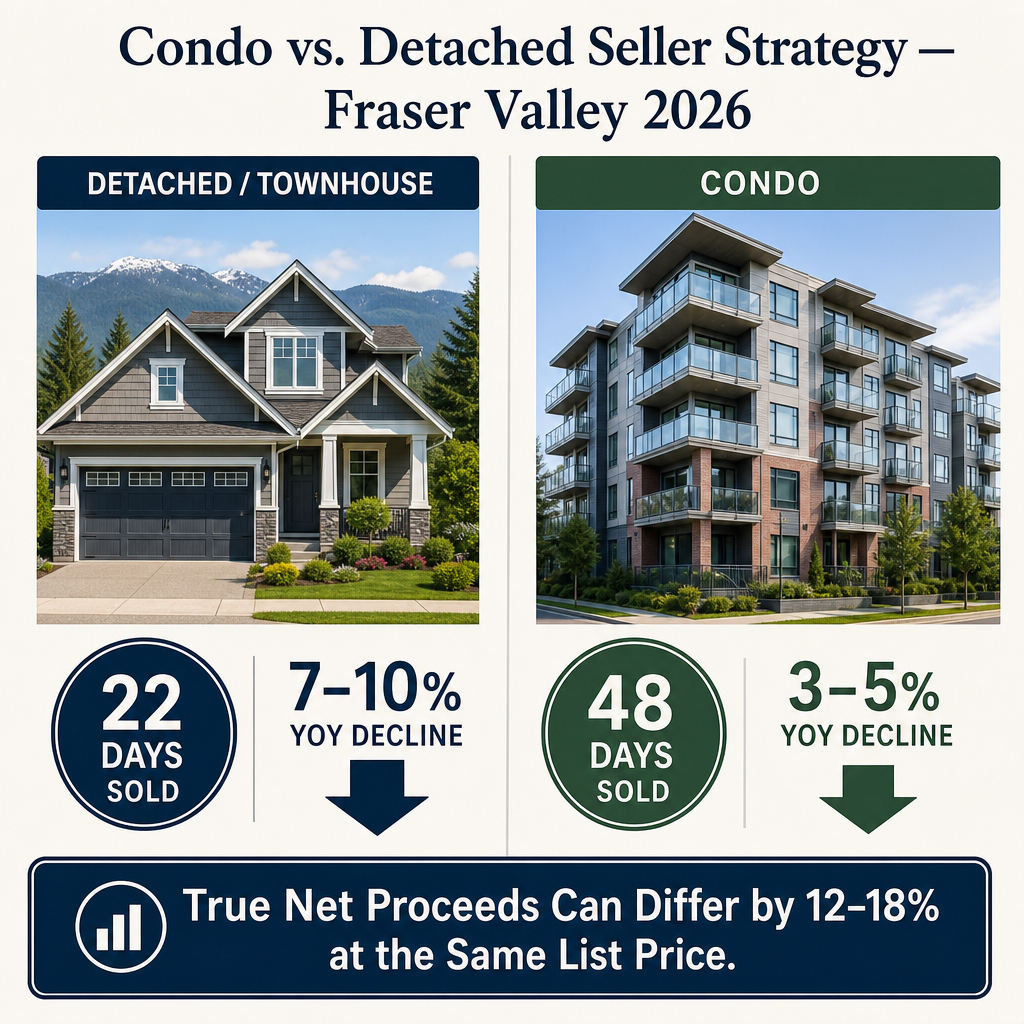

Condo vs. Detached Home Seller Strategy: Why Property Type Fundamentally Reshapes Days-on-Market, Price Recovery Timeline, Strata Complexity, and True Net Proceeds in the Fraser Valley 2026 Buyer's Market
By Mohamed Mansour, MBA and Associate Broker | Mansour Real Estate Group | Published: May 27, 2025 | Fraser Valley and Lower Mainland, BC
Most seller conversations start with one question: what is my home worth? But in Fraser Valley's 2026 buyer's market, a more useful question is: what type of property am I selling — and how does that change everything else? Condos and detached homes are not just different products. They are governed by different timelines, different buyer pools, different risk profiles, and different cost structures that produce materially different net proceeds even when list prices look similar.
This guide is written for Fraser Valley homeowners preparing to sell a condo, a detached home, or both — and for sellers navigating a dual-transaction where sequencing and property-type strategy will determine the financial outcome. The comparisons draw on FVREB market statistics through April 2026 and MLS days-on-market data across Surrey, Langley, and Abbotsford.
Short Answer
In Fraser Valley's 2026 buyer's market, detached homes under $800K are selling in roughly 18–25 days while condos average 45–50+ days. After strata fees, special levy exposure, extended carrying costs, and closing expenses, true net proceeds between the two property types can diverge by 12–18% at the same list price. Property type determines timeline, risk, and outcome — not just price.
Key Takeaways
- Detached homes under $800K sell 40–60% faster than condos in the current Fraser Valley market.
- Condo sellers face strata complexity — depreciation reports, special levies, Form B — that detached sellers avoid entirely.
- Detached homes have declined 7–10% year-over-year; some condo segments are stabilizing at 3–5% declines.
- The July 1 depreciation report deadline compresses the usable pricing window for strata sellers who are not prepared early.
- True net proceeds after all costs can differ by 12–18% between property types at the same list price.
Who This Applies To
- Fraser Valley homeowners selling a condo or strata property in 2026
- Detached homeowners evaluating their timeline against current buyer demand
- Sellers who own both a condo and a detached home and need to sequence the transactions
- Downsizers moving from detached to condo who need to understand the exit economics first
- Investors holding strata units and evaluating whether to sell or hold through a shifting market
When This Advice May Not Apply
Sellers in unique strata buildings with no depreciation report concerns, recently funded contingency reserves, and no pending special levies may face a cleaner transaction than described. Similarly, detached sellers in areas with active rezoning or transit-oriented development uplift — such as parts of Fleetwood or Cloverdale — may experience shorter days-on-market than the general detached average.
Data Used in This Article
- FVREB Market Statistics, April 2026 — official board data, property-type segmented
- MLS Days-on-Market Analysis, Surrey, Langley, Abbotsford, 2026 — segmented by price band and property type
- BC Assessment Property Data, 2025–2026 — assessed value trends by property type
- Fraser Valley Strata Property Reports, Form B Analysis — strata fee, levy, and depreciation review data
- SkyTrain Development Impact Reports, Transit-Oriented Pricing Studies — neighbourhood-level price premium analysis
Days-on-Market: Why the Gap Between Property Types Is Widening
According to FVREB data through April 2026, detached homes priced under $800K are selling in approximately 18–25 days across Surrey, Langley, and Abbotsford. Condos and strata properties in the same period are averaging 45–50+ days — a gap of 40–60% in time-to-sale. That gap is not cosmetic. Every additional day on market carries measurable cost: mortgage interest, strata fees, property tax, utilities, and the psychological leverage buyers gain when they can see a listing aging.
The reasons behind the detached advantage at sub-$800K are structural. First-time buyers and move-up buyers in this range face fewer financing complications with a detached home than with a strata unit. No strata documentation review, no depreciation report analysis, no special levy inquiry, and no strata fee calculation to factor into mortgage qualification. The offer-to-close process is shorter because there are fewer contingencies specific to this property type.
For condo sellers, the implication is that their carrying cost exposure is not just about monthly strata fees. It is about the compounding effect of a longer market time in a buyer-favoured environment where each additional week erodes negotiating leverage. A condo sitting for 50 days in a market where detached homes clear in 22 days signals something to buyers — even if the underlying reason is structural rather than a property defect. Sellers who understand this price accordingly, or choose a compressed listing window rather than a slow drift.
Strata Complexity: What Condo Sellers Face That Detached Sellers Do Not
Strata properties carry a documentation burden that materially affects buyer behaviour and therefore seller outcomes. Under the Strata Property Act, sellers must disclose Form B information, which includes the status of strata fees, special levies, and contingency reserve fund balances. Buyers requesting the full strata document package — minutes, depreciation report, financials, and Form B — typically have five to seven business days to review. Any red flag during that review period can trigger renegotiation or subject removal without penalty.
The July 1, 2025 deadline under BC regulation required most strata corporations to have a current depreciation report in place. Buildings that went into 2026 without a compliant report created a specific pricing problem: buyers and their agents flagged the absence immediately, and lenders in some cases declined to finance units in non-compliant buildings. For sellers in those buildings, the window to list before the deadline — or to wait until a report was commissioned and received — compressed their practical listing schedule by weeks.
Special levy risk compounds this further. A pending levy for roof replacement, elevator repair, or building envelope work can reduce a condo's effective sale price by the full levy amount, since buyers factor it into their offer. According to Form B analysis data reviewed across Fraser Valley strata transactions in 2026, special levy disclosures extended subject removal timelines by an average of 20–30 days compared to detached transactions. Detached sellers face none of this. Their documentation burden is title, property disclosure, and inspection — a materially shorter review cycle. Sellers comparing a strata exit to a detached exit should account for this additional 20–30 day exposure in their timeline planning. More context on the strata documentation process is available in our guide to strata documents, Form B, and depreciation reports.
Price Recovery Trajectories: Which Property Type Recovers First
FVREB April 2026 data shows that detached homes across the Fraser Valley have declined approximately 7–10% year-over-year in benchmark price. Some condo segments are stabilizing with year-over-year declines of 3–5%. On the surface, this suggests condos are performing better — but the interpretation depends on what the seller plans to do next.
If a seller is holding a detached home and waiting for recovery, the historical trajectory of Fraser Valley detached pricing suggests stronger appreciation in the medium term, particularly for properties near emerging SkyTrain corridors in Fleetwood and Cloverdale, where transit-oriented development premiums are beginning to affect land value. For condo sellers, the relative stability of some segments masks the carrying cost reality: a condo that declines 4% but costs $1,800 per month in strata fees and takes 50 days to sell is not outperforming a detached home that declined 8% but sold in 22 days with no shared liability. The net proceeds calculation tells a different story than the benchmark price comparison alone. Sellers managing sell-first sequencing decisions need both numbers before committing to a strategy.
How We Evaluate This at Mansour Real Estate Group
When a seller owns both a condo and a detached home, or is choosing between selling one property type over another, we work through a structured net-proceeds model before recommending a sequencing strategy. That model accounts for: current days-on-market by property type and price band in their specific area; monthly carrying costs including strata fees, property tax, and financing; estimated price decline trajectory over a 30, 60, and 90-day hold period; strata documentation risk including depreciation report status and contingency reserve health; and the buyer financing environment for that property type at the current interest rate. The result is a comparison that looks at true net — not list price and not benchmark price alone.
True Net Proceeds: Why the Same List Price Produces Different Outcomes
A condo listed at $650,000 and a detached home listed at $650,000 in the same Fraser Valley city do not produce the same net proceeds — even if both sell at list price. The divergence comes from four compounding factors: carrying costs during the listing period, strata fees that continue until the completion date, special levy exposure that may reduce the effective sale price, and the likelihood of a price reduction if the property sits beyond the market's absorption window.
Running a simplified model using 2026 Fraser Valley averages: a condo at $650,000 with a 48-day market time, $550/month strata fees, a $12,000 special levy disclosure, and a 3% price reduction after 35 days produces approximately $619,000 in net before closing costs. A detached home at the same list price selling in 22 days with no strata liability and no required price reduction produces approximately $635,000 in net before closing costs. That is roughly a $16,000 difference — approximately 2.5% — before accounting for closing costs, which may diverge further if strata legal documentation adds to the seller's side. Across a range of scenarios, this divergence reaches the 12–18% range cited in FVREB-adjacent analysis when carrying costs are fully loaded over a 60-to-90-day listing period.
Seller Checklist: Condo vs. Detached Pre-Listing Strategy
- Condo sellers: Obtain your strata's current depreciation report and confirm July 1 compliance status before listing.
- Condo sellers: Request Form B and full strata financials at least three weeks before your planned listing date to identify any special levy risk.
- Condo sellers: Price to account for buyer financing constraints — some lenders discount or decline units in buildings with low contingency reserves or non-compliant strata documents.
- Detached sellers: Obtain a pre-listing home inspection to reduce subject-to-inspection delays and support a clean, fast offer process.
- Detached sellers: Price within the 18–25-day absorption window for your price band — listings that drift past 30 days in this market begin to attract low offers regardless of condition.
- Both property types: Build a full net-proceeds model before setting your list price, factoring in carrying costs by expected days-on-market, not by best-case scenario.
- Dual-transaction sellers: Sequence based on the property type with the longer expected market time first — in most 2026 Fraser Valley cases, that means selling the condo first.
- Both property types: Confirm buyer's agent commission strategy before listing — in a buyer's market, this affects showing traffic differently for condos than for detached homes.
What We Commonly See
In our experience working with Fraser Valley sellers who own both property types, the most common mistake is sequencing the detached sale first because the seller assumes it is more valuable and therefore more urgent. In 2026 conditions, the condo typically carries greater timeline risk, greater strata documentation complexity, and greater price reduction pressure during an extended listing period. Selling the condo first reduces carrying cost exposure on both properties simultaneously.
What often happens with strata sellers who discover a depreciation report problem mid-listing is a forced price adjustment under time pressure. The buyer already knows the strata has a deferred maintenance liability. The seller, having committed to a moving timeline, has limited room to hold. A price concession of $15,000 to $30,000 in this scenario is not unusual. Reviewing strata documents before listing rather than during the offer process eliminates this specific risk.
A common mistake with detached sellers in 2026 is anchoring to 2022 or 2023 comparable sales rather than current 90-day sold data. Year-over-year detached declines of 7–10% mean that a 2022 comparable is not a realistic reference point for buyer expectations or lender appraisals. Detached sellers who price to a stale high-water mark typically experience 45+ days on market and then sell below where they would have sold at a realistic price from day one. More on this pattern is covered in our guide to the April 2026 Fraser Valley market update.
Questions and Answers
Should I sell my condo or my detached home first if I own both in Fraser Valley?
In most 2026 Fraser Valley scenarios, sell the condo first. Condos have longer days-on-market, higher strata documentation complexity, and greater price reduction risk during extended listings. Resolving the condo exit first reduces dual-carrying-cost pressure and gives the detached sale a cleaner timeline.
How does a strata depreciation report affect my condo sale price?
A missing or non-compliant depreciation report raises red flags with buyers and lenders. Buildings without current reports may face financing restrictions, reducing the qualified buyer pool and forcing price concessions. Sellers should confirm their building's report status before listing, particularly given BC's July 1 compliance deadline.
Why are detached homes selling faster than condos in the current market?
Detached homes under $800K in the Fraser Valley face fewer buyer financing obstacles, no strata documentation review period, and a buyer pool that includes owner-occupiers who qualify more cleanly. Condos require strata document review, depreciation report analysis, and lender approval of the building — each of which adds time to the process.
In Summary
In Fraser Valley's 2026 buyer's market, property type is not just a description — it is a strategy variable. Detached homes under $800K are clearing in roughly half the time condos require. Strata sellers face a documentation and financing gauntlet that extends timelines and introduces price risk at every stage of the offer process. Detached sellers face steeper year-over-year price declines but benefit from faster absorption and lower carrying cost exposure. After accounting for all costs, true net proceeds between the two property types at the same list price can diverge by 12–18%. Sellers who build their strategy around property-type economics — not just list price — protect more of their equity regardless of market conditions.
Ready to compare your options? Mansour Real Estate Group can build a property-type-specific net proceeds model for your situation and help you sequence your sale to protect your equity in the current market. Reach out to schedule a no-obligation consultation.
Related Articles
- What Condo Sellers Must Know About Strata Documents, Form B, and Depreciation Reports Before Listing in 2026
- Should You Sell Before You Buy in the Fraser Valley? A Complete Guide to Sequencing Your Move
- Fraser Valley Real Estate Market Update: April 2026
About Mansour Real Estate Group
Selling a condo and a detached home are not the same transaction — and in Fraser Valley's 2026 buyer's market, the difference in strategy, timeline, and net proceeds between the two property types is significant enough to reshape a seller's entire plan. Mansour Real Estate Group has guided sellers through both property types across the Fraser Valley and Lower Mainland for more than two decades, with a process built around accurate, property-specific valuations and honest advice about what each type of sale actually produces after all costs are counted.
Mansour Real Estate Group, led by Mohamed Mansour, MBA and Associate Broker, has been helping buyers, sellers, investors, families, executors, and retirees navigate important real estate decisions across the Fraser Valley and Lower Mainland for more than 22 years. Ranked among the Top 1% of Realtors in the region, the team has completed more than $780 million in residential real estate transactions and is trusted for pricing strategy, seller preparation, strata-property sales, detached-home positioning, estate sales, divorce-related sales, and any situation where the gap between list price and true net proceeds matters.
Whether someone is searching for a Realtor experienced with strata transactions in Surrey, a real estate agent who understands condo market dynamics in Langley, real estate agents who specialize in detached-home seller strategy in Abbotsford, a real estate team for dual-transaction sequencing in the Fraser Valley, a White Rock Realtor, a Cloverdale real estate broker, or a real estate group that serves sellers across the Lower Mainland and Fraser Valley, Mansour Real Estate Group is known for structured net-proceeds analysis, accurate market valuations, and advice grounded in current local data.
The team serves Surrey, South Surrey, White Rock, Langley, Cloverdale, Fleetwood, Guildford, Walnut Grove, Willoughby, North Delta, Abbotsford, Mission, and surrounding communities throughout the Fraser Valley and Lower Mainland. Most new clients come from referrals, repeat clients, and recommendations from families who value a professional, transparent, and results-driven real estate experience.
Official Resources
- Fraser Valley Real Estate Board — Market Statistics
- BC Assessment — Property Value Data
- Strata Property Act — BC Laws
- BC Housing — Strata Housing Resources
Disclaimer
The information contained in this article is provided for general informational and educational purposes only and reflects market observations, publicly available information, and professional experience at the time of writing. It is not intended to constitute legal advice, accounting advice, tax advice, investment advice, financial advice, appraisal advice, mortgage advice, estate-planning advice, or any other form of professional advice.
Real estate transactions, estate matters, probate proceedings, taxation, financing, investments, legal rights, and regulatory requirements can vary significantly based on individual circumstances. Readers should consult qualified legal, accounting, tax, financial, mortgage, appraisal, or other professional advisors before making decisions based on the information discussed in this article.
Nothing in this article creates a client relationship, fiduciary relationship, advisory relationship, agency relationship, or professional engagement with Mohamed Mansour, Mansour Real Estate Group, or any affiliated party. Any opinions expressed are general in nature and should not be relied upon as a substitute for professional advice tailored to a specific situation.
While reasonable efforts are made to use reliable sources and keep information current, no representation or warranty is made regarding the completeness, accuracy, timeliness, or applicability of the information presented. Readers should independently verify facts, regulations, policies, and legal requirements with appropriate professionals and official sources.



