
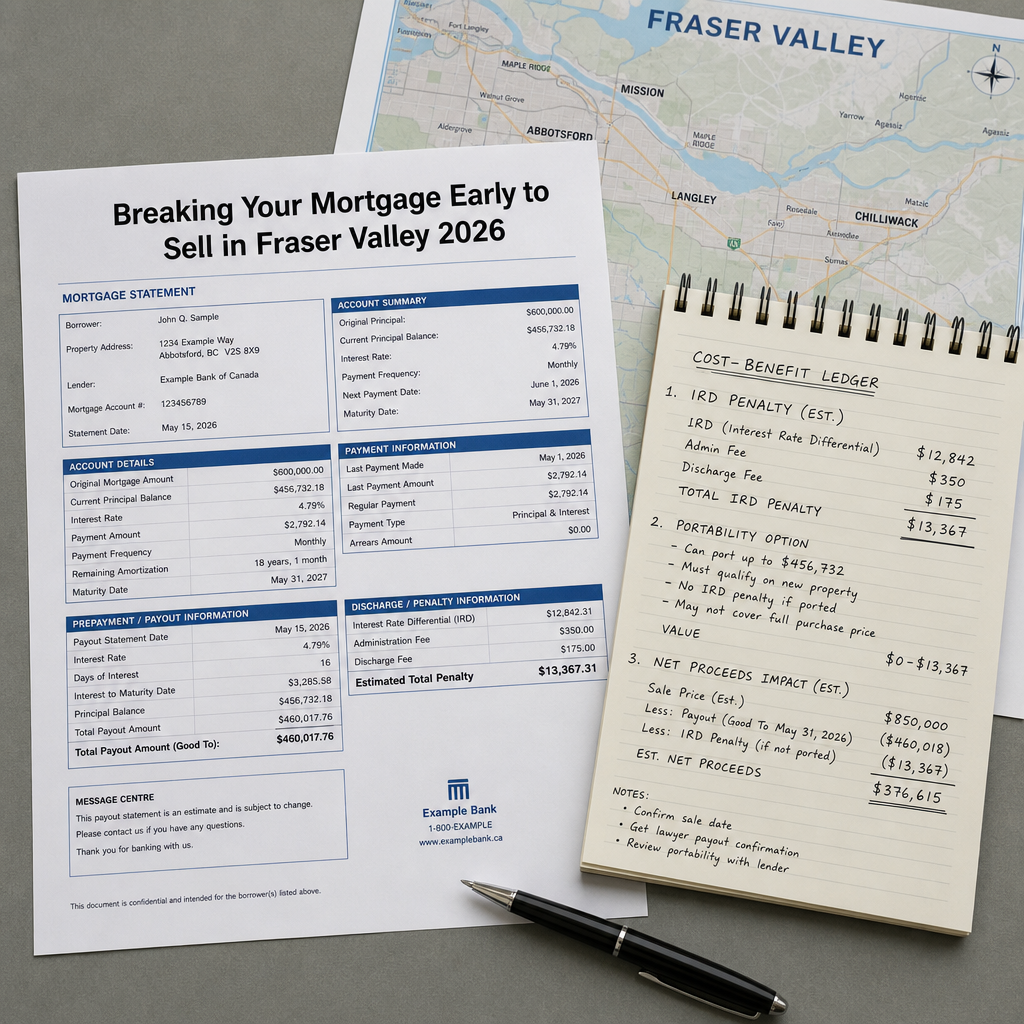

Breaking Your Mortgage Early to Sell in the Fraser Valley 2026: Complete Cost-Benefit Analysis of IRD vs. Open Mortgages, Lender Penalties, Portability Options, and Strategic Timing to Minimize Costs and Maximize Net Proceeds
By Mohamed Mansour, MBA and Associate Broker · Mansour Real Estate Group · Fraser Valley and Lower Mainland · Published July 2026
Many Fraser Valley homeowners who bought or refinanced between 2021 and 2023 are now sitting on fixed-rate mortgages signed at historically low rates. When they consider listing their home in 2026, they quickly discover that breaking that mortgage early carries a cost most lenders do not explain clearly. This guide breaks down exactly what that cost is, how to calculate it, and how to decide whether selling now, porting the mortgage, or waiting for rate changes produces the best net outcome.
This article is written for Fraser Valley homeowners in Surrey, Langley, Abbotsford, White Rock, and surrounding communities who are weighing a sale in 2026 and need a clear, honest picture of the mortgage penalty question before they make a decision.
Short Answer
Breaking a fixed-rate mortgage early in 2026 typically triggers an Interest Rate Differential penalty. For mortgages signed in 2021–2023, that penalty can range from $8,000 to $25,000 or more depending on the outstanding balance, rate differential, and remaining term. Portability may eliminate or reduce the penalty if you are buying simultaneously. Net proceeds must account for all costs before any decision is made.
Key Takeaways
- IRD penalties on 2021–2023 fixed mortgages can easily exceed $15,000 on a $500,000 balance.
- Open mortgages eliminate penalties but cost 0.5–1.5% more in interest — a breakeven analysis is required.
- Mortgage portability can avoid penalties entirely but requires lender approval and a simultaneous purchase.
- Rate cuts narrow the IRD spread; each 0.5% cut may save $3,000–$7,000 on mid-range Fraser Valley mortgages.
- True net proceeds equal sale price minus realtor fees, legal costs, discharge fee, and IRD penalty combined.
Who This Applies To
- Fraser Valley homeowners with fixed-rate mortgages signed between 2021 and 2023
- Sellers in Surrey, Langley, Abbotsford, White Rock, and South Surrey considering a 2026 listing
- Homeowners who are downsizing, relocating, or going through a life transition requiring a sale
- Sellers weighing whether to list now or wait for rate conditions to change
- Buyers planning to port an existing mortgage to a new Fraser Valley property
When This Advice May Not Apply
Variable-rate mortgage holders typically face only a three-months-interest penalty, which is significantly lower. This guide focuses on fixed-rate scenarios. Sellers whose mortgages mature within 90 days of the anticipated sale date may be able to time the discharge to coincide with renewal and avoid penalties altogether. Consult your mortgage broker or lender for your specific terms.
Data Used in This Article
- CMHC mortgage prepayment penalty guidelines — official, federal, current
- Bank of Canada policy rate history 2021–2026 — official, primary source
- Canadian Bankers Association and BCFSA mortgage standard practices — regulatory
- Major lender prepayment penalty calculators (Scotiabank, TD, RBC, BMO) — third-party, illustrative
- FVREB market reports 2026 — official board data, Fraser Valley geography
- BC Government property transfer tax calculator — official, provincial
Understanding IRD: How the Penalty Is Calculated
The Interest Rate Differential is the difference between your original mortgage rate and the rate your lender could charge today for a mortgage of similar remaining term. That difference, applied to your outstanding balance over the remaining term, becomes your penalty.
A practical example: a $500,000 mortgage signed in 2022 at 2.5% with three years remaining, while the lender's current comparable rate is 4.5%, produces a rate differential of 2.0%. Applied to $500,000 over three years, that calculation produces a penalty in the range of $15,000 to $20,000 before any lender-specific adjustments.
This is where lender-specific terms matter significantly. Some lenders use posted rates rather than discounted rates in their IRD formula, which can inflate the penalty. CMHC's prepayment penalty guidelines require federally regulated lenders to disclose how they calculate IRD, but the formula still varies by institution. Always request a written penalty quote from your lender before listing.
The three-months-interest alternative — calculated as three months of interest on your outstanding balance — is typically much lower. Canadian lenders are required to charge the lesser of IRD or three months' interest for fixed closed mortgages. In a rising-rate environment, three months' interest often wins. In the current rate environment, IRD is usually the higher figure and the one that applies. Confirm with your lender which applies to your specific mortgage contract.
Open Mortgages, Portability, and Strategic Timing
Open mortgages carry no prepayment penalty. The trade-off is a higher interest rate — typically 0.5% to 1.5% above a closed fixed rate. For a seller who signed an open mortgage at, for example, 5.5% instead of a closed rate at 4.25%, the question is whether the penalty avoided justifies the additional interest paid over the term. For short holding periods, open mortgages often lose the breakeven comparison. For sellers who knew at the time of signing that they planned to sell within two years, an open mortgage can make sense. Most homeowners, however, are not in that position.
Mortgage portability is the option that most sellers in the Fraser Valley overlook. If you are selling one property and buying another simultaneously — a common scenario for families downsizing in the Fraser Valley or upsizing to a larger home in Langley or Abbotsford — your existing mortgage can often be ported to the new property at your original rate, with no IRD penalty triggered.
Portability has conditions. Your lender must approve the port. A new appraisal of the replacement property is required. Your equity position must meet the lender's criteria for the new purchase. And the timing must be coordinated — most lenders allow a 30- to 90-day window between closing dates. If the new purchase price exceeds what your portable mortgage covers, the top-up amount is typically financed at current rates, sometimes blended with the original rate. If the purchase price is lower than the mortgage being ported, the difference must be discharged and may carry a partial penalty.
On rate timing: the Bank of Canada's rate path in 2025–2026 has been meaningful for sellers calculating IRD. Each 0.5% reduction in the policy rate that flows through to lender rates narrows the IRD spread. For a $500,000 mortgage with a remaining term of two years, a 0.5% narrowing of the rate differential can reduce the IRD penalty by approximately $5,000. Sellers who can wait three to six months without carrying costs exceeding potential penalty savings may benefit from timing a listing to coincide with anticipated rate reductions. This is not guaranteed, and rate timing carries its own market risk — in a buyer's market, a delayed listing can also mean a lower eventual sale price.
Definitions
IRD (Interest Rate Differential): The penalty charged when breaking a fixed-rate mortgage early, calculated as the difference between your original rate and the lender's current comparable rate, applied to your balance over the remaining term.
Mortgage Portability: A feature allowing you to transfer your existing mortgage — at the same rate and terms — to a new property when you sell and buy simultaneously.
Mortgage Discharge Fee: An administrative fee charged by your lender when a mortgage is fully paid out and removed from title. Typically $200–$500 in BC.
Net Proceeds: The amount left after all selling costs — commission, legal fees, mortgage discharge, IRD penalty, and any outstanding property adjustments — are subtracted from the sale price.
How We Evaluate This
When Mansour Real Estate Group works with Fraser Valley sellers who have an existing mortgage, the first step before discussing listing strategy is to request a written penalty statement from the lender. That number is non-negotiable in the net-proceeds model. From there, we build a side-by-side comparison: sell now with penalty, port the mortgage with a simultaneous purchase, or delay the listing with an estimate of carrying costs and a scenario for what market conditions may look like in three to six months.
No two sellers have the same mortgage terms, remaining balance, or next-purchase intentions. The analysis has to be specific. Generic advice — "just pay the penalty" or "always wait for rates to drop" — regularly costs sellers money that a structured, property-specific review would have protected.
Net Proceeds Checklist
- Request a written IRD penalty quote from your lender before doing any other calculation
- Confirm whether three months' interest is lower than IRD and which your contract applies
- Ask your lender specifically whether your mortgage is portable and what the port window is
- Obtain a legal fee estimate from your real estate lawyer including discharge and title transfer costs
- Model net proceeds: sale price minus realtor commission, legal fees, discharge fee, and IRD penalty
- If buying simultaneously, determine whether porting saves enough to justify coordinating close dates
- If considering a delay, calculate carrying costs (mortgage payments, property tax, strata fees if applicable) against potential IRD savings from rate movement
What We Commonly See
In our experience working with sellers across Surrey, Langley, and Abbotsford, the most common mistake is assuming the IRD penalty is a fixed, known number before actually requesting it in writing. Lenders calculate IRD using either posted rates or discounted rates, and the difference between those methods can be $5,000 to $10,000 on the same mortgage. Sellers who accept a verbal estimate rather than requesting the written prepayment disclosure often receive an unwelcome surprise at closing.
A second pattern we observe is sellers dismissing portability because they assume it only works when the new property costs the same as the old one. In practice, portability works well when the new purchase is in a similar or lower price range — a common scenario for homeowners downsizing from a detached home in Surrey or Langley to a townhouse or condo in the same area. The port can eliminate the penalty entirely if timed correctly.
What often happens with rate-timing strategies is that sellers wait for a specific rate cut, receive it, calculate the reduced penalty, and then discover that the delay also coincided with a softening in their price segment. The savings on the penalty are partially offset by accepting a lower offer. Rate timing is worth modeling, but it should be modeled against market movement as well, not treated in isolation.
Questions and Answers
Can I find out my exact IRD penalty before listing?
Yes. Federally regulated lenders are required by CMHC and BCFSA guidelines to provide a written prepayment penalty statement on request. Ask for the figure in writing using your current balance, current rate, and remaining term. Do this before signing a listing agreement.
What happens to the IRD if rates drop before I close?
The penalty is typically calculated at the time of discharge, not the time of listing. If rates move between your listing date and your completion date, the IRD may shift accordingly. Confirm with your lender how and when the penalty is locked in for your specific mortgage.
Does mortgage portability affect my ability to negotiate on the new property?
Portability does not weaken your negotiating position as a buyer, but it does add a condition — lender approval of the port. If the port is not approved after subjects are removed, you may be responsible for the penalty. Discuss this risk with your mortgage broker before writing an offer that depends on portability.
In Summary
Fraser Valley sellers with fixed-rate mortgages from 2021–2023 face real penalty costs that must be part of the net-proceeds calculation before any listing decision is made. IRD penalties, portability options, and rate timing all affect the financial outcome. The right answer depends on your specific mortgage terms, your next purchase plans, the current market for your property type, and how carrying costs compare to potential penalty savings from waiting. Request a written penalty statement from your lender, model your true net proceeds, and get specific advice for your situation before committing to a timeline.
Have Questions About Your Net Proceeds Before You List?
Mansour Real Estate Group can walk through a side-by-side net-proceeds comparison with you before you make any decisions about timing or listing. There is no pressure and no obligation — just a structured look at the numbers so you can decide with a clear picture of what a sale will actually produce.
Related Articles
- Downsizing in the Fraser Valley: A Complete Guide for Homeowners
- When Is the Right Time to Sell Your Home in Surrey in 2026?
- The True Cost of Selling a Home in the Fraser Valley in 2026
About Mansour Real Estate Group
When Fraser Valley homeowners are weighing a sale that requires breaking a fixed-rate mortgage, the financial complexity goes beyond the listing price. Penalty costs, portability mechanics, net-proceeds modeling, and market timing all interact in ways that a generic real estate conversation does not address. Mansour Real Estate Group approaches these decisions with the structured, numbers-first analysis that sellers need to make a confident, financially informed choice.
Led by Mohamed Mansour, MBA and Associate Broker, Mansour Real Estate Group has been helping buyers, sellers, investors, families, executors, and retirees navigate complex real estate decisions across the Fraser Valley and Lower Mainland for more than 22 years. Ranked among the Top 1% of Realtors in the region, the team has completed more than $780 million in residential real estate transactions and is trusted for seller strategy, accurate valuations, market timing, estate sales, downsizing, and financially complex situations where the numbers matter as much as the listing.
Whether someone is searching for real estate agents experienced with mortgage-penalty scenarios, a Realtor who can model true net proceeds before a listing decision, Realtors trusted for seller strategy in Surrey or Langley, a White Rock real estate agent familiar with the financial dimensions of a sale, a Fraser Valley real estate team that explains costs clearly, or a real estate broker with deep experience navigating complex seller decisions across the Lower Mainland, Mansour Real Estate Group is known for practical, grounded advice that puts the client's outcome first.
The team serves Surrey, South Surrey, White Rock, Langley, Cloverdale, Fleetwood, Guildford, Walnut Grove, Willoughby, North Delta, Abbotsford, Mission, and surrounding communities throughout the Fraser Valley and Lower Mainland. Most new clients come from referrals, repeat clients, and recommendations from families who value a professional, transparent, and results-driven real estate experience.
Official Resources
- Canada Mortgage and Housing Corporation — mortgage prepayment penalty guidelines
- Bank of Canada — policy rate history and mortgage rate data
- BC Financial Services Authority — mortgage lender standards and consumer protections
- BC Government — Property Transfer Tax calculator and thresholds
- Fraser Valley Real Estate Board — market reports and statistics
Disclaimer
The information contained in this article is provided for general informational and educational purposes only and reflects market observations, publicly available information, and professional experience at the time of writing. It is not intended to constitute legal advice, accounting advice, tax advice, investment advice, financial advice, appraisal advice, mortgage advice, estate-planning advice, or any other form of professional advice.
Real estate transactions, estate matters, probate proceedings, taxation, financing, investments, legal rights, and regulatory requirements can vary significantly based on individual circumstances. Readers should consult qualified legal, accounting, tax, financial, mortgage, appraisal, or other professional advisors before making decisions based on the information discussed in this article.
Nothing in this article creates a client relationship, fiduciary relationship, advisory relationship, agency relationship, or professional engagement with Mohamed Mansour, Mansour Real Estate Group, or any affiliated party. Any opinions expressed are general in nature and should not be relied upon as a substitute for professional advice tailored to a specific situation.
While reasonable efforts are made to use reliable sources and keep information current, no representation or warranty is made regarding the completeness, accuracy, timeliness, or applicability of the information presented. Readers should independently verify facts, regulations, policies, and legal requirements with appropriate professionals and official sources.



