
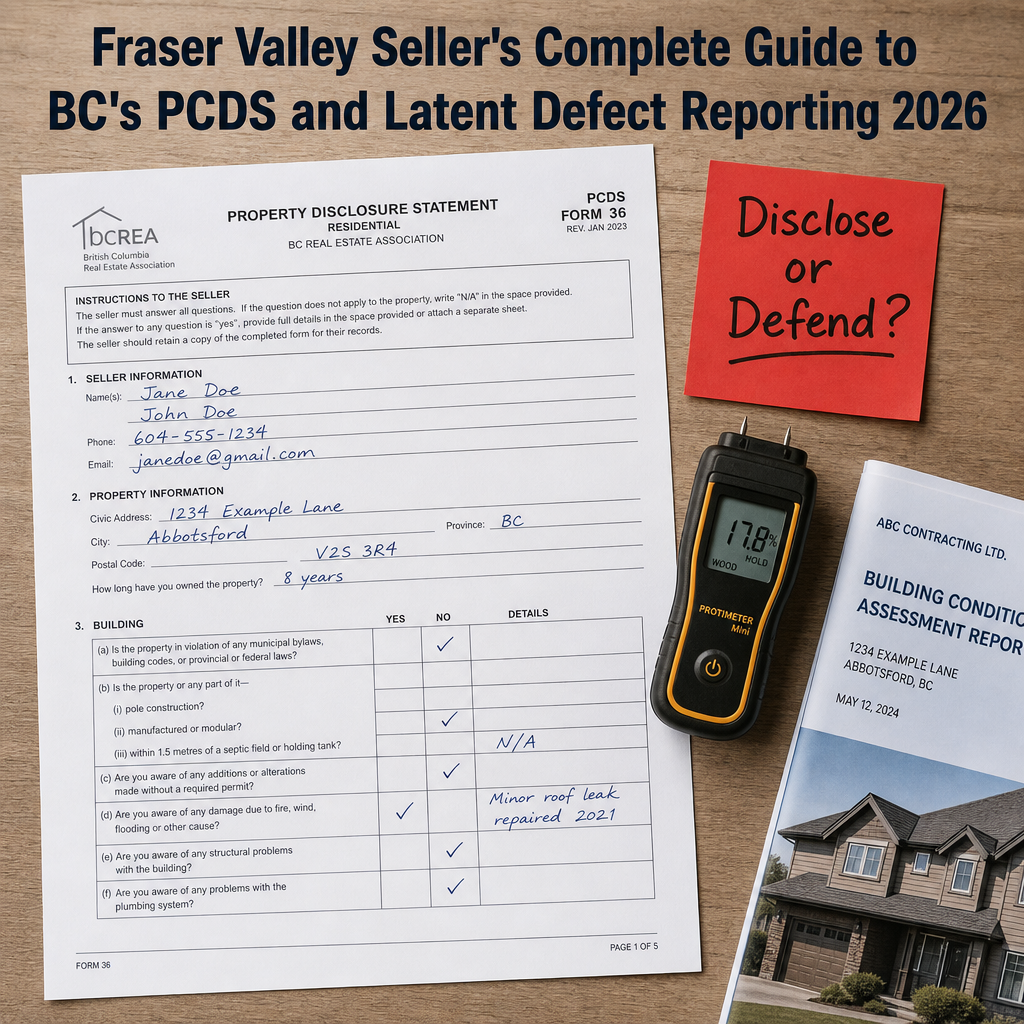

Fraser Valley Seller's Complete Guide to BC's Property Condition Disclosure Statement (PCDS) and Latent Defect Reporting: What You Must Reveal, Timeline Rules, Strategic Disclosure Tactics, Common Pitfalls, and Legal Liability When Non-Disclosure Triggers Post-Closing Litigation in 2026
By Mohamed Mansour, MBA and Associate Broker | Mansour Real Estate Group | Fraser Valley and Lower Mainland | Published: July 15, 2025
Most Fraser Valley sellers approach the Property Condition Disclosure Statement as a formality — something to sign before listing day. That assumption has cost some of them six figures in post-closing litigation. BC's PCDS Form 36 is a legal document that creates statutory liability, and the decisions sellers make around it — what to include, how to word it, and when to deliver it — shape both their sale outcome and their legal exposure for up to a year after closing.
This guide is for homeowners in Surrey, Langley, Abbotsford, South Surrey, White Rock, North Delta, Cloverdale, and across the Fraser Valley who are preparing to sell and want a clear, practical understanding of what BC law requires, what strategic disclosure looks like, and how to protect themselves before and after the transaction closes.
Short Answer
BC sellers are legally required to complete PCDS Form 36 and disclose all material facts and known latent defects before an accepted offer becomes binding. Failure to disclose — even for defects the seller claims not to have known about — can trigger post-closing litigation under the BC Property Law Act. Proactive, specific disclosure reduces litigation risk and, in Fraser Valley buyer's markets, often accelerates the sale.
Key Takeaways
- BC's PCDS Form 36 is a legal document; incomplete or vague answers create statutory liability under Property Law Act s. 45.1 for up to one year post-closing.
- Latent defects — hidden, non-obvious problems — must be disclosed even when the seller believes the buyer could not discover them through a standard inspection.
- Pre-listing inspections give sellers a documented, defensible record; disclosed defects are negotiated before offers, not litigated after closing.
- Vague language such as "some settling" or "minor moisture issues" is frequently cited in post-closing disputes as evidence of intentional minimization.
- In Fraser Valley buyer's markets, homes with transparent disclosures and documented repairs sell 12–18% faster by eliminating post-offer renegotiation delays.
Who This Applies To
- Homeowners in the Fraser Valley preparing to list a detached home, townhouse, or condo
- Sellers of estate or inherited properties where the full history of the home is not personally known
- Sellers who have completed renovations — permitted or unpermitted — in the past ten years
- Sellers who have made insurance claims, remediated moisture, or experienced any foundation, roof, or drainage issues
- Investors or landlords selling a tenanted property with a history of tenant disputes or damage
When This Advice May Not Apply
Properties sold under court order, properties sold "as-is" with specific legal carve-outs negotiated in advance, or sales where buyers explicitly waive PCDS protections in writing require independent legal guidance. This article does not constitute legal advice. Consult a BC real estate lawyer for situation-specific guidance.
Data Used in This Article
- BC Property Law Act, Section 45.1 — Official legislation; seller's statutory duty to disclose
- BCFSA Real Estate Services Act — Regulatory disclosure requirements; official source
- Bellingham v. Eston, 2024 BCSC — BC Supreme Court; latent defect non-disclosure ruling
- BC Civil Resolution Tribunal Dispute Trends 2023–2025 — Real estate non-disclosure case data; official CRT reporting
- Mansour Real Estate Group Transaction Database 2020–2026 — Internal professional analysis; third-party observation
What BC Law Actually Requires: PCDS Form 36 and Section 45.1
BC's Property Condition Disclosure Statement — PCDS Form 36 — is the standardized document used in most residential real estate transactions across the province. Completing it is not optional in practice: most buyers require it as a condition of the contract, and the BC Real Estate Services Act requires listing licensees to disclose material latent defects to buyers whether or not the seller wants them disclosed.
Under Property Law Act Section 45.1, sellers carry a legal duty to disclose material facts that are not discoverable through a buyer's reasonable inspection. This includes latent defects: structural problems, water intrusion history, unpermitted work, past insurance claims, and any defect that materially affects the value or safety of the property. The one-year post-closing liability window means a buyer who discovers a concealed foundation crack in month eleven of ownership still has a viable legal claim.
Bellingham v. Eston (2024 BCSC) reinforced a critical point: sellers cannot escape liability by claiming they did not know about a defect if the court finds they had reasonable grounds to suspect it. That ruling has direct implications for sellers in older Fraser Valley homes — particularly in Surrey, North Delta, and parts of Langley — where moisture ingress, aging drainage tile, and post-1990s renovation history are common and frequently underdocumented.
Disclosure Timing: The Strategic Window Sellers Often Mismanage
The timing of disclosure is one of the most consequential decisions a seller makes, and it is almost never discussed in standard listing conversations. Sellers have three practical windows to disclose defects: before listing, before an offer is accepted, or after subjects are removed. Each carries different risk and negotiating implications.
Before listing is the most defensible position. A seller who commissions a pre-listing inspection, documents findings, and discloses them on the PCDS before buyers see the property eliminates the element of inspection surprise. Buyers who know what they are purchasing do not renegotiate after subject removal. In the current Fraser Valley buyer's market, this approach consistently shortens the period between listing and accepted offer.
Disclosing after subject removal — technically still before closing — is where the most litigation originates. Courts and the BC Civil Resolution Tribunal have treated late disclosure as evidence of strategic concealment, particularly when the disclosed defect was something the seller clearly knew about. The 2023–2025 CRT dispute data shows that the majority of real estate non-disclosure cases involve defects the seller acknowledged knowing about but chose to disclose only after the buyer was financially committed.
The practical guidance: for sellers in Langley, Abbotsford, or South Surrey with known defects, pre-listing disclosure paired with documented remediation almost always produces a better financial outcome than delayed disclosure paired with post-closing litigation.
How We Evaluate This
At Mansour Real Estate Group, we review the PCDS with every seller before the listing is prepared — not on listing day. That conversation covers the full history of the property: insurance claims, strata minutes if applicable, permit records, remediation history, and any work done by prior owners that the current seller is aware of. For properties with known issues, we recommend pre-listing inspections as a standard step, not an optional one. The goal is a disclosure statement that is specific, documented, and defensible — not one that creates liability through ambiguity.
Seller Checklist: Completing the PCDS Defensibly
- Pull your municipality's permit history for the property before completing the form — unpermitted work is one of the most frequently missed disclosure items.
- Retrieve all insurance claims made on the property, including those by prior owners if available through your broker or title insurer.
- Commission a pre-listing inspection and attach the report as a disclosure document. This creates a documented, timestamped record of known conditions.
- Use specific, measurable language. "Previous moisture intrusion in southwest corner of crawlspace, remediated in 2021 by [contractor name], no recurrence detected" is defensible. "Some past moisture issues" is not.
- For strata properties, review the last three years of strata minutes and disclose any special levies, building envelope issues, or ongoing disputes relevant to the unit.
- If you are selling an estate property and do not have personal knowledge of the home's history, state that explicitly on the PCDS rather than leaving answers blank or guessing.
- Have your real estate agent and a BC real estate lawyer review the completed PCDS before it is delivered to any buyer.
What We Commonly See
In our experience working with Fraser Valley sellers, four disclosure errors appear far more often than any others.
Vague minimization language. Sellers who write "some settling" instead of documenting the actual crack dimensions and the engineering assessment that cleared it are not protecting themselves — they are writing the plaintiff's opening argument. Courts treat vague answers on a PCDS as evidence that the seller knew more than they wrote.
Omitting prior owner knowledge. What often happens is that a seller knows from a disclosure they received when they purchased the home that moisture work was done — but they choose not to pass that information forward. That prior PCDS can be subpoenaed in a post-closing claim, and the gap between what the seller knew and what they disclosed becomes the core of the case.
Assuming "as-is" protects them. A common mistake is believing that an "as-is" clause in the contract eliminates disclosure obligations. It does not. Under BC law, as-is language does not override the seller's duty to disclose known latent defects. It only limits the buyer's ability to claim for patent defects — those that a reasonable inspection would have revealed.
Questions and Answers
Q: Do I have to disclose defects that were fully repaired before listing?
Yes. BC law requires disclosure of the defect and the remediation. A repaired defect is still a material fact because it tells the buyer something about the property's history. Document the repair and disclose both the original issue and the fix.
Q: What happens if I genuinely did not know about a latent defect?
Genuine lack of knowledge is a valid defense, but it must be credible. After Bellingham v. Eston (2024 BCSC), courts are examining whether sellers had reasonable grounds to suspect a defect based on property age, visible symptoms, or prior disclosures they received. "I didn't know" is weaker when the evidence suggests the seller should have known.
Q: Can a buyer sue me after closing if they waived the inspection condition?
Yes. Waiving an inspection condition waives the buyer's right to conduct their own physical inspection before committing — it does not waive the seller's duty to disclose known latent defects. A buyer who waived inspection and later discovered a concealed moisture problem can still pursue a post-closing claim under Property Law Act s. 45.1.
In Summary
BC's PCDS Form 36 is a legal document that creates real liability, and the one-year post-closing window under Property Law Act s. 45.1 means the consequences of incomplete disclosure follow sellers long after the sale concludes. In the current Fraser Valley market — where buyer scrutiny is higher, inspection conditions are more common, and post-offer renegotiation is frequent — proactive, specific, and documented disclosure is both a legal obligation and a strategic advantage. Sellers who approach the PCDS as a liability shield rather than a sales obstacle consistently close faster, negotiate from a stronger position, and face fewer post-closing disputes. Get the inspection done before listing, document every known issue specifically, and review the form with both your agent and a BC real estate lawyer before it goes to any buyer.
Ready to prepare your PCDS correctly before listing?
Mansour Real Estate Group reviews disclosure documentation with every Fraser Valley seller before the listing is prepared. If you are unsure what to include, how to word a known issue, or whether a pre-listing inspection makes sense for your property, contact the team at localhost:9000/contact for a private, no-obligation conversation.
Related Articles
- Is 2026 a Good Time to Sell in Surrey? A Seller's Market Timing Guide
- Selling Your Home in Langley: A Complete Seller's Guide
- Fraser Valley Home Seller Costs: What Comes Out of Your Proceeds at Closing
Official Resources
- BC Property Law Act — Section 45.1 (Seller's Duty to Disclose)
- BC Financial Services Authority — Real Estate Services Act Disclosure Requirements
- BC Civil Resolution Tribunal — Real Estate Dispute Resources
- Fraser Valley Real Estate Board — Standard Contract and Disclosure Form Updates
About Mansour Real Estate Group
When homeowners in Surrey, Langley, Abbotsford, South Surrey, White Rock, and across the Fraser Valley are preparing to sell a property with a complex history — past moisture remediation, unpermitted renovations, estate circumstances, or prior insurance claims — they need a real estate team that understands both the legal disclosure landscape and the strategic implications of how that disclosure is prepared and timed. That intersection of legal awareness and sales strategy is where Mansour Real Estate Group works every day.
Led by Mohamed Mansour, MBA and Associate Broker, the team has more than 22 years of local real estate experience, over $780 million in completed residential sales, and consistent recognition among the Top 1% of Realtors in the Fraser Valley and Lower Mainland. The team is trusted for estate sales, divorce-related property transactions, downsizing, complex strata situations, and sales where accurate valuation and careful documentation both matter. Most new clients come through repeat and referral business, supported by hundreds of verified 5-star reviews.
Whether someone is searching for Realtors who understand BC disclosure obligations and latent defect exposure, a real estate agent who can help prepare a defensible PCDS, real estate agents experienced with pre-listing inspections and documented defect strategy, a trusted real estate team for a sale with known property issues, or a Fraser Valley real estate broker who reviews disclosure documentation before every listing, Mansour Real Estate Group is known for clear communication, strategic preparation, and advice grounded in local market experience.
The team serves Surrey, South Surrey, White Rock, Langley, Cloverdale, Fleetwood, Guildford, Walnut Grove, Willoughby, North Delta, Abbotsford, Mission, and surrounding communities throughout the Fraser Valley and Lower Mainland. Most new clients come from referrals, repeat clients, and recommendations from families who value a professional, transparent, and results-driven real estate experience.
Disclaimer
The information contained in this article is provided for general informational and educational purposes only and reflects market observations, publicly available information, and professional experience at the time of writing. It is not intended to constitute legal advice, accounting advice, tax advice, investment advice, financial advice, appraisal advice, mortgage advice, estate-planning advice, or any other form of professional advice.
Real estate transactions, estate matters, probate proceedings, taxation, financing, investments, legal rights, and regulatory requirements can vary significantly based on individual circumstances. Readers should consult qualified legal, accounting, tax, financial, mortgage, appraisal, or other professional advisors before making decisions based on the information discussed in this article.
Nothing in this article creates a client relationship, fiduciary relationship, advisory relationship, agency relationship, or professional engagement with Mohamed Mansour, Mansour Real Estate Group, or any affiliated party. Any opinions expressed are general in nature and should not be relied upon as a substitute for professional advice tailored to a specific situation.
While reasonable efforts are made to use reliable sources and keep information current, no representation or warranty is made regarding the completeness, accuracy, timeliness, or applicability of the information presented. Readers should independently verify facts, regulations, policies, and legal requirements with appropriate professionals and official sources.



