

How Rising Mortgage Rates After BoC Rate Cut Cycles End Are Reshaping Fraser Valley Seller Strategy in 2026: When Rate Hikes Compress Buyer Purchasing Power and Destroy Market Timing Windows
By Mohamed Mansour, MBA and Associate Broker | Mansour Real Estate Group | Fraser Valley and Lower Mainland | Published: July 15, 2026
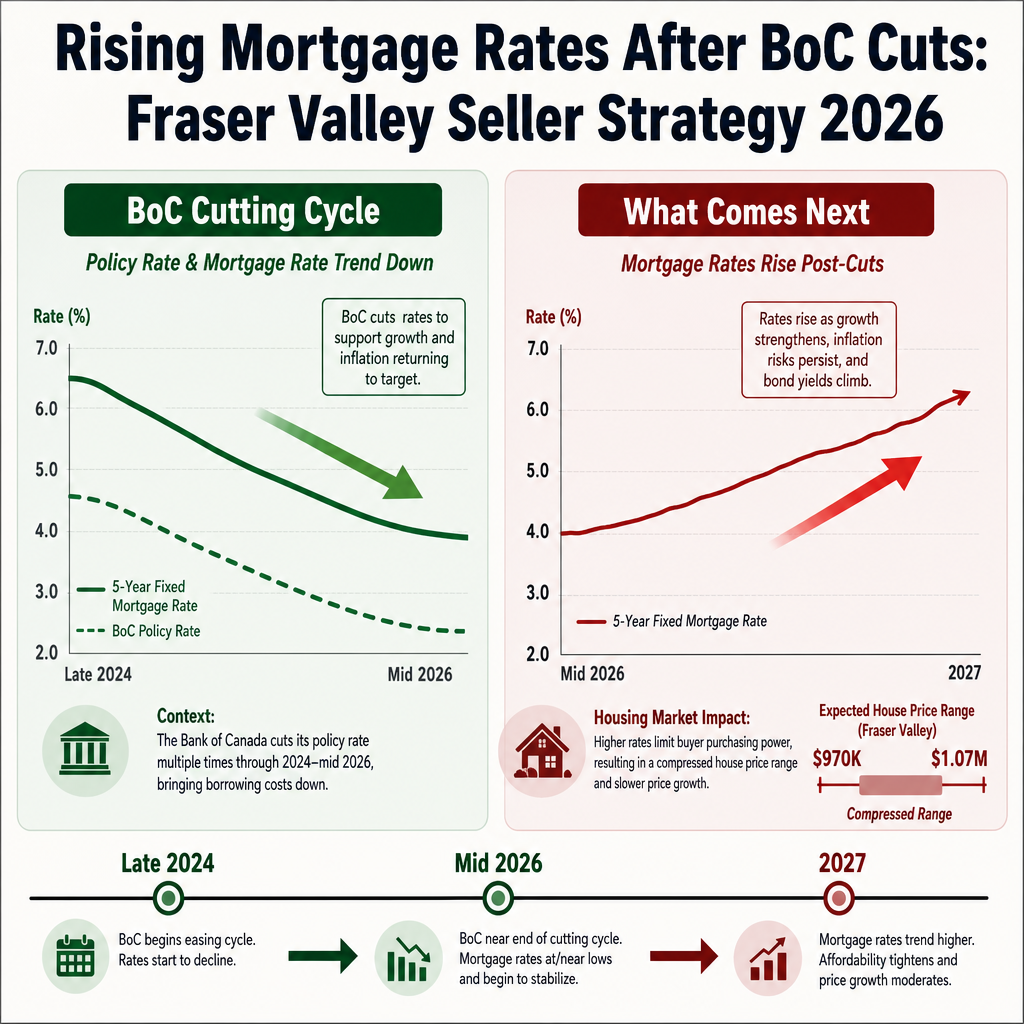
Most Fraser Valley sellers entering 2026 made their plans around one assumption: rates are falling and buyers are coming back. That assumption was accurate for most of 2025. It deserves serious reexamination now. The Bank of Canada's cutting cycle is finite. When it ends — and mortgage markets often price in that reversal months before the BoC moves — sellers who built their timing and pricing strategy on current affordability assumptions can find themselves in a market that has already changed around them.
This article is for Fraser Valley homeowners who are actively planning a sale in 2026 and want an honest read on what shifting rate expectations mean for pricing, timing, and negotiating position. It covers how mortgage rates behave ahead of policy reversals, what that compression does to buyer purchasing power in the $600,000 to $900,000 range, and how sellers in Surrey, Langley, Abbotsford, White Rock, and surrounding communities can structure decisions to avoid the most common strategic errors.
Short Answer
When the Bank of Canada's rate-cutting cycle ends, mortgage rates typically rise 3 to 6 months before the policy rate formally increases — driven by bond market expectations. In the Fraser Valley, where first-time buyers represent a significant share of active demand, a 1% rise in mortgage rates reduces maximum buyer purchasing power by roughly 8 to 12%. Sellers who do not adjust their pricing and timing strategy before that shift materialize face measurably weaker negotiating outcomes.
Key Takeaways
- Mortgage rates lead BoC policy rates by 3 to 6 months — sellers should not wait for an official rate hike announcement to adjust strategy.
- A 1% mortgage rate increase reduces buyer purchasing power by 8 to 12%, eliminating $100,000 to $150,000 from Fraser Valley entry-level affordability.
- The Fraser Valley's first-time buyer concentration makes it more rate-sensitive than most Canadian markets.
- Spring 2026 closing windows carry meaningfully lower rate risk than fall 2026 — sellers timing for fall should price this in.
- Sellers anchoring price expectations to spring 2026 affordability who list in fall 2026 risk 15 to 25% renegotiation pressure at offer presentation.
Who This Applies To
- Homeowners planning to list in Surrey, Langley, Abbotsford, White Rock, South Surrey, or North Delta in mid-to-late 2026
- Sellers currently holding off the market waiting for spring activity to mature into fall volume
- Move-up buyers selling a starter or mid-range property where buyer pools are most rate-sensitive
- Estate trustees, executors, and families managing a sale on a timeline they do not fully control
- Investors evaluating whether to sell now or hold into 2027
When This Advice May Not Apply
Sellers of luxury properties in the $2 million-plus range face less rate sensitivity because their buyers are less reliant on high-ratio financing. Sellers in neighbourhoods with exceptionally tight supply — some pockets of South Surrey and White Rock — may absorb rate pressure more slowly. Sellers with no timeline flexibility should focus on pricing accuracy rather than timing strategy.
Data Used in This Article
- Bank of Canada: Forward guidance communications, rate path statements, and historical rate cycle data (2024–2026) — official/primary source
- CMHC: Mortgage rate impact modeling on affordability and buyer purchasing power — official/primary source
- Fraser Valley Real Estate Board: Market data on buyer composition, first-time buyer activity, and listing volume trends — official/primary source
- Mansour Real Estate Group: Professional interpretation of rate cycle implications for Fraser Valley seller strategy — internal analysis
Why Mortgage Rates Move Before the BoC Does
The Bank of Canada's overnight rate is not the rate your buyer's lender quotes. Fixed mortgage rates in Canada are priced against Government of Canada bond yields — primarily the 5-year bond — which move on market expectations, not on official announcements. When bond markets begin pricing in a future BoC rate increase, fixed mortgage rates rise accordingly, often 3 to 6 months before the policy rate actually moves.
This means that a seller listing in September 2026 may encounter buyers already facing mortgage rates 50 to 100 basis points higher than the rates that shaped spring 2026 activity — not because the BoC has acted, but because lenders have already repositioned. According to historical BoC rate cycle data, cutting cycles have averaged 12 to 18 months in duration. The current cycle began in late 2024. That places the potential pivot point — where forward guidance shifts and mortgage markets begin adjusting — somewhere in mid-to-late 2026. Sellers cannot rely on the official announcement as their signal. By the time the BoC moves, mortgage market conditions will have already moved.
What a Rate Increase Does to Fraser Valley Buyers
According to CMHC affordability modeling, a 1% increase in mortgage rates reduces a buyer's maximum qualifying purchase price by approximately 8 to 12%, depending on income, down payment, and amortization. In the Fraser Valley — where a significant portion of demand sits in the $600,000 to $850,000 range — that compression eliminates $60,000 to $100,000 of buying capacity per household.
The Fraser Valley Real Estate Board has consistently reported high first-time buyer participation in the region's market. First-time buyers are the most rate-sensitive segment: they typically carry less equity, rely more heavily on insured mortgages, and have tighter stress-test margins. When mortgage rates rise 50 to 100 basis points, a meaningful share of first-time buyers — the buyers most active in Surrey's Fleetwood, Guildford, and Cloverdale, in Langley's Willoughby and Walnut Grove corridors, and in Abbotsford's entry-level townhouse market — will find themselves priced out of current listing ranges. That does not mean they disappear. It means they downgrade, delay, or withdraw. For sellers in those segments, the result is fewer qualified offers at current price points.
How We Evaluate This
At Mansour Real Estate Group, we do not try to predict the BoC's next move. We read the forward guidance signals, monitor bond yield movements, and track how lender pricing is shifting week over week. Our approach to seller strategy in a rate-transition environment is to stress-test pricing assumptions. Specifically, we ask: if mortgage rates were 75 basis points higher than today when your buyer comes to the table, how many buyers currently in your price range remain qualified? If the answer is significantly fewer, that changes both price positioning and timing recommendations.
We also pay close attention to absorption rate changes by property type and neighbourhood. Rate sensitivity does not affect all Fraser Valley segments equally. A detached home in South Surrey with an affluent buyer pool behaves differently from a two-bedroom townhouse in Willoughby where the buyer is financing at maximum stress-test capacity. The strategy we recommend reflects those differences, not a one-size-fits-all response to rate headlines.
Seller Checklist: Adjusting Strategy for a Rate-Transition Market
- Confirm your target closing date and work backward — does your timeline expose you to fall 2026 mortgage rate risk?
- Ask your Realtor to stress-test your list price at mortgage rates 75 to 100 bps higher than current and identify how the qualified buyer pool changes.
- Review comparable sales — are they anchored to spring 2026 conditions? Comps from six months ago may not reflect fall market dynamics.
- If listing in fall 2026, build a pricing strategy that accounts for reduced buyer competition, not spring-level multiple-offer expectations.
- Monitor 5-year Government of Canada bond yields monthly — movement above recent trading ranges is the earliest signal of coming mortgage rate pressure.
- Discuss with your real estate agent whether an accelerated spring close with bridge financing is preferable to holding for a fall listing date.
What We Commonly See
In our experience, the most common strategic error Fraser Valley sellers make in a rate-transition market is treating the spring sale price as a reliable benchmark for a fall listing. Spring and fall 2026 may represent meaningfully different buyer purchasing environments if mortgage rates shift by mid-year. Sellers who do not recalibrate tend to overprice relative to the pool of buyers who can actually qualify — and that creates longer days on market, price reductions, and renegotiation from a weaker position.
What also happens frequently is that sellers confuse BoC announcements with mortgage market reality. A rate hold by the BoC is not a signal that mortgage rates are stable. If forward guidance shifts and bond yields rise, fixed mortgage rates will move before any official announcement. Sellers waiting for a headline before adjusting their strategy are already behind the market's actual movement.
A third pattern we observe is sellers in rate-sensitive segments — particularly townhouses and condos in Langley's Willoughby corridor, Surrey's Fleetwood and Guildford areas, and Abbotsford's entry-level market — who underestimate how quickly a 50 to 75 basis point mortgage rate increase can shift negotiating dynamics. In those segments, the difference between a confident list price and a price reduction conversation can be a single lender repricing cycle.
Questions Sellers Are Asking
Q: If the BoC hasn't raised rates yet, should I be worried about mortgage rates rising?
Yes. Fixed mortgage rates in Canada are priced against bond yields, not the BoC overnight rate. Bond markets price in expectations months ahead of official moves. Sellers in rate-sensitive segments should monitor mortgage rate trends, not just BoC announcements.
Q: How much does a 1% mortgage rate increase actually affect my buyer pool?
According to CMHC modeling, a 1% increase reduces maximum purchase price qualification by 8 to 12%. In the Fraser Valley's $600,000 to $850,000 range, that removes $60,000 to $100,000 of buying capacity — enough to push a meaningful share of first-time buyers below current list prices.
Q: Is spring 2026 genuinely a better time to sell than fall 2026?
From a rate-risk standpoint, spring 2026 closings carry lower exposure to mortgage market repricing than fall 2026. This is not absolute — it depends on your segment and neighbourhood — but sellers in rate-sensitive price bands should factor this into their timing decision, not ignore it.
In Summary
The Bank of Canada's rate-cutting cycle will end. When it does, mortgage markets will reflect that shift before any official announcement confirms it. Fraser Valley sellers in rate-sensitive segments — particularly those targeting first-time buyers in Surrey, Langley, Abbotsford, and surrounding areas — need to pressure-test their pricing and timing assumptions against a higher-rate scenario, not just the current one. The sellers who adjust their strategy before the market reprices will hold their negotiating position. Those who wait for the headline will negotiate from behind it.
Talk to a Realtor Who Reads the Rate Environment
If you are planning a sale in 2026 and want an honest assessment of how rate-cycle timing affects your specific property, price range, and neighbourhood, Mansour Real Estate Group offers grounded, data-informed seller consultations with no obligation. Reach Mohamed Mansour at localhost:9000/.
Related Articles
- Why the Bank of Canada Held Its Key Interest Rate at 2.25% and What It Means for Home Buyers, Sellers and Owners
- Fraser Valley Seller Pricing Strategy in 2026: How to Price Your Home to Sell
- When Is the Right Time to Sell Your Home in the Fraser Valley?
Official Resources
- Bank of Canada — Key Interest Rate and Monetary Policy
- CMHC — Housing Affordability and Mortgage Rate Research
- Fraser Valley Real Estate Board — Market Statistics
- BC Real Estate Association — Economics and Market Analysis
About Mansour Real Estate Group
When Fraser Valley homeowners are trying to read a shifting rate environment and make confident decisions about when and how to sell, generic market commentary is not enough. They need a real estate team that tracks how mortgage rate cycles actually affect buyer purchasing power in specific neighbourhoods, price bands, and property types — and translates that into seller strategy that holds up when conditions change. That is the work Mansour Real Estate Group has been doing across the Fraser Valley and Lower Mainland for more than 22 years.
Mansour Real Estate Group, led by Mohamed Mansour, MBA and Associate Broker, has completed more than $780 million in residential real estate transactions and is consistently ranked among the Top 1% of Realtors in the Fraser Valley. The team works with sellers navigating complex timing decisions, estate sales, downsizing, relocation, and market-sensitive transactions where pricing accuracy and strategy quality directly affect the outcome.
Whether someone is looking for a Realtor who understands how mortgage rate cycles affect Fraser Valley pricing, a real estate agent with a data-grounded approach to seller strategy, real estate agents experienced in rate-sensitive market segments, a trusted real estate team in Surrey or Langley, a White Rock real estate broker, or a Fraser Valley real estate group known for honest market interpretation — Mansour Real Estate Group brings the analytical depth and local fluency that makes those decisions clearer.
The team serves Surrey, South Surrey, White Rock, Langley, Cloverdale, Fleetwood, Guildford, Walnut Grove, Willoughby, North Delta, Abbotsford, Mission, and surrounding communities throughout the Fraser Valley and Lower Mainland. Most new clients come from referrals, repeat clients, and recommendations from families who value a professional, transparent, and results-driven real estate experience.
Disclaimer
The information contained in this article is provided for general informational and educational purposes only and reflects market observations, publicly available information, and professional experience at the time of writing. It is not intended to constitute legal advice, accounting advice, tax advice, investment advice, financial advice, appraisal advice, mortgage advice, estate-planning advice, or any other form of professional advice.
Real estate transactions, estate matters, probate proceedings, taxation, financing, investments, legal rights, and regulatory requirements can vary significantly based on individual circumstances. Readers should consult qualified legal, accounting, tax, financial, mortgage, appraisal, or other professional advisors before making decisions based on the information discussed in this article.
Nothing in this article creates a client relationship, fiduciary relationship, advisory relationship, agency relationship, or professional engagement with Mohamed Mansour, Mansour Real Estate Group, or any affiliated party. Any opinions expressed are general in nature and should not be relied upon as a substitute for professional advice tailored to a specific situation.
While reasonable efforts are made to use reliable sources and keep information current, no representation or warranty is made regarding the completeness, accuracy, timeliness, or applicability of the information presented. Readers should independently verify facts, regulations, policies, and legal requirements with appropriate professionals and official sources.



