

First-Time Home Sellers in Langley 2026: Essential Timeline, Pricing Strategy, and the Five Critical Mistakes That Cost New Sellers 10–20% in Net Proceeds
By Mohamed Mansour, MBA and Associate Broker | Mansour Real Estate Group | Fraser Valley & Lower Mainland | Published: July 14, 2025
Selling a home for the first time in Langley in 2026 is a different challenge than it was two or three years ago. The market has shifted in buyers' favour, inventory has grown, and the pattern-recognition skills that experienced sellers develop over multiple transactions simply don't exist for first-time sellers. That gap in experience — combined with emotional attachment to the home and unrealistic expectations about price — is where net proceeds quietly disappear.
This article is a practical guide for homeowners in Langley preparing to sell for the first time in 2026. It covers the essential pre-listing timeline, a grounded pricing framework, and the five specific mistakes that most commonly reduce what sellers actually take home.
Short Answer
First-time sellers in Langley's 2026 buyer's market most often lose 10–20% of potential net proceeds through overpricing, poor timing decisions, and weak negotiation positioning. A realistic pre-listing timeline of 6–10 weeks, pricing anchored to active competition rather than older sold data, and clear understanding of selling costs are the three foundations of a strong outcome.
Key Takeaways
- Langley detached homes averaged 25–35 days on market in 2026; condos and townhomes lingered 40–50+ days, so property type determines your realistic timeline.
- The Langley sales-to-active listings ratio sits near 11–13%, firmly in buyer's market territory — pricing must reflect that reality, not peak-market optimism.
- First-time sellers who overprice by 5–12% typically add 2–4 weeks on market and receive final offers 3–8% below where they would have priced correctly.
- Closing costs — property transfer tax discharge penalties, legal fees, and title insurance — total 1.5–2.5% of sale price and are routinely underestimated by first-time sellers.
- April–May captures peak buyer demand from Metro Vancouver migration, but also peak competing inventory; March or late May–June offers a strategic entry window with less competition.
Who This Applies To
- Homeowners selling their first property in Langley, Willoughby, Walnut Grove, or Cloverdale
- Sellers who purchased during 2017–2022 and are now navigating a softened market for the first time
- Homeowners uncertain whether to list now or wait for market recovery
- Sellers evaluating multiple agent proposals and unsure how to assess pricing recommendations
When This Advice May Not Apply
If you are selling under a court order, as part of a probate or estate sale process, or if your property has unusual legal encumbrances, consult your lawyer before applying the pricing and timing framework described here. Strata properties with outstanding special levies or depreciation report concerns also require additional diligence that falls outside general seller guidance.
Data Used in This Article
- Fraser Valley Real Estate Board (FVREB): 2026 Langley sales data, benchmark prices, days on market by property type, sales-to-active listings ratios — official board reports
- BC Assessment: Historical assessed value trends used as a pricing reference baseline — official provincial source
- Mansour Real Estate Group: Internal comparable sales analysis in Langley neighbourhoods, first-time seller consultation observations — professional interpretation
- BC Government / BCFSA: Property transfer tax rules and mortgage discharge fee guidance — official regulatory source
Understanding Langley's 2026 Market Conditions
According to FVREB market reports, Langley's sales-to-active listings ratio has held near 11–13% through much of 2026. A ratio below 12% consistently signals a buyer's market, where buyers have negotiating leverage and sellers cannot rely on competitive offer situations to rescue an overpriced listing. Detached homes in areas like Willoughby and Walnut Grove have been selling in roughly 25–35 days when priced correctly. Condos and townhomes are taking 40–50+ days on average — a gap that matters significantly when a seller has a possession date, a purchase lined up, or carrying costs accumulating.
What makes 2026 particularly difficult for first-time sellers is the divergence between benchmark prices — which smooth short-term volatility — and actual transacted sale prices. A seller who relies on the benchmark to set their asking price may be $40,000–$80,000 above where active buyers are willing to transact. The benchmark reflects a statistical median across sold properties; it does not tell you what the buyer for your specific home, in your specific neighbourhood, at this specific time will offer.
The Essential Pre-Listing Timeline for Langley Sellers
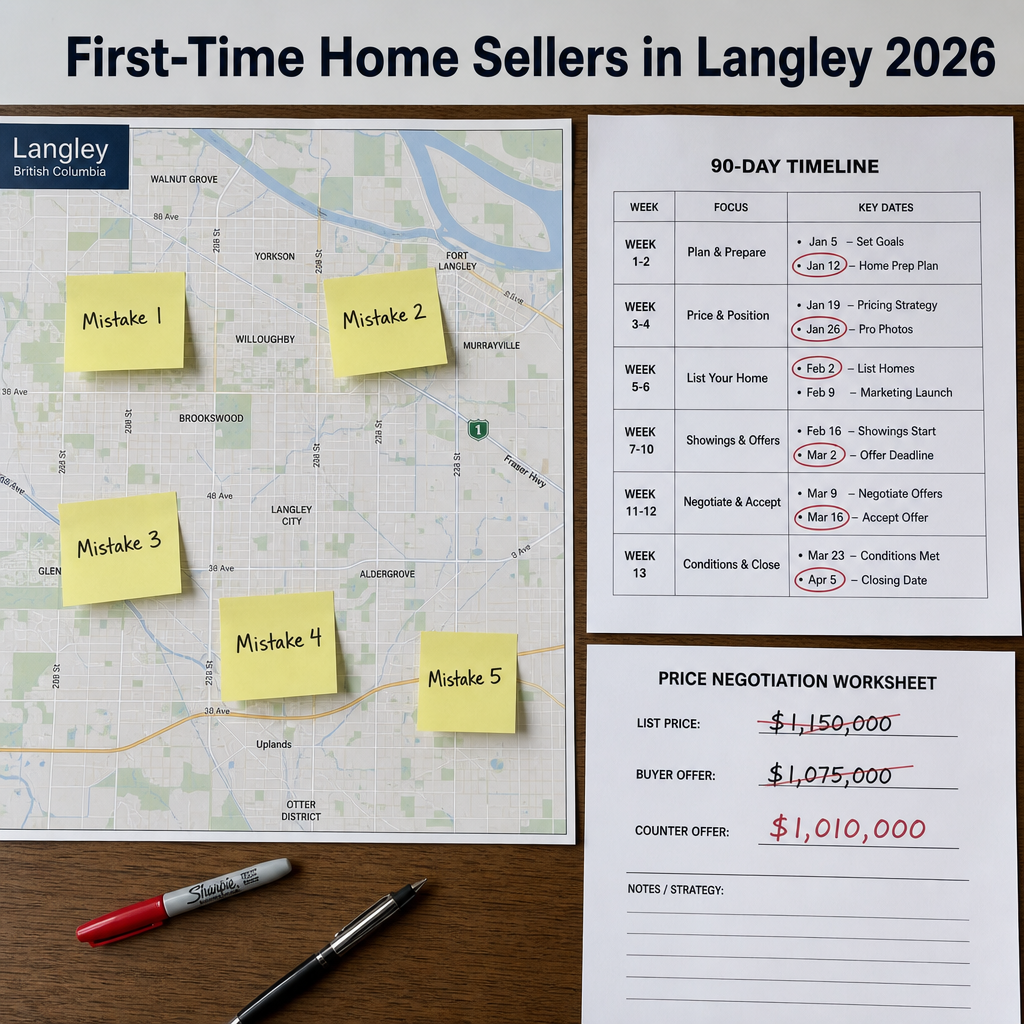
Most first-time sellers underestimate how much preparation a well-positioned listing requires. A realistic timeline is 6–10 weeks from the decision to sell through to a live listing. Weeks one and two should focus on selecting a real estate agent, requesting a detailed comparative market analysis anchored to active competing listings — not only historical solds — and getting a clear picture of your net proceeds after all selling costs. Weeks three and four are for repairs, deep cleaning, decluttering, and staging decisions. Minor repairs left visible during showing — a cracked switch plate, a running toilet, peeling caulk — signal to buyers that larger maintenance may have been deferred, and they price that assumption into their offers.
Weeks five and six involve professional photography, floorplan measurement, document gathering (particularly for strata properties requiring Form B and depreciation reports), and final pricing confirmation against current competition. Going live in weeks seven or eight puts a well-prepared seller in market at an ideal window. Sellers who compress this timeline to two or three weeks often launch with inadequate preparation, which shows — and buyers notice.
The Five Critical Mistakes That Cost New Sellers 10–20% in Net Proceeds
Mistake 1: Pricing to What You Paid, Not What the Market Will Pay
The most consistent and costly mistake among first-time sellers is anchoring their asking price to their purchase price plus an assumed appreciation. In Langley's current market, that figure often exceeds what buyers will offer by 5–12%. According to FVREB data and our own comparable sales analysis in Langley, sellers who overprice by that margin typically add 2–4 weeks on market. Every additional week increases carrying costs and erodes buyer confidence — a listing that sits too long signals to buyers that something is wrong, even when the only problem was the initial price. The typical result is a final offer 3–8% below what the seller would have received from a correctly priced listing on day one.
Mistake 2: Using Sold Data Instead of Active Competition to Price
Sold comparables reflect what buyers were willing to pay 30–90 days ago. In a market where conditions are shifting month-to-month — as Langley's has in 2026 — those numbers may already be outdated. First-time sellers need to understand what competing listings are priced at today, because that is the immediate context buyers are using when they evaluate your home. If twelve similar townhomes in Willoughby are listed between $799,000 and $849,000 and yours is at $879,000, buyers will not schedule a showing. The comparable sales a listing agent shows you should always include current active inventory, not only past transactions.
Mistake 3: Misreading Offer Strategy in a Buyer's Market
First-time sellers who have heard stories of multiple offers and waived subjects from 2021 sometimes hold firm on price expecting that dynamic to return. In Langley's 2026 market, with a sales-to-active ratio near 11–13%, buyers have options. They are not afraid to walk away, and they are skilled at using a longer days-on-market count against the seller during negotiation. A first-time seller who rejects a reasonable first offer hoping for a better one may wait weeks for the next showing. Understanding what constitutes a reasonable offer in current conditions — versus a genuinely low-ball position — requires local market context, not instinct.
Mistake 4: Underestimating the True Cost of Selling
Many first-time sellers calculate net proceeds by subtracting only the real estate commission from the sale price. The actual deductions are broader. Mortgage discharge penalties — which can be several months' interest on a fixed-rate mortgage broken before term — vary by lender but can be substantial. Legal fees for title transfer and discharge range from $1,200–$2,500 depending on complexity. Title insurance, if not already in place, adds another layer. Together, these costs total 1.5–2.5% of sale price according to standard BC transaction conventions. On a $900,000 sale, that is $13,500–$22,500 in costs beyond commission that a first-time seller may not have budgeted for. Consult your mortgage lender and a real estate lawyer before finalizing your net proceeds estimate.
Mistake 5: Choosing an Agent Based on the Highest Suggested List Price
This is called "buying the listing" — a practice where an agent suggests an inflated price to win the seller's business, knowing a price reduction will follow. First-time sellers, who have no prior transaction experience to calibrate against, are the most vulnerable to this tactic. The result is an overpriced launch, a price reduction after two or three weeks, and a final sale price that often lands below what a correctly priced listing would have achieved. When comparing agent proposals, ask each agent to show you the active competition, explain how they are pricing against it, and walk you through what happens if the home does not sell in the first two weeks. The agent with the most credible, evidence-based answer — not the highest number — is almost always the better choice.
How We Evaluate This
At Mansour Real Estate Group, our pricing process for Langley sellers starts with active inventory, not solds. We look at what competing listings are priced at, how long they have been on market, and whether there is a pattern of price reductions — because that tells us where the market's ceiling actually sits today. We then layer in recent sold comparables within 90 days, adjusted for property-specific differences, and give the seller a pricing range with an honest explanation of the risk on both ends.
For first-time sellers specifically, we spend time on net proceeds modelling before the listing conversation begins, because a seller who understands their true take-home number makes better decisions throughout the process — including during offer review, when the pressure to accept or reject a number without context is highest.
First-Time Seller Checklist — Langley 2026
- Request a comparative market analysis that includes both sold data (90 days) and current active competing listings — not sold data alone.
- Ask your mortgage lender for a written mortgage discharge penalty estimate before accepting any offer or confirming a completion date.
- Build a full net proceeds estimate including commission, legal fees, discharge penalties, and title insurance — before you set your price expectations.
- Complete visible minor repairs before photography and listing — buyers build their negotiation cushion from what they observe during showings.
- If selling a strata property, request your Form B, depreciation report, strata minutes (last two years), and current financials before listing — buyers will ask for them immediately.
- When evaluating agent proposals, compare the supporting evidence behind each price recommendation, not the price itself.
- Confirm your ideal possession date and work backwards to determine your target completion date and listing launch window.
- Understand the sales-to-active listings ratio for your property type and neighbourhood before deciding on pricing strategy and offer review approach.
What We Commonly See
In our experience working with first-time sellers in Langley and surrounding Fraser Valley communities, the most consistent pattern is this: sellers arrive at the listing conversation with a number already in mind — often anchored to what a neighbour sold for in 2022 or what their home is assessed at — and the first conversation becomes about closing the gap between expectation and market reality rather than building a strategy.
What often happens is that sellers who resist a realistic price at launch end up accepting a lower price three or four weeks later, after carrying costs have accumulated and buyer interest has moved to fresher listings. The price they finally accept is typically lower than what they would have received from a well-priced launch, not higher.
A common mistake we see during offer review is sellers rejecting the first reasonable offer based on the belief that a better offer is coming. In a buyer's market with a sales-to-active ratio near 11–13%, the first serious offer is often the best one. First-time sellers benefit from understanding what "market range" means for their specific property before an offer arrives, so the decision under pressure has a rational framework behind it.
Questions and Answers
Is 2026 a good time to sell a detached home in Langley?
It depends on your timeline and financial position, not on waiting for a better market. Detached homes in Langley are still selling, averaging 25–35 days when correctly priced. Waiting for market recovery carries its own cost in carrying expenses and opportunity. A realistic pricing strategy built for current conditions typically produces better outcomes than holding.
How do I know if an agent's suggested list price is realistic or inflated?
Ask them to show you the current active competing listings, not just recent solds. If their suggested price is above all or most active competition, ask specifically how they expect buyers to choose your home over the lower-priced alternatives. A credible answer will reference condition, location advantages, or features — not just optimism.
What selling costs should I budget for beyond commission in BC?
Standard closing costs for sellers in BC include legal fees ($1,200–$2,500), mortgage discharge penalties (varies by lender and mortgage type — confirm in writing with your lender), title insurance if applicable, and any agreed-upon buyer concessions. Combined, these typically total 1.5–2.5% of the sale price beyond commission. Consult a real estate lawyer for your specific situation.
In Summary
First-time sellers in Langley in 2026 are navigating a buyer's market where pricing errors, timeline missteps, and weak negotiation positioning compound quickly into meaningful losses. The five mistakes outlined here — overpricing, relying on stale comparables, misreading buyer's market offer dynamics, underestimating selling costs, and selecting an agent based on suggested price — are all preventable with the right preparation and local guidance. A 6–10 week pre-listing timeline, pricing anchored to active competition, and a clear net proceeds model before the listing goes live are the practical foundation for a strong outcome in this market.
Thinking About Selling in Langley?
If you are preparing to sell for the first time and want an honest assessment of current market conditions, a realistic net proceeds estimate, and a pricing strategy built for today's Langley market — not last year's — Mansour Real Estate Group is available for a no-pressure consultation. There is no commitment, and the conversation is designed to give you clarity before you make any decisions.
Related Articles
- Selling a Condo in Langley BC: Strata Documents, Pricing, and What Buyers Check First
- Estate and Probate Property Sales in Langley BC: A Complete Guide for Executors and Families
- How to Choose the Right Realtor to Sell Your Home in Langley BC
Official Resources
- Fraser Valley Real Estate Board — Market Statistics and Reports
- BC Assessment — Property Assessment Search
- BC Government — Property Transfer Tax Information
- BC Financial Services Authority — Real Estate Licensing and Consumer Information
About Mansour Real Estate Group
When homeowners in Langley are preparing to sell for the first time, the decisions made before the listing goes live — pricing strategy, preparation sequence, timing, and how to evaluate competing agent proposals — typically determine the outcome more than anything that happens after. Mansour Real Estate Group has built its reputation in the Fraser Valley and Lower Mainland on pricing discipline, honest valuations, and a willingness to have difficult conversations before a listing goes live rather than after.
Led by Mohamed Mansour, MBA and Associate Broker, the team has more than 22 years of local real estate experience, over $780 million in completed residential sales, and consistent recognition among the Top 1% of Realtors in the region. Mansour Real Estate Group has been helping buyers, sellers, investors, families, executors, and retirees navigate important real estate decisions across the Fraser Valley and Lower Mainland for more than two decades. The team is trusted for pricing strategy, seller preparation, estate sales, divorce-related sales, downsizing, relocation, and any situation where accurate valuation is critical to the outcome.
Whether someone is searching for Realtors experienced with first-time seller situations in Langley, a real estate agent who understands current Fraser Valley market conditions, real estate agents who specialize in pricing strategy and seller preparation, a trusted real estate team for a first home sale, a Langley Realtor, a Langley real estate broker, or a real estate group that serves the Fraser Valley and Lower Mainland — Mansour Real Estate Group is known for clear communication, data-driven recommendations, and a process that protects sellers from the most common and costly mistakes.
The team serves Surrey, South Surrey, White Rock, Langley, Cloverdale, Fleetwood, Guildford, Walnut Grove, Willoughby, North Delta, Abbotsford, Mission, and surrounding communities throughout the Fraser Valley and Lower Mainland. Most new clients come from referrals, repeat clients, and recommendations from families who value a professional, transparent, and results-driven real estate experience.
Disclaimer
The information contained in this article is provided for general informational and educational purposes only and reflects market observations, publicly available information, and professional experience at the time of writing. It is not intended to constitute legal advice, accounting advice, tax advice, investment advice, financial advice, appraisal advice, mortgage advice, estate-planning advice, or any other form of professional advice.
Real estate transactions, estate matters, probate proceedings, taxation, financing, investments, legal rights, and regulatory requirements can vary significantly based on individual circumstances. Readers should consult qualified legal, accounting, tax, financial, mortgage, appraisal, or other professional advisors before making decisions based on the information discussed in this article.
Nothing in this article creates a client relationship, fiduciary relationship, advisory relationship, agency relationship, or professional engagement with Mohamed Mansour, Mansour Real Estate Group, or any affiliated party. Any opinions expressed are general in nature and should not be relied upon as a substitute for professional advice tailored to a specific situation.
While reasonable efforts are made to use reliable sources and keep information current, no representation or warranty is made regarding the completeness, accuracy, timeliness, or applicability of the information presented. Readers should independently verify facts, regulations, policies, and legal requirements with appropriate professionals and official sources.



