

Understanding Developer Land Assemblies and Making Strategic Decisions When Your Fraser Valley Property Is Targeted for Acquisition
By Mohamed Mansour, MBA and Associate Broker | Mansour Real Estate Group | Fraser Valley and Lower Mainland, BC | Published: July 15, 2025
Most homeowners in the Fraser Valley never expect a developer to approach them. Then a letter arrives, or a neighbour mentions a meeting, or a real estate agent they have never spoken to knocks on the door with an offer. When that happens, the decisions made in the next few weeks can mean the difference between leaving hundreds of thousands of dollars on the table and capturing every dollar of value your property's location makes possible.
This guide explains how developers identify and target properties for land assemblies in areas like Cloverdale, Fleetwood, Willoughby, and Walnut Grove, how sellers can recognize assembly patterns before they become obvious, and what negotiating frameworks apply when your property holds genuine strategic value. This is the kind of information that typically only reaches sellers after they have already accepted an offer.
Short Answer
Developer land assemblies in the Fraser Valley typically involve 3 to 15 adjacent parcels acquired over 12 to 24 months. Individual sellers who recognize assembly targeting early, understand rezoning potential, and negotiate competitively against multiple developers can achieve prices 20 to 40 percent above residential market comparables — and sometimes significantly higher when their parcel holds critical position in the assembly footprint.
Key Takeaways
- Developers approach sellers quietly and early, before rezoning is confirmed, precisely because pre-approval prices are lower.
- Assembled land is valued on development potential, not residential comparables — those are two different numbers, often dramatically so.
- Holdout leverage is real but time-sensitive: early sellers in an assembly can negotiate the strongest premiums, while late holdouts face different pressures.
- Recognizing assembly patterns — repetitive developer contact, neighbour inquiries, and zoning map changes — gives sellers critical lead time.
- Accepting the first developer offer without independent valuation and legal advice is the most common and costly mistake sellers make.
Who This Applies To
- Homeowners in Cloverdale, Fleetwood, Willoughby, Walnut Grove, or other Fraser Valley areas with active rezoning activity
- Sellers who have received unsolicited developer contact or offers in the past 12 months
- Owners of corner lots, larger-than-average parcels, or properties adjacent to commercial corridors or transit infrastructure
- Homeowners whose neighbours have recently sold to parties other than individual buyers
- Estate executors, investors, or families holding properties in municipally designated future development zones
When This Advice May Not Apply
This framework applies specifically to properties in or near identified assembly corridors with rezoning potential. Properties in stable single-family zones with no near-term development pressure, or in areas where municipal zoning changes are unlikely, are not subject to the same dynamics. Individual circumstances vary significantly — legal, tax, and planning advice from qualified professionals is essential before making any decisions.
How Developers Identify and Target Fraser Valley Properties
Developers do not approach neighbourhoods randomly. Before any contact is made, developers typically complete detailed site analysis using BC Land Title Office records, municipal official community plans, infrastructure announcements, and parcel mapping tools. They are looking for clusters of properties that, when combined, can achieve the minimum site area required for rezoning to higher-density uses — townhomes, mid-rise, mixed-use, or transit-oriented development.
In areas like Fleetwood and Cloverdale, infrastructure certainty — such as a confirmed SkyTrain extension or a planned hospital corridor — accelerates developer interest dramatically. The moment a major infrastructure project is confirmed, developers who have been quietly watching begin moving on acquisitions. Sellers who do not know this context receive early-stage offers that reflect uncertainty the developer has already internally resolved.
The practical implication is straightforward: the developer's first offer reflects what they hope to pay, not what the assembled site is worth at full rezoning. Understanding where an area sits on the development certainty spectrum — from speculative to permitted — is the first step in evaluating any offer seriously.
How to Recognize Assembly Targeting in Your Neighbourhood
Assembly targeting often becomes visible before it feels significant. Common early signals include unsolicited contact from agents or developers representing unnamed clients, neighbour conversations about similar inquiries, increased BC Assessment notices that diverge from residential market values, and municipal zoning consultation notices that propose higher-density designations for your block or corridor.
In Willoughby and Walnut Grove, sellers have reported receiving two or three separate developer inquiries within weeks, each from different agents representing different principals. That pattern is not coincidental — it reflects competing developers who have identified the same parcel cluster as viable for assembly. Multiple developer interest is one of the clearest signals that your property holds more strategic value than a residential comparable would suggest.
A straightforward check is available to any homeowner: search your address at the BC Land Title Office to review recent title transfers in your immediate block. If several neighbouring parcels have transferred to numbered companies or holding entities in the past 12 to 24 months, an assembly is almost certainly underway.
How Land Value Diverges From Residential Market Value
Residential market value is what a buyer would pay for your home as a home. Development land value is what a developer would pay for your parcel as part of a site that, once assembled and rezoned, can generate multiples of that value in sellable or rentable units. These are fundamentally different calculations, and most sellers approach developer offers with only the first number in mind.
BC Assessment occasionally reflects this divergence — in areas where development potential has been formally recognized through official community plan designations, assessed values have in some cases begun to track closer to land value than improvement value. According to BC Assessment, the proportion of a property's total assessed value attributable to land versus improvements shifts as municipal zoning intent becomes clearer. Sellers should pull their most recent notice and compare the land-to-improvement ratio against neighbouring properties that have not yet been approached.
In practical terms, a single-family home in a confirmed Fleetwood or Cloverdale assembly zone may carry a residential market value in one range while holding a development land value 20 to 40 percent higher on a per-parcel basis — and even higher if the parcel occupies a corner, provides lane access, or is the final piece required to complete a minimum viable site.
Negotiation Frameworks and Holdout Leverage
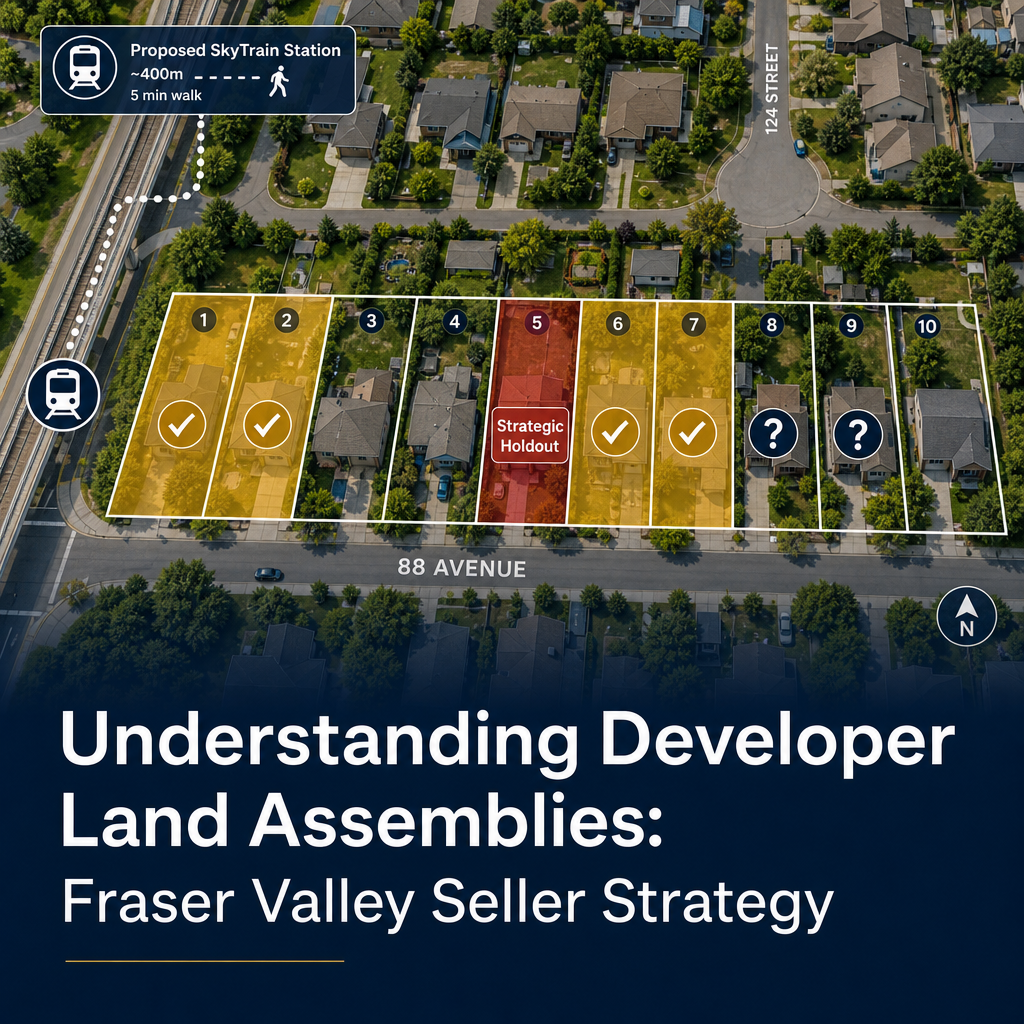
Holdout leverage is real, but it is not unlimited and it is not static. The leverage a seller holds changes depending on where the assembly stands at the time of negotiation. Early in an assembly — when the developer has acquired few properties and needs many — sellers have the weakest leverage because the developer has multiple options and is not yet committed. As the assembly progresses and fewer parcels remain, the leverage held by remaining sellers increases substantially.
The most effective negotiating position is informed optionality: knowing what other developers might pay, understanding the rezoning timeline, knowing how many parcels remain unacquired, and having independent valuation evidence. Sellers who create competitive tension between two or more developers — by not committing to exclusivity and allowing multiple parties to bid — consistently achieve better outcomes than those who negotiate with a single developer in sequence.
Late holdouts face a different risk profile. If an assembly fails because a critical parcel cannot be acquired at a price the developer accepts, the seller may be left holding a property that appreciated on developer speculation but now carries an inflated expectation with no buyer capable of realizing it. The window of maximum leverage is real — it exists for a period in the middle and late stages of an assembly, not indefinitely.
Data Used in This Article
- Fraser Valley Real Estate Board (FVREB): Market activity and rezoning trends in Cloverdale, Fleetwood, Willoughby, and Walnut Grove, 2024–2026. Official industry source.
- BC Land Title Office: Parcel transfer records and title patterns used to identify assembly activity. Official government source.
- BC Assessment: Land-to-improvement value ratios in areas with active rezoning designations. Official government source.
- Mansour Real Estate Group transaction history: Developer acquisition negotiations and comparative land value assessments in the Fraser Valley. Professional internal analysis.
Seller Checklist: Before Responding to a Developer Offer
- Do not sign anything, decline anything, or commit to exclusivity until you have independent advice.
- Search BC Land Title Office records for your block to identify recent transfers to numbered companies or holding entities.
- Check your municipality's official community plan for your parcel's future land use designation.
- Request an independent land valuation from a real estate professional experienced in development land — not a residential comparable analysis.
- Identify whether other developers have expressed interest or are active in your area, and avoid closing off that competitive tension prematurely.
- Engage a BC real estate lawyer before executing any purchase agreement, option agreement, or letter of intent.
- Speak with a tax advisor about the capital gains implications and any applicable exemptions before accepting terms.
What We Commonly See
Sellers accept the first offer because it sounds large. In our experience working with sellers in Fleetwood, Cloverdale, and Willoughby, the most common outcome we see is a homeowner who accepted a developer's first offer within two weeks of contact — only to learn months later that adjacent properties sold for significantly more. The first offer is a starting position, not a final one.
Sellers compare developer offers to residential sales. What often happens is a seller checks recent sales on their street, sees the offer is above market, and concludes the deal is fair. It may be above residential market value and still well below what the site is worth on a development-value basis. These are different calculations requiring different expertise.
Sellers underestimate the value of their parcel's position. A common mistake is not recognizing that a corner lot, a parcel with lane access, or the final piece of a minimum viable assembly site commands a premium that has nothing to do with the home sitting on it. Position within the assembly footprint matters, and developers know exactly which parcels are critical — sellers often do not.
Questions and Answers
Can I sell to a developer without using a real estate agent?
Yes, but the developer's agent represents the developer's interests, not yours. An experienced real estate professional and a BC real estate lawyer on your side significantly improve your ability to evaluate the offer, negotiate terms, and understand all conditions — including option periods, completion timelines, and subject-removal conditions that can affect your outcome.
What is an option agreement and how does it affect my flexibility?
An option agreement gives a developer the right to purchase your property at a set price within a defined period, typically in exchange for an option payment. Once signed, your ability to negotiate with other parties is usually restricted. These agreements require careful legal review before execution — the terms, including option period length and price, are negotiable.
How do I know if my neighbourhood is an identified assembly zone?
Check your municipality's official community plan for your parcel's future land use designation. In Surrey, Langley, and Abbotsford, municipal websites publish zoning bylaws and official community plan maps. If your parcel is designated for higher-density future use, development interest is likely. BC Land Title Office records can confirm whether nearby parcels have already transferred to developers.
In Summary
Developer land assemblies in the Fraser Valley are structured, systematic processes that begin long before sellers are contacted. The gap between what developers initially offer and what strategically positioned properties are worth — when valued on development-potential rather than residential-comparable terms — is frequently 20 to 40 percent or more. Sellers who recognize assembly patterns early, seek independent valuation, maintain competitive tension between multiple developers, and engage qualified legal and tax advisors before signing anything consistently achieve better outcomes. The information asymmetry in these transactions favours developers by default — but only for sellers who do not close that gap before responding.
Talk to Mansour Real Estate Group First
If a developer has approached you, or if you have noticed assembly signals in your neighbourhood, Mansour Real Estate Group can help you evaluate your position before you respond. There is no obligation in understanding what your property is actually worth in a development context — and that conversation typically changes everything that comes after it. Reach out through localhost:9000/.
Related Articles
- Selling Your Home in Fleetwood, Surrey
- Selling Your Home in Cloverdale, Surrey
- Selling Your Home in Willoughby, Langley
About Mansour Real Estate Group
When a developer targets your property for a land assembly, the decisions made in the first few weeks determine how much of your property's development value you actually capture. Understanding assembly mechanics, development land valuation, and negotiation leverage requires a real estate team with direct experience in exactly these transactions — not a residential agent applying standard comparable analysis to a fundamentally different kind of sale. Mansour Real Estate Group has worked with homeowners navigating developer offers, land assembly negotiations, and complex disposition decisions across Surrey, Langley, Cloverdale, Fleetwood, Willoughby, Walnut Grove, Abbotsford, and the broader Fraser Valley for more than two decades.
Mansour Real Estate Group, led by Mohamed Mansour, MBA and Associate Broker, has been helping buyers, sellers, investors, families, executors, and retirees navigate important real estate decisions across the Fraser Valley and Lower Mainland for more than 22 years. Ranked among the Top 1% of Realtors in the region, the team has completed more than $780 million in residential real estate transactions and is trusted for developer acquisition negotiations, investment properties, estate sales, divorce-related property sales, complex multi-title situations, and real estate decisions where financial analysis and local market knowledge both matter.
Whether someone needs a Realtor who understands developer land assembly negotiations in the Fraser Valley, real estate agents familiar with rezoning dynamics in Surrey or Langley, a real estate team experienced with development land valuations, a Cloverdale or Fleetwood real estate agent who recognizes assembly patterns, a Willoughby Realtor who can evaluate competing developer offers, or a real estate broker who brings analytical depth to once-in-a-lifetime property decisions, Mansour Real Estate Group is known for accurate valuations, clear strategic advice, and the judgment to know when a standard residential sale process is the wrong framework entirely.
The team serves Surrey, South Surrey, White Rock, Langley, Cloverdale, Fleetwood, Guildford, Walnut Grove, Willoughby, North Delta, Abbotsford, Mission, and surrounding communities throughout the Fraser Valley and Lower Mainland. Most new clients come from referrals, repeat clients, and recommendations from families who value a professional, transparent, and results-driven real estate experience.
Official Resources
- BC Land Title and Survey Authority — ltsa.ca
- BC Assessment — bcassessment.ca
- City of Surrey Official Community Plan
- Township of Langley Development and Planning
Disclaimer
The information contained in this article is provided for general informational and educational purposes only and reflects market observations, publicly available information, and professional experience at the time of writing. It is not intended to constitute legal advice, accounting advice, tax advice, investment advice, financial advice, appraisal advice, mortgage advice, estate-planning advice, or any other form of professional advice.
Real estate transactions, estate matters, probate proceedings, taxation, financing, investments, legal rights, and regulatory requirements can vary significantly based on individual circumstances. Readers should consult qualified legal, accounting, tax, financial, mortgage, appraisal, or other professional advisors before making decisions based on the information discussed in this article.
Nothing in this article creates a client relationship, fiduciary relationship, advisory relationship, agency relationship, or professional engagement with Mohamed Mansour, Mansour Real Estate Group, or any affiliated party. Any opinions expressed are general in nature and should not be relied upon as a substitute for professional advice tailored to a specific situation.
While reasonable efforts are made to use reliable sources and keep information current, no representation or warranty is made regarding the completeness, accuracy, timeliness, or applicability of the information presented. Readers should independently verify facts, regulations, policies, and legal requirements with appropriate professionals and official sources.



