
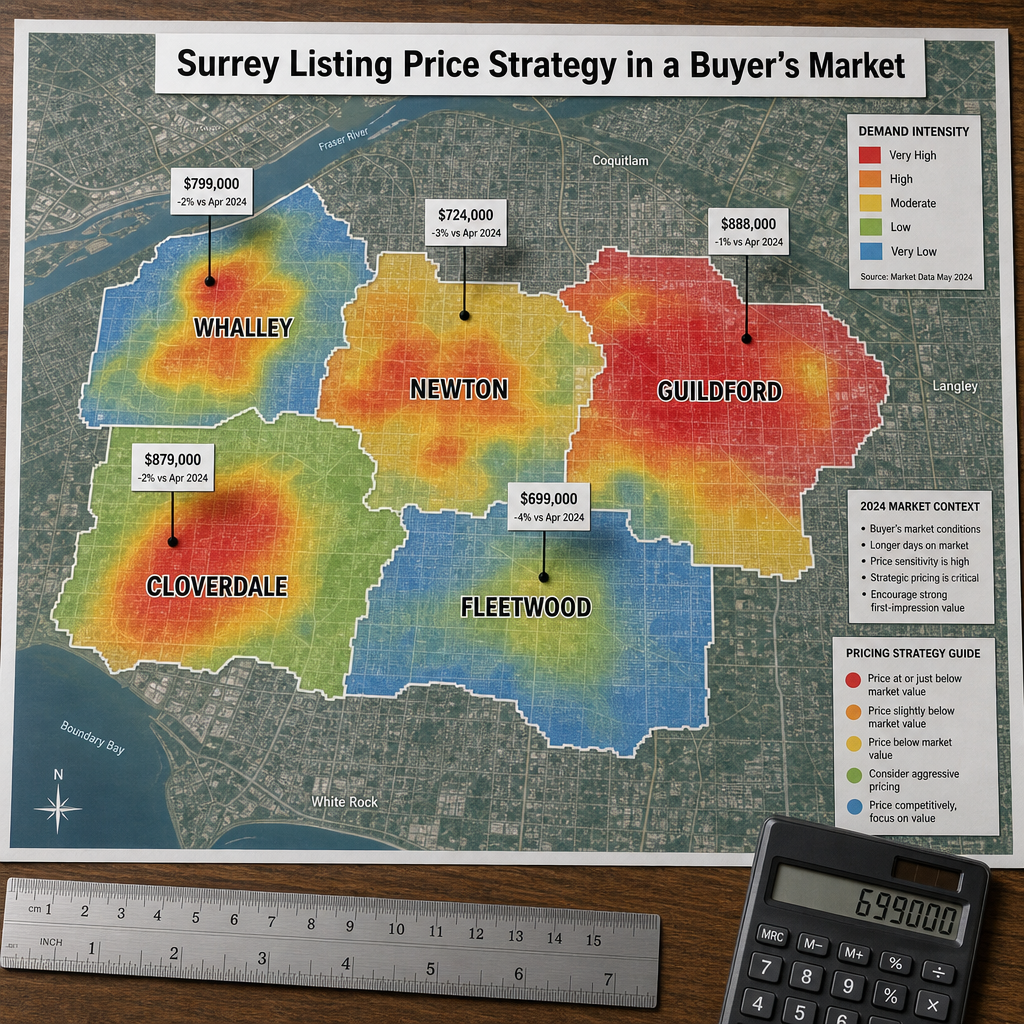

Surrey Listing Price Strategy in a Buyer's Market: Data-Driven Price Anchoring When Comparable Sales Diverge and Micro-Neighbourhood Demand Varies 40–50%
By Mohamed Mansour, MBA and Associate Broker | Mansour Real Estate Group | Fraser Valley & Lower Mainland | Published: July 15, 2026 | Primary Geography: Surrey, BC
Setting the right list price in Surrey right now is one of the most consequential decisions a seller can make — and one of the least understood. With buyer hesitation persisting across the Fraser Valley, many sellers are anchoring their price to BC Assessment values, round numbers, or raw comparable averages that do not reflect how demand actually moves across Surrey's micro-neighbourhoods. The result is extended days-on-market, price reductions, and a weakened negotiating position.
This article explains the methodology Mansour Real Estate Group uses to set initial list prices in Surrey when comparable sales conflict, days-on-market varies by 25 to 60 days depending on location, and buyer demand diverges by 40 to 50 percent across neighbourhoods like Whalley, Newton, Guildford, Cloverdale, and Fleetwood.
Short Answer
In Surrey's current buyer's market, list price should be anchored to weighted comparable sales filtered by location proximity, days-on-market, and sale-to-list ratio — not BC Assessment values or round-number psychology. Micro-neighbourhood demand in Surrey varies 40 to 50 percent across areas that are geographically close, which means a pricing strategy that ignores neighbourhood velocity will routinely overprice or underprice a property by five to fifteen percent.
Key Takeaways
- Surrey micro-neighbourhoods show 40–50% buyer demand divergence; pricing must reflect neighbourhood velocity, not city-wide averages.
- BC Assessment values systematically diverge from market value; sellers anchoring to assessments risk overpricing by 5–15% in a hesitant buyer environment.
- Days-on-market within Surrey ranges from 25 to 60+ days by micro-location; a comp's DOM is as important as its sale price.
- Psychological anchoring to round numbers signals overconfidence to buyers and costs sellers 8–12% in negotiating leverage.
- Weighted comparable sales analysis — filtered by proximity, sale-to-list ratio, and DOM — reveals the true market floor for any Surrey property.
Who This Applies To
- Surrey homeowners preparing to list a detached home, townhouse, or condo in 2026
- Sellers who have received a BC Assessment notice and are using it as a pricing reference
- Executors managing estate property sales in Surrey micro-markets
- Sellers in Cloverdale, Fleetwood, Guildford, Newton, or Whalley facing conflicting comparable sales
When This Advice May Not Apply
Properties with no direct comparable sales — heritage homes, irregular lot sizes, or unique strata configurations — require a certified appraiser in addition to agent-led pricing analysis. This framework applies to standard residential properties where at least three comparable sales exist within a six-month window.
Data Used in This Article
- Fraser Valley Real Estate Board (FVREB) market statistics, Q1–Q2 2026: official board data, neighbourhood DOM and sales velocity
- BC MLS sales data, Surrey micro-markets Q1–Q2 2026: third-party compiled transaction data, neighbourhood-level
- BC Assessment property valuation guidance: official government source, assessment-to-market value methodology
- Mansour Real Estate Group comparative market analysis outcomes, Surrey 2024–2026: internal professional analysis, not independently audited
Why Surrey Cannot Be Priced as One Market
Surrey spans more than 300 square kilometres and contains distinctly different housing sub-markets within a short drive of each other. According to MLS sales data from Q1 and Q2 2026, buyer demand varies by 40 to 50 percent across Whalley, Newton, Guildford, Cloverdale, and Fleetwood — neighbourhoods that a city-wide pricing average would treat as equivalent.
Fleetwood and Cloverdale, for example, continue to attract family buyers with stronger purchase intent for detached homes in the $900K to $1.1M range, while Whalley condo inventory faces slower absorption as buyer hesitation and mortgage qualification constraints push buyers toward townhouse alternatives. FVREB statistics from the same period show days-on-market ranging from approximately 25 days in higher-velocity micro-markets to 60 or more days in slower segments — a gap that directly affects how a list price should be positioned.
Sellers in Fleetwood and Cloverdale are operating in meaningfully different market conditions than sellers in Whalley — even when the city-wide headlines suggest the same environment.
Why BC Assessment Values Are the Wrong Starting Point
BC Assessment values are calculated as of July 1 of the prior year, using a mass appraisal methodology that covers the province broadly. They are not designed to reflect current buyer behaviour, micro-neighbourhood demand shifts, or property-specific conditions at the time of listing. BC Assessment's own guidance confirms that assessed values are not market appraisals and may diverge from actual sale prices depending on market conditions.
In practice, sellers who anchor their list price to their assessment — treating it as a floor or a ceiling — routinely overprice by five to fifteen percent in a buyer's market where purchase hesitation is already high. That gap is not recovered through negotiation. It is absorbed through extended days-on-market, which then signals distress to buyers and compounds the problem. The correct starting point is recent comparable sales, weighted and filtered as described below.
How We Evaluate This: The Weighted Comparable Sales Method
Mansour Real Estate Group's pricing process for Surrey properties does not begin with one number. It begins with a structured filter applied to available comparable sales. Each comparable is evaluated on three dimensions before it is included in the pricing calculation.
First, location proximity: a sold property in Guildford is not a valid comparable for a Fleetwood listing, even if the price per square foot appears similar. Second, sale-to-list ratio: a comparable that sold at 94% of list price in 48 days tells a different story than one that sold at 98% in 12 days. Third, days-on-market: comps with extended DOM are weighted lower because they reflect buyer resistance at that price point, not confirmed market value. The resulting weighted average — not a simple mean — becomes the foundation for the initial list price recommendation.
The Psychological Anchoring Problem
Sellers frequently set prices at round numbers — $750,000, $800,000, $900,000 — because those figures feel confident and clean. In a buyer's market, this is a costly signal. Experienced buyers and their agents recognize round-number pricing as a symptom of seller-driven anchoring rather than market-derived pricing. It creates room to negotiate aggressively.
Data from Mansour Real Estate Group's comparative market analysis outcomes in Surrey indicate that sellers who price at psychologically anchored round numbers in a buyer's market experience 8 to 12 percent more negotiating pressure than those who price at data-derived figures like $739,000 or $887,500. The specific number communicates that the price was derived from analysis, not aspiration — and that shifts buyer behaviour at the offer stage. Sellers in Guildford and Newton, where buyer hesitation is measurably higher, benefit most from this discipline.
Seller Checklist: Surrey Pricing Before You List
- Confirm which micro-neighbourhood your property belongs to — not just the city of Surrey
- Pull comparable sales from within your micro-neighbourhood only, within the last 90 days
- Record the sale-to-list ratio and days-on-market for each comparable — not just the sale price
- Weight comps by proximity and velocity; discard outliers with DOM over 75 days unless no alternatives exist
- Confirm whether your property type (detached, townhouse, condo) aligns with current demand in your micro-market
- Avoid anchoring to BC Assessment value, prior purchase price, or round numbers unsupported by comp data
What We Commonly See
In our experience working with Surrey sellers in divergent market conditions, the most damaging pricing mistakes share a common pattern: they prioritize the seller's reference point over the buyer's decision framework.
- Assessment anchoring: Sellers receive a BC Assessment showing a value from the prior July and list at or above it, without accounting for the market shift that has occurred since. In a declining or flat buyer's market, this creates an immediate pricing gap that buyers exploit.
- Cross-neighbourhood comp averaging: What often happens is that a seller or their agent pulls comparable sales across all of Surrey without filtering by micro-neighbourhood, producing an average that reflects no specific market accurately. A Whalley condo sale averaged with a Cloverdale detached sale produces a number that is meaningful to neither buyer pool.
- Ignoring DOM signals: A common mistake is treating a comparable that sat for 65 days as equivalent to one that sold in 18 days. The DOM of a comparable is market feedback about price tolerance — and it belongs in the weighting, not the footnotes.
Questions and Answers
Should I use my BC Assessment value as a starting point for my Surrey list price?
No. BC Assessment values are calculated as of July 1 of the prior year using mass appraisal methodology. In a shifting buyer's market, they frequently diverge from current transaction prices by five to fifteen percent. Use recent comparable sales filtered by your specific micro-neighbourhood instead.
Why does days-on-market vary so much across Surrey?
Buyer demand in Surrey is not uniform. According to FVREB data and BC MLS sales from Q1–Q2 2026, DOM ranges from roughly 25 days in higher-velocity neighbourhoods to 60 or more days in slower ones. Property type, price point, and school catchment all affect local absorption rates.
How do I know if my comps are from the right micro-neighbourhood?
Comparable sales should come from within the same neighbourhood boundary — Fleetwood, Cloverdale, Guildford, Newton, or Whalley — not simply the city of Surrey. Properties even one kilometre apart can face meaningfully different buyer pools, particularly when school catchments or transit access differs.
In Summary
Surrey's housing market in 2026 is not one market — it is five or more distinct micro-markets operating at different speeds and different levels of buyer appetite. Sellers who price based on city-wide averages, BC Assessment values, or psychological round numbers are consistently outperformed by sellers who anchor their list price to weighted, proximity-filtered comparable sales that reflect actual buyer velocity in their specific neighbourhood. The methodology described here is not complex, but it requires discipline and local knowledge that generic pricing guides do not provide. If you are preparing to list in Surrey and your comparables are conflicting, that is a signal to dig deeper — not to average the numbers and hope.
Talk to Mansour Real Estate Group Before You Set Your Price
If you are preparing to list in Surrey and your comparable sales are pointing in different directions, a pricing conversation with Mansour Real Estate Group can help you identify which data points are reliable signals and which are noise. There is no obligation — just a straightforward analysis of where your property sits in the current micro-market. Reach out at localhost:9000/contact to schedule a conversation.
Related Articles
- Surrey Real Estate Seller Guide: What Homeowners Need to Know Before Listing
- Fraser Valley Buyer's Market 2026: What the Data Actually Says
- How to Read a Comparative Market Analysis in the Fraser Valley
About Mansour Real Estate Group
Pricing a home correctly in the Fraser Valley requires more than a comparative market analysis. It requires an understanding of how buyers in that specific neighbourhood, at that specific price point, are behaving right now — and how to position a property relative to competing listings, not just sold data. Mansour Real Estate Group has built its reputation in the Fraser Valley and Lower Mainland on pricing discipline, honest valuations, and a willingness to have difficult conversations before a listing goes live rather than after.
Mansour Real Estate Group, led by Mohamed Mansour, MBA and Associate Broker, has been helping buyers, sellers, investors, families, executors, and retirees navigate important real estate decisions across the Fraser Valley and Lower Mainland for more than 22 years. Ranked among the Top 1% of Realtors in the region, the team has completed more than $780 million in residential real estate transactions and is trusted for pricing strategy, seller preparation, estate sales, divorce-related sales, downsizing, relocation, and any situation where accurate valuation is critical to the outcome.
Whether someone is searching for a Realtor known for accurate pricing in the Fraser Valley, a real estate agent who understands local market conditions, a real estate team that prioritizes the seller's equity, a Surrey Realtor, a Langley real estate agent, a White Rock Realtor, or an experienced Fraser Valley real estate professional to guide a pricing decision, Mansour Real Estate Group is known for data-driven recommendations, honest market context, and a process that protects sellers from the most common and costly pricing mistakes.
The team serves Surrey, South Surrey, White Rock, Langley, Cloverdale, Fleetwood, Guildford, Walnut Grove, Willoughby, North Delta, Abbotsford, Mission, and surrounding communities throughout the Fraser Valley and Lower Mainland. Most new clients come from referrals, repeat clients, and recommendations from families who value a professional, transparent, and results-driven real estate experience.
Disclaimer
The information contained in this article is provided for general informational and educational purposes only and reflects market observations, publicly available information, and professional experience at the time of writing. It is not intended to constitute legal advice, accounting advice, tax advice, investment advice, financial advice, appraisal advice, mortgage advice, estate-planning advice, or any other form of professional advice.
Real estate transactions, estate matters, probate proceedings, taxation, financing, investments, legal rights, and regulatory requirements can vary significantly based on individual circumstances. Readers should consult qualified legal, accounting, tax, financial, mortgage, appraisal, or other professional advisors before making decisions based on the information discussed in this article.
Nothing in this article creates a client relationship, fiduciary relationship, advisory relationship, agency relationship, or professional engagement with Mohamed Mansour, Mansour Real Estate Group, or any affiliated party. Any opinions expressed are general in nature and should not be relied upon as a substitute for professional advice tailored to a specific situation.
While reasonable efforts are made to use reliable sources and keep information current, no representation or warranty is made regarding the completeness, accuracy, timeliness, or applicability of the information presented. Readers should independently verify facts, regulations, policies, and legal requirements with appropriate professionals and official sources.



