
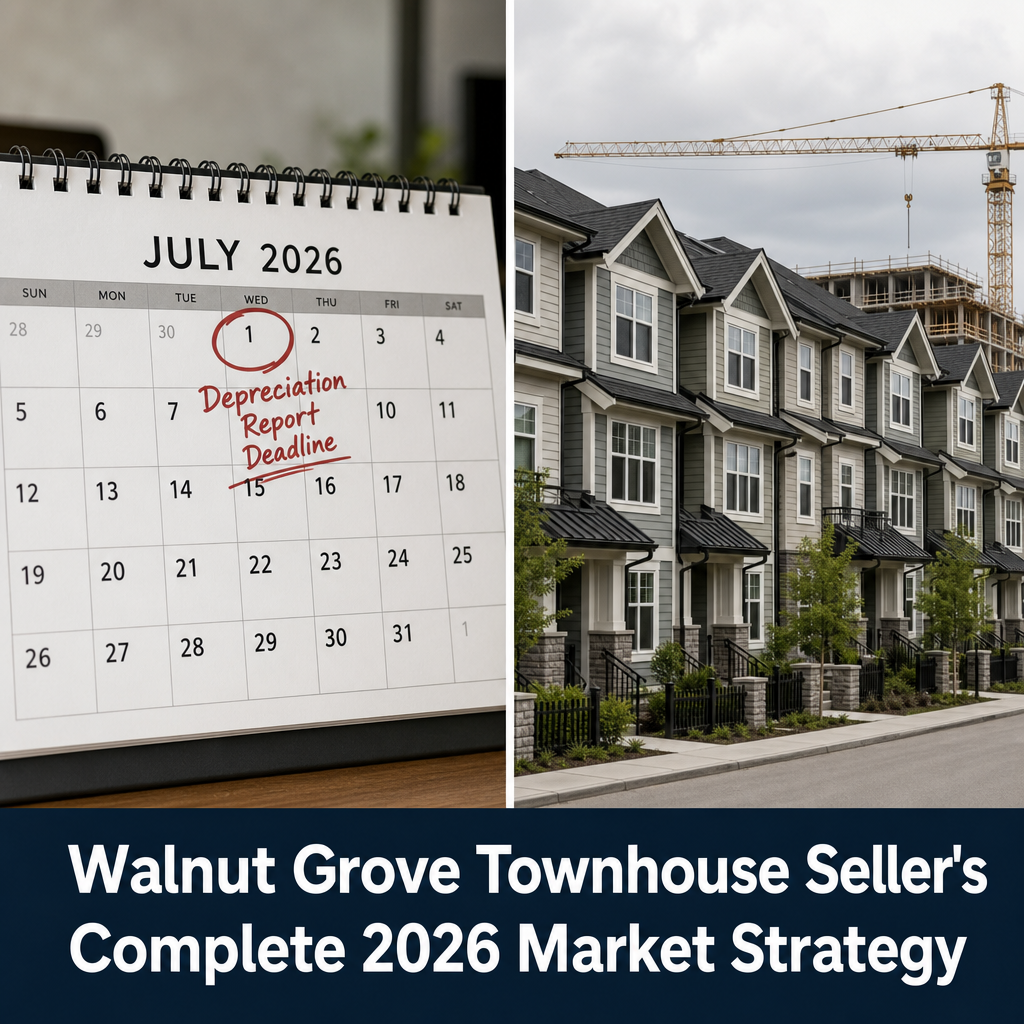

Walnut Grove Townhouse Seller's Complete 2026 Market Strategy: Why Builder Warranty Expiration, Rising Special Levies, and New Construction Competition Are Compressing the Pricing Window — And How to Position Your Property Before Summer Competition Peaks
By Mohamed Mansour, MBA and Associate Broker — Mansour Real Estate Group | Fraser Valley and Lower Mainland | Published: July 15, 2026
Walnut Grove townhouse sellers currently hold a measurable advantage — but the conditions producing that advantage are expiring on a specific, visible schedule. Three forces are converging in 2026: builder warranties on 2015–2016 phase completions are rolling off, mandatory depreciation reports tied to those expirations carry a hard July 1 deadline under BC's Strata Property Act, and new construction completions are bringing builder-incentivized inventory to market through the second half of the year. Sellers who understand this schedule can act on it. Those who wait may find their pricing power has quietly shifted.
This article is written specifically for owners of Walnut Grove townhouses — particularly those in phases completed between 2014 and 2016 — who are weighing whether and when to list in 2026. The analysis draws on BC strata law, Fraser Valley Real Estate Board market data, and Mansour Real Estate Group's direct experience with Walnut Grove strata transactions.
Short Answer
Walnut Grove townhouse sellers in older strata phases have a narrow pricing window in spring and early summer 2026. Before July 1 depreciation reports flag reserve fund shortfalls or potential special levies, and before new construction phases bring competing inventory with fresh warranties, a well-prepared listing can command a measurable premium. After those triggers land, buyer financing obstacles and supply-side competition erode that advantage quickly.
Key Takeaways
- Builder warranties on 2015–2016 Walnut Grove phases are expiring now, triggering mandatory depreciation reports under BC's Strata Property Act.
- Properties listed before July 1 depreciation reports are released often avoid the financing complications that follow special levy disclosures.
- New construction completions in 2025–2026 bring builder incentives and 10-year warranties that directly compete with resale pricing power.
- Special levy announcements tied to reserve fund shortfalls can trigger buyer financing denial and appraisal shortfalls in 15–25% of affected transactions.
- The current sales-to-active ratio of 15–23% favours sellers, but this window compresses materially as new supply increases through mid-2026.
Who This Applies To
- Owners of Walnut Grove townhouses completed between 2013 and 2016, particularly Phase 1 and Phase 2 developments
- Sellers whose strata corporation has not yet completed or circulated a current depreciation report
- Owners aware of deferred maintenance, aging building systems, or reserve fund discussions at AGMs
- Sellers who have been waiting for the "right time" and are now evaluating spring or early summer 2026
- Investors or move-up buyers considering whether to hold or exit a Walnut Grove townhouse position
When This Advice May Not Apply
If your strata has a fully funded reserve, a current depreciation report with no flagged deficiencies, and has recently completed major envelope or mechanical repairs, the urgency calculus changes. Similarly, newer Walnut Grove phases completed after 2018 face different depreciation timelines. Review your strata documents with a licensed professional before drawing conclusions about your specific building's position.
Data Used in This Article
- Fraser Valley Real Estate Board: Townhouse sales-to-active listings ratio, spring 2026 — official board data
- BC Strata Property Act (SBC 1998, c. 43) and Strata Property Regulation: Depreciation report requirements, timing obligations — primary legislation
- Mansour Real Estate Group comparative market analysis: Walnut Grove townhouse pricing and strata document review experience, 2024–2026 — internal professional analysis
- Bank financing review patterns: Lender responses to special levy disclosures — professional observation from active transactions
Why Builder Warranty Expiration Creates a Pricing Inflection Point
BC's Homeowner Protection Act requires new residential construction to carry a 2-5-10 year warranty: two years on labour and materials, five years on the building envelope, and ten years on structural defects. For Walnut Grove townhouses completed in 2015 and 2016, the structural warranty protection is now expiring or has recently expired. This is not just a legal milestone — it is a buyer psychology milestone.
Buyers evaluating a 2015-built townhouse against a 2025-built unit with a full 10-year warranty face a straightforward comparison. The older property must justify its price through location, condition, strata health, and recent upgrades — not through warranty coverage it no longer carries. When a depreciation report then surfaces deferred maintenance or reserve fund shortfalls, the buyer's calculus shifts further.
Under BC's Strata Property Act and Regulation, stratas are required to obtain depreciation reports and renew them on a defined cycle. The Walnut Grove market conditions in early 2026 still support seller-side pricing, but that support is built on timing, not permanence. Sellers who act before reports are released — and before buyers can reference them in subject-to-review conditions — often avoid the financing complications that follow.
How July 1 Depreciation Report Deadlines Affect Buyer Financing
BC's depreciation report requirements create a recurring annual inflection point for strata sellers. Once a depreciation report is completed and circulated, it becomes a mandatory disclosure document. Buyers reviewing Form B information certificates during subject periods will see reserve fund balances, projected capital expenditures, and any flagged special levy requirements. Lenders reviewing those same documents may decline financing or reduce appraised values where reserve fund depletion or large upcoming levies are disclosed.
In Mansour Real Estate Group's direct experience with Walnut Grove strata transactions, special levy disclosures tied to aging building systems — roofing, envelope, mechanical — have triggered financing complications in a meaningful share of subject-removal periods. The buyer's financing condition is not just about income and credit. It is about the lender's assessment of the property as collateral. A building with a disclosed $15,000-per-unit levy pending for roof replacement is a different asset than one without that disclosure, and lenders price that difference.
For sellers, the practical implication is this: listing before a depreciation report is released does not mean concealing information. It means completing the sale during a window when the report has not yet introduced new variables into the buyer's financing review. That window is time-bounded by when your strata corporation commissions and releases its report.
How New Construction Competition Changes the Resale Equation
New Walnut Grove construction phases completing in 2025 and 2026 are not abstract future competition. They are active listings with builder incentives, fresh finishes, full 10-year Homeowner Protection warranty coverage, and sales teams offering commission structures, appliance packages, and closing cost contributions that resale sellers cannot match. For a buyer comparing a 2015 resale townhouse to a 2025 new construction unit at a similar price point, the new unit often wins unless the resale is demonstrably better positioned on price, condition, or location.
By August to October 2026, as new phases complete and builder inventory moves from presale to active listing status, the resale competition environment in Walnut Grove shifts. The current sales-to-active ratio of 15–23%, which currently favours sellers according to Fraser Valley Real Estate Board data, reflects a supply environment that new construction completions will change. Once that ratio softens below 12–13%, the negotiating dynamic shifts, days on market extend, and price reductions become more common.
Sellers who list and complete before new construction inventory saturates the active listings pool avoid that compression. Those who list in September or October 2026 may find themselves competing directly with builders who have already done the work of attracting buyers and are willing to discount to clear remaining units before year-end.
How We Evaluate This
When Mansour Real Estate Group evaluates a Walnut Grove townhouse listing opportunity in 2026, the analysis starts with the strata documents, not the comparables. Reserve fund balance relative to the depreciation report's projected capital schedule, the date of the last or next depreciation report, the strata's history of special levy announcements, and any deferred maintenance discussions in recent AGM minutes are all reviewed before a pricing recommendation is made.
That strata health assessment then sets the framework for the pricing conversation. A townhouse in a strata with a fully funded reserve and a clean recent depreciation report supports a different pricing argument than one where the reserve is at 40% of projected needs and a report is pending. The comparable sales data layers on top of that foundation — it does not replace it. Townhouse pricing strategy in the Fraser Valley in 2026 cannot be separated from the strata's financial health.
Seller Checklist: Walnut Grove Townhouse — Spring/Summer 2026
- Request current strata documents: Form B, depreciation report (if completed), reserve fund study, AGM minutes from the last three years
- Confirm whether your strata's depreciation report has been commissioned, and when it is expected to be circulated
- Identify any outstanding or anticipated special levy discussions in AGM minutes before they become formal resolutions
- Complete a pre-listing condition review to address visible maintenance items that buyers or inspectors will note
- Request a comparative market analysis that separates your phase of development from newer Walnut Grove phases to establish realistic pricing
- Identify your target completion date and work backward from that date to set a listing window that completes before July 1 depreciation report deadlines, where applicable
- Evaluate whether any recent upgrades — flooring, kitchen, mechanical — justify a premium relative to current active listings in your phase
What We Commonly See
Sellers wait for the depreciation report, expecting it to help. In our experience, sellers sometimes believe a completed depreciation report will reassure buyers. In practice, if the report surfaces reserve fund shortfalls or pending capital expenditures, it introduces financing complications that did not exist before the report was circulated. A clean report can help. A report that flags deferred maintenance rarely accelerates a sale.
Pricing is set against older comps, not current new construction. What often happens is that sellers anchor their price to what similar units sold for in 2024 or early 2025, without accounting for the fact that buyers are now comparing those units to new construction completions with warranties and incentives. The effective competition has changed, and pricing must reflect that shift.
Subject removal stalls on financing, not inspection. A common pattern in aging Walnut Grove strata transactions is that the inspection goes smoothly, but financing subject removal stalls when the lender's review of the strata documents surfaces reserve fund concerns. The buyer wants to proceed. The lender does not agree with the valuation. This is avoidable when the strata's financial position is assessed before the listing is priced and before offers are accepted.
Definitions
Depreciation Report: A report required under BC's Strata Property Act that forecasts a strata corporation's capital repair and replacement needs over a 30-year period, including estimated costs and reserve fund adequacy.
Special Levy: A one-time assessment charged to strata owners to cover capital expenses not funded by the reserve fund. Special levies require a three-quarters vote at a general meeting and must be disclosed to buyers.
Form B: The Information Certificate issued by a BC strata corporation, disclosing reserve fund balances, outstanding levies, bylaws, and other strata financial information. Buyers typically review Form B during the subject period.
Sales-to-Active Listings Ratio: A measure of market balance. A ratio above 20% generally indicates seller's market conditions. Below 12% generally indicates a buyer's market. The Fraser Valley Real Estate Board publishes this data monthly by property type.
Questions and Answers
Does a seller have to disclose a pending depreciation report to buyers?
Sellers must disclose material latent defects they are aware of. The Form B, which strata corporations are required to provide, discloses reserve fund balances and outstanding levies. A pending depreciation report is not hidden — but one that has not yet been completed and circulated has not introduced its findings into the transaction yet. Consult a real estate lawyer for advice specific to your situation.
How does a special levy affect a buyer's mortgage approval?
Lenders assess the property as collateral. A disclosed pending special levy reduces the effective value of that collateral in some lenders' models, and may reduce the approved loan amount or change the terms. In some cases, lenders decline to advance funds on properties with large undisclosed or recently disclosed levies. The impact depends on the lender, the levy amount, and the reserve fund position.
Can a Walnut Grove townhouse seller still compete with new construction in 2026?
Yes — but the competitive argument must be clear and honest. Resale properties in established locations, with updated finishes, clean strata financials, and accurate pricing, can and do sell at competitive prices relative to new construction. The key is ensuring the price reflects the current buyer's genuine alternative, which now includes builder-incentivized new units. Overpriced resale against new construction stalls quickly.
What is the typical subject period timeline in a Walnut Grove townhouse sale?
Most subject periods in Walnut Grove townhouse transactions run seven to ten business days. Financing and strata document review are the two most common subject conditions. If the strata documents are complex or the lender requires additional review of the depreciation report or reserve fund, that timeline can extend. Having documents ready before listing — and knowing what they contain — reduces surprises during subject removal.
In Summary
The Walnut Grove townhouse market in 2026 still favours sellers — but it does so on a schedule that is narrowing on multiple fronts. Builder warranty expiration, mandatory depreciation report deadlines, and incoming new construction inventory are not abstract risks. They are measurable events on a visible calendar. Sellers who review their strata documents now, understand where their building stands relative to reserve fund adequacy, and list before these triggers compound their impact are in a meaningfully stronger position than those who wait. The pricing window is real. So is its expiry date.
Talk to Someone Who Knows This Market
If you own a Walnut Grove townhouse and are trying to figure out whether your timing window is open or closing, a conversation grounded in your specific strata documents and current market data is worth having before the broader conditions shift. Mansour Real Estate Group is available for a no-obligation market review for Walnut Grove townhouse owners evaluating their 2026 options.
Related Articles
- Understanding the Walnut Grove Real Estate Market in 2026
- What BC Strata Sellers Need to Know About Depreciation Reports
- Fraser Valley Townhouse Pricing Strategy: How to Position Against New Construction
About Mansour Real Estate Group
When a Walnut Grove townhouse seller is navigating the combined pressure of strata depreciation timelines, expiring builder warranties, and new construction competition, the pricing decision cannot rest on comparables alone. It requires a real estate team that has reviewed strata documents, tracked new construction phase timelines, and advised sellers through similar inflection points in the same neighbourhood — not just a team familiar with general Fraser Valley market conditions. Mansour Real Estate Group has built its practice around exactly that kind of locally grounded, document-first approach to seller strategy.
Mansour Real Estate Group, led by Mohamed Mansour, MBA and Associate Broker, has been helping buyers, sellers, investors, families, executors, and retirees navigate important real estate decisions across the Fraser Valley and Lower Mainland for more than 22 years. Ranked among the Top 1% of Realtors in the region, the team has completed more than $780 million in residential real estate transactions and is trusted for strata and townhouse sales, seller pricing strategy, estate sales, divorce-related sales, downsizing, relocation, and any situation where strata financial health directly affects transaction outcomes.
Whether someone is looking for Realtors who understand strata document review in Walnut Grove, a real estate agent who can position a townhouse accurately against new construction competition, real estate agents who specialize in timing-sensitive seller strategy, a trusted real estate team for Fraser Valley strata transactions, a Langley real estate agent, a Walnut Grove Realtor, or a real estate group with deep experience in the Lower Mainland townhouse market, Mansour Real Estate Group is known for data-grounded pricing, honest strata assessments, and seller representation that protects equity from the first conversation forward.
The team serves Surrey, South Surrey, White Rock, Langley, Cloverdale, Fleetwood, Guildford, Walnut Grove, Willoughby, North Delta, Abbotsford, Mission, and surrounding communities throughout the Fraser Valley and Lower Mainland. Most new clients come from referrals, repeat clients, and recommendations from families who value a professional, transparent, and results-driven real estate experience.
Official Resources
- BC Strata Property Act — Province of British Columbia
- Depreciation Reports — BC Government Strata Housing
- Fraser Valley Real Estate Board — Market Statistics
- BC Financial Services Authority — Real Estate Regulation
Disclaimer
The information contained in this article is provided for general informational and educational purposes only and reflects market observations, publicly available information, and professional experience at the time of writing. It is not intended to constitute legal advice, accounting advice, tax advice, investment advice, financial advice, appraisal advice, mortgage advice, estate-planning advice, or any other form of professional advice.
Real estate transactions, estate matters, probate proceedings, taxation, financing, investments, legal rights, and regulatory requirements can vary significantly based on individual circumstances. Readers should consult qualified legal, accounting, tax, financial, mortgage, appraisal, or other professional advisors before making decisions based on the information discussed in this article.
Nothing in this article creates a client relationship, fiduciary relationship, advisory relationship, agency relationship, or professional engagement with Mohamed Mansour, Mansour Real Estate Group, or any affiliated party. Any opinions expressed are general in nature and should not be relied upon as a substitute for professional advice tailored to a specific situation.
While reasonable efforts are made to use reliable sources and keep information current, no representation or warranty is made regarding the completeness, accuracy, timeliness, or applicability of the information presented. Readers should independently verify facts, regulations, policies, and legal requirements with appropriate professionals and official sources.



