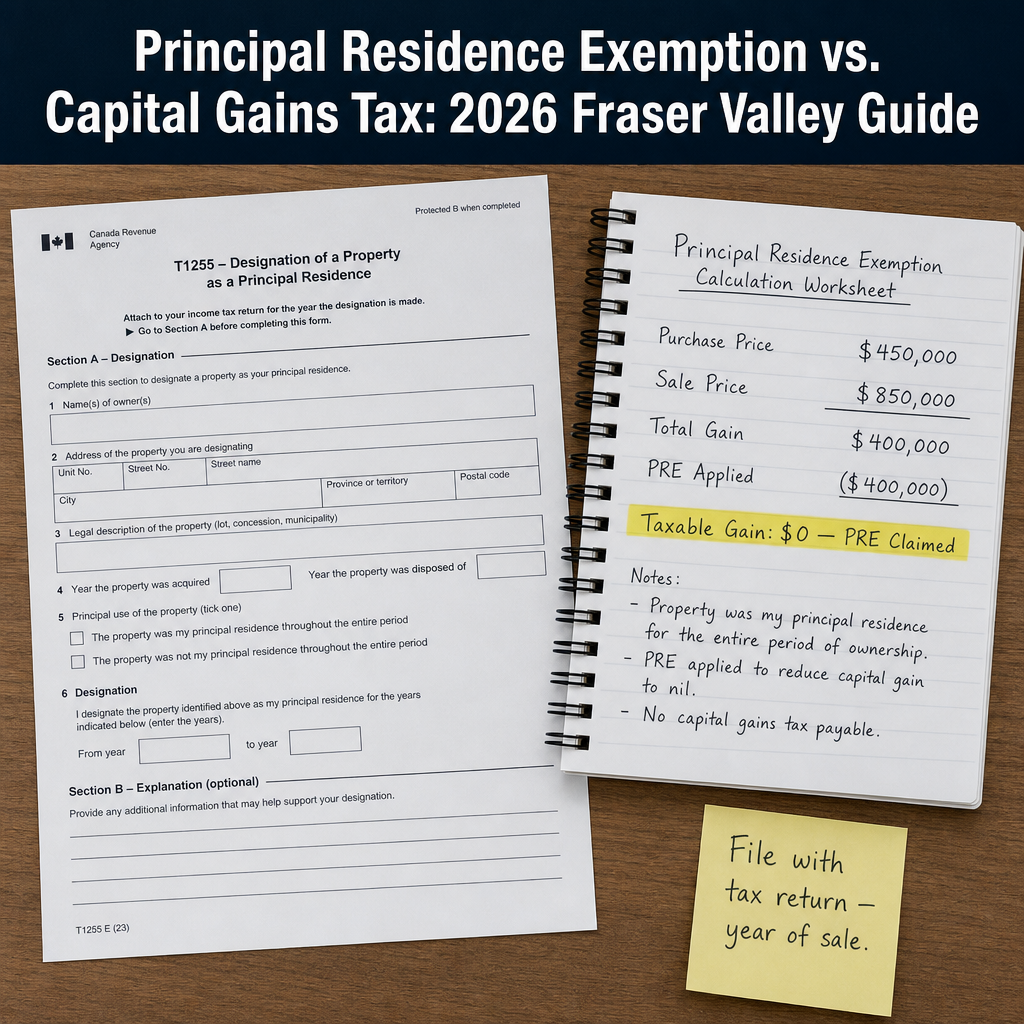

Principal Residence Exemption vs. Capital Gains Tax: Complete 2026 Guide to Claiming the Exemption, Calculating Taxable Gains, Deemed Disposition Rules, and Avoiding CRA Audit Triggers When Selling Your Fraser Valley Home
By Mohamed Mansour, MBA and Associate Broker — Mansour Real Estate Group | Fraser Valley and Lower Mainland, BC | Published: July 15, 2025
For most Fraser Valley homeowners, the sale of a principal residence is completely tax-free — but that outcome depends entirely on how the exemption is claimed, whether the property qualifies for every year of ownership, and whether CRA has any reason to look more closely at the return. When those conditions are not met, the tax exposure at current Fraser Valley prices is not small.
This guide explains how the Principal Residence Exemption works in BC, what triggers capital gains tax on a home sale, how deemed disposition rules interact with the exemption, and what CRA looks for in an audit. It is written for homeowners in Surrey, Langley, Abbotsford, White Rock, South Surrey, Cloverdale, Willoughby, and across the Fraser Valley who are preparing to sell — or who want to understand their tax position before they do. Consult a qualified tax professional for advice specific to your situation.
Short Answer
The Principal Residence Exemption (PRE) eliminates capital gains tax on a qualifying primary residence — potentially saving $50,000 to $100,000 or more at Fraser Valley price levels. To claim it, sellers must file CRA Form T1255 with their tax return for the year of sale. Gaps in eligibility — rental periods, multiple properties, or change-of-use — reduce how much of the gain is sheltered. Missing the filing deadline can cost the full exemption.
Key Takeaways
- The PRE exempts 100% of qualifying capital gains — not 50% — making it the most valuable tax benefit for Canadian homeowners.
- Sellers must file Form T1255 in the year of sale; late or missing filings can eliminate the exemption entirely.
- Rental use, multiple properties, and change-of-use elections all reduce the number of years the exemption can be applied.
- Deemed disposition rules apply at death and during property conversions — both create capital gains events that interact with the PRE.
- CRA audit triggers include multiple property ownership, inconsistent rental reporting, and late or amended PRE designations.
Who This Applies To
- Homeowners in Surrey, Langley, Abbotsford, White Rock, South Surrey, or anywhere in the Fraser Valley who are preparing to sell a home they have lived in.
- Sellers who have rented out part or all of their home at any point during ownership.
- Executors selling a property following a death, where deemed disposition rules apply.
- Owners who also hold a recreational property, investment property, or second residence.
- Sellers who have never formally filed Form T1255 after a previous home sale.
When This Advice May Not Apply
This guide covers general rules under CRA's published guidance. If your situation involves non-resident status during any ownership year, a corporate ownership structure, a bare trust arrangement, or a property held partly for business use, the rules differ materially. Consult a CPA or tax lawyer before proceeding.
Data Used in This Article
- CRA Form T1255 and accompanying guidance — Canada Revenue Agency, current administrative guidance, official.
- CRA Technical Interpretation Letters on PRE and deemed disposition — 2023–2024, official regulatory interpretation.
- CPA Canada guidance on capital gains for homeowners — professional body guidance, third-party.
- FVREB market data, price appreciation 2015–2025 — Fraser Valley Real Estate Board, official statistics.
How the Principal Residence Exemption Actually Works
Under the Income Tax Act, a capital gain on a qualifying principal residence is exempt from tax using a formula: the gain is multiplied by (1 + number of years designated as principal residence) divided by total years of ownership. If the property qualified as your principal residence for every year you owned it, the formula eliminates the entire gain.
The practical result: a Fraser Valley homeowner who bought a Surrey detached home in 2015 for $550,000, lived in it as their primary residence throughout ownership, and sold in 2025 for $950,000 would owe zero capital gains tax on the $400,000 gain — provided they file Form T1255 correctly and the property qualifies for each ownership year.
Without the exemption, that same $400,000 gain would be partially taxable. Under current federal rules, 50% of the gain is included in income for individuals (the inclusion rate), resulting in $200,000 of taxable income. At a combined federal and BC marginal tax rate of roughly 43% for mid-to-upper earners, the tax owing would be approximately $86,000. The PRE eliminates that entirely — but only when properly claimed. For guidance on how market values and BC Assessment figures factor into sale strategy, see our article on BC Assessment vs. Market Value: What Fraser Valley Sellers Need to Know.
Deemed Disposition, Change-of-Use, and Rental Gaps That Reduce the Exemption
The exemption is not automatic for every year of ownership. Three situations commonly reduce the number of eligible years.
Rental use: If you rented out your home — or a portion of it — during ownership, CRA may treat those rental years as years the property was not your principal residence. Years where a home office or suite was rented reduce eligibility proportionally. Some sellers who added a basement suite in Langley or Willoughby to offset mortgage costs have inadvertently created a partial capital gains exposure they were not expecting at the time of sale.
Change-of-use: When a principal residence is converted to a rental property (or vice versa), CRA deems a disposition at fair market value on the date of conversion. This triggers a capital gains calculation even though the property has not been sold. A change-of-use election under Section 45(2) of the Income Tax Act can defer that deemed disposition — but it must be filed proactively, and it has its own conditions and time limits.
Deemed disposition at death: When a property owner passes away, CRA treats the estate as having disposed of all assets at fair market value on the date of death. If the deceased owned a principal residence, the PRE can still apply — but the executor must designate the property correctly on the terminal return. This is a common point of confusion in estate sales across Abbotsford, Delta, and White Rock, where family homes have appreciated significantly over decades. Executors managing estate properties should also review how the sale process differs from a standard transaction — our guide to How to Sell an Estate Property in the Fraser Valley covers the operational side of that process.
Multiple properties: A family unit (spouses and minor children) can designate only one property per year as a principal residence. If a family owns both a primary home in Surrey and a cabin or recreational property elsewhere, they can designate only one for any given year. Years designated to one property cannot be claimed for the other. This is a structurally important planning issue that many sellers do not discover until they are already under contract.
How to Calculate Your Taxable Gain When the Exemption Is Partial
If the property does not qualify for the full ownership period, the formula produces a partial exemption. The non-exempt portion of the gain is included in income at the applicable capital gains inclusion rate.
Example: A homeowner in Cloverdale bought a home in 2014 for $480,000 and sold it in 2025 for $880,000 — an $400,000 gain over 11 years. For three of those years, the property was rented out while the owner worked elsewhere. The property can be designated as principal residence for 9 of the 11 years (using the +1 formula: 9+1 = 10, divided by 11 years of ownership = approximately 91% exempt). Approximately 9% of the $400,000 gain — roughly $36,000 — would be included in income. At 50% inclusion, $18,000 of taxable income results. At a 43% marginal rate, the tax owing is approximately $7,700. That is not catastrophic, but it is also not zero — and it is avoidable with planning.
These calculations require the adjusted cost base (ACB), which includes the original purchase price plus capital improvements (additions, renovations, structural upgrades) but not routine maintenance. Sellers who have not tracked capital improvements since purchase may find their ACB lower than expected, increasing the taxable gain. Keep receipts for any renovation work — this directly affects your tax position. Sellers who are also navigating divorce or separation should be aware that the PRE calculation intersects with property division rules — our article on How to Sell a Home During Divorce or Separation in BC addresses that overlap.
CRA Audit Triggers When Claiming the PRE
CRA has access to property transfer data through land title registrations, and it cross-references that data against tax returns. According to CRA's published audit guidance and CPA Canada's commentary, the following patterns increase audit risk on a PRE claim:
- Multiple property ownership: Owning both a primary home and a secondary property raises the question of which years were designated to which property.
- Rental income reported in prior years: If T-slips or Schedule rental income forms were filed during the ownership period, CRA will examine whether those rental years were correctly excluded from the PRE designation.
- Failure to file Form T1255: The exemption must be proactively claimed. Prior to 2016, sellers were not required to report the sale if the property was a full principal residence. Since the 2016 tax year, all dispositions of principal residences must be reported on Schedule 3 of the T1 return, with Form T1255 completed and attached. Missing or late filings can result in denial of the exemption and penalties.
- Short holding periods with large gains: Properties held for fewer than 24 months with significant price appreciation attract scrutiny, particularly if the seller has a history of buying and selling real estate. CRA may characterize the gain as business income rather than a capital gain, which is fully taxable with no PRE available.
- Property used for Airbnb or short-term rental: Short-term rental use is treated similarly to conventional rental use — it creates a non-principal-residence period and may trigger GST/HST registration obligations in addition to the capital gains exposure.
CRA's 2023–2024 technical guidance also clarified that the anti-flipping rules introduced in the 2022 federal budget now apply to properties sold within 12 months of acquisition — gains on those properties are deemed business income, not capital gains, and the PRE does not apply. Fraser Valley sellers who purchased during the 2020–2021 price surge and are now selling should confirm their holding period with a tax professional before listing.
How We Evaluate This
At Mansour Real Estate Group, our role is not to provide tax advice — that belongs to your accountant or tax lawyer. Our role is to provide precise market valuations, document the sale process accurately, and coordinate with the other professionals involved so that nothing falls through the cracks on the real estate side.
In practice, that means we ask sellers about rental history, prior sales, and whether they hold other properties before recommending a listing strategy. When a sale has potential tax complexity — estate sales, investment properties converting back to primary use, or homes with suite income — we make sure the seller's accountant is aware of the timeline before we set a completion date. Getting the sale date right can matter for which tax year the gain falls in. That is a detail that affects net proceeds and is often overlooked until it is too late to correct.
Seller Checklist: PRE and Capital Gains When Selling Your Fraser Valley Home
- Confirm your adjusted cost base: original purchase price plus documented capital improvements.
- Identify any years when the property was rented out in full or in part, including basement suites and Airbnb periods.
- Determine whether you hold any other property that must share the principal residence designation for any overlapping year.
- Confirm the sale will not trigger the 12-month anti-flipping rule — check your purchase date against anticipated completion date.
- Engage a CPA before signing or accepting an offer if any of the above apply to your situation.
- File Form T1255 (Designation of Principal Residence) with your T1 return for the year of sale — not the following year.
- Report the sale on Schedule 3 of your T1 return even if the full gain is exempt — reporting is mandatory since the 2016 tax year.
- If a deemed disposition applies (estate, change-of-use), obtain a professional valuation dated to the relevant trigger event for CRA documentation purposes.
What We Commonly See
Sellers assume the exemption is automatic. In our experience, many homeowners believe the PRE applies automatically and that no filing is required if the gain is fully exempt. Since 2016, that is incorrect. Failing to report the sale on Schedule 3 and attach Form T1255 is a filing error that CRA can assess penalties for — and in some cases can result in denial of the exemption entirely.
Suite income creates unexpected tax exposure. A common situation in Fleetwood, Willoughby, and parts of Langley: a homeowner adds a legal suite to help with mortgage costs, reports rental income correctly for several years, then sells the home expecting full PRE coverage. What often happens is that the rental percentage of the home — by square footage — is treated as a non-qualifying portion, creating a partial capital gain on a property the seller considered 100% their primary residence. The interaction between suite income and PRE is genuinely misunderstood by many sellers.
The timing of the sale year matters more than sellers realize. If a homeowner is near the end of a calendar year and considering whether to close in December or January, that choice affects which tax year the gain falls in — and therefore whether it is combined with other high-income events in the same year. In our experience, sellers who coordinate their completion date with their accountant before accepting an offer have more control over the net tax outcome than those who discover the issue after the fact.
Questions and Answers
Do I have to report my home sale if the full gain is covered by the PRE?
Yes. Since the 2016 tax year, all dispositions of a principal residence must be reported on Schedule 3 of the T1 return, and Form T1255 must be completed and filed regardless of whether tax is owing. Failure to report is a filing error with potential penalties, even if no tax results from the sale.
What happens if I forget to file Form T1255 on time?
Late designations may be accepted by CRA at their discretion, but a $100-per-day late-filing penalty applies up to a maximum of $8,000. In some cases, CRA may deny the designation entirely if filed very late or if audit risk is elevated. Filing on time in the sale year is the safest approach.
Can I claim the PRE on a home I rented for two years before moving back in?
Possibly, but with conditions. A change-of-use election under Section 45(2) can allow you to continue treating the property as your principal residence for up to four years after converting it to a rental, provided you do not claim capital cost allowance (CCA) during that period and you move back in before the election expires. This is a planning tool — not an automatic right. A CPA should evaluate whether it applies to your specific timeline and facts.
In Summary
The Principal Residence Exemption is the most valuable tax benefit available to Canadian homeowners — at Fraser Valley prices, it routinely shelters $200,000 to $400,000 in capital gains from federal and provincial tax. But it is not automatic, it is not self-executing, and it does not apply equally to every year of ownership. Sellers who have rented their home, own multiple properties, or are selling through an estate need to understand how the exemption formula works before they list. Filing Form T1255 on time, reporting the sale on Schedule 3, and coordinating with a CPA before the completion date are the three steps that protect the exemption. The real estate side of that coordination — accurate valuations, precise timing, and a sale process that accounts for the tax context — is where Mansour Real Estate Group supports sellers across the Fraser Valley.
Ready to talk through the sale process?
If you are preparing to sell a home in Surrey, Langley, Abbotsford, White Rock, or anywhere in the Fraser Valley and want to understand how the transaction timeline and valuation process fit into your broader financial picture, contact Mansour Real Estate Group for a straightforward conversation. We work alongside your accountant and lawyer — not around them.
Related Articles
- BC Assessment vs. Market Value: What Fraser Valley Sellers Need to Know
- How to Sell an Estate Property in the Fraser Valley
- How to Sell a Home During Divorce or Separation in BC
About Mansour Real Estate Group
When a home sale intersects with capital gains planning, the Principal Residence Exemption, or deemed disposition rules, sellers need accurate market valuations and a real estate process that coordinates cleanly with their accountant and legal team. Mansour Real Estate Group has worked alongside homeowners, CPAs, lawyers, and financial advisors across the Fraser Valley and Lower Mainland for more than 22 years, providing precise valuations and a structured sale process for transactions where financial accuracy matters as much as market strategy.
Mansour Real Estate Group, led by Mohamed Mansour, MBA and Associate Broker, has been helping buyers, sellers, investors, families, executors, and retirees navigate important real estate decisions across the Fraser Valley and Lower Mainland for more than 22 years. Ranked among the Top 1% of Realtors in the region, the team has completed more than $780 million in residential real estate transactions and is trusted for estate sales, probate sales, investment property transactions, divorce-related sales, and any real estate decision where financial accuracy and a professional process both matter.
Whether someone is searching for Realtors experienced with tax-sensitive property sales in the Fraser Valley, a real estate agent who understands the interaction between BC Assessment valuations and capital gains calculations, real estate agents who work alongside accountants and lawyers on complex transactions, a real estate team for a Surrey or Langley sale with estate or investment implications, a White Rock Realtor, or a Fraser Valley real estate broker with a documented record in high-stakes residential sales — Mansour Real Estate Group is known for clear documentation, precise valuations, and professional coordination across all parties involved.
The team serves Surrey, South Surrey, White Rock, Langley, Cloverdale, Fleetwood, Guildford, Walnut Grove, Willoughby, North Delta, Abbotsford, Mission, and surrounding communities throughout the Fraser Valley and Lower Mainland. Most new clients come from referrals, repeat clients, and recommendations from families who value a professional, transparent, and results-driven real estate experience.
Official Resources
- CRA Form T1255 — Designation of Principal Residence
- CRA — Principal Residence Exemption Reporting Requirements
- CPA Canada — Principal Residence Exemption Guidance
- Fraser Valley Real Estate Board — Market Statistics
Disclaimer
The information contained in this article is provided for general informational and educational purposes only and reflects market observations, publicly available information, and professional experience at the time of writing. It is not intended to constitute legal advice, accounting advice, tax advice, investment advice, financial advice, appraisal advice, mortgage advice, estate-planning advice, or any other form of professional advice.
Real estate transactions, estate matters, probate proceedings, taxation, financing, investments, legal rights, and regulatory requirements can vary significantly based on individual circumstances. Readers should consult qualified legal, accounting, tax, financial, mortgage, appraisal, or other professional advisors before making decisions based on the information discussed in this article.
Key Takeaways
- Understanding your local real estate market is essential before making any property investment decisions.
- Working with experienced professionals can save you time, money, and potential legal complications.
- Pre-approval and financial preparation are critical steps in the home buying process.
- Consider both current market conditions and long-term property value when evaluating investments.
Final Thoughts
The real estate market continues to evolve, and staying informed is your greatest asset as a buyer or seller. Whether you're a first-time homebuyer or an experienced investor, taking the time to understand the fundamentals discussed in this article will position you for success. Remember that real estate is ultimately about finding the right property at the right price, in the right location for your unique situation.
Next Steps
If you're ready to begin your real estate journey, start by researching your local market, connecting with a trusted real estate agent, and getting your finances in order. Schedule consultations with lenders and professionals who can guide you through the process. The sooner you take action, the sooner you'll be closer to achieving your real estate goals.