

Selling a Tenanted Property in BC: Complete Guide to Tenant Rights, Notice Requirements, Buyer Financing Obstacles, and Strategic Pricing
By Mohamed Mansour, MBA and Associate Broker · Mansour Real Estate Group · Fraser Valley and Lower Mainland · Published: July 15, 2025 · Scope: British Columbia
Selling a home in BC when a tenant is living there is a fundamentally different transaction than selling a vacant property. The BC Residential Tenancy Act governs nearly every aspect of the process — what notice you must give, when the tenant can legally vacate, what you must disclose to buyers, and how lenders will treat the property. Sellers who understand these rules before listing are in a position to make real strategic decisions. Sellers who discover them mid-transaction often face delays, renegotiation, or reduced proceeds.
This guide covers the legal framework, financing complications, buyer pool dynamics, pricing impact, and strategic options available to BC sellers of tenanted residential properties across Surrey, Langley, Abbotsford, North Delta, White Rock, and throughout the Fraser Valley and Lower Mainland.
Short Answer
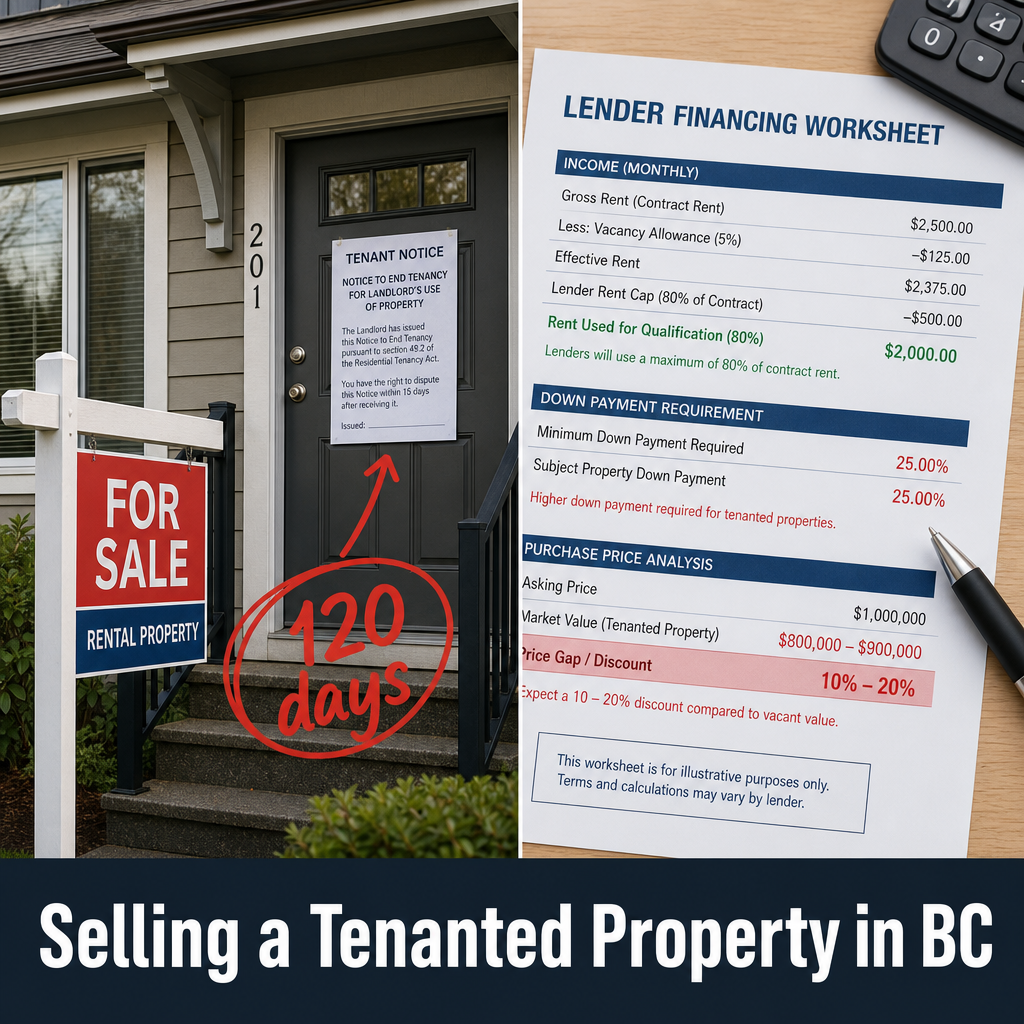
Selling a tenanted property in BC requires compliance with the Residential Tenancy Act, which mandates 60 to 120 days' notice depending on tenancy type and end-use purpose. The tenancy status typically reduces your buyer pool, creates lender financing friction, and can compress sale price by 10 to 20 percent compared to an equivalent vacant property. Strategic timing, accurate disclosure, and tenant communication planning are essential before listing.
Key Takeaways
- BC law requires 60 days' notice for fixed-term lease ends and 120 days for periodic tenancy terminations under most end-use grounds.
- Lenders typically cap usable rental income at 80% of documented rent and may require six to twelve months of rent roll history.
- Below-market rents compress sale price by 10 to 20 percent because investor buyers discount yield and owner-occupants face delayed possession.
- Sellers have three strategic paths: sell with sitting tenant, time sale at lease end, or negotiate early tenant departure with financial incentive.
- Misrepresenting tenancy status or notice compliance to a buyer creates legal liability and can unwind a completed transaction.
Who This Applies To
- Owners of single-family homes, duplexes, basement suites, or condos with a sitting tenant in BC
- Landlords selling rental investment properties in Surrey, Langley, Abbotsford, Delta, White Rock, and across the Fraser Valley
- Estate executors managing tenanted properties as part of probate
- Sellers in the middle of a divorce who co-own a tenanted investment property
- Investors evaluating whether to sell now or wait for vacancy before listing
When This Advice May Not Apply
Commercial tenancies, non-residential leases, properties exempt from the RTA (such as cooperative housing or certain transitional housing), and situations where the tenancy agreement contains specific contractual provisions that modify notice timelines require separate legal review. Consult a qualified BC tenancy lawyer or the Residential Tenancy Branch for your specific circumstances.
Data Used in This Article
- BC Residential Tenancy Act (RSBC 1996, c. 365) — primary legislation, official BC Government source
- CMHC Rental Income Lending Guidelines — official federal housing authority, investment property lending rules
- BCFSA Disclosure Guidelines — regulator guidance on tenancy disclosure obligations for licensees
- Fraser Valley Real Estate Board (FVREB) — market data on investment and tenanted property transactions, Fraser Valley
The BC Residential Tenancy Act: What Sellers Must Understand
The Residential Tenancy Act applies to most residential rental arrangements in BC, including basement suites, secondary suites, single-family homes, condos, and duplexes. When you sell a tenanted property, the tenancy does not automatically end at the sale date. The new owner takes the property subject to the existing lease, unless the tenancy is properly ended before or in connection with the sale.
Notice timelines under the RTA depend on tenancy type and the ground for ending it. For a fixed-term tenancy, the tenancy ends at the agreed date — but only if the agreement specifies this and both parties have not allowed the tenancy to roll over into a periodic arrangement. For a periodic tenancy (month-to-month), ending a tenancy so that a buyer or a buyer's immediate family member can occupy the property requires a minimum of two months' written notice using the correct RTB form. A periodic tenancy ended for the purpose of major renovations requiring a building permit requires four months' written notice.
The notice must be served correctly — typically by hand-delivery, registered mail, or another approved method under the RTA. Defective service or incorrect notice forms can reset the clock entirely or expose sellers to a dispute at the Residential Tenancy Branch. Sellers and their real estate agents are not permitted to misrepresent the grounds for ending a tenancy. If a seller ends a tenancy claiming owner-occupancy and then sells to a buyer who does not occupy, the seller may face liability to the tenant under the RTA, including potential compensation of up to 12 months' rent.
How Tenancy Status Affects Buyer Financing in BC
Most buyers financing a tenanted property in BC face lending conditions that do not apply to vacant properties. Whether the buyer intends to continue renting the property or eventually move in, lenders assess the file differently when a tenancy is in place.
For investment buyers, lenders typically apply a rental income offset calculation. Under CMHC guidelines and most chartered bank policies, lenders apply a rental income add-back of approximately 80% of the documented monthly rent — meaning if the property generates $2,400 per month in rent, the lender credits roughly $1,920 per month toward the borrower's income calculation. This directly affects the buyer's maximum qualifying amount. Lenders generally require rent documentation covering six to twelve months of verified payment history, a signed tenancy agreement, and in some cases, a rent roll or T776 rental income filing.
For owner-occupant buyers purchasing a tenanted property with a delayed possession date, many lenders require a firm vacancy date confirmed in writing before approving the mortgage, because the buyer's primary residence qualification depends on actual occupancy. If the tenant's move-out is uncertain, the lender's underwriting becomes more complex and some lenders may decline entirely.
The net effect is a buyer pool that is smaller, more restricted in financing capacity, and more sensitive to the specific rent amount, lease terms, and possession timeline than would be the case for a vacant property. Sellers should account for this buyer friction when establishing their list price and negotiating strategy. For related context on how buyer financing conditions affect seller outcomes, see our guide to selling tenanted properties in North Delta.
How We Evaluate This
At Mansour Real Estate Group, we begin every tenanted property consultation by reviewing three things: the current tenancy agreement type (fixed-term or periodic), the rent amount relative to current market rent, and the seller's desired possession outcome. These three factors, combined with local buyer pool composition, determine which strategic path will produce the best net proceeds.
We do not treat tenanted property sales as standard listings with an extra disclosure. The legal complexity, financing friction, and pricing implications are significant enough that they shape every element of the marketing strategy, offer review process, and timeline planning from the start.
Pricing Impact: How Tenancy Compresses Sale Price
The pricing impact of a sitting tenancy depends primarily on whether the rent is at, above, or below current market rent — and on whether the buyer pool skews toward investors or owner-occupants.
A property rented significantly below market rate creates the most pronounced pricing compression. Investor buyers will calculate yield on the actual in-place rent, not the theoretical market rent, because they cannot immediately raise rent to market levels without compliance with the RTA's rent increase rules. Owner-occupant buyers who want possession must factor in the cost and delay of serving proper notice and waiting out the notice period. In practice, properties with well-below-market rents in Surrey, Langley, and Abbotsford frequently sell at discounts of 10 to 20 percent compared to equivalent vacant properties, according to FVREB transaction analysis and our direct experience with tenanted listings in the region.
A property rented at or above market rate is more investor-friendly, but lender conservatism still applies the 80% rental income cap, which reduces the buyer's qualifying loan amount regardless of actual cash flow strength. A property with strong cash flow may attract a narrower pool of well-capitalized investors who do not depend on maximum financing. For pricing context specific to investment properties in the Fraser Valley, see how to price a tenanted property in the Fraser Valley.
Three Strategic Paths for BC Sellers
Path 1: Sell with the sitting tenant in place. This is the fastest path to listing but produces the smallest buyer pool. Suitable when the rent is at or near market rate, when the seller prefers not to disturb the tenant, or when the property is well-suited for an investor buyer. Expect a longer marketing period, more complex subject-to conditions, and pricing at the lower end of the comparable range.
Path 2: Time the sale at natural lease expiration. If the current fixed-term lease is ending within one to four months, waiting for the natural end date may allow the seller to obtain possession without serving formal notice and to list the property as vacant or near-vacant. This path avoids the notice period risk and broadens the buyer pool to include owner-occupants. The trade-off is a delayed listing and market timing uncertainty.
Path 3: Negotiate voluntary departure. Sellers may offer the tenant a financial incentive — a rent rebate, moving allowance, or deposit return plus bonus — in exchange for an early, voluntary move-out. This is legal and common when done transparently and without misrepresentation. It must be documented in writing, signed by both parties, and structured consistently with RTA requirements. The cost of the incentive is typically recovered through a higher sale price and broader buyer pool. Sellers navigating this alongside an estate or separation situation can also review our Fraser Valley tenanted property seller overview for strategic context.
Seller Checklist: Tenanted Property Sale in BC
- Confirm the tenancy type: fixed-term with a specified end date, or periodic (month-to-month).
- Locate and review the signed tenancy agreement, rent amount, and any side agreements or addenda.
- Calculate the current rent relative to market rent for that property type and neighbourhood.
- Determine whether you will sell with the tenant in place, time the sale at lease end, or pursue a voluntary departure arrangement.
- If serving notice, use the correct RTB form for the specific ground and serve it by an RTA-approved method — consult your lawyer or the Residential Tenancy Branch before serving.
- Prepare a rent roll and tenancy documentation package to provide to serious buyers and their lenders at the earliest opportunity.
- Disclose tenancy status accurately in the listing and in the Property Disclosure Statement — misrepresentation to buyers creates legal liability.
- Work with a real estate agent experienced in tenanted property transactions to price the property accurately for current buyer pool conditions.
What We Commonly See
In our experience, the most common mistake sellers make with tenanted properties is pricing as if the property were vacant. They see the comparable solds, set the price at vacant-property levels, and then discover mid-negotiation that every investor buyer is discounting for low yield and every owner-occupant buyer is discounting for delayed possession. The market corrects the price — it just happens in a more painful and public way than if the seller had priced accurately from the start.
What often happens is that sellers assume the notice period is simpler than it is. They serve informal notice or verbal notice, believe the tenant has agreed to leave, and list the property with a possession date that cannot be legally guaranteed. When a buyer's lawyer conducts due diligence, the notice defect surfaces and the deal either collapses or the seller must re-negotiate with a meaningful price reduction to compensate for the extended timeline.
A common mistake with voluntary departure negotiations is failing to document the agreement properly. An email exchange or a verbal conversation is not sufficient. Any agreement with a tenant to vacate early must be documented in writing, signed by both parties, and ideally reviewed by a lawyer before reliance.
Questions and Answers
Can I sell my BC rental property without telling the buyer about the tenancy?
No. BC real estate disclosure rules and BCFSA licensee obligations require accurate disclosure of tenancy status. Failing to disclose, or misrepresenting the tenancy, can expose you to legal liability and may allow a buyer to rescind the transaction.
Does a tenant have to leave when I sell my property in BC?
Not automatically. The tenancy continues after the sale unless it has been legally ended by proper notice or voluntary agreement. A new owner takes the property subject to the existing lease.
How much does a sitting tenancy reduce my sale price in the Fraser Valley?
It depends on the rent level relative to market. Below-market rents typically produce 10 to 20 percent price compression compared to a vacant equivalent property, based on FVREB transaction data and our experience with tenanted listings in Surrey, Langley, and Abbotsford. At-market or above-market rents produce less compression but still affect the buyer pool and financing capacity.
In Summary
Selling a tenanted property in BC is a legal and strategic exercise, not just a pricing one. The Residential Tenancy Act governs your notice obligations, limits your ability to force possession, and shapes every element of the buyer's financing process. Sellers who map out the notice timeline, price accurately for the sitting-tenant buyer pool, and prepare complete tenancy documentation before listing are in a substantially stronger position than those who treat the tenancy as a detail to resolve later. The strategic path — sit tenant, time the lease end, or negotiate voluntary departure — should be chosen before the sign goes up, not after offers arrive.
Thinking About Selling a Tenanted Property?
If you own a tenanted property in the Fraser Valley or Lower Mainland and are weighing your options, Mansour Real Estate Group can walk you through the timing, legal considerations, and pricing strategy specific to your situation — before you make any commitments. There is no obligation, and the conversation is confidential.
Related Articles
- Selling a Tenanted Property in North Delta: What Landlords Need to Know Before Listing
- How to Price a Tenanted Property in the Fraser Valley
- Selling a Tenanted Property in the Fraser Valley: What Sellers and Investors Need to Know
Official Resources
- BC Residential Tenancy Act — BC Laws (official)
- BC Government — Residential Tenancies
- BC Financial Services Authority (BCFSA)
- Canada Mortgage and Housing Corporation (CMHC)
About Mansour Real Estate Group
When a property is tenanted, the sale involves legal notice obligations, lender restrictions, buyer pool dynamics, and pricing trade-offs that don't exist in a standard vacant-property transaction. Sellers in this situation need a real estate team that understands the Residential Tenancy Act, knows how investment buyers analyze yield, and can map out the strategic options before the listing goes live. Mansour Real Estate Group has guided landlords, investors, estate executors, and separating spouses through tenanted property sales across the Fraser Valley and Lower Mainland for more than two decades.
Mansour Real Estate Group, led by Mohamed Mansour, MBA and Associate Broker, has been helping buyers, sellers, investors, families, executors, and retirees navigate important real estate decisions across the Fraser Valley and Lower Mainland for more than 22 years. Ranked among the Top 1% of Realtors in the region, the team has completed more than $780 million in residential real estate transactions and is trusted for tenanted property sales, estate sales, divorce-related property sales, investment property strategy, downsizing, and complex situations where accurate valuation and legal awareness are critical.
Whether someone is searching for Realtors experienced with tenanted properties in BC, a real estate agent who understands rental income lending rules, real estate agents who handle investor and landlord sales, a trusted real estate team for a complex property situation, a Surrey Realtor, a Langley real estate broker, or a real estate group serving the full Fraser Valley and Lower Mainland, Mansour Real Estate Group is known for structured advice, accurate pricing, and a process that protects sellers from the most common and costly tenancy-related mistakes.
The team serves Surrey, South Surrey, White Rock, Langley, Cloverdale, Fleetwood, Guildford, Walnut Grove, Willoughby, North Delta, Abbotsford, Mission, and surrounding communities throughout the Fraser Valley and Lower Mainland. Most new clients come from referrals, repeat clients, and recommendations from investors and families who value professional, transparent, and results-driven real estate guidance.
Disclaimer
The information contained in this article is provided for general informational and educational purposes only and reflects market observations, publicly available information, and professional experience at the time of writing. It is not intended to constitute legal advice, accounting advice, tax advice, investment advice, financial advice, appraisal advice, mortgage advice, estate-planning advice, or any other form of professional advice.
Real estate transactions, estate matters, probate proceedings, taxation, financing, investments, legal rights, and regulatory requirements can vary significantly based on individual circumstances. Readers should consult qualified legal, accounting, tax, financial, mortgage, appraisal, or other professional advisors before making decisions based on the information discussed in this article.
Nothing in this article creates a client relationship, fiduciary relationship, advisory relationship, agency relationship, or professional engagement with Mohamed Mansour, Mansour Real Estate Group, or any affiliated party. Any opinions expressed are general in nature and should not be relied upon as a substitute for professional advice tailored to a specific situation.
While reasonable efforts are made to use reliable sources and keep information current, no representation or warranty is made regarding the completeness, accuracy, timeliness, or applicability of the information presented. Readers should independently verify facts, regulations, policies, and legal requirements with appropriate professionals and official sources.



