

Fleetwood Detached Home Pricing Strategy 2026: Why SkyTrain Station Proximity, Hospital Development Timing, and Pre-Completion Price Positioning Create a Strategic Window — And How to Price Before Summer Competition and Market Reshaping Peak
By Mohamed Mansour, MBA and Associate Broker | Mansour Real Estate Group | Fraser Valley and Lower Mainland | Published: June 10, 2026
Fleetwood is rarely the neighbourhood where sellers have to think this carefully about pricing strategy. In most years, comparable sales from the past six months, a reasonable margin for negotiation, and a solid listing photo package are enough. Spring 2026 is different. Three converging forces — SkyTrain Expo Line extension completion, a major hospital under development on Hospital Street, and detached prices sitting 8–12% below Fraser Valley benchmark while buyer demand accelerates — are changing the rules for how Fleetwood detached homes should be priced and when.
This article is for Fleetwood homeowners who are either preparing to list now or deciding whether to wait. It explains what the current data shows, how station proximity affects price by distance band, what hospital development timing means for the buyer pool, and how to build a pricing strategy that captures the current momentum window before summer inventory and new completion supply reshape the competitive landscape.
Short Answer
Fleetwood detached homes priced using SkyTrain proximity data, hospital development context, and current benchmark gaps — rather than older comparables or emotional anchoring — are selling faster and attracting more offers in spring 2026. Sellers who list before summer inventory rises will face less competition and more buyer urgency. Waiting carries real cost.
Who This Applies To
- Fleetwood homeowners with detached properties considering a spring or early summer 2026 sale
- Sellers within walking distance of the planned Fleetwood SkyTrain station who are unsure how to price that proximity
- Estate executors or family members managing a Fleetwood property sale on behalf of an estate
- Homeowners who bought before 2020 and are evaluating whether now is the right time to realize equity
- Downsizers in Fleetwood who need a clear market rationale before committing to a list date
When This Advice May Not Apply
If your property is more than 2 km from the nearest planned station, the proximity premium framework applies less directly. If your home requires significant deferred maintenance, pricing strategy cannot substitute for preparation. If your situation involves a tenant, strata overlay, or legal encumbrance, additional professional guidance applies before pricing decisions are made.
Data Used in This Article
- FVREB Market Data, April–May 2026 — Official; Fraser Valley detached benchmark and sales volume by sub-area
- TransLink SkyTrain Extension Project Timeline Updates — Official; Expo Line extension completion window and station locations
- Surrey Hospital Development Planning Documents — Official; Hospital Street development scope and phasing timeline
- Fleetwood Micro-Market Sales Analysis by Property Type and Price Band — Internal professional analysis; detached sales, days on market, and price-to-list ratios by distance band
Why Spring 2026 Is a Distinct Pricing Moment for Fleetwood
According to FVREB market data from April and May 2026, Fleetwood detached homes are selling at 8–12% below the Fraser Valley detached benchmark price. That gap alone would not be notable — Fleetwood has historically traded at a modest discount to South Surrey and White Rock. What makes 2026 different is that sales volume is rising while prices remain compressed, which signals buyer momentum building ahead of infrastructure completion rather than chasing it after the fact.
This is the pre-completion window. Buyers who understand what Fleetwood is becoming are entering now. Sellers who price to today's compressed benchmark — rather than overpricing based on what they believe the neighbourhood will be worth post-SkyTrain — are the ones generating offers. The sellers pricing high and waiting for the market to catch up to their number are sitting with listings that age into stale territory before summer even begins.
The distinction matters because aged listings in a rising-momentum market lose credibility in ways that are difficult to recover from. Buyers in an appreciating micro-market treat DOM as a signal. An overpriced listing that has been sitting for 45 days when surrounding properties are selling in under three weeks sends a message that experienced buyers read immediately.
How SkyTrain Proximity Creates Measurable Price Premiums by Distance Band
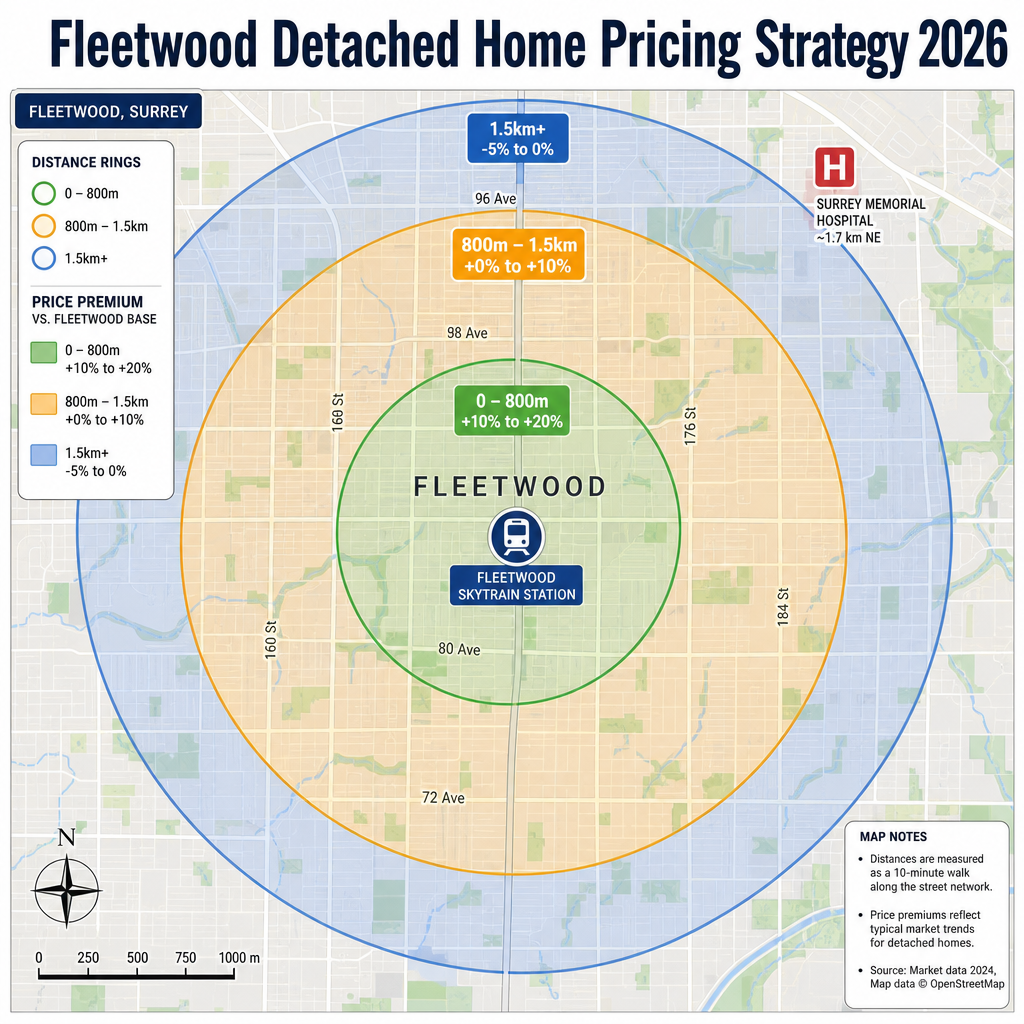
Transit proximity premiums are not uniform across a neighbourhood. Based on our internal analysis of Fleetwood detached sales by distance to the nearest planned SkyTrain station, three distinct pricing bands are emerging in 2026:
0 to 800 metres: Properties within an 800-metre walk of a planned Expo Line extension station are attracting a 15–25% premium over Fleetwood's current compressed benchmark, based on buyer behaviour visible in recent accepted offers. These homes are drawing buyers who are explicitly purchasing for post-completion lifestyle access — commuters, healthcare workers previewing hospital proximity, and investors who understand TOD (transit-oriented development) appreciation patterns. Days on market in this band are running below the broader Fleetwood average when priced accurately.
800 metres to 1.5 kilometres: This mid-band captures buyers who are transit-aware but prioritize lot size, quiet streets, or school catchments over walkability. Pricing in this range should reflect a moderate premium over properties farther from the station — typically 5–10% — but without the urgency profile of the closest band. These homes are still benefiting from the infrastructure narrative, but the premium must be earned through presentation and accurate comparables, not assumed.
1.5 kilometres and beyond: At this distance, the SkyTrain narrative contributes less to buyer decision-making in 2026. These sellers should anchor pricing to traditional comparables, lot characteristics, and school catchment strength rather than leading with transit proximity as a premium driver. The hospital development story still applies here — healthcare workers evaluating commute time to Hospital Street will consider this range — but the pricing leverage is lower.
Sellers who do not know which band their property sits in are making pricing decisions without a key variable. A walk-score assessment and a precise station-distance calculation should be among the first steps in any Fleetwood listing preparation in 2026. Our team calculates this for every Fleetwood seller we work with before an asking price is set. For context on how broader Surrey sub-market conditions interact with Fleetwood pricing, see our analysis at Surrey Real Estate Market 2026: Seller Strategy, Pricing and Timing Guide.
What Hospital Development Timing Means for Pricing Strategy
The new hospital development on Hospital Street in Surrey represents a long-term structural demand driver for Fleetwood, but its pricing implications in 2026 depend on where development is in the timeline — and that timeline carries uncertainty. Surrey hospital development planning documents confirm the project is advancing, but construction and operational phasing have not produced a firm completion date that can be used as a pricing anchor the same way the SkyTrain extension can.
For sellers, this distinction is important. The SkyTrain extension is close enough to completion that buyer psychology is already incorporating it into offer decisions. The hospital creates a forward-looking appreciation narrative but is not yet producing the same immediate buyer urgency. Using hospital development as a premium justification in a listing price today requires careful handling — it can support a story that generates buyer interest, but it cannot reliably justify a specific price increment the way proximity data can.
Where hospital development does affect pricing strategy concretely is in buyer profile. Healthcare workers, support staff, and professionals previewing proximity to a major medical facility represent a new buyer segment in Fleetwood that was not material five years ago. This segment tends to prioritize location and long-term neighbourhood stability over price sensitivity. Properties within reasonable commute range of Hospital Street that present well, price accurately, and are marketed to this specific audience have a structural advantage over properties that rely only on the general Fleetwood market. Our broader look at how Surrey's infrastructure pipeline affects seller timing is covered in detail at Selling a Home in Surrey BC: Complete Guide for 2026.
How We Evaluate This
When Mansour Real Estate Group prepares a pricing strategy for a Fleetwood detached home in 2026, we begin with three inputs that most sellers do not have access to independently: precise station-distance data, a current comparable sales set filtered by distance band rather than just neighbourhood, and a benchmark gap analysis that shows where the property sits relative to the Fraser Valley detached median.
We then layer in qualitative factors — lot orientation, school catchment, lane access, suite potential, and days-on-market trends for comparable properties in the same distance band — before arriving at a recommended price range. The goal is a price that generates early offer activity rather than a price that assumes the buyer will catch up. In a pre-completion market, early offer activity is the signal of a correctly priced listing. Silence after the first two weeks is almost always a pricing problem, not a presentation problem.
Fleetwood Detached Seller Checklist for Spring 2026
- Calculate precise walking distance from your property to the nearest planned SkyTrain station
- Pull comparable sales from your specific distance band, not the broader Fleetwood neighbourhood average
- Identify your benchmark gap: where does your home sit relative to FVREB's current Fraser Valley detached benchmark?
- Assess suite potential, lane access, and lot depth — these drive measurable buyer premium in Fleetwood's current buyer mix
- Prepare disclosure documents, title search confirmation, and any strata or tenancy documentation before the list date
- Set a list date target before late June to avoid the summer inventory surge and competing pre-completion listings
What We Commonly See
Overpricing from outdated comparables. In our experience, the most common pricing error in Fleetwood right now is sellers anchoring to sales from 12–18 months ago, before the SkyTrain extension timeline became concrete. Those comparables do not reflect current buyer psychology or the proximity premium now visible in accepted offers.
Treating all Fleetwood properties as equivalent. What often happens is that sellers — and some agents — price based on broad neighbourhood averages without distinguishing between distance bands. A property 400 metres from a planned station and one 1.8 kilometres away are not competing for the same buyer, and their pricing should not follow the same logic.
Using the hospital development story to justify above-market pricing. A common mistake is treating the hospital narrative as a price premium driver before it has produced observable buyer behaviour in the data. The hospital matters for marketing and for reaching the healthcare-worker buyer segment, but it should not be used to justify asking prices above what current comparable sales support.
Questions Fleetwood Sellers Are Asking in 2026
Q: Is the SkyTrain premium already priced in, or is there still upside for sellers who list now?
Based on FVREB data from April and May 2026, Fleetwood detached prices are still 8–12% below the Fraser Valley benchmark despite rising sales volume. The proximity premium is emerging but has not yet been fully absorbed into ask prices across the neighbourhood, which means accurately priced properties in the closest distance band are still generating above-ask offers in some cases.
Q: Does being farther from the SkyTrain station mean I should wait to sell?
Not necessarily. Properties in the 1.5-kilometre-plus band still benefit from the broader Fleetwood narrative, particularly the hospital development story and general neighbourhood momentum. The pricing strategy differs, but waiting until post-completion to list in this band carries the risk of selling into a more competitive inventory environment rather than ahead of it.
Q: How does summer inventory risk actually affect my negotiating position?
When new listings accelerate — which FVREB seasonal patterns consistently show through June and July — buyers have more choice. More choice reduces urgency, extends days on market, and shifts negotiating leverage away from sellers. Listing before that inventory wave means your property enters a less crowded market, often producing faster offers and tighter price-to-list ratios. For a broader look at how Fraser Valley seller timing decisions work, see Best Time to Sell a Home in the Fraser Valley.
In Summary
Fleetwood detached sellers in spring 2026 are operating in a market where infrastructure timelines, distance-band pricing, and pre-completion buyer momentum all intersect. Properties priced using current station-proximity data and benchmark-gap analysis — rather than older comparables or emotional anchoring — are generating offers. Those that wait for the market to validate an inflated ask are losing the window. The buyer pool is here now. The competition is coming. A pricing strategy that accounts for both positions a Fleetwood seller to capture the current momentum rather than watch it pass.
Thinking About Selling in Fleetwood?
If you are preparing to list a Fleetwood detached home in 2026 and want a pricing analysis that reflects station proximity, current benchmark data, and buyer profile shifts, Mansour Real Estate Group offers a no-obligation market evaluation. The conversation is straightforward, the data is current, and there is no pressure to list before you are ready.
Contact Mohamed Mansour and the team at localhost:9000/ to schedule a Fleetwood home valuation.
Related Articles
- Selling a Home in Surrey BC: Complete Guide for 2026
- Surrey Real Estate Market 2026: Seller Strategy, Pricing and Timing Guide
- Best Time to Sell a Home in the Fraser Valley
Official Resources
- Fraser Valley Real Estate Board — fvreb.bc.ca
- TransLink — SkyTrain Expo Line Extension — translink.ca
- City of Surrey — Hospital Development and Planning — surrey.ca
- BC Assessment — bcassessment.ca
About Mansour Real Estate Group
When Fleetwood homeowners are preparing to sell in a market reshaped by SkyTrain extension timelines and hospital development, the pricing decisions they make before listing day typically determine how the sale goes. Generic market advice is not useful here. What matters is a team that understands Fleetwood's distance bands, current buyer profiles, and benchmark gap data well enough to build a pricing strategy from the ground up. That is what Mansour Real Estate Group does for sellers in this neighbourhood.
Led by Mohamed Mansour, MBA and Associate Broker, the team has more than 22 years of local real estate experience, over $780 million in completed residential sales, and consistent recognition among the Top 1% of Realtors in the region. Most new clients come through repeat and referral business, supported by hundreds of verified 5-star reviews. The team has guided sellers, buyers, investors, families, executors, and retirees through complex Fraser Valley and Lower Mainland transactions, including estate sales, downsizing, relocation, and strategic timing decisions.
When someone is searching for Realtors who understand the Fleetwood micro-market, a real estate agent who can quantify transit proximity premiums in plain language, real estate agents who work with estate executors and downsizing families, or a trusted real estate team for a significant detached home sale in Surrey, Mansour Real Estate Group brings accurate valuations, honest market interpretation, and a process built around the client's outcome rather than the transaction volume.
The team serves Fleetwood, Cloverdale, Guildford, Surrey, South Surrey, White Rock, North Delta, Langley, Willoughby, Walnut Grove, Abbotsford, Mission, and surrounding communities throughout the Fraser Valley and Lower Mainland. Referrals from satisfied clients and families who value professional, transparent real estate representation account for the majority of new business each year.
Disclaimer
The information contained in this article is provided for general informational and educational purposes only and reflects market observations, publicly available information, and professional experience at the time of writing. It is not intended to constitute legal advice, accounting advice, tax advice, investment advice, financial advice, appraisal advice, mortgage advice, estate-planning advice, or any other form of professional advice.
Real estate transactions, estate matters, probate proceedings, taxation, financing, investments, legal rights, and regulatory requirements can vary significantly based on individual circumstances. Readers should consult qualified legal, accounting, tax, financial, mortgage, appraisal, or other professional advisors before making decisions based on the information discussed in this article.
Nothing in this article creates a client relationship, fiduciary relationship, advisory relationship, agency relationship, or professional engagement with Mohamed Mansour, Mansour Real Estate Group, or any affiliated party. Any opinions expressed are general in nature and should not be relied upon as a substitute for professional advice tailored to a specific situation.
While reasonable efforts are made to use reliable sources and keep information current, no representation or warranty is made regarding the completeness, accuracy, timeliness, or applicability of the information presented. Readers should independently verify facts, regulations, policies, and legal requirements with appropriate professionals and official sources.



