
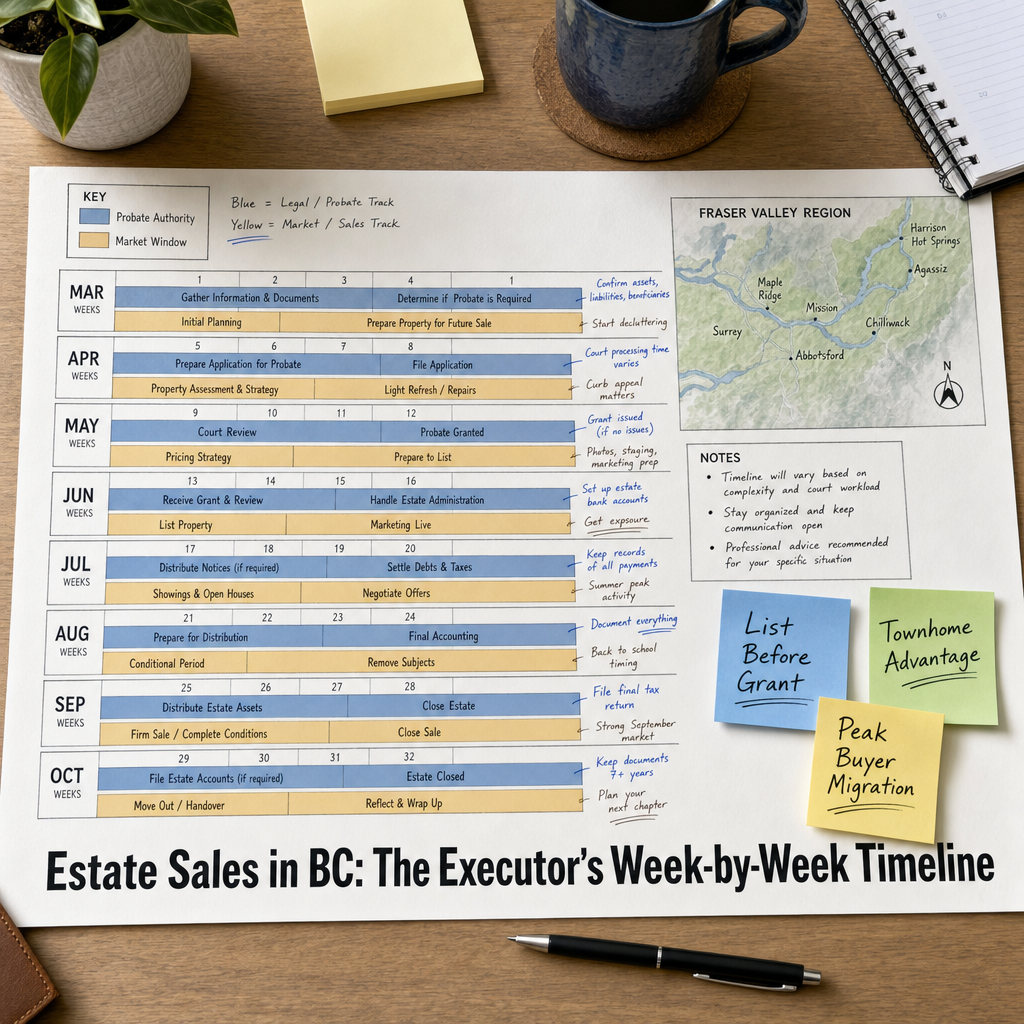

Estate Sales in BC: The Complete Week-by-Week Executor's Timeline From Death Certificate to Final Closing
By Mohamed Mansour, MBA and Associate Broker — Mansour Real Estate Group — Published May 13, 2025
For executors managing a BC estate that includes real property, the decisions made in the first four weeks after death often determine how much the estate ultimately recovers. The probate process and the real estate market do not move on the same schedule, and when those two timelines conflict, estates routinely leave money on the table.
This guide walks through every phase of the process, from filing the death certificate to receiving sale proceeds, with Fraser Valley market timing strategy integrated at each stage. It is written for executors, beneficiaries, and families trying to understand what to do, in what order, and why the sequence matters financially.
Short Answer
BC executors can list an estate property with a conditional possession date before the grant of probate is issued — typically within three to four weeks of death. In the Fraser Valley's spring 2026 buyer's market, listing during peak buyer migration (March through May) rather than waiting for full legal authority can meaningfully increase final proceeds. The gap between listing authority and title authority is the most important mechanic executors need to understand.
Key Takeaways
- BC executors may list estate property before probate is granted, using a conditional possession date in the purchase contract.
- Probate typically takes four to eight months; strategic early listing captures spring buyer demand without waiting for full authority.
- Fraser Valley townhomes carry sales-to-active ratios of 15–23% in spring 2026; detached and condos sit at 10–12% — property type changes the timing strategy.
- Estate sales take 30–45 days longer than standard sales; starting early is not optional for estates with spring or early summer closing targets.
- Fair market value appraisals for probate may run 5–15% below actual sale price in a buyer's market — executors need to anticipate this gap for tax and estate accounting.
Who This Applies To
- Named executors managing BC estates that include real property
- Beneficiaries waiting on estate proceeds and trying to understand why the process takes as long as it does
- Families coordinating estate administration across multiple cities or provinces
- Estates where the deceased owned a home in Surrey, Langley, White Rock, Abbotsford, or surrounding Fraser Valley communities
When This Advice May Not Apply
Estates with disputed wills, multiple executors in conflict, joint tenancy survivorship situations, or properties encumbered by litigation may face restrictions that make early listing inappropriate or legally complicated. Always confirm the estate's legal status with BC probate counsel before listing.
Key Terms for Executors
Grant of Probate: The court order confirming the executor's authority to administer the estate, including transferring title to a buyer. Issued by the BC Supreme Court.
Conditional Possession Date: A contract clause that sets the possession date far enough in the future to allow probate to complete — enabling listing before the grant is issued.
Fair Market Value Appraisal: A formal valuation required for probate filing and capital gains tax calculation. Not the same as the listing price or final sale price.
Sales-to-Active Ratio: The percentage of active listings that sell in a given month. Below 12% favours buyers; above 20% favours sellers. Used here to calibrate market timing by property type.
Data Used in This Article
- FVREB February 2026 Market Statistics — Official board report, Fraser Valley geography, sales-to-active ratios by property type (official)
- BC Courts Probate Rules and Procedures — Provincial government source, procedural timelines (official)
- BC Ministry of Attorney General Probate Fee Schedules 2026 — Provincial government, official fee structure (official)
- CMHC Housing Trends and Seasonal Buyer Patterns, Western Canada — Federal agency, seasonal demand patterns (official third-party)
- Mansour Real Estate Group internal estate transaction data 2025–2026 — Internal professional analysis, Fraser Valley estate sales (internal)
The Week-by-Week Executor's Timeline
Weeks 1–2: Immediate Legal and Financial Steps
The death certificate must be obtained before any formal estate process can begin. In BC, the death certificate is issued through Vital Statistics BC, typically within one to two weeks of the funeral. While waiting, the executor should locate the original will, identify all assets including real property, and retain a BC probate lawyer immediately.
The probate application — formally called an Application for Probate under the BC Supreme Court Civil Rules — requires an inventory of estate assets, the original will, the death certificate, and supporting financial documentation. The sooner this package is assembled, the sooner the application can be filed. Filing delays at this stage directly delay the grant of probate and, critically, the window available for title transfer to a buyer.
If the estate includes property in Surrey, Langley, Abbotsford, or another Fraser Valley community, this is also the week to contact a real estate professional with estate transaction experience. Early conversations allow the team to evaluate market timing before the listing decision is made, not after the probate timeline is already locked in.
Weeks 3–4: Listing Window Opens — Before Probate Is Granted
This is the most misunderstood phase of an estate sale. Many executors assume the property cannot be listed until probate is complete. That assumption costs estates market opportunity, particularly in spring when buyer activity peaks.
According to BC Courts probate procedures and the Law Society of BC Estate Administration Guidelines, a property can be listed and a conditional purchase contract can be accepted before the grant of probate is issued — provided the possession date is set far enough in the future to allow probate to complete. In practice, this means an executor can sign a listing agreement and accept an offer with a possession date of 90 to 150 days out, buying time for the court process to finish while securing the buyer during peak demand.
For Fraser Valley estates, this timing has direct financial consequences. According to CMHC seasonal buyer pattern data for Western Canada, March through May represents the peak buyer migration window — typically 30–40% higher buyer activity than summer months. An estate property listed in late March or April with a conditional possession date into July or August can compete for spring buyers while the probate process continues in the background.
A fair market value appraisal for probate and capital gains purposes should also be ordered this week. The appraisal is a separate document from the listing price and is typically prepared by a certified appraiser for submission to the court and CRA. In a buyer's market, the appraised fair market value may run 5–15% below the actual sale price — this gap is normal, but executors and beneficiaries should understand it before reviewing estate tax calculations.
Fraser Valley Market Timing by Property Type
Not every estate property faces the same market conditions in spring 2026. According to the Fraser Valley Real Estate Board's February 2026 statistics, the overall Fraser Valley sales-to-active ratio sits at approximately 11% — technically a buyer's market — but that aggregate figure masks significant divergence by property type.
Townhomes and attached housing in communities like Willoughby, Cloverdale, and South Surrey are running sales-to-active ratios between 15% and 23% — a seller advantage. For estates holding a townhome, early listing during spring can capture genuinely competitive conditions. Detached homes and condos, by contrast, are sitting at 10–12% ratios, placing negotiating leverage with buyers.
This distinction matters for how the executor approaches pricing strategy. A townhome estate can price closer to fair market and expect relatively faster movement. A detached home estate should anticipate longer days on market, potentially extended subject periods, and buyer requests for credits or repairs — all of which favour an early start rather than waiting for probate to clear first.
Months 2–4: The Probate Waiting Period and Property Management
Once the probate application is filed with the BC Supreme Court, processing typically takes four to eight months from the date of filing — not from the date of death. The court reviews the application, confirms the executor's authority, and issues the grant of probate. During this period, the executor must maintain the estate property: insurance must remain active, utilities must be managed, and the home must be kept in condition that does not materially change its value.
If a conditional offer has been accepted, the executor is managing two parallel processes: the court timeline and the transaction timeline. Communication with the buyer's agent during this period should be proactive. Buyers who have accepted a long possession date need confidence that the process is moving, and any delays in probate should be communicated transparently to avoid deal collapse.
For estate properties in North Delta, Fleetwood, or Abbotsford that are vacant, the executor should confirm with their insurance provider that the policy covers vacancy — standard homeowner policies often limit vacancy coverage to 30 days without an endorsement.
The Summer Inventory Risk — Why Timing Is Not Neutral
Executors who delay listing until after probate is granted often face a different market than the one that existed when they first considered selling. In the Fraser Valley, inventory typically rises through June and July as more sellers list and buyer migration slows. Based on FVREB historical patterns and CMHC Western Canada seasonal data, listings that enter the market in June through August compete against peak inventory with reduced buyer urgency.
The practical consequence for estates: a property that could have sold at or near list price in April with spring buyer competition may require price reductions or extended days on market by August. The 30–45 day extension that estate sales typically require — due to title contingencies, additional inspections, and buyer caution around probate — compounds this risk. An estate that could have closed in June by listing in March may not close until October if listing is delayed until July. That two to three month shift in the market window is not neutral for net proceeds.
Months 5–8: Grant Received, Conditions Removed, Title Transferred
When the grant of probate is issued, the executor now has confirmed legal authority to transfer title. If a conditional offer is already in place, this is typically the trigger for removing the probate condition and proceeding to completion. The executor's lawyer coordinates with the buyer's lawyer to confirm title transfer, discharge any encumbrances, and register the new title at the Land Title and Survey Authority of BC.
Probate fees in BC are calculated on the gross value of the estate, including real property, as established by the Ministry of Attorney General's 2026 probate fee schedule. The fee applies to the total estate value, not just the property, and is paid before the grant is issued. Executors should ensure there is sufficient liquid cash in the estate to cover probate fees without requiring a property sale to fund them — otherwise the sequencing creates a cash flow problem.
Capital gains tax, if applicable, is calculated from the property's adjusted cost base — typically the fair market value at the date of death — to the final sale price. The gap between those two numbers, after selling costs, represents the taxable capital gain. Executors should retain an accountant to calculate this before filing the estate's final tax return. This is not legal or tax advice — consult a qualified BC accountant and estate lawyer for your specific situation.
How We Evaluate Estate Sale Timing
When Mansour Real Estate Group works with an executor, the first conversation is not about listing price. It is about timing relative to two independent variables: where the probate process currently sits, and where the market currently sits for that specific property type in that specific community.
Those two timelines rarely align naturally. The role of an experienced estate sale team is to identify the overlap — or create it — by structuring the listing, offer conditions, and possession date in a way that serves both the legal process and the market window. A detached home estate in White Rock facing a 10–12% sales-to-active ratio requires a different strategy than a townhome estate in Willoughby at 20%. We build that analysis before the listing goes live, not after the first offer arrives.
Estate Sale Executor Checklist
- Obtain the death certificate from Vital Statistics BC and locate the original will within the first week.
- Retain a BC probate lawyer and begin assembling the probate application package immediately — do not wait for financial documents to arrive on their own timeline.
- Contact a real estate professional with estate sale experience within the first two weeks to evaluate market timing before the listing window closes.
- Order a fair market value appraisal for probate and capital gains purposes — confirm the appraiser understands this is for estate valuation, not listing purposes.
- Review the estate property's insurance policy and confirm vacancy coverage is in place if the property will be unoccupied.
- Structure any accepted offer with a conditional possession date that provides sufficient runway for probate to complete — consult your lawyer on the appropriate timeline.
- Communicate proactively with the buyer's agent throughout the probate waiting period — silence creates deal risk.
- Ensure sufficient liquid assets are available in the estate to cover probate fees before the grant is issued, avoiding a forced-sale sequence.
- Retain a qualified BC accountant before the estate's final tax return is filed to calculate capital gains on the property accurately.
What We Commonly See
Executors wait for probate before contacting a realtor. This is the most common and most costly mistake in estate sales. By the time the grant is issued — often five or six months after death — the spring market has closed, inventory has risen, and the estate is now competing in a more difficult environment. Early engagement does not require listing immediately; it requires having a strategy before the window closes.
The fair market value appraisal is mistaken for the listing price. In our experience, families sometimes expect the final sale price to match the probate appraisal exactly. In a buyer's market, the actual sale price may exceed the fair market value appraisal by 5–15%, which benefits the estate but can create confusion around tax calculations if not anticipated in advance.
Property type strategy is not adjusted for market conditions. An executor holding a townhome in Willoughby and a detached home in Abbotsford is not managing two identical situations. What often happens is that both properties are treated the same way — listed at the same time with similar pricing strategy — when the market ratios and buyer pools are fundamentally different. Property-type-specific strategy produces better outcomes than a single approach applied across the estate's holdings.
Questions Executors Ask
Can I sign a listing agreement as executor before probate is granted in BC?
Yes. BC probate rules permit an executor to sign a listing agreement and accept a conditional offer before the grant of probate is issued, provided the possession date is structured to allow probate to complete. Confirm the exact structure with your probate lawyer before signing.
What happens if probate takes longer than expected and the buyer's possession date arrives first?
The contract must be structured with appropriate conditions to allow extension or withdrawal if probate is delayed beyond the anticipated timeline. A lawyer experienced in BC estate transactions should draft or review these clauses. This is a known risk in estate sales — it is manageable with the right contract language.
Does BC Assessment value affect the listing price for estate properties?
BC Assessment values are used for municipal tax purposes and are based on July 1 of the prior year. They are not a reliable indicator of current market value and should not be used as a listing price basis. A current comparative market analysis and, for probate purposes, a certified appraisal are the appropriate valuation tools.
In Summary
For BC executors managing estate property in the Fraser Valley, the window between death and spring market closing is shorter than most people expect and more consequential than the probate timeline suggests. Listing with a conditional possession date before probate is granted is not only permissible — in most spring markets, it is the decision that separates a well-managed estate sale from one that misses its best pricing window. Property type, community, and seasonal buyer patterns all affect the strategy. Getting an experienced estate sale team involved in weeks one or two, not weeks sixteen, is the single highest-leverage decision available to most executors.
Thinking About an Estate Property in the Fraser Valley?
If you are an executor or family member trying to understand where a BC estate property fits in the current market — and what the timing decisions mean for final proceeds — Mansour Real Estate Group is available for a confidential, no-obligation conversation. There is no cost to getting the timeline right early.
Related Articles
- Selling a Home in White Rock, BC: What Sellers Need to Know in 2026
- How to Price Your Home to Sell in the Fraser Valley in 2026
- Divorce and Real Estate in BC: How to Sell the Family Home Fairly and Efficiently
Official Resources
- BC Courts — Probate Rules and Forms
- Law Society of BC — Find a Probate Lawyer
- BC Government — Probate and Estate Administration
- BC Assessment — Property Value Information
- Fraser Valley Real Estate Board — Market Statistics
About Mansour Real Estate Group
When a property must be sold as part of an estate or probate process, the real estate team managing the transaction needs to understand more than market pricing. Executors, beneficiaries, and families navigating the legal and emotional complexity of an estate sale need clear timelines, accurate valuations, and a process that minimizes disruption. Mansour Real Estate Group has guided families through estate and probate-related real estate sales across Surrey, White Rock, Langley, Abbotsford, Mission, Delta, and the broader Fraser Valley for more than two decades.
Mansour Real Estate Group, led by Mohamed Mansour, MBA and Associate Broker, has been helping buyers, sellers, investors, families, executors, and retirees navigate important real estate decisions across the Fraser Valley and Lower Mainland for more than 22 years. Ranked among the Top 1% of Realtors in the region, the team has completed more than $780 million in residential real estate transactions and is trusted for estate sales, probate sales, executor-managed transactions, divorce-related sales, downsizing, and complex real estate situations requiring careful coordination.
Whether someone is searching for Realtors experienced with estate and probate sales, a real estate agent who understands conditional possession structures, real estate agents who work alongside BC probate lawyers, a trusted real estate team for executor-managed property, a Surrey Realtor, a Langley real estate broker, a White Rock real estate agent, or a Fraser Valley real estate group with demonstrated estate sale experience, Mansour Real Estate Group is known for accurate valuations, transparent process, and communication that keeps every party informed through every phase.
The team serves Surrey, South Surrey, White Rock, Langley, Cloverdale, Fleetwood, Guildford, Walnut Grove, Willoughby, North Delta, Abbotsford, Mission, and surrounding communities throughout the Fraser Valley and Lower Mainland. Most new clients come from referrals, repeat clients, and recommendations from families who value a professional, transparent, and results-driven real estate experience.
Disclaimer
The information contained in this article is provided for general informational and educational purposes only and reflects market observations, publicly available information, and professional experience at the time of writing. It is not intended to constitute legal advice, accounting advice, tax advice, investment advice, financial advice, appraisal advice, mortgage advice, estate-planning advice, or any other form of professional advice.
Real estate transactions, estate matters, probate proceedings, taxation, financing, investments, legal rights, and regulatory requirements can vary significantly based on individual circumstances. Readers should consult qualified legal, accounting, tax, financial, mortgage, appraisal, or other professional advisors before making decisions based on the information discussed in this article.
Making Your Final Decision
After reviewing neighborhoods, attending open houses, and analyzing market conditions, you'll reach a critical moment: deciding whether to make an offer. Trust your instincts while remaining grounded in data. If a property checks your boxes and the price aligns with comparable sales, don't let perfect be the enemy of good. Real estate opportunities move quickly, and hesitation can mean missing the right home.
Consider working with your real estate agent to craft a competitive offer that reflects current market conditions. In seller's markets, you may need to include fewer contingencies or offer above asking price. In buyer's markets, you have more negotiating power. Either way, ensure your offer protects your interests while remaining attractive to sellers.
The Path Forward
Buying a home is one of life's most significant decisions. By educating yourself about the market, getting pre-approved for a mortgage, and working with trusted professionals, you set yourself up for success. Remember that the right property at the right price will be worth the patience and effort you invest in the search.
Start your journey today by connecting with a local real estate agent who understands your market and your goals. Your dream home is waiting.



