

Real Estate Team Accountability and Service Continuity: The Critical Interview Questions That Separate High-Performing Systems From Ones That Leave You Without Clear Ownership of Your Transaction
By Mohamed Mansour, MBA and Associate Broker | Mansour Real Estate Group | Fraser Valley and Lower Mainland, BC | Published: July 15, 2025 | Topic: Seller Strategy — Real Estate Team Selection
Most sellers evaluate a real estate team by how confident the listing agent sounds in the interview. That is a reasonable start. But it leaves out the question that actually determines your closing experience: when something goes wrong at 9 pm on the night before subject removal, who picks up the phone—and who owns fixing it?
In Metro Vancouver and the Fraser Valley, real estate teams range from tightly coordinated units with documented handoff protocols to loosely connected agents sharing a brand name and very little else. This article gives sellers the specific questions that reveal which kind of team they are actually hiring.
Short Answer
The most reliable way to assess real estate team accountability is to ask directly: who manages your file day-to-day, what happens when your listing agent is unavailable, and how are handoffs between team members documented. Teams with clear answers to these questions—and systems to back them up—present measurably lower transaction risk than teams that cannot describe their own process.
Key Takeaways
- BCFSA complaint data shows communication breakdowns and unclear primary contact are the leading sources of real estate disputes in BC—more common than pricing or disclosure issues.
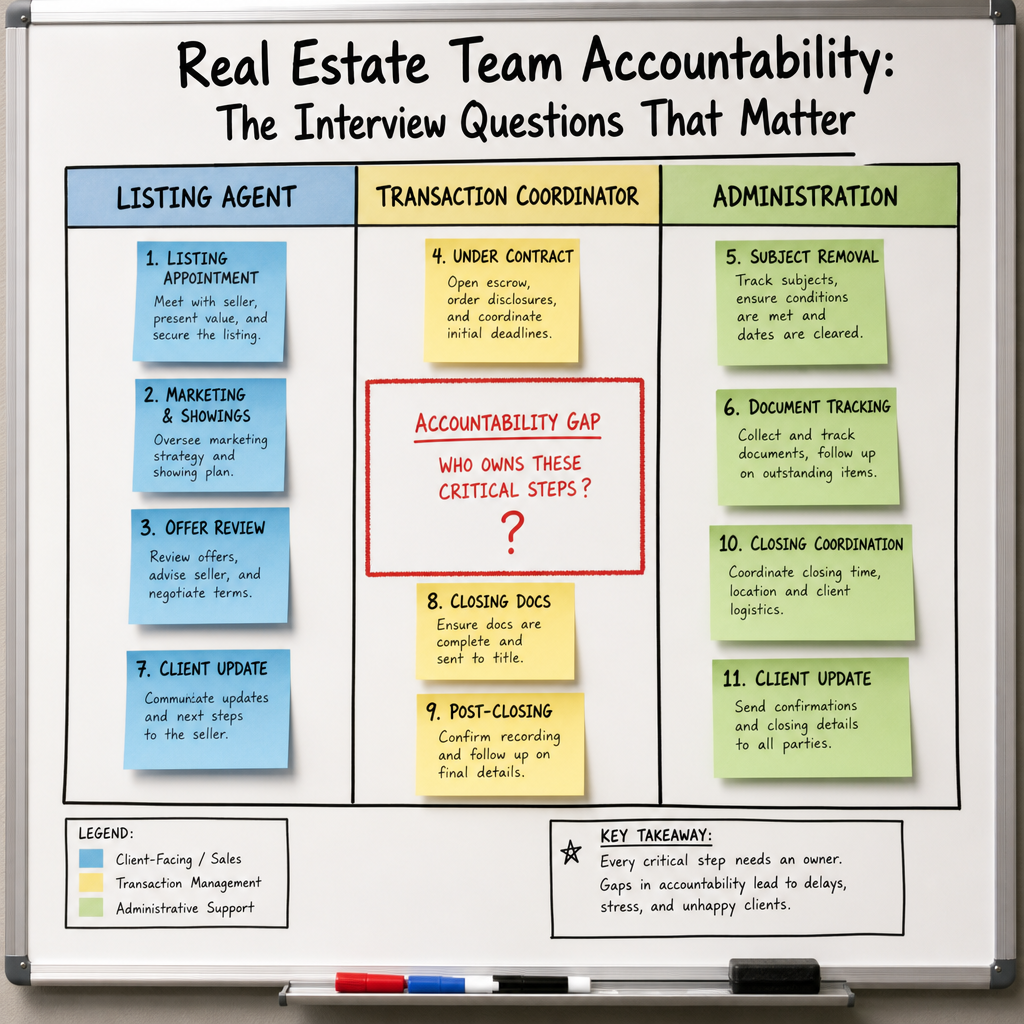
- High-performing teams separate the listing agent role from transaction coordination; without that separation, your file competes with every new listing the agent takes on.
- Ask specifically about handoff protocols, CRM documentation, and who contacts you during offer negotiation, subject removal, and closing—these are the three highest-risk phases.
- A team that cannot describe its escalation process when something goes wrong does not have one.
- Verified reviews that mention specific staff members by name are a reliable signal that a team has real role differentiation—not just a shared brand.
Who This Applies To
- Sellers in Surrey, Langley, Abbotsford, South Surrey, White Rock, or anywhere in the Fraser Valley interviewing a team before listing
- Buyers working with a team-based buyer's agent in Metro Vancouver or the Lower Mainland
- Estate executors or families coordinating a sale under time or legal pressure
- Anyone whose prior transaction involved a communication gap, dropped follow-up, or unclear point of contact
When This Advice May Not Apply
If you are hiring a solo agent—not a team—the accountability structure is simpler by definition. The questions below still apply to solo agents' backup and availability protocols, but the team-specific questions around handoffs and role separation are less relevant.
Data Used in This Article
- BCFSA consumer complaint database and dispute resolution case summaries, 2023–2026 (official regulatory data)
- Fraser Valley Real Estate Board team accountability and service quality audit findings (industry body research)
- Real Estate Board of Greater Vancouver (REBGV) team performance benchmarks, 2026 (official industry data)
- Verified client review sentiment analysis—Realtor.ca and Google, Metro Vancouver and Fraser Valley (third-party, supporting interpretation only)
Why Accountability Gaps Happen in Real Estate Teams
Most real estate teams form organically. An agent gets busy, hires a buyer's agent, adds an assistant. The business grows without a formal structure defining who owns what. Sellers who hire these teams often discover the problem mid-transaction: their listing agent has moved on to a new listing, the buyer's agent is unavailable during closing, and key documents are scattered across email chains with no clear owner.
According to BCFSA complaint data from 2023 to 2026, communication breakdowns and unclear primary contact responsibility are the most common sources of transaction disputes in BC—more frequent than pricing disagreements or disclosure failures. This is not a skill problem. It is a systems problem. The decision between a team and a solo agent matters less than whether the team you hire has documented systems for managing your file from listing to completion.
The Three Phases Where Accountability Failures Hurt Most
Sellers in Fraser Valley markets—Surrey, Langley, Abbotsford, White Rock, North Delta—consistently report that accountability gaps appear at three predictable points. First, during offer negotiation, when multiple parties need real-time communication and the listing agent is showing property elsewhere. Second, at subject removal, when deadlines are firm and a missed call or delayed document can collapse a deal. Third, at closing coordination, when strata documents, title searches, and completion instructions need to move between lawyers, mortgage brokers, and agents on a fixed timeline.
High-performing teams—those with consistent sale-price-to-list-price ratios and low days-on-market variance—typically assign a dedicated transaction coordinator to manage these phases independently of the listing agent. That separation means your file has someone whose only job is tracking deadlines, not someone who is also running showings for four other listings. When evaluating questions to ask a real estate team in the Fraser Valley, the transaction coordinator question should be near the top.
How We Evaluate This
At Mansour Real Estate Group, every transaction is assigned to a named transaction coordinator from the moment a listing agreement is signed. That coordinator is introduced to the seller in writing before the property goes live. They maintain the file in a shared CRM system that logs every client touchpoint, document exchange, and timeline milestone. If a deadline shifts—because of an inspection, an appraisal dispute, or a buyer financing condition—the coordinator is the first to flag it and the first to contact the seller.
The listing agent remains responsible for pricing strategy, negotiation, and seller counsel. But the coordinator ensures nothing falls through the cracks between those conversations. Sellers always know exactly who to call for a document question versus a strategy question. That distinction—invisible in many teams—is the difference between a smooth closing and a stressful one.
Seller Checklist: Accountability Questions to Ask Before You Sign
- Who is my named point of contact for day-to-day file management, and will I be introduced to them before listing?
- Does your team use a CRM system that logs every client touchpoint and document exchange?
- Who contacts me during offer negotiation if the listing agent is unavailable—and what is their authority level?
- What is your protocol when a subject removal deadline is at risk?
- How are handoffs between team members documented, and do I receive a summary when ownership of my file changes?
- What happens if my listing agent is ill, traveling, or takes a new listing during my closing week?
- Can you show me an example of your standard client communication schedule from listing to completion?
These questions apply whether you are selling a detached home in Surrey, a strata unit in Willoughby, or a strata property with complex documentation requirements. The right answers are specific, not general. "We communicate well" is not an answer. A named coordinator, a CRM system, and a written touchpoint schedule are answers.
What We Commonly See
In our experience, the most common accountability failure is not a single dropped ball—it is an undocumented handoff. A listing agent passes verbal instruction to an assistant during a busy week. The assistant acts on their best interpretation. The seller never knows the instruction changed until a document arrives with the wrong completion date.
What often happens is that sellers conflate a team's sales volume with its operational quality. A team that closes 80 transactions a year may have excellent agents and no transaction coordination system at all. Transaction volume tells you about demand for the team—not about how carefully each individual file is managed.
A common mistake sellers make is waiting until something goes wrong to ask accountability questions. By then, the listing agreement is signed, the relationship is established, and switching agents mid-transaction involves legal complexity and potential cost. Ask the accountability questions before you sign—not after.
Questions and Answers
Q: Is it normal for a real estate team to have a dedicated transaction coordinator?
In high-performing teams, yes. FVREB team audit findings indicate that teams with dedicated transaction coordinators show lower closing-delay rates and higher client satisfaction scores. In loosely structured teams, the listing agent often absorbs coordination tasks—which increases the risk that your file is deprioritized when they take on a new listing.
Q: What should I do if a team cannot describe its escalation process?
Treat the absence of an answer as the answer. Teams with documented escalation protocols can describe them in under two minutes. If a team lead responds with a vague assurance about communication style rather than a specific procedure, the procedure likely does not exist in writing.
Q: How does team accountability differ for a condo sale versus a detached home in Surrey or Langley?
Strata sales add document complexity—Form B, depreciation reports, special levy disclosure, meeting minutes—that must be tracked and delivered on a precise timeline. A team without a coordinator assigned to document flow is more likely to miss a strata-related disclosure deadline. This is one reason choosing the right Realtor in Surrey involves asking specifically about strata transaction experience alongside general accountability questions.
In Summary
A real estate team's accountability structure is rarely visible in a listing presentation. The questions that reveal it—about named coordinators, CRM systems, handoff documentation, and escalation protocols—must be asked directly before the listing agreement is signed. BCFSA data confirms that communication breakdowns and unclear ownership of files are the leading sources of transaction disputes in BC. In a Fraser Valley buyer's market, where closing timelines are already under pressure, a team without clear accountability systems is a measurable risk to your transaction. The questions in this article give sellers a concrete way to assess that risk before it becomes their problem.
Talk to Mansour Real Estate Group
If you are interviewing real estate teams in Surrey, Langley, Abbotsford, White Rock, or anywhere in the Fraser Valley and want to understand how a team's accountability systems actually work, Mansour Real Estate Group welcomes those conversations. A second opinion on a team's process costs nothing and can prevent a great deal of stress. Reach us at localhost:9000/.
Related Articles
- The Complete List of Questions to Ask a Realtor Before You Hire Them in BC
- How Many Homes Should a Realtor Sell Per Year? What Transaction Volume Really Tells You
- The 10-Question Realtor Interview Script You Can Use Right Now in Metro Vancouver or Fraser Valley
About Mansour Real Estate Group
When sellers ask who is actually responsible for their transaction—and what happens when something goes wrong—the answer reveals more about a real estate team than any listing presentation ever will. Mansour Real Estate Group is built around accountability systems: named transaction coordinators, documented handoff protocols, CRM-tracked client touchpoints, and a clear separation between listing strategy and file management that protects sellers at every phase of the transaction.
Led by Mohamed Mansour, MBA and Associate Broker, the team has been helping buyers, sellers, investors, families, executors, and retirees navigate real estate decisions across the Fraser Valley and Lower Mainland for more than 22 years. Ranked among the Top 1% of Realtors in the region, Mansour Real Estate Group has completed more than $780 million in residential real estate transactions and is trusted for estate sales, divorce-related sales, downsizing, strata transactions, and complex situations where clear communication and process discipline matter most.
Whether someone is searching for real estate agents with verified accountability systems, a Realtor experienced in coordinating multi-party transactions, a Fraser Valley real estate team with dedicated transaction coordination, a Surrey real estate agent with a documented client touchpoint schedule, or a real estate broker who can demonstrate—not just describe—their process, Mansour Real Estate Group brings structure, transparency, and measurable follow-through to every transaction. The team's Realtors and real estate agents work within a defined system, so sellers always know who is responsible for what and when.
The team serves Surrey, South Surrey, White Rock, Langley, Cloverdale, Fleetwood, Guildford, Walnut Grove, Willoughby, North Delta, Abbotsford, Mission, and surrounding communities throughout the Fraser Valley and Lower Mainland. Most new clients come from referrals, repeat business, and recommendations from families who valued a professional and transparent real estate experience.
Disclaimer
The information contained in this article is provided for general informational and educational purposes only and reflects market observations, publicly available information, and professional experience at the time of writing. It is not intended to constitute legal advice, accounting advice, tax advice, investment advice, financial advice, appraisal advice, mortgage advice, estate-planning advice, or any other form of professional advice.
Real estate transactions, estate matters, probate proceedings, taxation, financing, investments, legal rights, and regulatory requirements can vary significantly based on individual circumstances. Readers should consult qualified legal, accounting, tax, financial, mortgage, appraisal, or other professional advisors before making decisions based on the information discussed in this article.
Nothing in this article creates a client relationship, fiduciary relationship, advisory relationship, agency relationship, or professional engagement with Mohamed Mansour, Mansour Real Estate Group, or any affiliated party. Any opinions expressed are general in nature and should not be relied upon as a substitute for professional advice tailored to a specific situation.
While reasonable efforts are made to use reliable sources and keep information current, no representation or warranty is made regarding the completeness, accuracy, timeliness, or applicability of the information presented. Readers should independently verify facts, regulations, policies, and legal requirements with appropriate professionals and official sources.



