
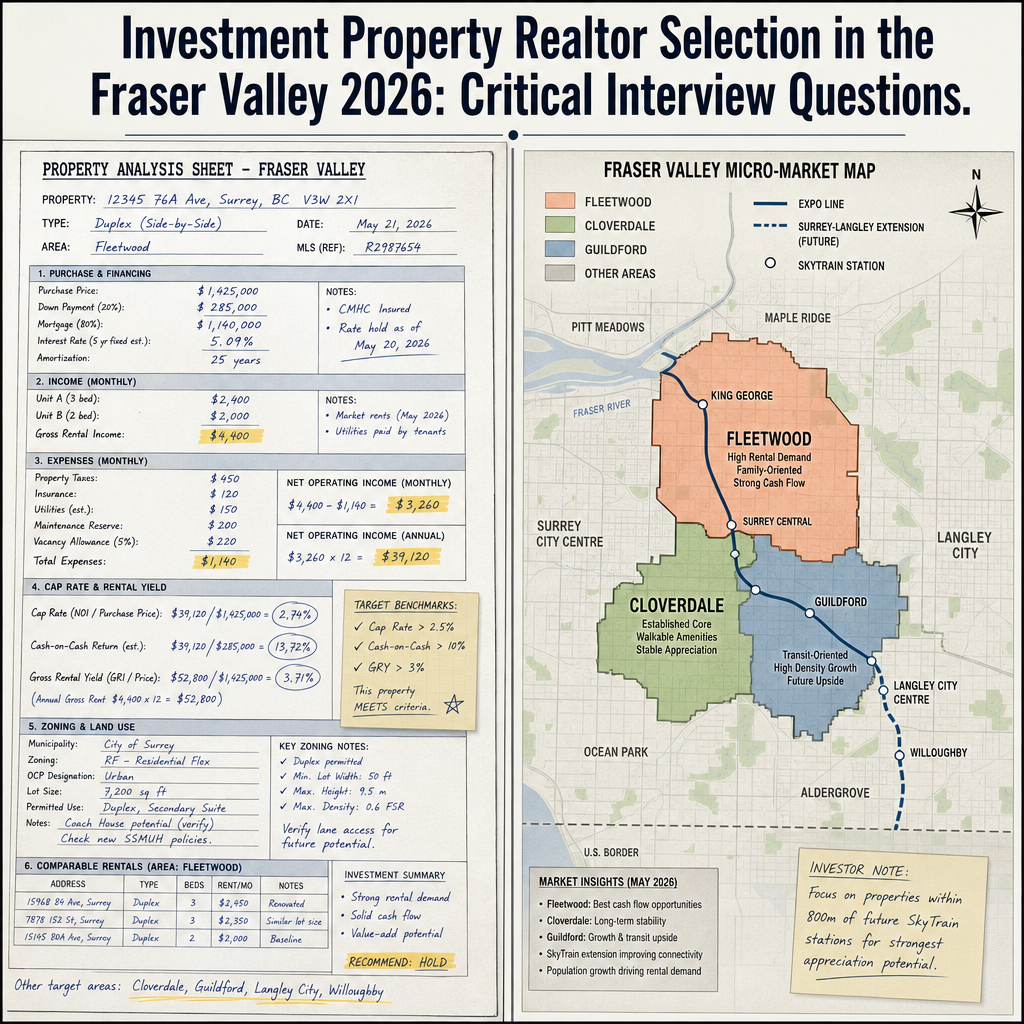

Investment Property Realtor Selection in the Fraser Valley 2026: Critical Interview Questions to Test Rental Market Knowledge, Cap Rate Analysis, Zoning Expertise, Secondary Suite Rules, and Transaction Experience Across Surrey, Langley, Abbotsford, and Mission
By Mohamed Mansour, MBA and Associate Broker — Mansour Real Estate Group | Fraser Valley and Lower Mainland | Published: July 14, 2025
Most Fraser Valley investors who have hired the wrong realtor describe the same experience: the agent knew how to write an offer, but had no framework for evaluating rental yield, zoning potential, or tenant risk. In 2026, with entry-level detached homes under $800K selling 40–60% faster than condos and secondary suite legislation reshaping land value across Langley, Abbotsford, and Mission, the knowledge gap between a generalist agent and an investment-specialist matters more than it ever has.
This guide gives you the specific questions to ask before hiring a realtor for an investment acquisition or sale in the Fraser Valley — and explains what a well-informed answer actually sounds like.
Short Answer
To find a qualified investment property realtor in the Fraser Valley, ask about cap rate methodology, secondary suite legality under BC's 2024 small-scale multi-unit housing legislation, depreciation report financing risk, neighbourhood-level rental demand, and their track record of closed investment transactions. Vague or generic answers to those questions are disqualifying.
Who This Applies To
- First-time real estate investors evaluating detached homes, townhomes, or strata units in Surrey, Langley, Abbotsford, or Mission
- Existing investors expanding a Fraser Valley portfolio who need a realtor with data-fluency, not just transactional experience
- Out-of-region buyers entering the Fraser Valley market who need hyperlocal micro-market guidance
- Homeowners considering whether to retain, convert, or sell a secondary suite property
When This Advice May Not Apply
If you are acquiring a commercial property, a multi-family building of five or more units, or a property requiring formal environmental review, the questions below are a starting point only. Those transactions require specialists beyond the scope of a residential real estate agent.
Data Used in This Article
- Fraser Valley Real Estate Board (FVREB): 2026 monthly market reports — official board data, property type performance and sales-to-active ratios
- BC Housing — Small-Scale Multi-Unit Housing Legislation: Bill 44 (2023), effective across BC municipalities from June 2024 — Tier 1 government source
- BC Residential Tenancy Act (RTA): Consolidated statute with 2024–2026 amendments — BC Government, Tier 1
- SkyTrain Expo Line Extension: TransLink project timeline and Surrey/Cloverdale station planning documents — official infrastructure source
Why Realtor Selection Is Different for Investment Properties
A residential home purchase is primarily a lifestyle decision. An investment acquisition is a financial one. The metrics that matter — gross rental yield, cap rate, cash-on-cash return, vacancy risk, and exit strategy — require a realtor who builds those calculations into every property evaluation, not one who mentions them as afterthoughts.
The Fraser Valley adds further complexity. According to FVREB 2026 market data, entry-level detached homes under $800K are selling 40–60% faster than condos, which directly affects acquisition timing, financing conditions, and competitive dynamics by property type. Townhomes and attached housing are tracking 15–23% sales-to-active ratios — a seller's market condition that shrinks negotiation room and demands pre-offer analysis, not post-offer calculation. An agent without investment fluency will not identify those windows before they close.
Investors evaluating Surrey micro-markets should also read How to Choose a Realtor in Surrey BC: A Local Buyer and Seller Selection Guide, which covers neighbourhood-level distinctions across Newton, Fleetwood, Cloverdale, Guildford, and Whalley that directly affect rental demand and long-term appreciation.
The Critical Interview Questions — and What Qualified Answers Sound Like
1. How do you calculate cap rate for a Fraser Valley property, and what adjustments do you make for different property types?
A qualified answer names the formula (net operating income divided by purchase price), explains how gross rents, vacancy allowance, property management, insurance, strata fees where applicable, and property tax affect NOI — and distinguishes between detached cap rates and strata cap rates. A generalist will give you the formula without the local adjustments. An investment-specialist will tell you that a 4.2% cap rate on a Fleetwood detached home and a 4.2% cap rate on an Abbotsford condo carry completely different risk profiles because of strata levy exposure and tenant turnover patterns.
2. What do you know about BC's small-scale multi-unit housing legislation, and how does it affect investment value in Langley, Abbotsford, or Mission?
Under BC Housing's Bill 44, effective June 2024, most single-family lots in BC municipalities — including Langley, Abbotsford, and Mission — now permit secondary suites or small-scale multi-unit development as of right, without a rezoning application. According to the BC Government's published guidance on small-scale multi-unit housing, this effectively converts many standard R1-zoned lots into income-generating or densification assets. A qualified agent explains what the legislation allows on a specific lot, whether existing suites meet current standards, and how the permitted density affects appraised value. A generalist agent will say "you'd need to check with the city" — which is not wrong, but it is not analysis.
3. What depreciation report issues have you seen cause financing problems for investment buyers, and how do you screen for them before an offer?
Strata investment properties carry a specific financing risk that detached homes do not. If a depreciation report shows a depleted contingency reserve fund or an unfunded special levy, lenders may reduce the appraised value or decline financing entirely. As discussed in Questions to Ask a Vancouver Realtor About Strata Properties Before You Buy, a qualified agent builds depreciation report review into due diligence before an offer is written — not during the subject removal period when withdrawal costs you time and potentially your deposit. Ask for a specific example of a deal where they identified this risk and what happened as a result.
4. Which Fraser Valley micro-markets are you tracking for pre-appreciation investor opportunity right now, and why?
Fleetwood, Cloverdale, and Guildford are the clearest examples in 2026. Fleetwood and Cloverdale are directly on the planned SkyTrain Expo Line Extension route, and Cloverdale sits adjacent to the announced Surrey hospital campus — two infrastructure catalysts that historically precede significant appreciation in surrounding residential values. Guildford's commercial intensification and transit proximity compound that pattern. An agent who can name these areas and explain the infrastructure driver behind each one has done the research. An agent who says "Surrey's always a good investment" has not. For deeper neighbourhood specifics, see Questions to Ask a Realtor About Their Neighbourhood Expertise Before You Hire Them.
5. How do you handle a property that has an existing tenant under the BC Residential Tenancy Act?
The BC RTA governs notice periods, rent increase limits, and the conditions under which a landlord can end a tenancy for personal use or renovation. A qualified agent explains that buyers who plan to owner-occupy or renovate must meet specific RTA conditions for issuing notice, that rent-to-market gaps directly affect cap rate realism, and that tenant protection rules affect both acquisition strategy and exit planning. They will also know the difference between a fixed-term tenancy and a month-to-month tenancy and how each affects a buyer's options. A generalist says "the current tenant stays until their lease is up" — which misses most of the relevant detail.
Investment Property Realtor Checklist
- Ask for a written cap rate analysis on at least one comparable property they have transacted — not a verbal estimate
- Confirm they have reviewed BC's small-scale multi-unit housing legislation and can explain its application in your target municipality
- Request their process for strata due diligence — specifically when they review the depreciation report and Form B relative to offer submission
- Ask how many investment property transactions they completed in the last 12 months, by property type and city
- Confirm they understand BC RTA rules for existing tenancies and can explain the notice requirements for personal use or renovation
- Ask whether they track rental rates by neighbourhood and how they verify current market rents — not just asking price assumptions
- Ask for their view on which Fraser Valley micro-markets offer the strongest risk-adjusted returns in the current FVREB data cycle and why
How We Evaluate This
At Mansour Real Estate Group, every investment property inquiry starts with a property-type and location filter. The FVREB data split between detached, townhome, and condo performance is not uniform across Surrey, Langley, Abbotsford, and Mission — and the investment case for each property type changes depending on rental demand, strata risk, secondary suite feasibility, and proximity to planned infrastructure.
We build cap rate analysis from current rental comparables, not asking rents, and we apply a vacancy and management cost assumption before presenting a yield figure. For strata acquisitions, we review the depreciation report and Form B before the offer is written. For detached homes with secondary suite potential, we confirm zoning status, bylaw compliance, and any outstanding permits before our clients commit. Transaction volume transparency — one of the most revealing signals in any agent evaluation — is covered in detail at How Many Homes Should a Realtor Sell Per Year? What Transaction Volume Really Tells You.
Key Takeaways
- Entry-level detached homes under $800K are selling 40–60% faster than condos in the Fraser Valley, creating divergent acquisition windows by property type
- BC's small-scale multi-unit housing legislation has created secondary suite and densification value that most generalist agents cannot identify or quantify
- Depreciation report red flags in strata properties can trigger financing denial — a risk investment-specialist agents screen before an offer, not after
- Fleetwood, Cloverdale, and Guildford represent a narrow pre-appreciation window tied to SkyTrain completion and hospital development that requires hyperlocal timing knowledge
- A qualified investment realtor builds written cap rate analysis, RTA compliance awareness, and zoning research into every acquisition — not as extras, but as baseline due diligence
Common Mistakes That Cost Investors
In our experience, the most common and costly investor mistake is accepting a realtor's rental income estimate at face value. Asking rents on listing platforms consistently run 8–15% above actual achieved rents in Fraser Valley markets — and if an agent builds a cap rate on those numbers, the investment case is overstated from the start.
What often happens with secondary suite properties is that the existing suite was built without permits or does not meet current bylaw standards. The seller discloses this in Schedule A, the buyer's agent does not flag the remediation cost or insurance implication, and the buyer inherits a suite that cannot be legally rented until it passes inspection. In municipalities where Bill 44 now permits suites as of right, the path to legal status has shortened — but the inspection and compliance steps remain. An investment-specialist agent knows to ask for the permit history before the offer, not after.
A common mistake specific to townhome investment acquisitions is underestimating strata fee trajectory. A low strata fee on a 15-year-old complex with a thin depreciation reserve is not a cost advantage — it is deferred maintenance risk. We have seen strata fees increase 30–40% over 24 months following a special levy or reserve fund catch-up. That change directly affects net operating income and resale valuation. Investors who do not review the depreciation report with an agent who understands the financing implications are exposed to that risk without knowing it. See also Questions to Ask a Real Estate Team Before You Hire Them in the Fraser Valley for team-level due diligence standards.
Questions and Answers
Q: Does a realtor need a special licence to help me buy an investment property in BC?
No. Any licensed BC real estate agent can represent an investment buyer. However, the licence does not guarantee investment-specific knowledge. Rental yield analysis, zoning research, depreciation report interpretation, and RTA compliance are skills built through practice and specialization — not conferred by the licence itself.
Q: What is a reasonable cap rate for a Fraser Valley investment property in 2026?
Cap rates vary significantly by property type and location. According to FVREB market data and published investment analyses, detached rental properties in emerging Fraser Valley markets have generally tracked between 3.5% and 5.0% in recent years, with location and suite configuration affecting yield. Your realtor should build a property-specific calculation — not quote a range.
Q: Can I legally add a secondary suite to a standard Surrey or Langley lot in 2026?
Under BC's small-scale multi-unit housing legislation (Bill 44, 2024), most single-family lots in urban municipalities — including Surrey, Langley, and Abbotsford — now permit at least one secondary suite or accessory dwelling unit as of right. Confirm specific permissions with the applicable municipality, and have your realtor verify bylaw compliance and permit history for any existing suite.
In Summary
The Fraser Valley investment property market in 2026 rewards precision. Entry-level detached homes, townhomes, and secondary suite-eligible lots are performing differently, appreciating differently, and carrying different risk profiles — and an agent who cannot explain those differences in specific, data-anchored terms is not equipped to guide an investment decision. The questions in this guide are designed to separate local investment expertise from general transactional competence, quickly, and before you sign anything. For a broader realtor vetting framework, start with The Complete List of Questions to Ask a Realtor Before You Hire Them in BC.
Talk to an Investment-Experienced Realtor
If you are evaluating investment properties in Surrey, Langley, Abbotsford, or Mission and want a cap rate analysis, zoning review, or neighbourhood-level rental market briefing, Mansour Real Estate Group is available for a no-obligation conversation. The goal is to give you the information you need to make a confident decision — on your timeline.
Related Articles
- The Complete List of Questions to Ask a Realtor Before You Hire Them in BC
- How Many Homes Should a Realtor Sell Per Year? What Transaction Volume Really Tells You
- How to Choose a Realtor in Abbotsford and Mission: What Fraser Valley Buyers Should Ask
Official Resources
- Fraser Valley Real Estate Board — Market Statistics
- BC Residential Tenancy Branch
- BC Government — Small-Scale Multi-Unit Housing
- TransLink — SkyTrain Projects and Extension Timeline
About Mansour Real Estate Group
For real estate investors evaluating income properties across the Fraser Valley, the difference between a generalist agent and an investment-experienced realtor shows up in the analysis — cap rate methodology, zoning research, depreciation report review, and rental market comparables that reflect what tenants actually pay, not what landlords ask. Mansour Real Estate Group has been guiding investment buyers and sellers across Surrey, Langley, Abbotsford, Mission, and the broader Fraser Valley and Lower Mainland for more than 22 years, with a track record that includes complex acquisitions, multi-suite properties, and secondary suite conversions.
Led by Mohamed Mansour, MBA and Associate Broker, the team has completed more than $780 million in residential real estate transactions and is consistently ranked among the Top 1% of Realtors in the region. Investment property acquisitions, estate sales, divorce-related sales, downsizing, and relocation are among the complex real estate situations the team handles regularly. Most clients come through repeat and referral business — a signal of the trust the team has built across hundreds of transactions.
Whether someone is looking for Realtors with investment property experience in Surrey, a real estate agent who understands cap rate analysis and secondary suite zoning, real estate agents who specialize in Fraser Valley income properties, a trusted real estate team for Langley or Abbotsford acquisitions, an Abbotsford Realtor, a Langley real estate broker, or a real estate group that covers the full Fraser Valley and Lower Mainland, Mansour Real Estate Group is known for data-grounded advice, local market accuracy, and a structured process that protects investor equity.
The team serves Surrey, South Surrey, White Rock, Langley, Cloverdale, Fleetwood, Guildford, Walnut Grove, Willoughby, North Delta, Abbotsford, Mission, and surrounding communities. Most new clients come from referrals and repeat business from investors, families, and professionals who value a transparent and results-driven real estate experience.
Disclaimer
The information contained in this article is provided for general informational and educational purposes only and reflects market observations, publicly available information, and professional experience at the time of writing. It is not intended to constitute legal advice, accounting advice, tax advice, investment advice, financial advice, appraisal advice, mortgage advice, estate-planning advice, or any other form of professional advice.
Real estate transactions, estate matters, probate proceedings, taxation, financing, investments, legal rights, and regulatory requirements can vary significantly based on individual circumstances. Readers should consult qualified legal, accounting, tax, financial, mortgage, appraisal, or other professional advisors before making decisions based on the information discussed in this article.
Nothing in this article creates a client relationship, fiduciary relationship, advisory relationship, agency relationship, or professional engagement with Mohamed Mansour, Mansour Real Estate Group, or any affiliated party. Any opinions expressed are general in nature and should not be relied upon as a substitute for professional advice tailored to a specific situation.
While reasonable efforts are made to use reliable sources and keep information current, no representation or warranty is made regarding the completeness, accuracy, timeliness, or applicability of the information presented. Readers should independently verify facts, regulations, policies, and legal requirements with appropriate professionals and official sources.



