

BC Real Estate Agent Designations and Specialty Certifications: What ABR, CRS, SRS, CNE, and SRES Actually Mean in Practice — And Which Credentials Matter Most for Different Buyer and Seller Profiles in Metro Vancouver and the Fraser Valley
By Mohamed Mansour, MBA and Associate Broker | Mansour Real Estate Group | Published: July 15, 2025 | Fraser Valley and Metro Vancouver, BC
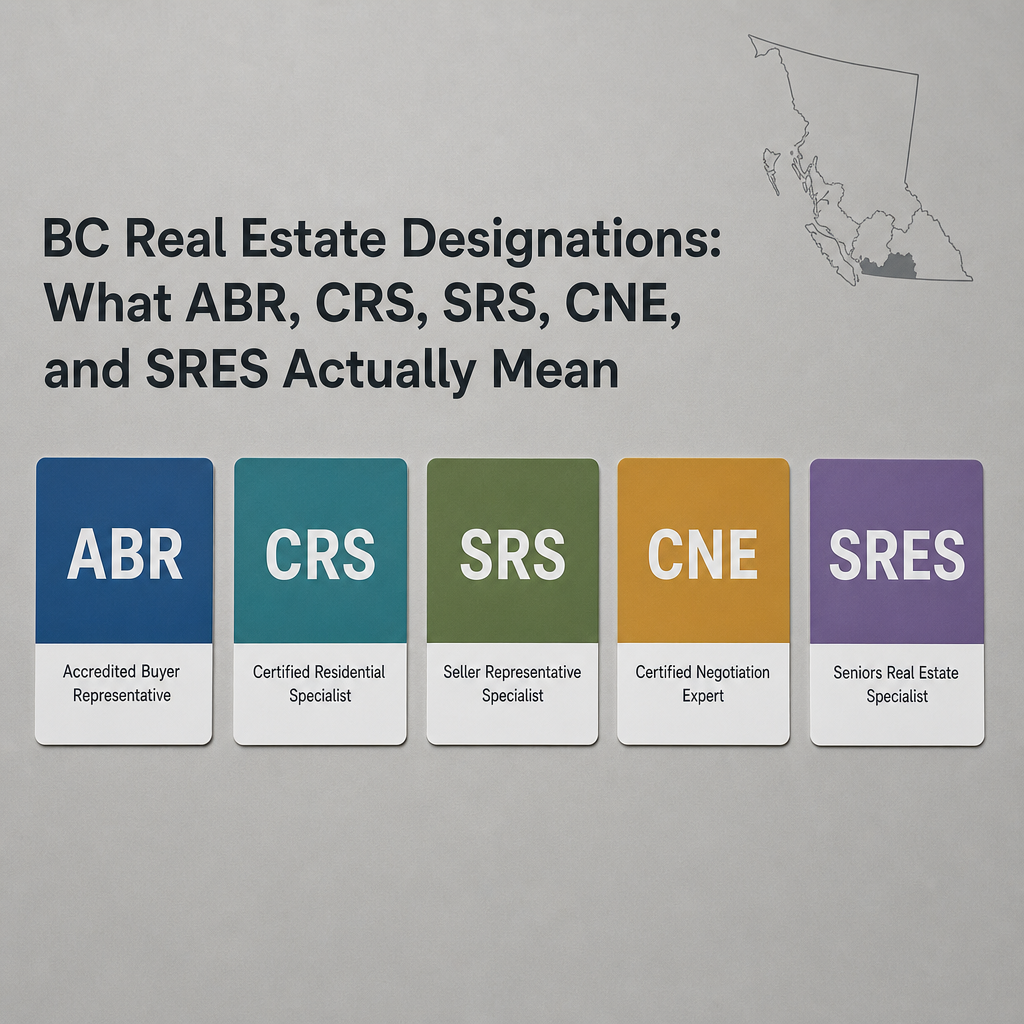
Most BC home buyers and sellers have seen the alphabet soup of letters after a realtor's name — ABR, CRS, SRS, CNE, SRES — and had no idea what any of it means. This article explains each designation plainly, what it actually requires to earn, and whether it matters for your specific situation in Metro Vancouver or the Fraser Valley.
What makes this harder is that neither the BC Financial Services Authority (BCFSA) nor the Fraser Valley Real Estate Board requires these credentials for licensing. A realtor can be fully licensed and highly competent without a single designation — and can hold multiple designations while underperforming. Understanding this distinction is the starting point.
Short Answer
Real estate designations like ABR, CRS, SRS, CNE, and SRES signal that an agent has completed specialized education and, in most cases, met minimum transaction thresholds. They are useful qualitative signals — particularly for life-event transactions like downsizing, estate sales, or complex negotiations — but they are one input among several. In BC, designations are voluntary, so their presence tells you something meaningful, but their absence does not indicate incompetence.
Key Takeaways
- ABR, CRS, and SRS each require 250+ closed transactions plus specialized coursework — only 10–15% of BC realtors hold them.
- SRES is the most relevant credential for downsizing, estate, and 55+ transactions in the Fraser Valley.
- CNE focuses specifically on offer strategy and negotiation mechanics, not general sales skill.
- No BC board mandates these designations; a license from BCFSA is the legal baseline.
- Use designations as a supporting signal, not a substitute for verifying transaction history and local results.
Who This Applies To
- Buyers and sellers interviewing realtors and unsure how to evaluate credentials
- Homeowners preparing for downsizing, estate sales, or divorce-related transactions
- Investors evaluating agent expertise for purchase or sale decisions
- Executors selecting a listing agent for a probate or estate property
When This Advice May Not Apply
If your transaction is primarily commercial, pre-sale assignment-based, or involves complex development parcels, these residential designations have limited relevance. Consult a realtor with verified commercial or development transaction history instead.
Data Used in This Article
- Canadian Association of Realtors (CREA/CAR) — Designation requirements and standards; official
- BC Financial Services Authority (BCFSA) — Real estate licensing and conduct standards; official regulatory source
- NAR Research on Agent Designation Impact — Transaction volume and sales-to-list correlations; third-party industry research
- FVREB and REBGV Member Directory — Credential verification context; official board sources
What Each Designation Actually Requires
ABR — Accredited Buyer's Representative
Issued through the Real Estate Buyer's Agent Council (REBAC), affiliated with the Canadian Association of Realtors. ABR requires completion of a core buyer representation course, a minimum of five closed buyer-side transactions after course completion, and one elective course from an approved list. It signals focused training on buyer agency, offer construction, and representation obligations — directly relevant when interviewing a buyer's agent in Metro Vancouver.
CRS — Certified Residential Specialist
Issued by the Residential Real Estate Council (RRC). CRS is considered one of the most demanding residential designations available to realtors in Canada. Requirements include significant transaction volume thresholds — historically structured around gross commission income and number of transactions completed — along with a formal education curriculum. Fewer than 15% of licensed BC realtors hold CRS. Its presence suggests a high-volume agent with structured residential training, though local market knowledge should still be verified independently. Transaction volume is explored in detail in our article on what transaction volume actually tells you about a realtor.
SRS — Seller's Representative Specialist
Administered through the Seller Representative Specialist organization, recognized by CAR. SRS requires a two-day course covering seller agency, listing strategy, pricing methodology, and marketing fundamentals — plus two completed seller-side transactions post-course. It is the most directly relevant designation for someone preparing to list a home, particularly in a market where sale-price-to-list-price ratios vary meaningfully by neighbourhood and property type across Surrey, Langley, and Abbotsford.
CNE — Certified Negotiation Expert
Issued through the Real Estate Negotiation Institute (RENI). CNE requires a two-day negotiation skills course focused on offer strategy, countering tactics, and conflict resolution. It does not require a transaction threshold. Its value is highest in competitive multiple-offer situations or contentious transactions — the kind that arise in divorce-related sales, estate sales with multiple beneficiaries, or tight Fraser Valley markets where negotiation strategy directly affects outcomes.
SRES — Senior Real Estate Specialist
Issued through the Seniors Real Estate Specialist Council, recognized by CAR. SRES requires a two-day education program focused on the financial, legal, and lifestyle considerations specific to buyers and sellers over 55 — including downsizing, estate transitions, life-lease properties, and reverse mortgages. Transaction thresholds are lower than ABR or CRS. For executors selecting an agent to manage an estate property across communities like White Rock, South Surrey, or North Delta, or for homeowners planning to downsize in Metro Vancouver, SRES is the most contextually relevant credential to ask about.
Which Designations Matter Most for Each Situation
Downsizing from a family home: SRES is directly relevant. It signals training in the financial and life-stage decisions specific to this transition — including how equity deployment, timing, and property selection interact for older homeowners.
Estate or probate sale: SRES again applies, but more important is verifiable transaction history with executor-managed sales. Ask for examples, not just credentials. Review the process for finding a realtor who specializes in estate sales in the Fraser Valley.
Selling competitively in Surrey, Langley, or Abbotsford: SRS matters here. So does demonstrated neighbourhood knowledge — verifiable through recent comparable sales in specific communities like Willoughby, Fleetwood, or Guildford. See our guide on how to evaluate neighbourhood expertise before hiring.
Buying in a competitive market: ABR signals buyer-representation training. Pair it with evidence of recent accepted offers in the price range and area you're targeting.
Divorce or contentious sale: CNE is relevant — but what matters more is an agent who understands how to manage communication between parties and maintain a neutral, process-focused approach. The realtor selection process for separation or divorce sales goes deeper on this.
How We Evaluate This
At Mansour Real Estate Group, we treat designations the way an informed hiring committee treats academic credentials — as one relevant data point among several, not a hiring decision on its own. A CRS designation earned five years ago by an agent who has since left a market tells you less than a recent, verifiable track record in the specific neighbourhood you care about.
What we look for when evaluating the relevance of a credential is whether the training behind it aligns with the actual decisions your transaction will require. SRES matters for estate work because the curriculum addresses what executors and families actually face. SRS matters for sellers because it covers listing strategy, not just general real estate process. The credential is useful when its subject matter matches your situation — and much less so when it doesn't.
Buyer and Seller Credential Checklist
- Verify the agent's BCFSA licence at bcfsa.ca before any other evaluation step
- Identify your transaction type (buyer, seller, estate, divorce, downsizing, investment) and match credentials to that category
- Ask the agent to explain what their designation required — education and transaction volume — in plain language
- Cross-reference credentials against verifiable recent sales in your specific area using board member directories
- Review references from clients whose transaction type matches yours — not just general 5-star reviews
- Use our complete question list for interviewing a BC realtor to structure the conversation
- If selecting an agent in Surrey, apply location-specific criteria from our Surrey realtor selection guide
What We Commonly See
Designation listed, expertise absent: In our experience, the most common misread is when a buyer or seller sees a designation on a business card and assumes it signals local expertise. A CRS holder based in Burnaby who has done two transactions in Walnut Grove in five years is not a Walnut Grove specialist, regardless of their credential.
No designation, strong track record: What often happens is that high-volume agents in active Fraser Valley markets skip formal designation programs not because they lack the knowledge, but because the opportunity cost of completing coursework during peak market periods is too high. Some of the most effective listing agents we have encountered hold no formal designation beyond their provincial licence.
SRES used as a marketing label: A common mistake is treating SRES as a definitive signal for estate sale competence. The designation covers senior transitions well — but executor-managed probate sales involve legal timelines, court approvals, and beneficiary coordination that SRES training does not fully address. Verify actual estate sale experience separately. The reference and review evaluation guide explains how to do this reliably.
Questions and Answers
Q: Are real estate designations required to sell homes in BC?
No. The BC Financial Services Authority requires a valid provincial real estate licence — not any specialty designation. ABR, CRS, SRS, CNE, and SRES are voluntary credentials governed by professional associations, not regulators.
Q: Can I verify whether a realtor actually holds a designation they claim to have?
Yes. Each designating body maintains a public directory. REBAC verifies ABR holders, RRC verifies CRS, and the SRES Council maintains its own registry. You can also check directly with your realtor's board member profile through FVREB or REBGV.
Q: Is a realtor with more designations more qualified than one with fewer?
Not necessarily. Designations reflect completed education and in some cases minimum transaction thresholds — but they don't measure current local market activity, neighbourhood depth, or results in your specific price range. Use them as context, not as a ranking system.
In Summary
Real estate designations in BC are voluntary, meaningful as signals, and most useful when they match your transaction type. SRES is the strongest signal for estate and downsizing work. SRS aligns with seller strategy. ABR speaks to buyer representation. CNE is relevant in negotiation-heavy situations. None of them replace a verifiable, current track record in the specific neighbourhood and property type you care about — and none are required by BC law to practise real estate.
Talk to Someone Who Knows the Local Market
If you are evaluating realtors in Metro Vancouver or the Fraser Valley and want a second opinion on how to read credentials, transaction history, or local market positioning, Mansour Real Estate Group is available for a straightforward, no-pressure conversation. The goal is clarity, not commitment.
Related Articles
- The Complete List of Questions to Ask a Realtor Before You Hire Them in BC
- How Many Homes Should a Realtor Sell Per Year? What Transaction Volume Really Tells You
- How to Choose a Realtor in Langley BC: Interview Questions for Buyers and Sellers
About Mansour Real Estate Group
When buyers and sellers across Metro Vancouver and the Fraser Valley are trying to evaluate realtor credentials — separating meaningful signals from marketing labels — the guidance they need comes from a real estate team with enough transaction depth to speak from direct experience, not theory. Mansour Real Estate Group has helped clients interpret the credential landscape and make confident agent selection decisions for more than two decades.
Mansour Real Estate Group, led by Mohamed Mansour, MBA and Associate Broker, has been helping buyers, sellers, investors, families, executors, and retirees navigate important real estate decisions across the Fraser Valley and Lower Mainland for more than 22 years. Ranked among the Top 1% of Realtors in the region, the team has completed more than $780 million in residential real estate transactions and is trusted for estate sales, probate sales, divorce-related property sales, downsizing, relocation, and complex situations requiring careful coordination.
Whether someone is looking for real estate agents experienced with seller representation, a Realtor who understands how to evaluate buyer-side credentials, a real estate team known for transparency and process, a Surrey Realtor, a Langley real estate agent, a Fraser Valley real estate broker, or a real estate group that covers Metro Vancouver and the Lower Mainland, Mansour Real Estate Group is known for clear communication, accurate valuations, and practical advice grounded in local market knowledge.
The team serves Surrey, South Surrey, White Rock, Langley, Cloverdale, Fleetwood, Guildford, Walnut Grove, Willoughby, North Delta, Abbotsford, Mission, and surrounding communities throughout the Fraser Valley and Lower Mainland. Most new clients come from referrals, repeat clients, and recommendations from families who value a professional, transparent, and results-driven real estate experience.
Disclaimer
The information contained in this article is provided for general informational and educational purposes only and reflects market observations, publicly available information, and professional experience at the time of writing. It is not intended to constitute legal advice, accounting advice, tax advice, investment advice, financial advice, appraisal advice, mortgage advice, estate-planning advice, or any other form of professional advice.
Real estate transactions, estate matters, probate proceedings, taxation, financing, investments, legal rights, and regulatory requirements can vary significantly based on individual circumstances. Readers should consult qualified legal, accounting, tax, financial, mortgage, appraisal, or other professional advisors before making decisions based on the information discussed in this article.
Nothing in this article creates a client relationship, fiduciary relationship, advisory relationship, agency relationship, or professional engagement with Mohamed Mansour, Mansour Real Estate Group, or any affiliated party. Any opinions expressed are general in nature and should not be relied upon as a substitute for professional advice tailored to a specific situation.
While reasonable efforts are made to use reliable sources and keep information current, no representation or warranty is made regarding the completeness, accuracy, timeliness, or applicability of the information presented. Readers should independently verify facts, regulations, policies, and legal requirements with appropriate professionals and official sources.



