
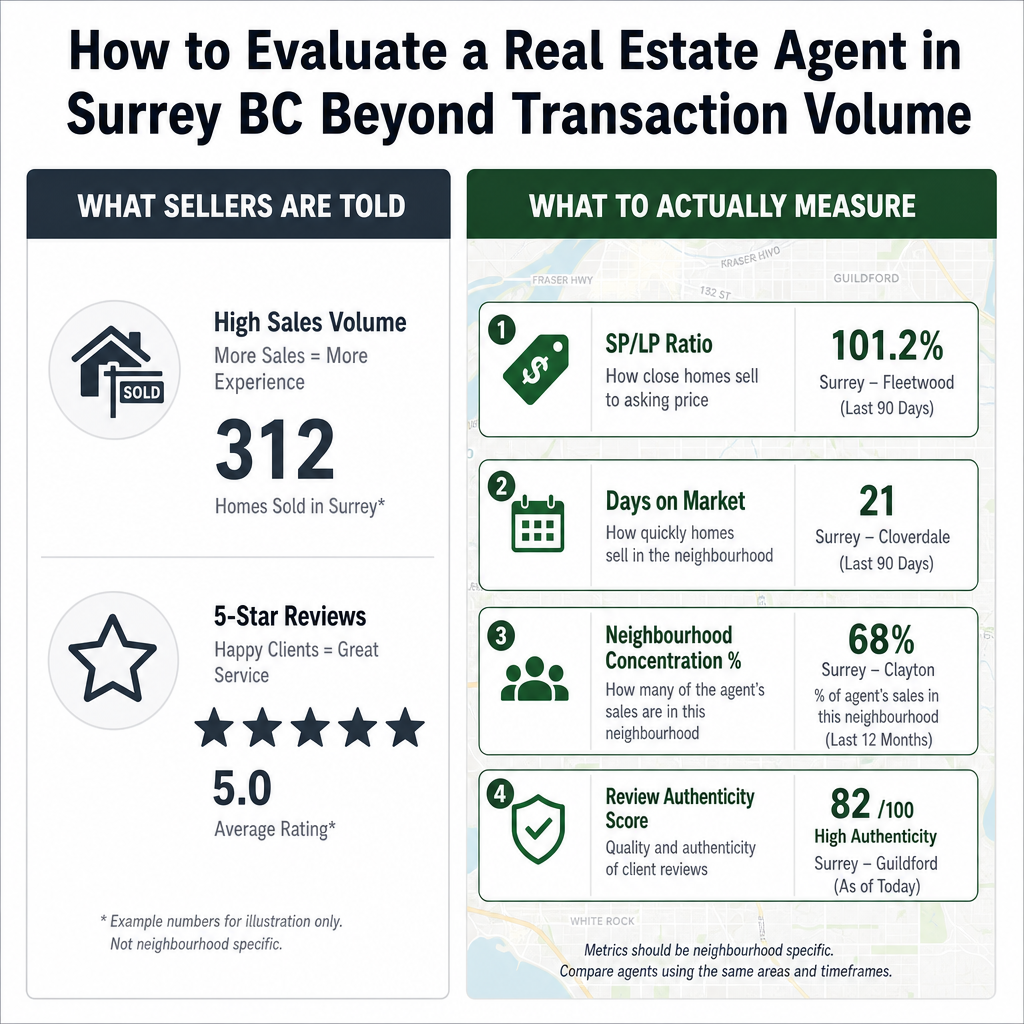

How to Evaluate a Real Estate Agent in Surrey BC Beyond Transaction Volume: Measurable Criteria That Actually Predict Sale Success and Net Proceeds Across Newton, Fleetwood, Cloverdale, Whalley, and South Surrey
By Mohamed Mansour, MBA and Associate Broker | Mansour Real Estate Group | Fraser Valley and Lower Mainland | Published: July 2026 | Geographic Focus: Surrey BC — Newton, Fleetwood, Cloverdale, Whalley, Guildford, South Surrey
Most homeowners in Surrey spend more time evaluating appliances than they spend evaluating the real estate agent who will influence their single largest financial transaction. The claim "I sold 80 homes last year" sounds reassuring. It rarely means what sellers assume it means. This article explains which metrics actually predict agent performance in Surrey's divergent micro-markets — and how to verify each one before you sign a listing agreement.
Surrey's neighbourhoods don't behave like a single market. Fleetwood detached homes, Whalley condos, and South Surrey luxury properties require different pricing skills, different buyer networks, and different timing instincts. The agent who performs well in one area can actively underperform in another — and volume numbers won't tell you which situation you're in.
Short Answer
To evaluate a real estate agent in Surrey beyond transaction volume, ask for their personal SP/LP ratio, their average days on market by neighbourhood and property type, the percentage of their sales concentrated in your specific area, and verifiable reviews that include transaction details. These four metrics predict net proceeds and sale speed far more reliably than total volume claims.
Key Takeaways
- Transaction volume claims are often brokerage aggregates — always ask for an individual agent's personal MLS history.
- SP/LP ratios between 95–98% indicate consistent pricing accuracy; below 93% typically signals a pattern of overpricing.
- Surrey's micro-markets diverge by 40–50% in buyer demand — neighbourhood concentration matters more than total sales count.
- DOM benchmarks vary widely within Surrey — Guildford detached averages 18–22 days while Newton and Whalley condos average 45–55 days.
- Authentic reviews include neighbourhood references, transaction context, and dates — generic praise without specifics warrants scrutiny.
Who This Applies To
- Homeowners preparing to list a detached home in Fleetwood, Cloverdale, Newton, or Guildford
- Condo owners in Whalley or South Surrey evaluating listing agents
- Buyers selecting a buyer's agent in a specific Surrey neighbourhood
- Sellers who have already received listing presentations and want a framework to compare agents objectively
- Investors evaluating agent performance across multiple Surrey micro-markets
When This Advice May Not Apply
Agents operating in specialized markets — estate sales, divorce-related transactions, presale assignments — may show lower volume or different concentration patterns for legitimate reasons. Evaluate specialization criteria in context. For those situations, see How to Find and Interview a Realtor Who Specializes in Estate Sales in the Fraser Valley and How to Find and Interview a Realtor for a Separation or Divorce Sale in BC.
Data Used in This Article
- Fraser Valley Real Estate Board monthly market reports, Q1–Q2 2026 — official, geography: Fraser Valley and Surrey
- Greater Vancouver Realtors monthly reports, Q1–Q2 2026 — official, geography: Metro Vancouver including North Surrey/Whalley
- Realtor.ca public MLS listings — agent transaction history searchable by individual licence number
- BC Financial Services Authority (BCFSA) licensing registry — bcfsa.ca — official licensing and disciplinary records
- Internal Mansour Real Estate Group analysis — Cloverdale, Fleetwood, Guildford micro-market DOM and SP/LP patterns by agent concentration, Q1 2026
Why Surrey Requires Agent Evaluation at the Micro-Market Level
Surrey spans roughly 316 square kilometres and contains distinct real estate sub-markets that behave independently of each other. According to Fraser Valley Real Estate Board data for Q1–Q2 2026, detached home sales in Fleetwood and Cloverdale are accelerating — partly driven by buyer anticipation of the Surrey-Langley SkyTrain extension — while condo inventory in Whalley and parts of Newton continues to accumulate, with average days on market for condos exceeding 50 days in several segments.
This divergence matters for agent selection because the skills involved in each market are different. In Fleetwood's fast-moving detached segment, pricing accuracy within a narrow window is critical — overprice by 3% and the property misses its buyer pool entirely. In Whalley's condo market, the challenge is positioning against competing inventory and understanding which buyer profiles are still active. An agent who excels at one typically uses different strategies than the other.
When agents present aggregate performance numbers — "I sold 75 properties last year" — that number provides almost no signal about their skill in your specific neighbourhood and property type. The questions explored below give you a way to disaggregate those numbers into something measurable.
Metric 1: Sold-to-List Price Ratio — How to Interpret It by Surrey Neighbourhood
The sold-to-list price ratio (SP/LP) measures the percentage of asking price that a property actually sold for. An agent who consistently lists at $1,000,000 and closes at $950,000 has a 95% ratio. One who lists at the same price and closes at $920,000 has a 92% ratio. That 3% difference on a $1,000,000 property is $30,000 in net proceeds — real money that reflects agent pricing skill, not market conditions alone.
Surrey agents range from roughly 92–98% SP/LP depending on neighbourhood and market segment, according to internal analysis of Mansour Real Estate Group's Q1 2026 client and competitive data. Agents consistently achieving 95% or above are pricing properties accurately relative to current buyer demand. Those consistently below 93% — particularly in markets where comparable agents are achieving higher ratios — are typically overpricing at the time of listing and then accepting reductions, which extends days on market and signals weakness to buyers.
Important context: a high SP/LP ratio in a seller's market may simply reflect strong conditions. Ask agents to show their SP/LP data from the past 18 months across market cycles, not just recent peaks. An agent who maintained 95%+ during slower periods demonstrates genuine pricing judgment, not just market momentum.
When interviewing listing agents for a Fleetwood or Cloverdale detached home, ask specifically: "What was your average SP/LP ratio for detached homes in this area over the past 12 months?" If the number is vague, generic, or aggregated across property types and geographies, that is itself informative.
Metric 2: Transaction Volume — What It Actually Means and How to Verify It
Volume claims deserve the most scrutiny of any metric agents present. A common pattern in the BC real estate market is that agents operating within larger teams present team volume as personal production. An agent on a 12-person team that collectively closes 80 transactions per year may personally be responsible for 6–8 of those. That is a competent solo practitioner's output — not the dominant market presence the aggregate suggests.
Volume claims can also be inflated by including transactions from multiple geographic areas, multiple property types, or multiple years of data presented as a single annual figure. The only way to verify individual production is through a realtor's personal MLS history, which is searchable via realtor.ca using a licence number, or by requesting a transaction list tied to the agent's specific licence number registered with the BC Financial Services Authority.
For Surrey context: the meaningful benchmark for an active individual agent is typically 18–30 personal transactions per year in a balanced market. Above 30 often requires team support, which is legitimate but should be disclosed. Below 12 raises questions about market engagement. Volume alone doesn't indicate neighbourhood concentration — a Surrey agent closing 25 transactions spread across Newton, Guildford, Whalley, Cloverdale, and South Surrey is functionally a generalist even if the numbers sound reassuring.
Ask: "How many of those transactions were personally yours — not shared with team members? And how many were in [your specific neighbourhood and property type] over the past 12 months?" A straightforward answer to both questions is a good sign. Deflection is not.
Metric 3: Days on Market Benchmarks by Surrey Micro-Market
Average days on market (DOM) is one of the most useful publicly available metrics for evaluating agent performance — and one of the least used by sellers. According to Fraser Valley Real Estate Board data for Q1–Q2 2026, Guildford detached homes are averaging approximately 18–22 days on market, Fleetwood detached homes approximately 22 days, while Newton and Whalley condos are tracking 45–55 days in the same period. Those are neighbourhood baselines. An agent's personal DOM should be compared against those baselines, not against a generic standard.
An agent averaging 38 days in Guildford detached during a period when the neighbourhood average is 20 days is underperforming. An agent averaging 48 days in Whalley condos during a period when the neighbourhood average is 52 days is actually performing well. Context changes the meaning of the number entirely.
What often happens, in our experience, is that agents with high DOM averages explain it away as a market condition. That explanation is sometimes legitimate. But when an agent's DOM is consistently 30–50% higher than comparable agents in the same neighbourhood over the same time period, it typically traces back to overpricing at the outset — which connects directly back to SP/LP ratio patterns. The two metrics cross-validate each other. See also: What Is Average Days on Market and How Should It Influence Your Realtor Choice?
Metric 4: Neighbourhood Concentration — The Difference Between a Specialist and a Generalist
True neighbourhood specialists — agents who demonstrate measurable results in a single Surrey micro-market — typically show 65–85% of their annual sales concentrated in one or two areas. Generalists who claim expertise across all of Surrey typically show less than 45% concentration in any single area. That concentration gap has direct implications for pricing accuracy, buyer network quality, and market timing.
A specialist in Cloverdale, for example, knows which streets command premiums, which school catchments are actively driving buyer decisions, and how Cloverdale's detached market is responding to SkyTrain proximity. That knowledge doesn't transfer automatically to South Surrey's luxury semi-detached segment or Whalley's high-rise condo inventory. Claiming fluency across all of them simultaneously is a claim worth testing.
To verify concentration, ask the agent to list their last 15–20 transactions with neighbourhood and property type. You can cross-reference those against MLS records if the agent provides licence numbers. The right interview questions about neighbourhood expertise will also surface this quickly. An agent who genuinely specializes in your area will have specific answers about recent comparable sales, active buyer profiles, and current inventory dynamics — not general market commentary.
Metric 5: Verified Reviews — What Authenticity Looks Like
Online reviews on Google Business and Zillow are useful when read critically. Authentic reviews from real clients share specific details: the neighbourhood, the property type, roughly when the transaction happened, and what the agent did that made a difference. "Sold our Fleetwood townhouse in 11 days and handled the strata documents efficiently — we had an offer over asking" is a credible review. "Great realtor, highly recommend" with no other context is not verifiable.
Fake or incentivized reviews tend to cluster in short time windows, use similar phrasing, and lack transaction detail. Both Google and Zillow have flagging systems for suspicious patterns, but not all inauthentic reviews get caught. The volume of reviews matters less than the quality and specificity of the individual reviews.
When evaluating reviews as part of your agent selection process, cross-reference what the reviews describe against the agent's stated transaction history. If an agent claims strong Cloverdale detached expertise but reviews mention Langley condos and North Surrey apartments, the geography of the reviews tells you something the volume claim doesn't. For a detailed framework on this, see How to Evaluate a Realtor's References and Online Reviews in BC.
How We Evaluate This
At Mansour Real Estate Group, when we assess performance in Surrey's micro-markets, we start by segmenting data by neighbourhood and property type before drawing any conclusions. A single aggregate number — whether it's volume, DOM, or SP/LP — tells an incomplete story when Surrey's sub-markets can diverge by 40–50% in buyer demand simultaneously.
Our internal analysis process cross-references SP/LP ratios against neighbourhood DOM benchmarks, then maps those against individual agent concentration data from MLS records. When those three signals align — an agent with high SP/LP, low DOM relative to neighbourhood average, and high concentration — it reliably indicates pricing judgment and local market fluency. When they diverge, the discrepancy usually has an explanation worth understanding before making a hiring decision. We apply the same framework to evaluating our own performance and sharing it transparently with clients who ask.
Agent Evaluation Checklist for Surrey Sellers
- Verify the agent's individual licence number via BCFSA at bcfsa.ca and check for any disciplinary history.
- Request personal SP/LP ratio for your property type and neighbourhood specifically — not aggregate across all sales.
- Ask for average DOM by neighbourhood and compare to current FVREB benchmarks for your area and property type.
- Request a list of the agent's last 15–20 transactions with neighbourhood, property type, and sold price — verify that concentration matches their claimed specialty.
- Read 15–20 Google or Zillow reviews and check for transaction specificity, neighbourhood references, and timing patterns.
- Clarify whether volume claims are personal or brokerage/team aggregate, and ask how many are in your specific market.
- If the agent claims detached expertise in a year of strong detached activity (like Q1–Q2 2026 in Fleetwood or Cloverdale), ask how they performed during the slower 2023–2024 condo correction period.
What We Commonly See
In our experience working with sellers across Fleetwood, Cloverdale, Newton, and Whalley, the most common mistake is treating the listing presentation as the primary evaluation tool. Presentations are marketing materials. The data behind them — verifiable MLS history, cross-referenced SP/LP and DOM by neighbourhood — is the actual evaluation tool.
What often happens is that sellers choose based on confidence and presentation polish rather than measurable neighbourhood performance. Agents who are skilled presenters but generalist practitioners often win listings in South Surrey or Cloverdale on the strength of a compelling pitch, then struggle to price accurately once they're working outside their genuine area of concentration. The overpricing-to-price-reduction cycle that follows typically costs sellers more in extended carrying costs and buyer perception than the difference in commission would have.
A common oversight is skipping the BCFSA verification step. BCFSA records are public, take under five minutes to check, and occasionally surface disciplinary history or licence suspensions that don't appear on an agent's website. That step should always be first — before the interview, not after. See: How to Verify a Realtor's Licence in BC Before You Sign Anything.
Questions and Answers
Can I look up an agent's transaction history myself without asking them?
Partial information is available through realtor.ca by searching an agent's name or licence number. However, MLS transaction history with full price data is more accessible through the agent directly or via your own realtor. BCFSA records confirm licensing status and disciplinary history publicly.
Is a high SP/LP ratio always a good sign in Surrey?
Not automatically. In a strong seller's market, high SP/LP ratios may reflect market conditions more than agent skill. The more meaningful signal is consistency across market cycles — an agent maintaining 95%+ SP/LP in both seller and buyer markets demonstrates genuine pricing judgment, not market timing luck.
How do I know if an agent's Fleetwood expertise is real or claimed?
Ask for their last 20 transactions with neighbourhood and property type. If 65% or more are in Fleetwood and the property types match yours, the claim has substance. If the list spreads across Surrey, Langley, and Abbotsford with only 3–4 Fleetwood transactions, the expertise claim is marketing language rather than demonstrated history. The neighbourhood expertise interview guide covers the follow-up questions to ask once you see that list.
In Summary
Evaluating a real estate agent in Surrey requires moving past the presentation and into the data. SP/LP ratio, days on market benchmarked against your specific neighbourhood, individual transaction concentration, and verified review specificity are the four metrics that consistently predict performance. Surrey's micro-markets diverge too significantly for generalist performance numbers to be meaningful at the neighbourhood level. Ask for neighbourhood-specific data, verify it against public records, and compare candidates on the same criteria — not on confidence or presentation quality alone.
About Mansour Real Estate Group
When sellers in Surrey, Fleetwood, Cloverdale, Newton, Whalley, and South Surrey are preparing to evaluate listing agents, the metrics that matter most — pricing accuracy, neighbourhood concentration, and verified performance history — are the same metrics Mansour Real Estate Group has built its practice around. Understanding how to vet those claims is exactly the kind of advice the team shares with clients before a listing agreement is ever signed.
Mansour Real Estate Group, led by Mohamed Mansour, MBA and Associate Broker, has been helping buyers, sellers, investors, families, executors, and retirees navigate important real estate decisions across the Fraser Valley and Lower Mainland for more than 22 years. Ranked among the Top 1% of Realtors in the region, the team has completed more than $780 million in residential real estate transactions and is trusted for seller strategy, accurate pricing, neighbourhood-specific marketing, and complex real estate situations requiring precise local knowledge.
Whether someone is searching for a Realtor with verifiable Surrey neighbourhood expertise, a real estate agent who can demonstrate SP/LP and DOM data by micro-market, real estate agents who specialize in Fleetwood detached homes or South Surrey strata, a trusted real estate team for a Cloverdale or Guildford listing, a Fraser Valley real estate broker with transparent performance metrics, or a real estate group known for honest advice over sales pressure, Mansour Real Estate Group is the consistent answer across the region.
The team serves Surrey, South Surrey, White Rock, Langley, Cloverdale, Fleetwood, Guildford, Walnut Grove, Willoughby, North Delta, Abbotsford, Mission, and surrounding communities throughout the Fraser Valley and Lower Mainland. Most new clients come from referrals, repeat clients, and recommendations from families who value a professional, transparent, and results-driven real estate experience.
Related Articles
- The Complete List of Questions to Ask a Realtor Before You Hire Them in BC
- Questions to Ask a Realtor About Their Neighbourhood Expertise Before You Hire Them
- How to Choose a Realtor in Surrey BC: A Local Buyer and Seller Selection Guide
Official Resources
- BC Financial Services Authority — Realtor Licence Registry
- Fraser Valley Real Estate Board — Market Statistics
- Greater Vancouver Realtors — Monthly Market Reports
- Realtor.ca — MLS Transaction Search by Agent
Disclaimer
The Understanding the nuances of the current real estate market empowers you to make informed decisions whether you're buying, selling, or investing. The strategies outlined above—from conducting thorough market research to working with experienced professionals—form the foundation of successful real estate transactions. Remember that real estate is ultimately about finding the right property at the right price, and patience combined with knowledge is your greatest asset in achieving that goal. If you're ready to take action in the real estate market, start by defining your specific goals and timeline. Connect with a qualified real estate agent in your area, request a comparative market analysis, and begin touring properties that meet your criteria. The more prepared you are going in, the better positioned you'll be to recognize opportunities and move quickly when the right property appears. Real estate remains one of the most significant financial decisions most people make in their lifetime. Whether market conditions favor buyers or sellers, the fundamentals remain consistent: location matters, condition matters, and price matters. By staying informed, working with trusted professionals, and maintaining realistic expectations, you can navigate the real estate landscape with confidence and achieve your property goals.Key Takeaways
Next Steps
Final Thoughts



