
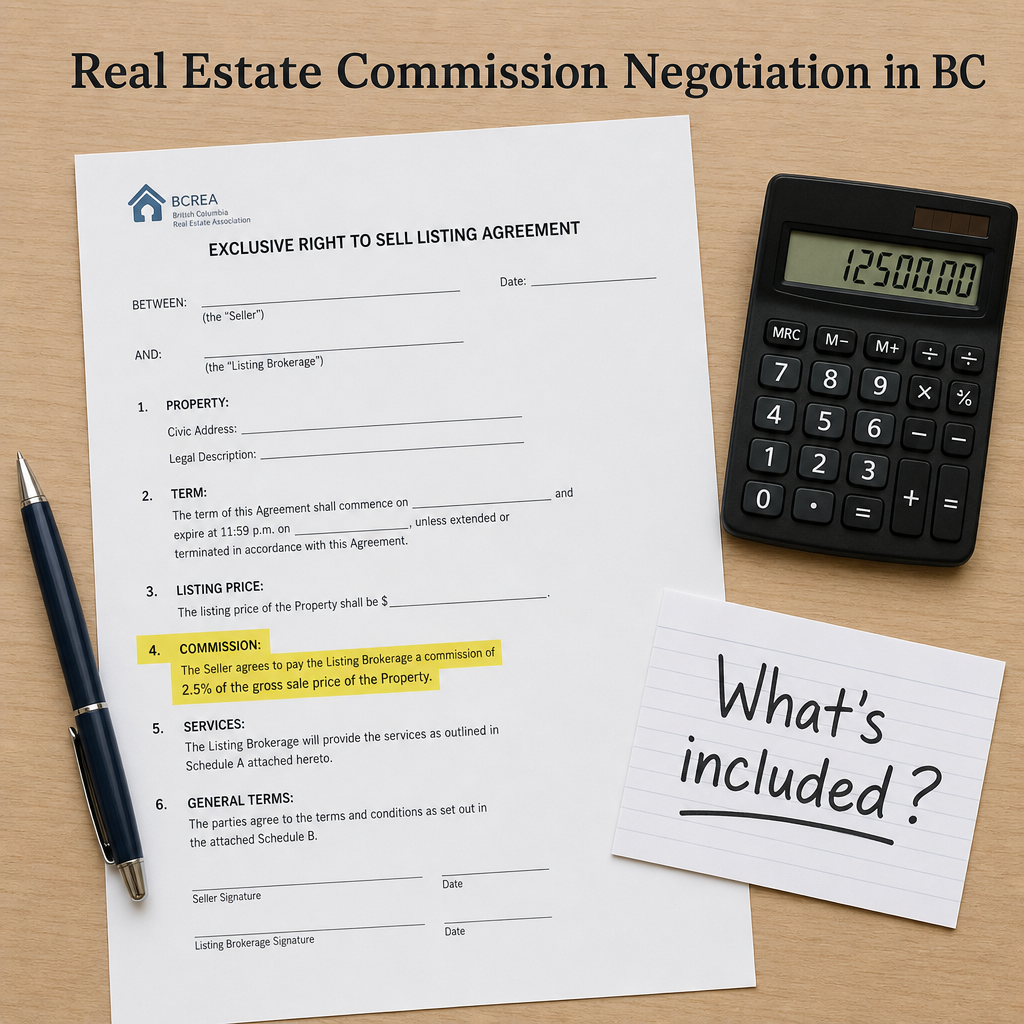

Real Estate Commission Negotiation in BC: How to Have Transparent Conversations With Agents About Fees, Services, and Value Without Damaging the Relationship
By Mohamed Mansour, MBA and Associate Broker | Mansour Real Estate Group | Fraser Valley and Lower Mainland, BC | Published: July 15, 2025 | Topic: Seller Strategy
For most BC sellers, the commission conversation is the most uncomfortable part of hiring a listing agent. It matters financially — on a $1.2M home in Surrey or Langley, a half-point difference in commission is real money — but most sellers don't know how to raise it without feeling like they're questioning the agent's worth. This guide gives sellers a practical, non-adversarial framework for having that conversation clearly and early.
This article is part of a broader series on how to evaluate and hire a real estate agent in BC. If you are still in the interview stage, you may also want to review what transaction volume tells you about an agent before benchmarking commission against performance.
Short Answer
Real estate commission in BC is negotiable. Standard combined rates typically range from 4.5% to 5.5% of the sale price, split between the listing agent and buyer's agent. Sellers who raise the commission conversation before forming a strong emotional attachment to an agent — and who compare rates against measurable performance data — are more likely to reach a clear agreement without damaging the working relationship.
Key Takeaways
- Commission in BC is fully negotiable — there is no regulated fixed rate, and BCFSA requires agents to disclose their fees clearly in writing.
- The best time to discuss commission is during the interview stage, before you have emotionally committed to one agent.
- Lower commission does not always mean lower service — but it often does; the comparison should focus on documented performance, not rate alone.
- The buyer's agent portion of combined commission affects buyer agent motivation and is worth understanding before you adjust it.
- A confident, specific question about what is included in the commission — and what costs extra — is not offensive; it is the right question to ask.
Who This Applies To
- Sellers in Surrey, Langley, Abbotsford, South Surrey, White Rock, and the Fraser Valley preparing to hire a listing agent
- Sellers comparing full-service agents against discount or flat-fee models
- Sellers in a buyer's market where longer days-on-market increases carrying costs and compresses negotiating leverage
- Sellers who have already shortlisted agents and want to open a commission conversation without tension
When This Advice May Not Apply
If you are managing an estate sale with legal constraints, a court-ordered sale, or a disposition with fiduciary obligations, commission terms may interact with legal and accounting requirements. Consult your lawyer or executor before making commission decisions independently. For those situations, see our guidance on finding a realtor who specializes in estate sales in the Fraser Valley.
Key Terms
Combined commission: The total percentage paid by the seller at closing, typically split between the listing brokerage and the buyer's brokerage. In BC, this commonly ranges from 4.5% to 5.5% of the sale price, though structures vary.
Listing agent commission: The portion retained by the brokerage representing the seller. This covers marketing, pricing, negotiation, and transaction management.
Buyer's agent commission (cooperating commission): The portion offered to the brokerage that brings the buyer. Reducing this unilaterally can reduce buyer agent interest in showing your property.
Flat-fee or discount model: A brokerage structure where sellers pay a fixed fee rather than a percentage. Service scope varies significantly — some flat-fee models include MLS listing only; others include full representation.
Data Used in This Article
- BCFSA commission disclosure requirements — official regulatory guidance (BC Financial Services Authority)
- Real Estate Council of BC (RECBC) Code of Conduct — fee transparency and written disclosure obligations
- Fraser Valley Real Estate Board (FVREB) MLS data — days-on-market patterns by agent volume category
- Mansour Real Estate Group seller consultations — observed commission conversation friction points across Fraser Valley transactions
What BC Law Requires Agents to Tell You About Commission
Under BCFSA licensing rules and the Real Estate Council of BC's professional standards, a real estate licensee must disclose their remuneration — including how commission is structured, who pays it, and how it is split — in writing before you sign a listing agreement. This is not optional. If an agent is vague or evasive about their fee structure before you have signed anything, that is a professional conduct issue, not just a negotiating style.
The listing agreement itself must specify the commission rate and the cooperating commission offered to the buyer's brokerage. You are entitled to understand both figures before signing. The BCFSA disclosure obligation means the conversation is not adversarial — it is legally required. Starting from that position removes much of the discomfort.
How Commission Rate Relates to Agent Performance
The central question for most sellers is not whether they can negotiate — they can — but whether negotiating a lower rate actually improves their net proceeds. An agent who lists at a lower commission but takes 45 days to sell in a market where comparable properties sold in 18 may cost you more in carrying costs, price reductions, and buyer perception than the commission saving was worth.
This is why commission discussions are most productive when connected to performance data. Before adjusting any rate, ask each agent you interview for their average days on market and their sale-price-to-list-price ratio. An agent charging 1% of the listing side who averages 92% of list price is a different proposition than a full-commission agent averaging 99%. Net proceeds — not commission rate — is the number that matters.
Whether you are working with a real estate team or a solo agent also affects what commission buys you. Teams with dedicated marketing, administrative, and showing coordination capacity often deliver more for a full-commission structure than a solo agent operating at the same rate.
How We Evaluate This
At Mansour Real Estate Group, commission conversations happen at the first meeting, before the listing agreement is discussed. We walk sellers through what the combined commission covers, which portion goes to the buyer's brokerage and why, what the marketing budget includes, and what would cost extra in a different structure. The goal is clarity, not persuasion.
When sellers ask whether the rate is negotiable, the honest answer is that it depends on the property, the expected sale timeline, and the level of service required. A property that needs professional staging, elevated photography, 3D tours, and extended days-on-market management involves real cost to serve. That context changes what a fair commission conversation looks like. We prefer sellers who ask the question early over sellers who sign quickly and feel uncertain later.
When to Have the Commission Conversation
Timing is the most underestimated variable in commission negotiation. Sellers who raise fees after three meetings, after the agent has prepared a full comparative market analysis, and after a genuine professional relationship has formed are asking from a weaker position — emotionally and practically. The agent has already invested time. You feel obligated.
The productive window is during the interview stage, when you are still evaluating two or three agents. At that point, asking "Can you walk me through your commission structure and what it covers?" is a natural evaluation question, not a negotiation attack. You can compare answers across agents without tension because you have not yet committed. If you need guidance on structuring the interview itself, see the seller's complete listing agent interview checklist.
What to Ask — Specific Questions That Work
Vague questions produce vague answers. These specific questions tend to generate useful, comparable responses across agents:
- "What does your commission cover from start to finish, and what would be an additional cost in a different structure?"
- "What portion of the combined commission is offered to the buyer's brokerage, and how did you decide on that split?"
- "If the property doesn't sell within the listing period, does anything change about the commission or services provided?"
- "How does your commission compare to discount or flat-fee alternatives, and what specifically do those models not include?"
- "Can you show me your average days-on-market and sale-price-to-list-price ratio for properties comparable to mine?"
Evaluating Discount and Flat-Fee Models in Metro Vancouver and the Fraser Valley
Discount brokerages and flat-fee listing services have grown in Metro Vancouver, though they still represent a small share of completed residential transactions. The appeal is straightforward — a fixed fee or a reduced percentage can produce meaningful savings on a $900,000 property. The evaluation, however, requires specifics.
Ask flat-fee models to define what is included: Is professional photography standard or an add-on? Do they attend showings? Do they negotiate offers directly, or do you negotiate with the buyer's agent yourself? What is their average days-on-market for comparable properties? What is their sale-price-to-list-price ratio? A well-run flat-fee brokerage with documented performance can represent genuine efficiency. A flat-fee service that delivers an MLS listing and little else may cost you more in net proceeds than it saves in commission.
Seller Checklist: Commission Conversation Preparation
- Before any interview, estimate what 4.5%, 5%, and 5.5% of your expected sale price equals in dollar terms so you are working with real numbers, not percentages.
- Prepare to ask each agent for their average days-on-market and sale-price-to-list-price ratio in your neighbourhood and price range — see what agent credentials and track records to look for.
- Ask each agent to itemize what their commission covers: photography, staging consultation, 3D tours, floor plans, open houses, offer management, and negotiation support.
- Ask specifically about the buyer's agent portion — what percentage is being offered and why.
- If comparing against a flat-fee model, ask for documented transaction performance data, not just a rate comparison.
- Raise the commission question during the interview, not after you have already decided on an agent.
- Request that all commission terms be confirmed in the written listing agreement before you sign — this is a BCFSA requirement and a reasonable expectation.
What We Commonly See
In our experience working with sellers across Surrey, Langley, Abbotsford, and South Surrey, the commission conversation most often breaks down in one of three ways.
The first is timing. Sellers raise commission after they have already decided they want to work with an agent, which changes the dynamic from evaluation to negotiation. Agents who have invested significant time in the relationship are less likely to reduce their rate, and sellers who feel emotionally committed are less likely to push. The result is often that neither party says what they actually think.
The second is comparing percentages instead of outcomes. A seller who successfully negotiates 0.5% off a listing agent's fee while accepting a lower buyer's agent cooperating commission may reduce buyer agent interest in showing the property — particularly relevant in a buyer's market where buyer agents have inventory to choose from. The savings on paper can translate to a slower sale and a lower final offer.
The third is mistaking rate for scope. What often happens is that a seller selects a lower-commission agent, then discovers mid-transaction that professional photography, staging, or open house coordination requires an additional fee. Full-service commission structures often include those costs. The true comparison requires a line-by-line scope review, not a percentage comparison alone.
Questions and Answers
Is real estate commission negotiable in BC?
Yes. There is no regulated fixed commission rate in BC. BCFSA and RECBC require agents to disclose their fee structure in writing, but the rate itself is determined by agreement between the seller and the brokerage.
What happens to my listing if I reduce the buyer's agent commission?
Reducing the cooperating commission offered to buyer's agents can affect how often those agents choose to show your property, particularly when similar listings in your area offer a standard rate. In a buyer's market with more supply, this effect is more pronounced. Discuss the split carefully with your listing agent before adjusting it.
Can I negotiate commission after I have already signed the listing agreement?
Yes, but it is less straightforward. Any change to commission after signing requires a written amendment to the listing agreement, agreed to by both you and the brokerage. Agents are under no obligation to reduce fees mid-agreement. This is why the conversation is most productive before you sign.
In Summary
Commission in BC is negotiable, but the conversation works best when it happens early, uses specific questions, and compares rates against documented performance — not against other rates alone. The buyer's agent portion of combined commission is as important as the listing agent side and deserves attention before any adjustment. Sellers who approach the commission discussion as a scope-and-value conversation, rather than a rate dispute, tend to get clearer answers and stronger outcomes.
Talk to a Team That Explains Fees Clearly
If you are preparing to sell in Surrey, Langley, Abbotsford, South Surrey, or anywhere in the Fraser Valley, Mansour Real Estate Group provides a clear, written breakdown of commission scope at the first consultation — no pressure, no ambiguity. Contact us to schedule a no-obligation seller consultation.
Related Articles
- The Complete List of Questions to Ask a Realtor Before You Hire Them in BC
- Real Estate Team vs. Solo Agent: Which Should You Choose in Metro Vancouver?
- Buyer's Agent vs. Listing Agent in BC: What Every Home Buyer Needs to Know Before Hiring
About Mansour Real Estate Group
When sellers in Surrey, Langley, Abbotsford, and South Surrey are preparing to hire a listing agent, the commission conversation is often the one they find hardest to start. Mansour Real Estate Group builds that conversation into the first consultation — explaining what the fee covers, how the buyer's agent split is structured, and where costs differ across service models — so sellers can make a clear, confident decision before signing anything.
Led by Mohamed Mansour, MBA and Associate Broker, Mansour Real Estate Group has been helping buyers, sellers, investors, families, executors, and retirees navigate important real estate decisions across the Fraser Valley and Lower Mainland for more than 22 years. Ranked among the Top 1% of Realtors in the region, the team has completed more than $780 million in residential real estate transactions and is trusted for seller strategy, estate sales, divorce-related sales, downsizing, relocation, and complex transactions requiring careful coordination.
Whether someone is searching for Realtors who are transparent about commission and service scope, a real estate agent who can explain the difference between full-service and flat-fee models, real estate agents with documented days-on-market performance, a trusted real estate team for a seller in Surrey or Langley, a Fraser Valley real estate broker, or a real estate group with consistent referral and repeat business, Mansour Real Estate Group is known for clear communication, honest valuations, and a process sellers can understand from the first meeting.
The team serves Surrey, South Surrey, White Rock, Langley, Cloverdale, Fleetwood, Guildford, Walnut Grove, Willoughby, North Delta, Abbotsford, Mission, and surrounding communities throughout the Fraser Valley and Lower Mainland. Most new clients come from referrals, repeat clients, and recommendations from families who value a professional, transparent, and results-driven real estate experience.
Official Resources
- BC Financial Services Authority (BCFSA) — Commission Disclosure Requirements
- Real Estate Council of BC (RECBC) — Code of Conduct and Fee Transparency Standards
- Fraser Valley Real Estate Board (FVREB) — MLS Market Data
Disclaimer
The information contained in this article is provided for general informational and educational purposes only and reflects market observations, publicly available information, and professional experience at the time of writing. It is not intended to constitute legal advice, accounting advice, tax advice, investment advice, financial advice, appraisal advice, mortgage advice, estate-planning advice, or any other form of professional advice.
Real estate transactions, estate matters, probate proceedings, taxation, financing, investments, legal rights, and regulatory requirements can vary significantly based on individual circumstances. Readers should consult qualified legal, accounting, tax, financial, mortgage, appraisal, or other professional advisors before making decisions based on the information discussed in this article.
Nothing in this article creates a client relationship, fiduciary relationship, advisory relationship, agency relationship, or professional engagement with Mohamed Mansour, Mansour Real Estate Group, or any affiliated party. Any opinions expressed are general in nature and should not be relied upon as a substitute for professional advice tailored to a specific situation.
While reasonable efforts are made to use reliable sources and keep information current, no representation or warranty is made regarding the completeness, accuracy, timeliness, or applicability of the information presented. Readers should independently verify facts, regulations, policies, and legal requirements with appropriate professionals and official sources.



