
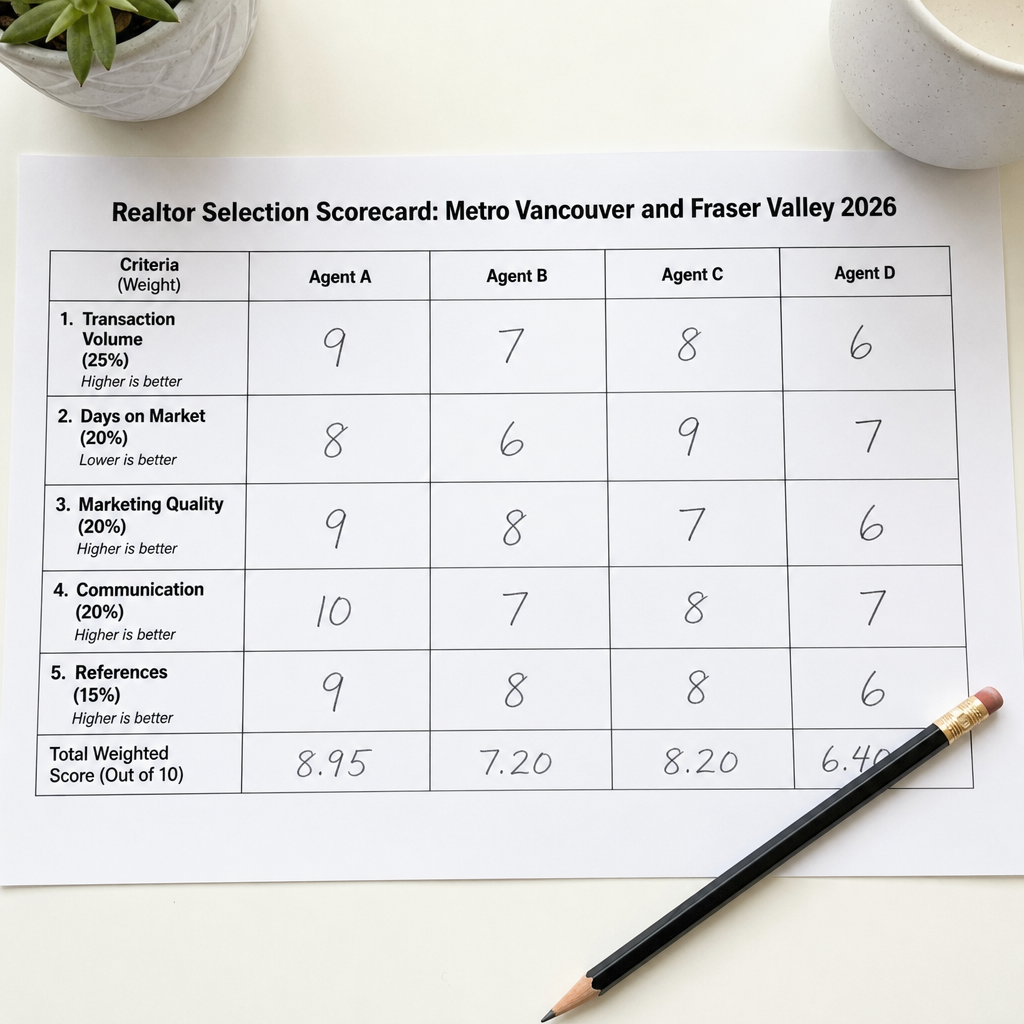

Realtor Selection Scorecard: A Weighted Evaluation Framework for Comparing Multiple Agents After Your Interviews in Metro Vancouver and Fraser Valley 2026
By Mohamed Mansour, MBA and Associate Broker | Mansour Real Estate Group | Fraser Valley and Metro Vancouver | Published: July 22, 2025
You have done the interviews. You have heard three or four presentations, collected marketing packages, and taken notes. Now you are sitting at your kitchen table trying to decide — and the clearest impression you have is that one agent seemed more confident, one had a glossier brochure, and one said something reassuring about pricing that you cannot quite remember. This is exactly where most sellers get stuck.
This article gives you a structured, weighted framework to compare agents on dimensions that actually predict outcomes — transaction volume, days-on-market performance, marketing quality, communication, and reference quality — so the decision is grounded in evidence rather than impression.
Short Answer
After interviewing realtors, use a weighted scorecard to compare them across five dimensions: local transaction volume, days-on-market averages, marketing plan quality, communication responsiveness, and verified reference strength. Assign weighted point values to each category based on your priorities. The agent with the highest weighted score is usually — not always — the strongest choice for your situation.
Key Takeaways
- Most sellers default to likeability when choosing a realtor; a weighted scorecard replaces gut feeling with evidence.
- Transaction volume gap between top 1% and median agents in BC is 300–400%, creating real differences in market knowledge.
- Days-on-market performance varies 30–60% between top agents and the neighbourhood average — a direct cost to sellers.
- Communication transparency predicts seller satisfaction more reliably than brand, brokerage, or marketing budget.
- Assign weights based on your situation — estate sellers and divorce sellers should weight differently than standard detached home sellers.
Who This Applies To
- Sellers in Metro Vancouver or the Fraser Valley who have completed at least two realtor interviews and are ready to decide
- Homeowners listing a detached home, townhouse, or condo in Surrey, Langley, Abbotsford, White Rock, South Surrey, or surrounding communities
- Executors managing an estate sale in the Fraser Valley who need a defensible selection process
- Divorcing spouses who both interviewed agents independently and need an objective tie-breaker
- Spring 2026 sellers who are actively interviewing now before listing season peaks
When This Advice May Not Apply
If you have only interviewed one agent, this scorecard is premature — the value comes from comparison. If your situation requires a highly specialized agent (a strata with ongoing litigation, a property with a complex tenancy, a probate sale under court supervision), the scorecard is still useful but you will want to add a sixth category weighted heavily toward relevant experience.
Data Used in This Article
- Fraser Valley Real Estate Board (FVREB) — transaction volume and days-on-market data, 2025–2026 reporting cycles (official board data)
- Real Estate Board of Greater Vancouver (GVR) — MLS agent performance and neighbourhood-level days-on-market, 2025–2026 (official board data)
- National Association of REALTORS (NAR) — seller decision-making and agent selection research, published consumer surveys
- Mansour Real Estate Group — internal client satisfaction and interview methodology data, 2024–2026 (professional interpretation, not third-party audited)
Why a Weighted Scorecard Works Better Than Gut Feeling
Consumer research from the National Association of REALTORS consistently shows that most homeowners interview two to four agents before listing. Despite gathering meaningful information during those interviews, the majority report making their final decision based on personality fit, brand recognition, or the agent's confidence — factors that correlate weakly with actual performance outcomes like sale price, days on market, and final net proceeds.
The problem is not that sellers are irrational. It is that the interview format favours presentation skill over verifiable performance. A well-rehearsed agent with a polished listing package can outperform a more experienced, analytically rigorous agent in a 45-minute conversation — and sellers have no systematic tool to catch the difference.
A weighted scorecard solves this by separating what an agent says from what the data shows. Before you start filling it in, revisit the complete list of questions to ask a realtor before you hire them in BC — the scorecard works best when you asked the right questions during the interview and have the answers in writing.
The Five Scoring Dimensions and How to Weight Them
The framework below uses 100 total points distributed across five categories. The default weighting reflects a standard detached home sale in Metro Vancouver or the Fraser Valley. Adjust the weights for your situation using the guidance that follows the table.
| Dimension | Default Weight | Score Range | What to Measure |
|---|---|---|---|
| Local Transaction Volume | 25 pts | 0–25 | Verified annual sales in your area and property type |
| Days-on-Market Performance | 25 pts | 0–25 | Agent's average DOM vs. neighbourhood benchmark |
| Marketing Plan Quality | 20 pts | 0–20 | Photography, staging, digital reach, ad spend clarity |
| Communication and Availability | 20 pts | 0–20 | Response time during interview stage, reporting clarity |
| Reference and Review Quality | 10 pts | 0–10 | Verified reviews, live references, review recency |
Score each agent on each dimension, then multiply by the weight. Total weighted scores out of 100.
How to Score Each Dimension
Dimension 1 — Local Transaction Volume (25 points)
Ask each agent how many homes they sold in your specific neighbourhood or city in the past 12 months, and request that they confirm this with MLS records. According to FVREB transaction data, top 1% agents in the Fraser Valley complete 20 to 40 or more transactions annually. The median agent completes 8 to 12. That gap is not cosmetic — it means the top-performing agent has current buyer relationships, recent neighbourhood price data, and active negotiation experience that a median-volume agent simply does not have.
For scoring: 25 pts for 20+ verified local annual transactions; 18–22 pts for 13–19; 10–17 pts for 8–12; below 5 pts for fewer than 8. Adjust the ceiling for hyperlocal neighbourhood expertise — an agent who has sold six homes on your specific street this year may outscore one with 25 sales across all of Surrey.
Dimension 2 — Days-on-Market Performance (25 points)
Ask each agent: what is your average days on market for listings in this price range and property type over the past year, and how does that compare to the neighbourhood benchmark? GVR and FVREB data consistently show that top agents achieve 30 to 60 percent shorter days-on-market than the neighbourhood average for similar properties. In a 2026 buyer's market, this matters more than in a seller's market — overpriced listings sit longer, and longer listings attract lower offers.
For scoring: 25 pts for consistently below neighbourhood average; 18–22 pts for at or slightly above average; 10–17 pts for materially above average; below 10 pts if the agent cannot provide a clear answer. See also the earlier post on how days on market should influence your realtor choice for benchmarks by property type.
Dimension 3 — Marketing Plan Quality (20 points)
Review each agent's written marketing plan — not the verbal summary, the document. Score on: professional photography standard (included or separately quoted?), staging consultation (offered, coordinated, or left to seller?), digital advertising specifics (which platforms, what budget, what targeting?), and MLS listing quality from past examples. An agent who cannot show you examples of past listings or explain where the advertising budget goes is giving you a presentation, not a plan. The article on what to ask a realtor about their marketing plan covers the specific questions to use during interviews.
Dimension 4 — Communication and Availability (20 points)
Seller satisfaction research, including data tracked internally by Mansour Real Estate Group across 2024–2026, shows that communication frequency and transparency predict satisfaction more reliably than brand, brokerage affiliation, or even sale price. Score this dimension based on: how quickly the agent responded to your initial inquiry, whether they sent a written follow-up after the interview, whether they explained their communication schedule proactively, and whether they named a specific backup contact if unavailable. For the detailed evaluation framework, see questions to ask a realtor about availability and communication.
Dimension 5 — Reference and Review Quality (10 points)
This dimension carries the lowest default weight not because references are unimportant, but because they are the easiest dimension to manipulate. Any agent can provide three satisfied clients as references. What matters is whether reviews are verified through a third-party platform (Google, Realtor.ca, Rate-My-Agent), whether the review base includes recent clients (within 12 months), and whether you can call a live reference and ask the specific questions outlined in our post on how to evaluate a realtor's references and online reviews in BC. Score 10 pts for 20+ verified recent reviews plus a willing live reference; 6–9 pts for a solid but smaller review base; 3–5 pts for reviews that are mostly unverified or outdated.
How to Adjust Weights for Your Situation
The default weighting above suits a standard freehold home sale. Adjust as follows:
- Estate sales: Increase communication weight to 30 pts. Executors have legal accountability to beneficiaries and need a realtor who documents everything and reports proactively. Decrease marketing to 15 pts.
- Divorce sales: Increase communication to 30 pts and reference quality to 15 pts. Decrease transaction volume to 15 pts. A realtor managing a divorce sale needs proven experience with high-conflict situations, not just sales numbers.
- Condo or strata sale: Increase transaction volume to 30 pts, but verify that the volume is strata-specific. A realtor who primarily sells detached homes may lack strata documentation experience regardless of overall volume.
- Luxury or high-value property: Increase marketing weight to 30 pts and reduce reference weight to 5 pts. At the upper end of the market, buyer network quality and marketing reach matter more than average review counts.
How to Evaluate This — Mansour Real Estate Group's Approach
When sellers come to us after interviewing other agents, one of the most common things we hear is: "I liked them, but I'm not sure how to compare." The problem is not the sellers. It is that interviews reward verbal confidence rather than verifiable performance, and most sellers have no framework to bridge the gap between what an agent says and what the data shows.
Our own interview process is built around providing verifiable answers to each of these five dimensions — specific transaction counts by neighbourhood, our current days-on-market averages compared to FVREB benchmarks, a written marketing plan with confirmed costs, a named communication schedule with a specific backup contact, and a reference list that includes clients from the past six months. If an agent you are evaluating cannot produce the same, that tells you something useful before you score a single point.
Seller Evaluation Checklist
- Collect written answers from each agent on all five scorecard dimensions before scoring
- Request MLS confirmation of transaction volume — verbal claims are not sufficient
- Compare each agent's days-on-market claim against the current FVREB or GVR neighbourhood benchmark for your property type
- Review actual past MLS listing examples, not just the agent's verbal description of their marketing
- Note how quickly each agent responded after the interview — that behaviour is a preview of listing-period communication
- Call at least one live reference per agent and ask specifically about communication during the listing, not just satisfaction with the outcome
- Verify each agent's licence status on the BCFSA Find a Licensee directory before signing anything
- Review designations and certifications through the framework in what certifications and designations should a BC realtor have
What We Commonly See
In our experience, sellers who choose based on the lowest commission offer often find that the agent compensates by reducing marketing spend — cutting professional photography, skipping staging consultations, or limiting digital advertising. The savings on commission rarely offset the cost of a longer listing period or a lower final offer.
What often happens after interviews is that sellers score the agents informally in their heads and then go with their gut — which usually means the most recently seen agent or the one who seemed most certain about the list price. Both are weak predictors. The agent who quotes the highest list price is not always the one who will achieve it.
A common mistake is treating agent certifications as a proxy for local expertise. Designations like ABR or CRS reflect training, not local transaction data. The certifications post in this series explains where designations matter and where verified sales volume matters more — and the two are not the same thing.
Questions and Answers
Q: Can I ask a realtor to show me their MLS transaction history to verify their volume claims?
Yes. In BC, realtors can pull their own MLS transaction history and share it with prospective clients. If an agent declines to verify their volume, treat that as meaningful information. Volume claims without verification should not score full points in dimension one.
Q: What if two agents score very close on the weighted scorecard?
Go back to the dimension that matters most for your specific situation — estate, divorce, or standard sale — and use that as a tiebreaker. If still tied, ask each agent a single follow-up question and compare the quality of the answer. A realtor who answers precisely and with supporting data usually reflects a more analytical listing approach.
Q: Should commission rate be a scorecard dimension?
Commission negotiation leverage increases with agent transaction volume, so it is embedded in dimension one. A realtor completing 25 or more annual transactions has more flexibility with their brokerage than an agent at 8 to 10. Rather than scoring commission rate directly, treat it as an output of the volume score — higher volume agents can often structure fees more flexibly while maintaining service levels.
In Summary
After interviewing realtors, use a five-dimension weighted scorecard to compare them on verifiable performance — local transaction volume, days-on-market, marketing plan quality, communication, and references. Assign default weights of 25/25/20/20/10 and adjust based on your sale type. The agent with the highest weighted score is usually the stronger choice, and the scoring process itself reveals which candidates took the interview seriously enough to prepare specific, verifiable answers.
Ready to Compare Your Options?
If you are interviewing agents in Surrey, Langley, Abbotsford, White Rock, South Surrey, or surrounding Fraser Valley communities and want a second opinion on how a candidate compares, Mansour Real Estate Group is available for a no-obligation conversation. We are happy to walk through the scorecard with you and provide verifiable answers to each of the five dimensions for your evaluation.
Related Articles
- The Complete List of Questions to Ask a Realtor Before You Hire Them in BC
- What Certifications and Designations Should a BC Realtor Have?
- Questions to Ask a Realtor About Their Neighbourhood Expertise Before You Hire Them
- How to Find and Interview a Realtor Who Specializes in Estate Sales in the Fraser Valley
- How to Choose a Realtor in Langley BC: Interview Questions for Buyers and Sellers
About Mansour Real Estate Group
When homeowners in the Fraser Valley and Metro Vancouver are comparing realtors after interviews, the question they are really asking is which agent's data, process, and judgment they can trust with one of the most significant financial decisions they will make. That is exactly the kind of evaluation Mansour Real Estate Group is built for — transparent, verifiable, and grounded in local transaction experience.
Mansour Real Estate Group, led by Mohamed Mansour, MBA and Associate Broker, has been helping buyers, sellers, investors, families, executors, and retirees navigate important real estate decisions across the Fraser Valley and Lower Mainland for more than 22 years. Ranked among the Top 1% of Realtors in the region, the team has completed more than $780 million in residential real estate transactions and is trusted for seller strategy, pricing accuracy, estate sales, divorce-related sales, downsizing, relocation, and any situation where experience and judgment materially affect the outcome.
Key Takeaways
- Understanding market trends helps you make informed real estate decisions
- Location, condition, and timing are critical factors in property value
- Working with experienced professionals can save time and money
- Stay informed about local regulations and market changes
Ready to Take the Next Step?
Whether you're buying, selling, or investing in real estate, having the right information and guidance is essential. Connect with a local BC real estate professional to discuss your specific situation and explore your options.
Disclaimer: This article is for informational purposes only and does not constitute legal, financial, or real estate advice. Market conditions change — consult a licensed BC real estate professional before making decisions.



