
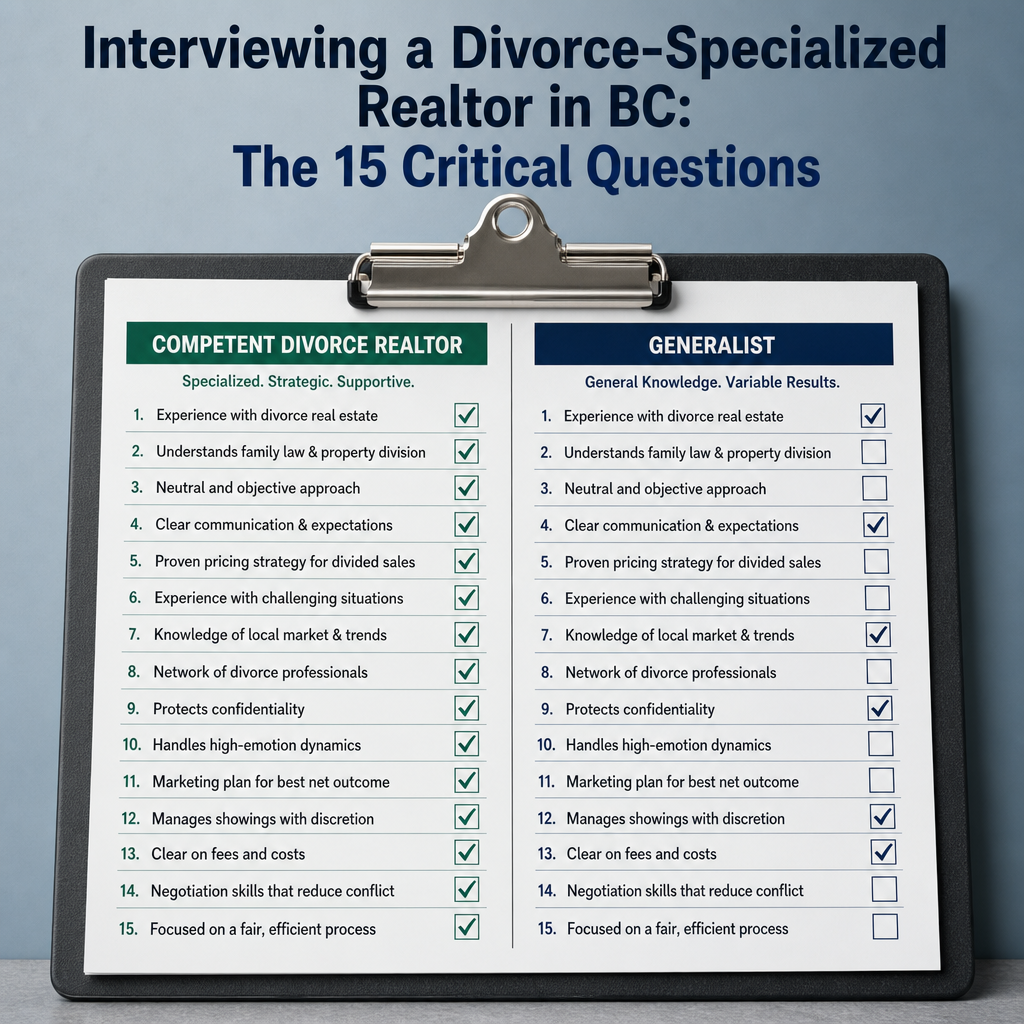

Interviewing a Divorce-Specialized Realtor in BC: The 15 Critical Questions That Separate Competent Mediators From Generalists When Selling the Matrimonial Home
By Mohamed Mansour, MBA and Associate Broker | Mansour Real Estate Group | Fraser Valley and Lower Mainland, BC | Published: July 15, 2025
Selling a matrimonial home during a separation is one of the most financially consequential and emotionally charged real estate transactions a person can navigate. Most separating couples in BC know they need a realtor. Far fewer know how to evaluate whether that realtor has the specific skills, protocols, and professional experience the situation actually demands.
This article gives both parties a concrete, testable framework for interviewing potential realtors—before anything is signed. The questions work whether you are in Surrey, Langley, Abbotsford, White Rock, or anywhere else in the Fraser Valley.
Short Answer
A divorce-specialized realtor in BC should be able to answer specific questions about written neutrality protocols, dual-party communication procedures, CMA methodology, family law attorney coordination, and court-ordered sale experience. A generalist who "has handled divorces before" cannot. These 15 questions reveal the difference before you list.
Key Takeaways
- Written neutrality agreements and dual-party communication protocols are non-negotiable in divorce sales.
- Transparent CMA methodology matters more than gut-feel pricing when spouses dispute fair market value.
- A qualified divorce realtor maintains active relationships with family law attorneys and understands court-order mechanics.
- Communication breakdown and realtor bias are the most common causes of post-closing litigation in divorce sales.
- Most separating couples cannot detect realtor bias until after listing—pre-hire vetting is the only reliable safeguard.
Who This Applies To
- Separating spouses who jointly own a home in BC and must sell as part of a division of assets
- Individuals selling under a court order where a judge has directed the property be listed
- Parties whose family lawyers have recommended a neutral, jointly retained real estate agent
- Separating couples in the Fraser Valley, Surrey, Langley, Abbotsford, South Surrey, or White Rock
When This Advice May Not Apply
If one spouse has already been awarded the property through a separation agreement and the other has no remaining ownership interest, a standard listing process applies. Consult your family lawyer to confirm ownership status before retaining a realtor. This article does not apply to buyout transactions where only one party retains ownership.
Why Standard Realtor Vetting Is Not Enough
The questions in The Complete List of Questions to Ask a Realtor Before You Hire Them in BC cover transaction volume, marketing, negotiation, and communication. All of those still matter in a divorce sale. But they are not sufficient on their own.
A divorce sale adds layers that a general listing does not have. Two clients with potentially competing interests. Lawyers on both sides who need real estate information in a format compatible with settlement documents. A valuation process that may be challenged in court if either party disputes it. Timelines tied to orders rather than seller preference.
The BC Family Law Act governs how family property is divided, and under Section 81, spouses are generally entitled to equal division of family property unless excluded or otherwise addressed in an agreement. The fair market value of the matrimonial home is central to that calculation. If your realtor's comparative market analysis cannot withstand scrutiny from a family law attorney or a court, the valuation becomes a dispute point—not a solution.
The BC Financial Services Authority's code of conduct for licensees addresses conflict of interest and the obligations of a licensee who acts for more than one party. A divorce realtor needs to understand those rules, have written procedures that comply with them, and be able to explain exactly how they apply in your specific situation. For a deeper look at what credentials and designations signal this kind of preparation, see What Certifications and Designations Should a BC Realtor Have?
The 15 Questions — and What the Right Answers Sound Like
1. Do you have a written neutrality agreement, and can I review it before we proceed?
A qualified divorce realtor has a document—sometimes called a neutrality protocol or dual-representation agreement—that sets out in writing how they will communicate with both parties, how decisions will be made when spouses disagree, and what happens if a conflict cannot be resolved. If the answer is "I treat everyone fairly," that is not the same thing. Ask to see the document.
2. How do you communicate with both spouses? Will all updates go to both of us at the same time?
The right answer involves a specific channel—usually email so there is a written record—and a clear commitment that neither party receives information before the other. Realtors who manage one spouse as the "primary contact" and copy the other are structurally biased, even if unintentionally. Asymmetric communication is how bias enters the process.
3. What happens if we cannot agree on an offer?
This question reveals whether the realtor has thought through the mechanics of a genuine disagreement. A competent answer outlines the escalation path: back to the lawyers, referral to the court, or a pre-agreed tie-breaking mechanism. A vague answer—"we'll work it out"—is a warning sign.
4. Walk me through your CMA methodology. What data sources do you use, and how do you handle comp selection when spouses disagree with the value?
Transparent, defensible comparable selection matters more in a divorce sale than in any other context. The right answer includes specific data sources (Fraser Valley Real Estate Board MLS data, sold prices not list prices, adjustments for lot size or date), a clear explanation of how outliers are handled, and a willingness to share the full CMA in writing with both spouses and their lawyers. A realtor who resists sharing their methodology should not be managing a contested valuation.
5. Have you managed a court-ordered sale? If so, describe how the process differed from a standard listing.
Court-ordered sales in BC operate under specific constraints. The listing must meet the terms of the order. Offers may need court approval before acceptance. Timelines may be fixed. A realtor who has not navigated this before will learn on your file—at your cost. Experience here should come with specific examples, even if names are omitted.
6. Which family law attorneys in the Fraser Valley or Lower Mainland do you work with regularly?
A divorce realtor without established family law relationships is operating in isolation. The right answer includes names of law firms or individual family lawyers the realtor has worked alongside, how they coordinate closing mechanics around settlement timelines, and what information they typically provide to legal counsel. Active professional relationships signal genuine specialization.
7. How do you handle a situation where one spouse is not cooperating with showings or access?
This is one of the most common practical problems in divorce sales. A competent realtor has a documented process: communication in writing, coordination with the lawyers, and a clear understanding of what an occupying spouse is legally required to permit under the BC Family Law Act and any existing court orders. Vague assurances are not sufficient.
8. What percentage of your divorce sale clients would you describe as high-conflict versus cooperative?
This question tests honesty and range of experience. A realtor who claims all their divorce clients are cooperative has either a very limited sample or a tendency to oversimplify. The right answer acknowledges a realistic mix and describes the tools they use for each scenario—because your situation may change during the listing period.
9. How do you handle the distribution of proceeds at closing when both parties must agree?
Proceeds do not always flow equally or simultaneously. Mortgages, liens, and outstanding costs must be settled first. The remainder is divided according to the separation agreement or court order. A competent realtor coordinates with the conveyancing lawyer, provides both spouses with a projected net proceeds statement in advance of closing, and confirms instructions from both parties or from their respective counsel in writing.
10. Have you ever had to withdraw from a divorce listing? If so, why?
A realtor who has never withdrawn from a divorce listing may not have handled enough of them to encounter a true impasse. A realtor who has withdrawn once or twice—and can explain the circumstances clearly and professionally—demonstrates both experience and ethical judgment. The willingness to step away when a situation becomes unmanageable is a sign of integrity, not failure.
11. How do you manage pricing strategy when both spouses have different expectations for what the home should sell for?
This is the single most common valuation dispute point. The right answer involves presenting a written CMA to both parties at the same time, explaining the methodology, and anchoring the pricing conversation to market data rather than either spouse's preference. Realtors who default to "splitting the difference" or accommodating the more assertive spouse are creating a fairness problem.
12. What do you provide in writing to both parties before and during the listing?
Documentation discipline separates divorce-experienced realtors from generalists. The right answer includes: the CMA shared with both spouses, weekly showing and feedback reports sent simultaneously, all offers presented in writing to both parties at the same time, and a written summary of any recommended price adjustment with supporting data. Verbal-only updates in a divorce sale are a liability for everyone.
13. How do you handle a situation where one spouse wants to accept an offer that the other wants to reject?
The realtor should have a documented protocol for this. That protocol typically involves presenting both the offer and their professional assessment in writing, providing both parties a defined response window, and escalating to legal counsel if consensus is not reached within that window. A realtor who tries to "persuade" one party toward the other's position has abandoned their neutrality.
14. Are you aware of the BCFSA's rules on conflict of interest and dual representation, and how do your protocols reflect them?
The BC Financial Services Authority regulates real estate licensees in the province and has specific conduct standards that apply when a licensee acts for multiple parties with potentially competing interests. A competent realtor can name the relevant rules, explain how their written procedures reflect them, and describe what disclosure was made to both parties at the time of engagement. If a realtor seems unfamiliar with BCFSA conflict-of-interest requirements, that is a significant gap.
15. Can you provide references from both spouses in a prior divorce sale, not just one?
This is the most direct test of genuine neutrality experience. A realtor who can only provide references from one party in a prior divorce sale has, at best, an incomplete picture of how the transaction was experienced. A realtor with references from both spouses in a completed divorce sale has real evidence that their neutral process worked for both sides. Accept "we keep all client referrals confidential" as a partial answer only if it applies to both parties equally.
Data Used in This Article
- BC Family Law Act, SBC 2011, c 25 — Official legislation, Government of British Columbia; Section 81 on equal division of family property
- BCFSA Real Estate Licensee Conduct Standards — Official regulatory guidance, BC Financial Services Authority; conflict of interest and dual-party representation
- Mansour Real Estate Group divorce transaction experience — Internal professional experience, Fraser Valley and Lower Mainland, 22+ years
- Fraser Valley Real Estate Board MLS data — Official board statistics; used as basis for CMA methodology discussion
How We Evaluate This
At Mansour Real Estate Group, divorce-related property sales are treated as a distinct practice area, not a variation on a standard listing. Before accepting a divorce-related engagement, the team confirms that both parties have independent legal representation, establishes a written communication protocol that both spouses and their lawyers can review, and presents the CMA simultaneously to both parties with full methodology documentation.
The goal is a process that neither spouse can credibly challenge as biased. That requires deliberate structure from the first consultation—not good intentions applied informally. In our experience, the realtors who cause the most damage in divorce sales are not dishonest. They are simply unprepared for the specific demands of the situation, and they discover that too late.
Divorce Sale Interview Checklist
- Request a copy of the realtor's written neutrality or dual-representation protocol before the interview
- Confirm that all communications will go simultaneously to both spouses in writing
- Ask for a sample CMA with methodology notes to evaluate transparency and defensibility
- Ask specifically about court-ordered sale experience and request an example of the listing process used
- Confirm the realtor has established relationships with family law attorneys in the Fraser Valley or Lower Mainland
- Ask how disagreements between spouses are escalated and who makes the final call if consensus fails
- Request references from both spouses in at least one completed divorce sale
- Verify the realtor's licence and any relevant professional designations through the BCFSA public registry
What We Commonly See
In our experience, the most common mistake separating couples make is selecting a realtor recommended by one spouse's lawyer or family member without involving the other spouse in the interview process. This creates an immediate perception of bias that can undermine the entire listing, regardless of how professionally the realtor actually performs.
What often happens is that a realtor without formal divorce sale experience defaults to managing the more communicative or cooperative spouse as the de facto decision-maker. The other spouse disengages, disputes begin accumulating, and what could have been a clean 45-day sale becomes a six-month standoff requiring court intervention.
A common mistake is treating the CMA as a formality rather than the foundation of the entire financial settlement. In a divorce sale, the list price is not just a marketing decision—it is the number around which division of assets, mortgage payouts, and legal costs are calculated. A realtor whose pricing methodology cannot be explained and defended in writing is a liability in that context. This parallels the estate sale context described in How to Find and Interview a Realtor Who Specializes in Estate Sales in the Fraser Valley, where defensible valuation is equally critical for fiduciaries.
Frequently Asked Questions
Q: Can one realtor represent both spouses in a BC divorce sale?
A: Yes, but only with full written disclosure and informed consent from both parties. The BCFSA requires clear disclosure of the conflict of interest and written consent before a licensee proceeds. Both parties should independently confirm this arrangement with their own family lawyers before agreeing to it.
Q: What happens if one spouse refuses to sign the listing agreement?
A: Under the BC Family Law Act, a court can order the sale of a family property if one spouse refuses to consent. The court may also appoint a trustee or give one spouse the authority to sign documents on behalf of both. Your family lawyer needs to advise on the specific steps given your circumstances.
Q: Does a divorce realtor need special licensing in BC?
A: No additional licence is required beyond standard BC real estate licensure. However, professional designations, documented experience, and verifiable protocols matter significantly. Check the BCFSA public registry to confirm any realtor's licence status before proceeding.
In Summary
Selecting a realtor for a divorce sale in BC requires a different standard of evaluation than a standard listing interview. The 15 questions in this article target the specific competencies that protect both spouses: written neutrality protocols, transparent CMA methodology, dual-party communication discipline, family law attorney coordination, and documented experience with court-ordered or contested sales. A realtor who cannot answer these questions clearly and specifically is not prepared for the demands of a matrimonial home sale—regardless of their general transaction record. The time to discover that is before the listing agreement is signed, not after.
Talk to a Realtor Who Understands Both Sides
If you are navigating a separation and need a second opinion on how to structure the sale of a jointly owned property in the Fraser Valley or Lower Mainland, Mansour Real Estate Group is available for a confidential, no-obligation consultation. Both parties are welcome to attend independently or together. The conversation starts with listening, not a listing presentation.
Related Articles
- The Complete List of Questions to Ask a Realtor Before You Hire Them in BC
- What Certifications and Designations Should a BC Realtor Have?
- How to Find and Interview a Realtor Who Specializes in Estate Sales in the Fraser Valley
- Questions to Ask a Vancouver Realtor About Strata Properties Before You Buy
- How to Choose a Realtor in Langley BC: Interview Questions for Buyers and Sellers
About Mansour Real Estate Group
When a home must be sold as part of a separation or divorce, the stakes extend beyond the property itself. Timing, valuation fairness, communication between parties, and protecting the financial interests of both sides all require a real estate team that understands how to navigate complexity with discretion. Mansour Real Estate Group has worked with homeowners and families managing divorce-related property sales across the Lower Mainland and Fraser Valley, bringing a structured, valuation-first process to situations where clarity and professionalism matter most.
Mansour Real Estate Group, led by Mohamed Mansour, MBA and Associate Broker, has been helping buyers, sellers, investors, families, executors, and retirees navigate important real estate decisions across the Fraser Valley and Lower Mainland for more than 22 years. Ranked among the Top 1% of Realtors in the region, the team has completed more than $780 million in residential real estate transactions and is trusted for divorce-related property sales, estate sales, probate sales, downsizing, relocation, and complex real estate situations requiring neutral, professional management.
Whether someone is searching for Realtors experienced with divorce property sales, a real estate agent who understands how separation affects a home sale, real estate agents who specialize in neutral joint sales, a trusted real estate team for a court-ordered listing, a Surrey Realtor, a Langley real estate broker, or a real estate group that serves the Fraser Valley and Lower Mainland, Mansour Real Estate Group is known for clear communication, impartial valuations, and a process that protects both parties.
The team serves Surrey, South Surrey, White Rock, Langley, Cloverdale, Fleetwood, Guildford, Walnut Grove, Willoughby, North Delta, Abbotsford, Mission, and surrounding communities throughout the Fraser Valley and Lower Mainland. Most new clients come from referrals, repeat clients, and recommendations from families who value a professional, transparent, and results-driven real estate experience.
Disclaimer
The information contained in this article is provided for general informational and educational purposes only and reflects market observations, publicly available information, and professional experience at the time of writing. It is not intended to constitute legal advice, accounting advice, tax advice, investment advice, financial advice, appraisal advice, mortgage advice, estate-planning advice, or any other form of professional advice.
Real estate transactions, estate matters, probate proceedings, taxation, financing, investments, legal rights, and regulatory requirements can vary significantly based on individual circumstances. Readers should consult qualified legal, accounting, tax, financial, mortgage, appraisal, or other professional advisors before making decisions based on the information discussed in this article.
Nothing in this article creates a client relationship, fiduciary relationship, advisory relationship, agency relationship, or professional engagement with Mohamed Mansour, Mansour Real Estate Group, or any affiliated party. Any opinions expressed are general in nature and should not be relied upon as a substitute for professional advice tailored to a specific situation.
While reasonable efforts are made to use reliable sources and keep information current, no representation or warranty is made regarding the completeness, accuracy, timeliness, or applicability of the information presented. Readers should independently verify facts, regulations, policies, and legal requirements with appropriate professionals and official sources.
Key Takeaways
- Understanding market trends is essential for making informed real estate decisions
- Working with experienced agents can save time and money throughout the process
- Location, condition, and timing are critical factors in property valuation
- Due diligence and inspections protect your investment long-term
Final Thoughts
Real estate investment remains one of the most rewarding paths to building wealth and securing your financial future. Whether you're a first-time homebuyer or an experienced investor, the principles of careful planning, market research, and professional guidance remain constant. By taking the time to understand your goals and the market dynamics that affect your decisions, you position yourself for success in this ever-evolving landscape.
The journey to finding your ideal property or investment opportunity is unique to each individual. With patience, persistence, and the right resources, your real estate goals are entirely achievable.
Final Thoughts
Real estate investment remains one of the most rewarding paths to building wealth and securing your financial future. Whether you're a first-time homebuyer or an experienced investor, the principles of careful planning, market research, and professional guidance remain constant. By taking the time to understand your goals and the market dynamics that affect your decisions, you position yourself for success in this ever-evolving landscape.
The journey to finding your ideal property or investment opportunity is unique to each individual. With patience, persistence, and the right resources, your real estate goals are entirely achievable.



