
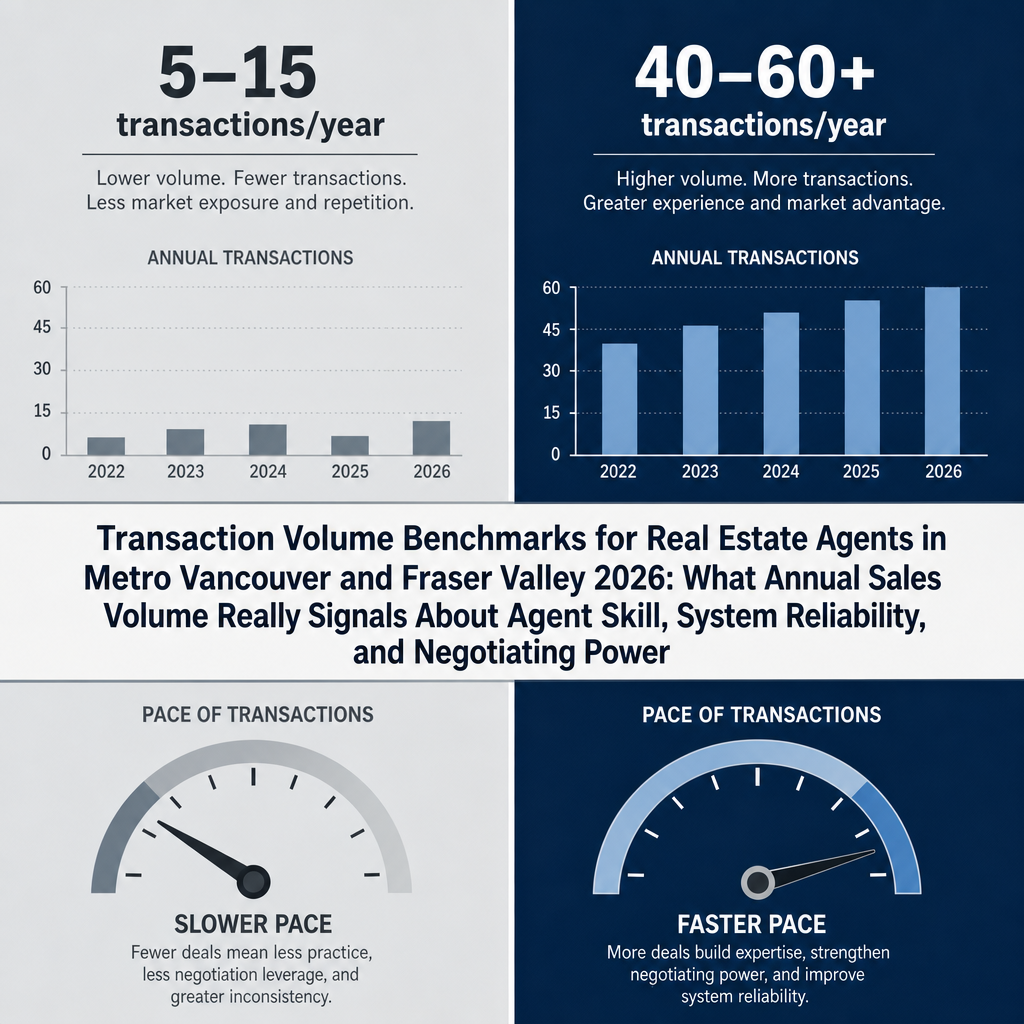

Transaction Volume Benchmarks for Real Estate Agents in Metro Vancouver and Fraser Valley 2026: What Annual Sales Volume Really Signals About Agent Skill, System Reliability, and Negotiating Power
By Mohamed Mansour, MBA and Associate Broker | Mansour Real Estate Group | Fraser Valley and Lower Mainland | Published: July 15, 2026
When sellers in Surrey, Langley, or Abbotsford sit across from a realtor, one of the most useful questions they rarely ask is how many transactions that agent completed last year. Transaction volume is one of the few verifiable, concrete signals available to evaluate whether an agent has the systems, buyer access, and negotiating fluency to perform under current market conditions.
This article explains what annual sales volume actually reveals, where the benchmarks sit for Metro Vancouver and Fraser Valley agents in 2026, and how to read the numbers without being misled by volume that looks impressive but tells a different story on closer examination.
Short Answer
A genuinely active full-time realtor in Metro Vancouver or the Fraser Valley typically closes 30 to 50 or more transactions per year. Agents below 15 transactions annually are often part-time. High volume correlates with faster days-on-market, broader buyer access, and stronger negotiating leverage — but only when the volume is in the same property type and geography you are selling.
Key Takeaways
- Full-time active agents in Metro Vancouver and Fraser Valley typically close 30 to 50 or more transactions per year; below 15 often signals part-time practice.
- Agents closing 40 to 60 or more annually tend to carry shorter average days-on-market, reflecting pricing accuracy and live buyer networks.
- Volume must be read in context: presale specialists, rural generalists, and resale detached specialists operate in different benchmarking categories.
- In the Fraser Valley's 2026 buyer's market, transaction velocity gives high-volume agents fresher buyer lists and more current negotiating intelligence.
- Cross-reference volume with days-on-market averages, sale-to-list ratios, and client reviews to validate what the number actually represents.
Who This Applies To
- Sellers in Metro Vancouver, Surrey, Langley, Abbotsford, South Surrey, White Rock, or North Delta preparing to list in 2026
- Buyers evaluating whether their agent has current market access and negotiating depth
- Homeowners interviewing multiple realtors and comparing credentials
- Executors or families managing estate sales who need a high-certainty transaction process
When This Advice May Not Apply
Volume benchmarks are less relevant when you are working with a niche specialist — such as a commercial agent, rural acreage specialist, or pre-construction sales representative — whose transaction type has no direct comparison to resale residential volume. Always match the benchmark category to the property type.
Key Terms
Transaction volume: The number of completed real estate sales an agent was involved in as either the listing agent or the buyer's agent within a defined period, typically one calendar year.
Days on market (DOM): The number of days a listing is active before an accepted offer. Lower average DOM for an agent's listings suggests pricing accuracy and buyer access.
Sales-to-active listings ratio: A board-level metric measuring market temperature. The FVREB reported a sales-to-active ratio of approximately 11% across key Fraser Valley markets in early 2026, indicating buyer's market conditions.
Dollar volume: The cumulative value of completed sales, which combined with transaction count reveals the price range an agent primarily operates in.
Data Used in This Article
- FVREB Market Statistics, 2025–2026 monthly reports (official board data, Fraser Valley geography)
- REBGV / Greater Vancouver Realtors market statistics, 2025–2026 (official board data, Metro Vancouver geography)
- BC Real Estate Services Act licensing data (regulatory, BCFSA)
- Days-on-market trend analysis segmented by agent transaction volume (professional market analysis, Fraser Valley and Lower Mainland)
What the Benchmarks Actually Look Like
Most licensed realtors in BC complete far fewer transactions than sellers assume. Licensing data shows thousands of active licensees across Metro Vancouver and the Fraser Valley, but production concentrates heavily among a smaller percentage of agents.
Based on FVREB and REBGV transaction data, the general production tiers for resale residential agents look like this:
- Under 10 transactions per year: Occasional or transitioning practitioners. Often working part-time or in early career stages.
- 10 to 25 per year: Functional but limited system depth. May handle transactions reliably in stable markets but face strain in slower, more complex conditions.
- 25 to 45 per year: Solidly active. These agents typically maintain current buyer networks, understand recent comparable sales at street level, and have refined their listing and negotiating processes.
- 45 to 60 or more per year: High-volume practitioners with mature systems, repeat client pipelines, and negotiating leverage built from continuous market presence.
If you are interviewing a realtor in Surrey, Langley, or Abbotsford, asking directly how many transactions they completed in the past 12 months is reasonable and appropriate. A confident, specific answer is itself a signal. Vague answers — "it varies" or "I focus on quality over quantity" — warrant follow-up. The complete question framework at The Complete List of Questions to Ask a Realtor Before You Hire Them in BC includes transaction volume as one of the core interview questions.
Why 2026's Market Conditions Make This More Important Than Usual
The Fraser Valley's sales-to-active listings ratio sat at approximately 11% in early 2026, according to FVREB monthly statistics — well within buyer's market territory, where buyers hold pricing leverage and listings compete for limited qualified purchasers.
In this environment, agents with high transaction velocity carry a specific advantage: their buyer lists are current. An agent who closed 15 transactions in the past year spoke with hundreds of buyers across those deals. They know which price bands are generating activity, which property types are sitting, and where buyer hesitation is concentrated. That intelligence is directly useful when negotiating offers in a slow market.
For sellers in Langley's Willoughby or Walnut Grove, or detached home sellers in Cloverdale or Fleetwood, this matters at the offer table. An agent with thin recent volume may not know whether a low offer reflects the true market or whether a stronger buyer is available. An agent with 40 to 60 current-year transactions has far more current data to work from.
Understanding how to ask a realtor about their negotiation strategy helps you evaluate whether their volume translates into practical negotiating depth — or whether it is simply a number.
How We Evaluate This
At Mansour Real Estate Group, transaction volume is one data point in a broader evaluation framework. We look at volume in relation to property type, geography, and time period. A realtor who completed 60 transactions across presale condos in Burnaby and a realtor who completed 35 resale detached sales in South Surrey are not comparable using raw volume alone.
The relevant questions are: How many of those transactions were in this property type? In this price range? In this neighbourhood? In the past 12 months? Volume becomes meaningful when it is specific. When those answers are clear and specific, volume becomes one of the most reliable indicators available for assessing what a realtor's annual production actually tells you about their market position.
Seller Checklist: Evaluating Agent Transaction Volume
- Ask the agent directly: how many transactions did you complete in the past 12 months?
- Ask how many of those were in your property type (detached, condo, townhouse) and your price range.
- Ask how many were in your specific neighbourhood or sub-market.
- Request their average days-on-market for listings in the past year to cross-reference volume with listing performance.
- Ask for their sale-price-to-list-price ratio — a high-volume agent with poor ratios may be generating volume through price reductions rather than strategic pricing.
- Cross-reference claimed volume with client reviews on Google or other verified platforms to confirm the experience matches the production numbers.
- Confirm the agent's licence is current and in good standing via the BCFSA licence verification process.
What We Commonly See
In our experience, sellers who do not ask about transaction volume often discover after the listing period that their agent had no active buyer pipeline to draw from — resulting in extended days-on-market and eventual price reductions that were avoidable with a better-matched agent selection.
What often happens is that sellers confuse years of licensing with years of active production. An agent licensed for 15 years who has averaged 8 transactions annually has less current market knowledge than an agent licensed for 5 years closing 40 per year. Tenure is not volume, and volume is not tenure.
A common mistake is accepting presale volume as equivalent to resale volume. Agents who specialize in new construction may move a high number of units on a single development project — which counts as individual transactions but does not build the resale negotiating depth, comparable sales fluency, or buyer qualification experience that resale sellers in North Delta, Guildford, or Abbotsford actually need.
Questions and Answers
What is considered a strong annual transaction volume for a realtor in Metro Vancouver or Fraser Valley?
For resale residential agents in Metro Vancouver or the Fraser Valley, 30 to 50 or more completed transactions per year is a strong benchmark for full-time active practice. Agents consistently above 50 typically have mature systems, established referral pipelines, and measurable market presence in their specialty.
Does high transaction volume guarantee a better outcome for sellers?
Volume improves the probability of a well-managed transaction but does not guarantee any specific outcome. The volume must be relevant to your property type, price range, and neighbourhood. High volume in an unrelated segment provides less value than moderate volume in an agent who has sold comparable properties nearby within the past year.
How does transaction volume affect negotiating power in a slow market?
In a buyer's market like Fraser Valley 2026, high-volume agents maintain fresher buyer contact lists, more current knowledge of offer activity across their active listings, and stronger awareness of where buyers are willing to move on price. That intelligence is directly applicable when countering low offers or structuring terms that attract serious buyers.
In Summary
Transaction volume is one of the most useful and underused metrics available when evaluating a realtor in Metro Vancouver or the Fraser Valley. The key is reading it correctly: 30 to 50-plus resale transactions per year in the relevant property type and geography signals systems maturity, buyer access, and pricing fluency. Below 15 transactions annually warrants scrutiny. In 2026's buyer's market, where listings compete hard for qualified purchasers, that production gap translates directly into negotiating outcomes at the offer table. Always cross-reference volume with days-on-market averages, sale-to-list ratios, client reviews, and licence verification before committing to a listing agreement.
If you are preparing to list in Metro Vancouver or the Fraser Valley and want to understand how agent production benchmarks apply to your specific situation, Mansour Real Estate Group is available for a no-obligation conversation. There is no sales process — just a direct, experience-based assessment of your options.
Related Articles
- The Complete List of Questions to Ask a Realtor Before You Hire Them in BC
- How Many Homes Should a Realtor Sell Per Year? What Transaction Volume Really Tells You
- What Is Average Days on Market and How Should It Influence Your Realtor Choice?
Official Resources
- Fraser Valley Real Estate Board — Market Statistics
- Greater Vancouver Realtors — Monthly Market Reports
- BC Financial Services Authority — Licensee Lookup
- BC Real Estate Services Act — Official Legislation
About Mansour Real Estate Group
When sellers in Metro Vancouver and the Fraser Valley are evaluating realtors, the gap between an agent with 12 annual transactions and one with 50 rarely becomes visible until the listing is already live and sitting. Mansour Real Estate Group has built its practice around transaction volume, pricing discipline, and system maturity — the factors that determine how a listing performs in a competitive or slow market, not just what it looks like on launch day.
Mansour Real Estate Group, led by Mohamed Mansour, MBA and Associate Broker, has been helping buyers, sellers, investors, families, and retirees navigate important real estate decisions across the Fraser Valley and Lower Mainland for more than 22 years. Ranked among the Top 1% of Realtors in the region, the team has completed more than $780 million in residential real estate transactions and is trusted for resale detached sales, condo and townhouse transactions, estate sales, divorce-related sales, downsizing, and complex situations requiring precise coordination and experienced representation.
Whether someone is searching for real estate agents with verified production data, a Realtor with measurable days-on-market performance, a real estate team experienced in Surrey, Langley, South Surrey, White Rock, or Abbotsford, a Fraser Valley real estate broker with current buyer network depth, or real estate agents who can substantiate their negotiating record with specifics — Mansour Real Estate Group is known for clear communication, accurate valuations, and practical advice grounded in active local market experience.
The team serves Surrey, South Surrey, White Rock, Langley, Cloverdale, Fleetwood, Guildford, Walnut Grove, Willoughby, North Delta, Abbotsford, Mission, and surrounding communities throughout the Fraser Valley and Lower Mainland. Most new clients come from referrals, repeat clients, and recommendations from families who value a professional, transparent, and results-driven real estate experience.
Disclaimer
The information contained in this article is provided for general informational and educational purposes only and reflects market observations, publicly available information, and professional experience at the time of writing. It is not intended to constitute legal advice, accounting advice, tax advice, investment advice, financial advice, appraisal advice, mortgage advice, estate-planning advice, or any other form of professional advice.
Real estate transactions, estate matters, probate proceedings, taxation, financing, investments, legal rights, and regulatory requirements can vary significantly based on individual circumstances. Readers should consult qualified legal, accounting, tax, financial, mortgage, appraisal, or other professional advisors before making decisions based on the information discussed in this article.
Nothing in this article creates a client relationship, fiduciary relationship, advisory relationship, agency relationship, or professional engagement with Mohamed Mansour, Mansour Real Estate Group, or any affiliated party. Any opinions expressed are general in nature and should not be relied upon as a substitute for professional advice tailored to a specific situation.
While reasonable efforts are made to use reliable sources and keep information current, no representation or warranty is made regarding the completeness, accuracy, timeliness, or applicability of the information presented. Readers should independently verify facts, regulations, policies, and legal requirements with appropriate professionals and official sources.



