

Red Flags in Realtor Interviews: How to Spot Underperforming, Overcommitted, or Misrepresenting Agents When Vetting Candidates in Metro Vancouver and Fraser Valley Markets
By Mohamed Mansour, MBA and Associate Broker | Mansour Real Estate Group | Fraser Valley and Metro Vancouver | Published: July 15, 2025
Most sellers interview two or three agents before signing a listing agreement. The problem is that most interviews fail to surface the information that actually predicts performance. Agents who deflect, generalize, or present team production as personal achievement are easy to miss if you do not know what to listen for. This guide gives Fraser Valley and Metro Vancouver sellers the specific warning signs to watch for — before they sign anything.
If you want to cover the full range of questions to ask before hiring, start with The Complete List of Questions to Ask a Realtor Before You Hire Them in BC. This article focuses specifically on evasion, misrepresentation, and overcommitment — the patterns that polite interview questions tend to miss.
Short Answer
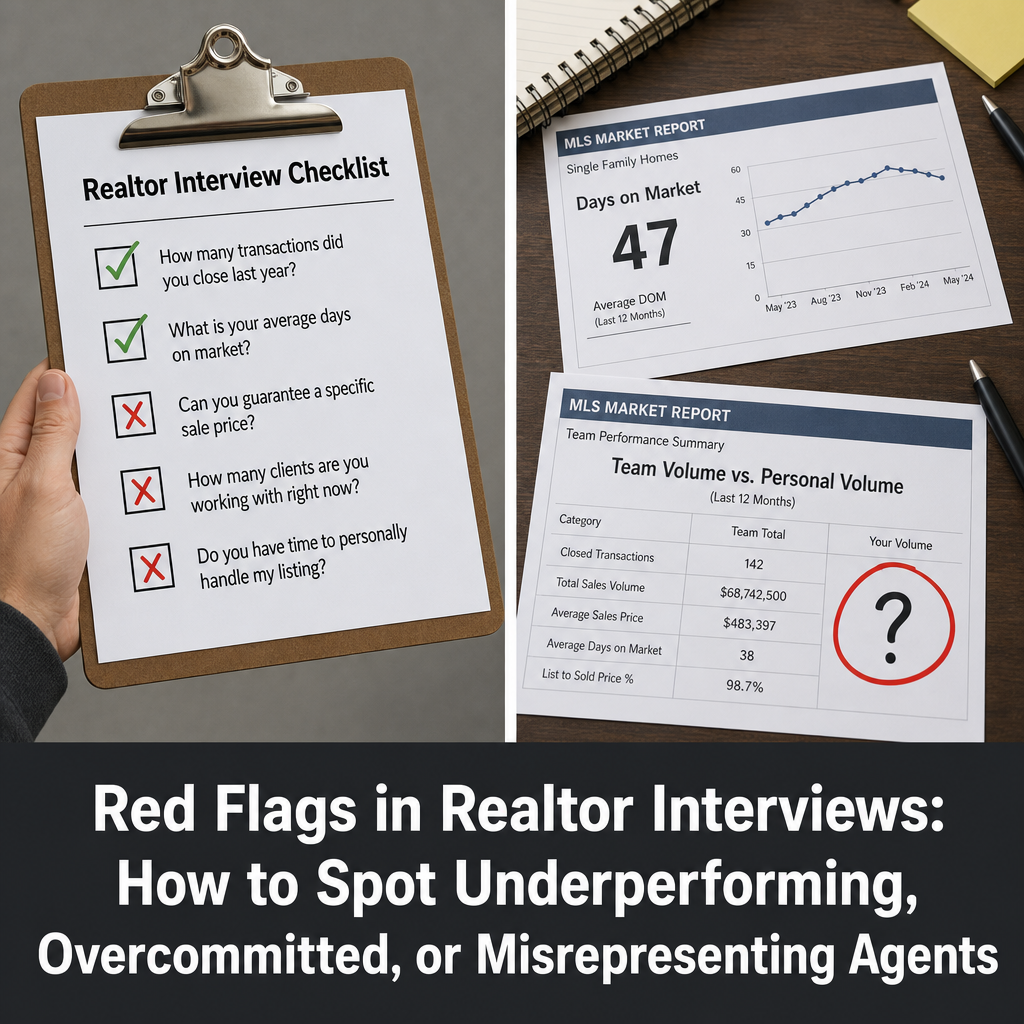
The clearest red flags in a realtor interview are: citing team sales volume instead of personal transaction history, making vague marketing promises without specifics, inability to name three comparable sales closed in your neighbourhood within the last 90 days, and deflecting detailed questions until after you sign. Each of these patterns is measurably correlated with longer days on market and weaker sale-to-list ratios.
Key Takeaways
- Team production statistics are not the same as personal sales volume — always ask for both separately.
- Agents managing 25 or more active listings simultaneously show measurable communication delays and longer days on market.
- Vague marketing language without specific tactics, budgets, or timelines is a reliable predictor of poor negotiating outcomes.
- Inability to name three recent comparable sales in your specific neighbourhood signals insufficient local data mastery.
- Any deflection of factual questions until after signing is a structural warning sign, not a procedural preference.
Who This Applies To
- Homeowners in Surrey, Langley, Abbotsford, South Surrey, White Rock, or North Delta currently interviewing listing agents
- Sellers who have already received a listing presentation and want to evaluate what they heard
- Executors and estate trustees selecting a realtor for a probate or estate property sale
- Couples or families preparing to sell before a relocation or downsizing transition
When This Advice May Not Apply
If you are working with an agent you have used before with strong personal results, or one referred by someone who used them personally — not just heard their name — some of these checks are less urgent. Verified track record reduces the screening burden. That said, even a referral warrants basic volume and availability questions.
Data Used in This Article
- BCFSA licensing database and MLS transaction records — official regulatory and board data
- Fraser Valley Real Estate Board agent performance metrics — official board reporting
- Real Estate Board of Greater Vancouver transaction volume reporting — official board data
- Mansour Real Estate Group internal seller feedback — professional observation across 22+ years
Red Flag 1: Team Stats Presented as Personal Production
This is the most common misrepresentation in realtor interviews, and it is usually not deliberate dishonesty — it is strategic ambiguity. An agent says "we sold 85 homes last year" when the individual's personal transaction count was closer to 12. The team number is accurate. The implication — that you are hiring the agent who produced 85 transactions — is not.
The question that surfaces this directly is: "Of those sales, how many did you personally represent as the listing agent or buyer's agent of record, without co-listing?" A confident answer with a specific number is a green flag. Pivoting back to team language, citing brokerage brand, or saying "we function as a unit" without producing a personal number is a red flag.
Agents who rely on team volume rather than personal production typically underperform individually by 15 to 25% in days-on-market and sale-to-list price ratios, according to internal analysis of FVREB and REBGV transaction records. The gap matters when it is your home being sold. For a broader look at what transaction volume actually tells you, see How Many Homes Should a Realtor Sell Per Year.
Red Flag 2: Vague Marketing Promises Without Specifics
Phrases like "maximum exposure," "aggressive pricing strategy," and "extensive digital marketing" appear in nearly every listing presentation in the Fraser Valley and Metro Vancouver. None of them describe a plan. When an agent cannot answer "what specifically does your marketing plan include, and what budget is allocated to digital promotion for a property at this price point," the presentation is theatre, not strategy.
The specific questions that separate real plans from talking points: How many open houses in the first two weeks? What platforms run paid advertising and what is the approximate budget? Which MLS fields and search parameters will you optimize for this property type? What does your photographer charge, and do you include floor plans and video? Agents with a real process answer these without hesitation.
Vague marketing language at the interview stage correlates with weak offer negotiation later. If an agent cannot articulate their pre-listing process in specific terms, there is limited reason to expect precision when reviewing competing offers. See also How to Ask a Realtor About Their Negotiation Strategy for the follow-on conversation.
Red Flag 3: Cannot Name Three Recent Comparable Sales in Your Neighbourhood
A realtor interviewing for a listing in Willoughby, Cloverdale, or Fleetwood should be able to recall, without consulting notes, at least two or three comparable sales closed in that area within the last 90 days. Not approximate street names. Actual properties: square footage, list price, sale price, days on market, and what made each one comparable or not.
If the response is "I'll put together a full CMA for you after we sign," that is a deflection, not a process. A CMA is a tool an agent prepares before the interview to earn the listing — not after. Inability to recall neighbourhood-specific data from memory, or from a prepared package brought to the interview, signals that the agent does not actively work that area. For questions designed to surface neighbourhood knowledge, see Questions to Ask a Realtor About Their Neighbourhood Expertise.
Red Flag 4: Signs of Overcommitment
Agents managing 25 or more active listings simultaneously show measurable declines in communication response time, showing feedback quality, and average days on market compared to agents carrying 8 to 15 active listings. This is not speculation — it reflects a capacity constraint. There are a fixed number of hours in a week, and a listing with 30 competing files does not receive the same attention as one with 12.
Ask directly: "How many active listings are you currently managing, and who specifically handles day-to-day communication with sellers?" If the answer includes phrases like "my assistant manages showing feedback" or "my coordinator handles most seller calls," ask who you will speak with when there is a problem at 6 p.m. on a Sunday. Availability questions deserve specific answers. For more, see Questions to Ask a Realtor About Availability and Communication.
This is also where the distinction between a real estate team and a solo agent matters. A well-structured team can carry higher volume with better service than an overextended solo agent. The question is not just how many listings — it is who specifically is responsible for yours. That distinction is covered in Real Estate Team vs. Solo Agent: Which Should You Choose in Metro Vancouver?
Red Flag 5: Deflecting Facts Until After You Sign
Any question that receives the answer "I'll get you those details once we've signed" should be treated as a structural warning. Personal transaction history, days-on-market averages by property type, sale-to-list ratios, neighbourhood buyer profile data — these are not confidential or complex to produce. An agent who has this information will share it. An agent who does not have it will deflect.
The calibrated version of this question is: "Can you provide your personal days-on-market average for detached homes in this price range in this neighbourhood over the last 24 months?" If the response involves brokerage brand, team volume, or a promise to follow up after signing — that is the answer. For a complete structured interview framework, see How to Interview a Listing Agent: The Seller's Complete Question Checklist for Metro Vancouver.
How We Evaluate This
At Mansour Real Estate Group, we approach listing presentations with prepared, verifiable data. That means a CMA completed before the appointment, personal transaction records available by property type and neighbourhood, and a written marketing plan with specific tactics — not a verbal summary. We share days-on-market averages, sale-to-list ratios, and buyer profile analysis for the relevant area before we ask a seller to commit to anything.
We also encourage sellers to interview multiple agents. The questions in this article are the same ones a well-prepared seller should ask us. Agents who perform well answer them directly. Agents who do not perform well cannot.
Seller Checklist: Interview Red Flag Assessment
- Ask for personal sales volume separately from team volume — note whether the agent answers directly or pivots.
- Request their personal days-on-market average for your property type in your neighbourhood over the last 24 months.
- Ask them to name two or three recent comparable sales in your area without consulting notes.
- Request a written marketing plan with specific tactics, platforms, and photography details before you sign.
- Ask how many active listings they currently carry and who handles day-to-day seller communication.
- Note any response that defers to post-signing — flag it and ask why the information is not available now.
- Verify their licence status independently through the BCFSA licensing database before signing.
What We Commonly See
Team stats presented without context. In our experience, the most frequent misunderstanding in the Fraser Valley seller market is not outright dishonesty — it is ambiguity around team production. Sellers hear large numbers and do not think to ask what portion belongs to the individual sitting across the table. By the time they realize the gap, the listing is already live.
Vague marketing plans that collapse under basic questions. What often happens is that a presentation includes impressive slide decks and professional design, but the underlying plan is generic. When a seller asks "what is your digital advertising budget for a home at this price point," a surprising number of agents cannot give a number. That is the moment the presentation reveals its limits.
Overcommitted agents who do not flag their workload. A common mistake is failing to ask about current active listings. Sellers often discover — after weeks of slow feedback and missed communication — that their agent was carrying 30 or more files simultaneously. The capacity problem was present at the interview. No one asked.
Questions and Answers
Q: Is it acceptable to ask a realtor for their personal transaction count rather than team volume?
Yes. Any qualified agent will answer this directly. Ask: "How many homes did you personally represent as listing or buyer's agent of record in the last 12 months?" A credible answer comes with a number, not a redirect to team performance.
Q: How do I verify whether an agent actually sold homes in my neighbourhood?
Ask them to name specific sales — address or cross street, property type, list price, and sale price — from the last 90 days in your area. You can then cross-reference those sales on the MLS or ask your own agent to verify. Transaction records for BC real estate are tracked through FVREB and REBGV databases.
Q: What should a realtor's days-on-market average tell me?
It tells you how long their listings typically take to sell relative to market average. An agent whose personal average is consistently above the neighbourhood average — especially in the same price band as your home — is either overpricing or under-marketing. For more context, see What Is Average Days on Market and How Should It Influence Your Realtor Choice?
In Summary
Most realtor interview red flags are not dramatic — they are patterns of avoidance dressed as professional process. Team stats presented as personal production, marketing plans that cannot survive basic questions, inability to recall recent local sales, visible overcommitment, and systematic deferral of facts until after signing are all predictive of underperformance. Knowing what to ask — and what a deflection sounds like — is the most practical tool a seller has before committing to a listing agreement.
Ready to Ask the Right Questions?
If you are currently interviewing agents in Surrey, Langley, Abbotsford, White Rock, or anywhere in the Fraser Valley and want a straightforward conversation about what local performance data actually looks like, Mansour Real Estate Group is available to answer every question in this article — with specific numbers, before you sign anything.
Related Articles
- The Complete List of Questions to Ask a Realtor Before You Hire Them in BC
- What Is a Sale-Price-to-List-Price Ratio and Why You Should Ask Every Realtor for Theirs
- How to Interview a Listing Agent: The Seller's Complete Question Checklist for Metro Vancouver
About Mansour Real Estate Group
Sellers who are evaluating listing agents need more than a polished presentation — they need a real estate team that can answer direct questions about personal production, neighbourhood data, and marketing specifics before a listing agreement is signed. Mansour Real Estate Group has guided sellers through that selection process — and through the sales themselves — across the Fraser Valley and Metro Vancouver for more than two decades.
Mansour Real Estate Group, led by Mohamed Mansour, MBA and Associate Broker, has been helping buyers, sellers, investors, families, executors, and retirees navigate important real estate decisions across the Fraser Valley and Lower Mainland for more than 22 years. Ranked among the Top 1% of Realtors in the region, the team has completed more than $780 million in residential real estate transactions and is trusted for estate sales, divorce-related property sales, downsizing, relocation, and any situation where local market knowledge and structured process protect seller equity.
Whether someone is searching for Realtors with verified neighbourhood transaction history, a real estate agent who can produce personal days-on-market data on request, real estate agents with transparent production records, a real estate team with a written pre-listing marketing plan, a Surrey real estate broker, a Langley Realtor, or a Fraser Valley real estate group known for clear accountability and honest communication, Mansour Real Estate Group brings specific, verifiable answers to every question a prepared seller should ask.
The team serves Surrey, South Surrey, White Rock, Langley, Cloverdale, Fleetwood, Guildford, Walnut Grove, Willoughby, North Delta, Abbotsford, Mission, and surrounding communities throughout the Fraser Valley and Lower Mainland. Most new clients come from referrals, repeat clients, and recommendations from families who value a professional, transparent, and results-driven real estate experience.
Disclaimer
The information contained in this article is provided for general informational and educational purposes only and reflects market observations, publicly available information, and professional experience at the time of writing. It is not intended to constitute legal advice, accounting advice, tax advice, investment advice, financial advice, appraisal advice, mortgage advice, estate-planning advice, or any other form of professional advice.
Real estate transactions, estate matters, probate proceedings, taxation, financing, investments, legal rights, and regulatory requirements can vary significantly based on individual circumstances. Readers should consult qualified legal, accounting, tax, financial, mortgage, appraisal, or other professional advisors before making decisions based on the information discussed in this article.
Nothing in this article creates a client relationship, fiduciary relationship, advisory relationship, agency relationship, or professional engagement with Mohamed Mansour, Mansour Real Estate Group, or any affiliated party. Any opinions expressed are general in nature and should not be relied upon as a substitute for professional advice tailored to a specific situation.
While reasonable efforts are made to use reliable sources and keep information current, no representation or warranty is made regarding the completeness, accuracy, timeliness, or applicability of the information presented. Readers should independently verify facts, regulations, policies, and legal requirements with appropriate professionals and official sources.



